
Here's the short answer: yes — Blum soft-close hinges are worth the investment. They're independently tested to 200,000 open-and-close cycles, carry a limited lifetime warranty on the mechanism, and protect your doors and cabinet boxes from decades of slamming — all for a premium of just a few dollars per hinge. On many quality cabinet lines, including every Fabuwood series we sell, they're included standard, so the "investment" is really about knowing what to look for when you compare cabinet brands.
This guide explains what makes Blum hinges different from the generic soft-close hardware flooding the market, how the BLUMOTION damping system actually works, what the upgrade costs when it isn't included, and how to tell from a spec sheet whether the cabinets you're pricing have hardware that will outlast the finish.
Table of Contents
- What Are Blum Soft-Close Hinges?
- How BLUMOTION Soft-Close Technology Works
- Blum vs. Standard Hinges: What the Difference Buys You
- Built for 200,000 Cycles — the Durability Math
- What the Upgrade Costs (and When It Pays Off)
- Which Cabinet Lines Include Blum Hardware Standard
- Common Questions, Answered
- The Verdict in 60 Seconds
Here's how Blum soft-close hinges compare with the standard self-close hinges still used on budget cabinetry:
| Factor | Standard Self-Close Hinge | Blum Soft-Close Hinge |
|---|---|---|
| Closing action | Spring snaps the door shut — bang | Hydraulic damper eases it closed silently |
| Tested lifespan | Varies widely; often unrated | 200,000 open-close cycles |
| Warranty | Typically 1 year or none | Limited lifetime on mechanical hardware |
| Adjustability | Often 2-way, if any | Six-way (height, depth, side) for perfect alignment |
| Door removal | Unscrew the hinge | Tool-free clip on/off for cleaning and painting |
| Wear on cabinets | Impact loosens joints and hinges over time | Controlled close protects doors and face frames |
| Typical price | $1–$3 per hinge | $6–$12 per hinge retail |
What Are Blum Soft-Close Hinges?
Blum soft-close hinges are concealed cabinet hinges with a built-in hydraulic damper — called BLUMOTION — that catches the door in the last couple of inches of travel and glides it shut silently, no matter how hard it was pushed. "Concealed" means the hinge is completely hidden when the door is closed: no visible barrel or knuckle, just a clean door face.
Blum (formally Julius Blum GmbH) is a family-owned Austrian hardware manufacturer founded in 1952, and it has been the reference standard for cabinet hinges and drawer runners for decades. Its mechanical hardware is engineered and tested in Austria, and the company has manufactured in Stanley, North Carolina since 1977 — the hardware in most American kitchens that use Blum was made in the U.S.
Two hinge families cover nearly every kitchen: CLIP top BLUMOTION for frameless (European-style) cabinets, and COMPACT BLUMOTION for framed American cabinetry, where the hinge mounts to the face frame. Both integrate the soft-close damper inside the hinge cup, so there's no add-on piston cluttering the cabinet interior.
How BLUMOTION Soft-Close Technology Works
Inside the hinge is a small fluid damper — think of a miniature shock absorber. As the door swings closed, the damper engages during the final stretch of travel and converts the door's momentum into hydraulic resistance. The clever part is that the damping is adaptive: slam the door hard and the mechanism firms up to absorb the extra force; nudge it gently and it stays light so the door still closes fully instead of stalling an inch short. Either way, the door lands silently and completely closed, every time.
Two other engineering details matter in daily use:
- Six-way adjustability. Blum hinges adjust in three dimensions — height, depth, and side to side — so an installer can dial in perfectly even reveals between doors, and you can re-true a door in minutes years later if the house settles.
- Tool-free CLIP release. Doors clip off and back on without a screwdriver, which turns cleaning day, painting projects, and appliance moves from a chore into a ten-second task.

Blum vs. Standard Hinges: What the Difference Buys You
A cheap self-closing hinge uses a spring to snap the door shut. That snap is the problem: every close is a small impact, transferred through the door into the hinge screws and the cabinet face. Multiply it by every door, every day, for years, and it shows up as loose hinges, sagging doors, chipped finish along door edges, and hairline-cracked face-frame joints.
The soft-close difference compounds over the life of the kitchen:
- Silence. No slamming — a bigger quality-of-life upgrade than most people expect, especially in open-plan homes and households with early risers or late-night snackers.
- Safety. The damper closes the door at a controlled speed, which means no pinched fingers — worth a lot in a home with young kids.
- Alignment that lasts. Doors that close gently stay where the installer set them. Doors that slam drift out of alignment, and crooked doors are the fastest way to make a good kitchen look tired.
- Finish protection. Repeated impact is hard on painted door edges and the cabinet frame they strike. A controlled close protects the finish you paid for — one more reason it pairs well with the habits in our cabinet care guide.
To be fair to the category: generic soft-close hinges exist at a third of Blum's price, and they feel similar out of the box. The difference is what happens after year three — cheap dampers lose their resistance, springs weaken, and "soft-close" quietly becomes "slow slam." The cycle rating and the warranty are what you're actually paying for.

Built for 200,000 Cycles — the Durability Math
Blum tests its hinges to 200,000 opening and closing cycles without damage. Put that in kitchen terms: a heavily used cabinet door — say the one over the coffee mugs — might open a dozen times a day. That's about 4,400 cycles a year, which means the hinge is rated for roughly 45 years of hard daily use. Most doors in a kitchen see a fraction of that traffic.
Behind the test number sits a limited lifetime warranty on Blum's mechanical hardware — the hinge is guaranteed for the life of the cabinet. In practice, that means hinge failure is simply removed from the list of things that can go wrong with your kitchen. Compare that with bargain hardware, where a sagging door at year five means hunting for a discontinued hinge pattern or living with the sag.
Durable hardware also changes the renovation math. Cabinet boxes and doors routinely outlast their hardware on budget cabinetry — and once hinges fail, the labor to source and swap forty hinges often costs more than the original hardware did. Hardware rated beyond the life of the cabinet means the kitchen ages as one piece.
What the Upgrade Costs (and When It Pays Off)
Retail, a Blum soft-close hinge runs roughly $6–$12, versus $1–$3 for a builder-grade self-close hinge. A typical 10×10 kitchen has around 15–20 doors at two hinges each, so the difference between bargain and best-in-class hardware is roughly $150–$350 across the whole kitchen — usually one to two percent of the cabinet budget, protecting the other ninety-eight.
Three ways the numbers play out:
- Buying new cabinets: the smart move is choosing a line where Blum hardware is standard, not an upcharge. The upgrade then costs you nothing except reading the spec sheet — our guide to the most popular cabinet brands flags which lines include premium hardware.
- Upgrading existing cabinets: most concealed hinges can be swapped for soft-close equivalents in an afternoon with a drill, and Blum also makes clip-on BLUMOTION adapters that add damping to compatible existing hinges for a few dollars a door.
- Selling the house: soft-close everything is one of the first things buyers test at an open house. It reads as "quality kitchen" in two seconds, which is more than most $300 upgrades can claim.
Which Cabinet Lines Include Blum Hardware Standard
Hardware is where cabinet lines quietly cut costs, so "soft-close included" deserves a follow-up question: whose soft-close? Every Fabuwood series we carry answers it the right way — Blum hardware is standard across the lineup at no additional charge:
- Fabuwood Allure — shaker and slab door collections with six-way adjustable Blum soft-close hinges featuring quick-release, plus TANDEM plus BLUMOTION full-extension undermount runners on dovetailed drawer boxes.
- Fabuwood Illume — high-gloss and matte European styling, same Blum hinge and drawer hardware underneath.
- Fabuwood Ovela — the newest slab-door series, pairing fifteen Catalina finishes with premium Blum soft-close hardware throughout.
That hardware spec is one of the reasons Fabuwood consistently wins our value comparisons — the full breakdown is in our Fabuwood cabinets review. Other quality manufacturers equip their lines with comparable European soft-close systems, which is exactly why we recommend judging any cabinet line by its published hardware spec rather than the marketing phrase "soft-close."
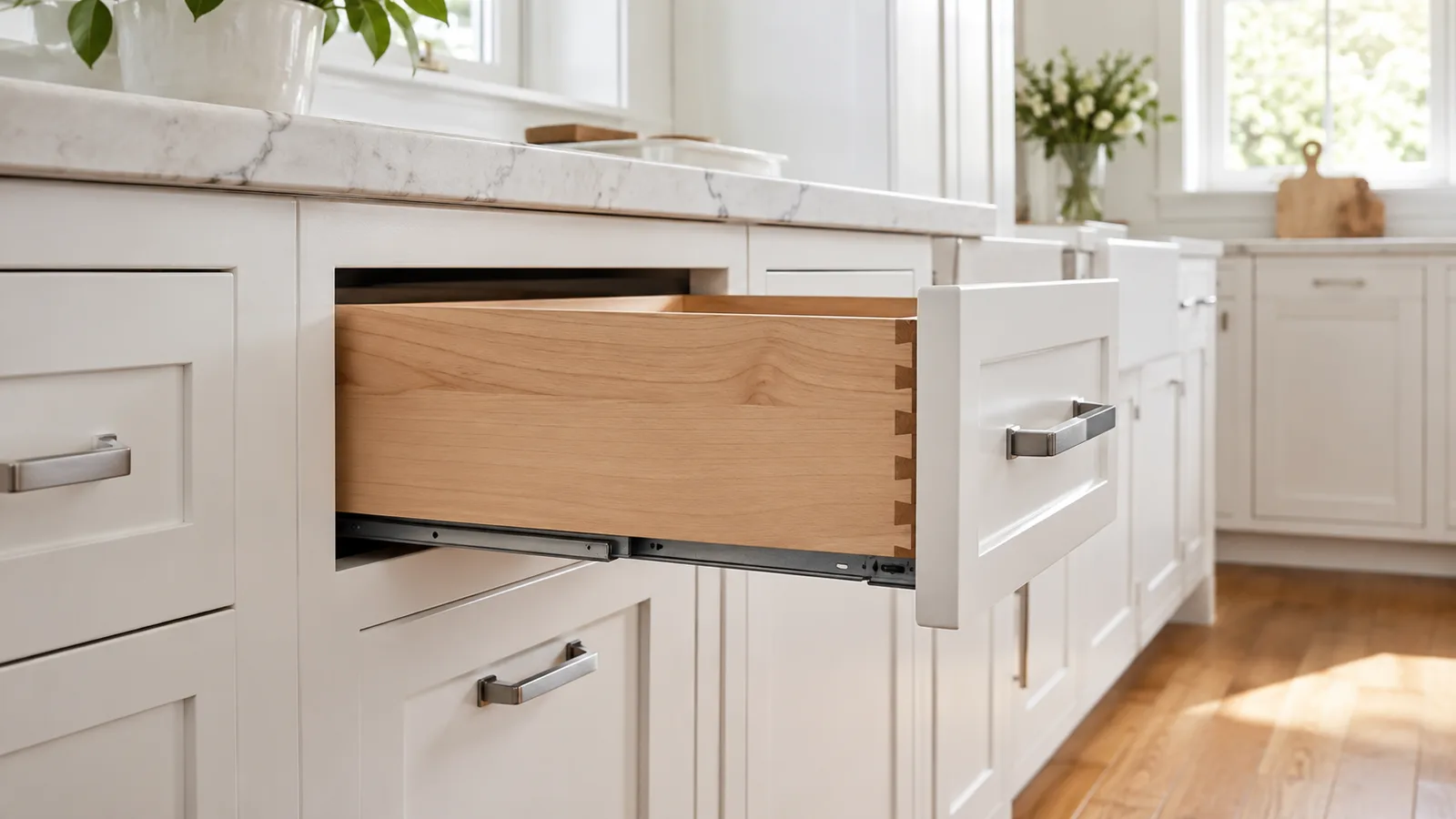
The soft-close difference is something you feel more than read about — and you can test it without buying a cabinet. Our free 3D kitchen design service turns your measurements into a complete layout with an itemized quote, usually within one business day, and every line we quote with Blum hardware says so on the spec sheet. Want to judge the door quality in your own light first? Order real door samples, or call 609-900-3358 and ask a designer which lines fit your budget with premium hardware included.
Frequently Asked Questions
Are Blum soft-close hinges worth the extra cost?
Yes, for most kitchens. The premium over builder-grade hinges is roughly $150–$350 across an entire kitchen, and in exchange you get hardware tested to 200,000 cycles, a lifetime warranty, silent operation, and doors that hold their alignment. On many quality lines, including Fabuwood, Blum hardware is included at no charge.
How long do Blum hinges last?
Blum tests its hinges to 200,000 open-close cycles — roughly 45 years on a door opened a dozen times a day — and backs the mechanism with a limited lifetime warranty. In practical terms, the hinges are engineered to outlast the cabinets they're mounted on.
Can I add soft-close hinges to my existing cabinets?
Usually, yes. Most concealed hinges can be replaced with soft-close equivalents using the same or similar drilling pattern, and Blum makes clip-on BLUMOTION adapters that add damping to compatible hinges without replacing them. A full kitchen retrofit is typically an afternoon project.
What's the difference between Blum and generic soft-close hinges?
Out of the box they feel similar; the difference is longevity. Blum hinges carry a 200,000-cycle test rating, a lifetime mechanical warranty, six-way adjustability, and adaptive damping that firms up when a door is slammed. Generic dampers commonly lose resistance after a few years, turning soft-close into a slow slam.
Do Blum hinges come with a warranty?
Yes. Blum provides a limited lifetime warranty on its mechanical hardware, including hinges and drawer runners — the hardware is guaranteed for the life of the furniture it's installed in.
Are Blum soft-close hinges adjustable?
Yes — six ways. Height, depth, and side-to-side adjustments let an installer set perfectly even gaps between doors, and let you re-align a door in minutes if it ever drifts. The doors also clip off without tools for cleaning or painting.
Which cabinet brands use Blum hinges?
Hardware varies by manufacturer and even by series, so always check the spec sheet. Among the lines we carry, every Fabuwood series — Allure, Illume, and Ovela — includes Blum soft-close hinges and TANDEM plus BLUMOTION drawer runners as standard equipment.
The Verdict in 60 Seconds
- The technology: BLUMOTION is a hydraulic damper built into the hinge that closes any door silently, adapting to how hard it was pushed.
- The durability: tested to 200,000 cycles — decades of daily use — and covered by a limited lifetime warranty on the mechanism.
- The cost: about $6–$12 per hinge retail, or roughly $150–$350 more than bargain hardware across a full kitchen. On Fabuwood cabinetry it's included standard.
- The payoff: no slamming, no pinched fingers, doors that stay aligned, finishes that don't chip at the edges — and one less thing that can ever wear out.
- The takeaway: judge cabinet lines by their hardware spec. A line that includes Blum standard is telling you something about everything else it's built with.

Written by
Noor K.Technology Manager at Captivating Cabinets
Noor manages and develops the Captivating Cabinets website, and writes practical guides on cabinet styles, finishes, pricing, and remodel planning.
Ask our Cabinets AI assistant
Get instant answers on cabinet styles, finishes, sizing, and SKUs — or find the right products for your kitchen in seconds.
Chat with Cabinets AIRecent Articles

August 21, 2026
Fabuwood Cabinet Sizes and Specs: The Complete Dimension Guide (2026)

August 20, 2026
How Much Kitchen Island Clearance Do You Really Need

August 19, 2026
How to Match Kitchen Cabinets With Countertops, Backsplash and Flooring

August 18, 2026
Stock vs Semi-Custom vs Custom Cabinets — What's the Difference

August 17, 2026
How Long Do Kitchen Cabinets Last?


