





Fabuwood Galaxy Linen cabinets: a working guide to the beige shaker
Reviewed September 2026 · Captivating Cabinets
Fabuwood Galaxy Linen cabinets are the one light finish in the Allure Galaxy line that is not trying to be white. That single fact drives every decision on this page: which rooms it suits, which countertops it tolerates, which hardware looks intentional, and whether you should be looking at Dove instead. The door, box and hardware are the same as every other Galaxy color and cost the same — so this guide spends its time on the part that is different, and then shows you how to spec and price a kitchen in it.
Beige on purpose: what the paint actually is

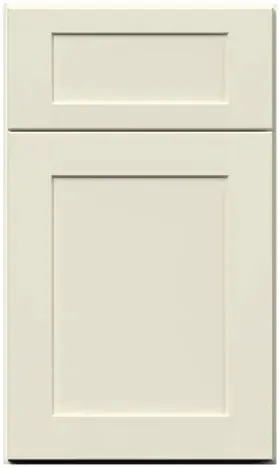
Linen is a genuine light beige with an earthy, faintly greige cast. On its own wall it can pass for a deep cream; beside a white ceiling, white quartz or white trim it declares itself as a color within seconds — beige, not white. So the first test is simple: does this room have a lot of white that is staying? If so, the cabinets will be the beige element in a white room, and you need to want that.
The paint sits on the same Galaxy door as every other color in the line: a five-piece recessed-panel shaker, solid wood frame around a ⅜″ MDF center panel, finished smooth rather than matte. On a beige that smooth face earns its keep — it bounces a little light back, which stops a warm color sinking into the wall the way a chalky flat beige does.
Where it sits in the catalog: Fabuwood makes it, Allure is the mid-tier line, Galaxy is the door, Linen is the color. The Allure series guide places the Galaxy door against the other five Allure profiles, and the full color guide shows the other thirteen Galaxy paints if this one is still a maybe.
Window direction and bulb temperature decide whether it glows or goes muddy

A white finish is forgiving of light because there is not much in it to shift. A beige is not: the same Linen door looks creamy and expensive in one kitchen and flat and muddy in another, and the difference is almost entirely the light falling on it. Work out which of these rooms you have.
| The room | What the beige does | What to do about it |
|---|---|---|
| South- or west-facing, good daylight | Glows — the cream comes forward and the greige recedes | Nothing. This is the room it was made for |
| North-facing or few windows | Goes muddy — the greige takes over and the warmth drains out | Warm LEDs throughout and under-cabinet lighting on every run; or reconsider Dove |
| Evenings under warm LEDs (2700–3000K) | Flattered — the closest an artificial light gets to the daylight it likes | Specify the bulbs before the electrician does |
| Cool LEDs (4000K and above) | Stripped of its warmth; reads gray-beige and cheap | Avoid. This is the single most common reason a beige kitchen disappoints |
| Next to a white ceiling and white trim | Declares itself as a color | Decide you like that. Painting trim to a warm off-white softens the contrast |
Two consequences. First, the door sample is not optional with this finish — tape it where the uppers will hang and look at it at breakfast and again after dark under the bulbs you will actually use. Second, under-cabinet lighting is part of the cabinet decision, not the electrical one. The wall cabinet article goes into light rail and LED temperature, because that is where the bulb meets the beige.
Counters, floors and hardware that return the warmth

The rule for pairing with a beige is that every surface has to give the warmth back. A cool gray counter takes it and returns nothing, and the cabinets go muddy against it; a cream quartz, a butcher block or a stone with beige movement hands it straight back and the room reads as one warm scheme.
| Surface | Works with the beige | Fights it |
|---|---|---|
| Quartz | Cream, warm white, soft veining with a beige or gold cast | Cool gray, bright blue-white, stark black-and-white veining |
| Natural stone | Travertine, limestone, granites with beige and brown movement | Cold gray granite, anything with a blue undertone |
| Wood counters | Butcher block in maple, oak or walnut — the easiest pairing there is | Nothing here; the only caution is sealing at the sink |
| Floors | Pale oak, warm wood, terracotta or cream tile | Gray-washed planks, cool gray porcelain |
| Backsplash | Handmade cream or warm-white tile, zellige, warm stone | Bright white subway — it turns the cabinets beige by comparison |
| Hardware | Brass, unlacquered brass, bronze; satin nickel as the quiet option | Matte black is riskier here than on Dove — it can look heavy on a soft color |
Hardware is the cheapest line on that list and the one people get wrong most. Brass and bronze are the natural fit, satin nickel disappears politely, and matte black only works when the room already has black elements — a range, window frames — to justify it. The matching guide has the white-card undertone test for the counter and floor samples you already have.
Linen, Dove or Frost: the three-way call
The three light Galaxy paints get cross-shopped constantly and the construction is identical, so the decision is only color. Answer these honestly and the choice usually makes itself.
| The question | Linen | Dove | Frost |
|---|---|---|---|
| Do you want the kitchen to photograph as white? | No — it photographs beige | Yes, a softened white | Yes, a bright clean white |
| Is the room north-facing or dim? | Risky; needs warm lighting | Can drift faintly gray but stays white | Stays neutral |
| Are the counters or trim cool gray or bright white? | Will go muddy against them | Tolerates them | Made for them |
| Do you want brass to look deliberate? | Yes — the best of the three for it | Yes | Fine, reads as an accent |
| Matte black hardware? | Only with black elsewhere in the room | Carries it cleanly | The classic pairing |
One warning: do not put Linen and Dove in the same kitchen. They are close enough that the pairing reads as a matching error rather than a two-tone choice. The Linen vs Dove comparison works through the two warm finishes in more depth, and the guide to choosing a white is the read if this table has pushed you toward a white after all.
Two-tone: this beige leads, it does not accent

White finishes are natural team players in a two-tone kitchen: the perimeter stays white and the island takes the color. Linen does not work that way. As the accent under white uppers it looks like an afterthought; as the quiet partner to a dark island it loses its warmth and reads gray. It wants to be the lead.
The pairings we draw most often: a full Linen perimeter and island over pale oak or warm tile, with the wall paint doing the quiet work of contrast; or a Linen perimeter with a wood-tone island in one of the Galaxy stained finishes, which keeps everything in one warm family. What we steer people away from is a Linen island under white uppers, and a Linen-and-Dove mix.
Open shelving and glass fronts break up the color without a second paint. Every Galaxy cabinet has a natural wood veneer interior, so an open-shelf or no-door wall cabinet shows warm wood inside a beige frame, a two-tone effect that comes free. The 27 kitchen ideas gallery has several warm-neutral rooms built this way.
What does not change when you choose beige
Everything below the paint is identical across the Galaxy line — the beige costs nothing extra, ships in the same window and carries the same warranty. If you have read a spec sheet for any Galaxy color, you have read this one.
- Door — solid wood frame around a ⅜″ MDF center panel, factory painted. MDF is used for the panel because it does not move with humidity, so the paint stays intact at the frame joint.
- Box — ½″ select solid wood, natural wood veneer inside. That warm-toned interior is what shows behind every open shelf and glass door, and it suits this paint better than it suits a cool white.
- Drawer box — ⅝″ solid wood, dovetailed at every corner, behind a five-piece recessed-panel drawer front.
- Hardware — Blum Tandem plus Blumotion full-extension concealed glides; Blum Quick-Release hinges with Blumotion soft-close. Standard, not an option line.
- Assembly — pre-assembled at the factory with dowel-and-glue and pocket-screw joinery. Full-overlay doors.
- Lead time and warranty — 7 days to 3 weeks where the other Allure series take 3 to 5, with a limited lifetime warranty.
The Fabuwood review makes the case for why those specs matter, and the dovetail drawer explainer for why the drawer box is the line to compare between quotes.
How a kitchen in this finish gets drawn, run by run
The size grid is the standard American one — bases 34½″ high and 24″ deep in 3″ width steps, wall cabinets 12″ to 42″ high, talls at 84″ to 96″ in 12″ and 24″ depths — so the layout rules are the usual ones. What changes with a beige is a handful of details in each run, and each type page carries the full size and price table for that run.
Base cabinets
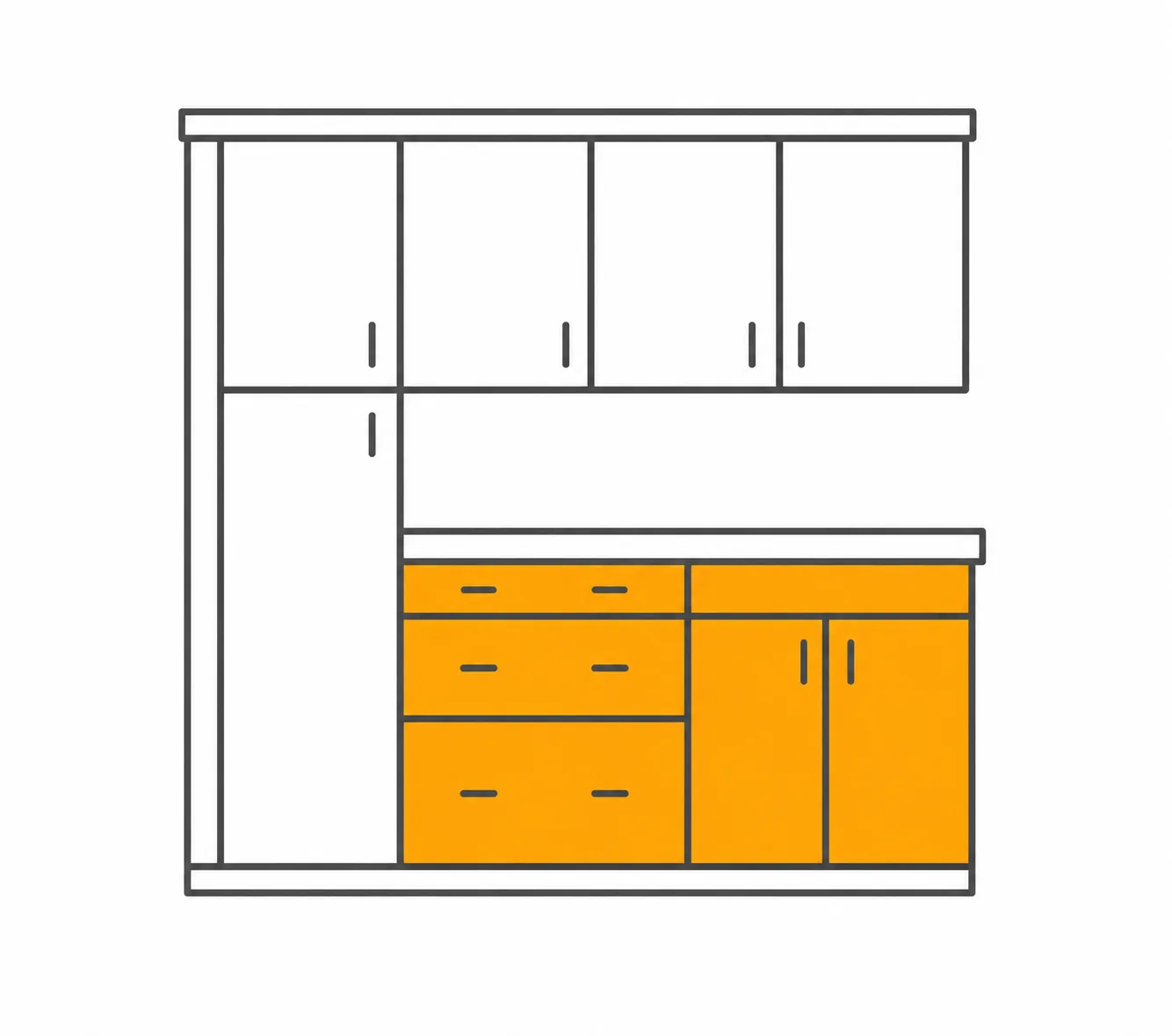
The base run is judged at close range against the countertop, so it is where the counter pairing above matters most. Plan it by work zone and price drawers against doors at each width before deciding; the base cabinet guide does that with the live SKUs.
Wall cabinets
The uppers are the beige you see at eye level, and taller uppers mean more of it: 42″ with crown in a bright room, 30″ or 36″ with an open-shelf or glass box breaking the run in a dim one. Light rail and LED temperature live here too — start with the wall cabinet guide.
Tall cabinets
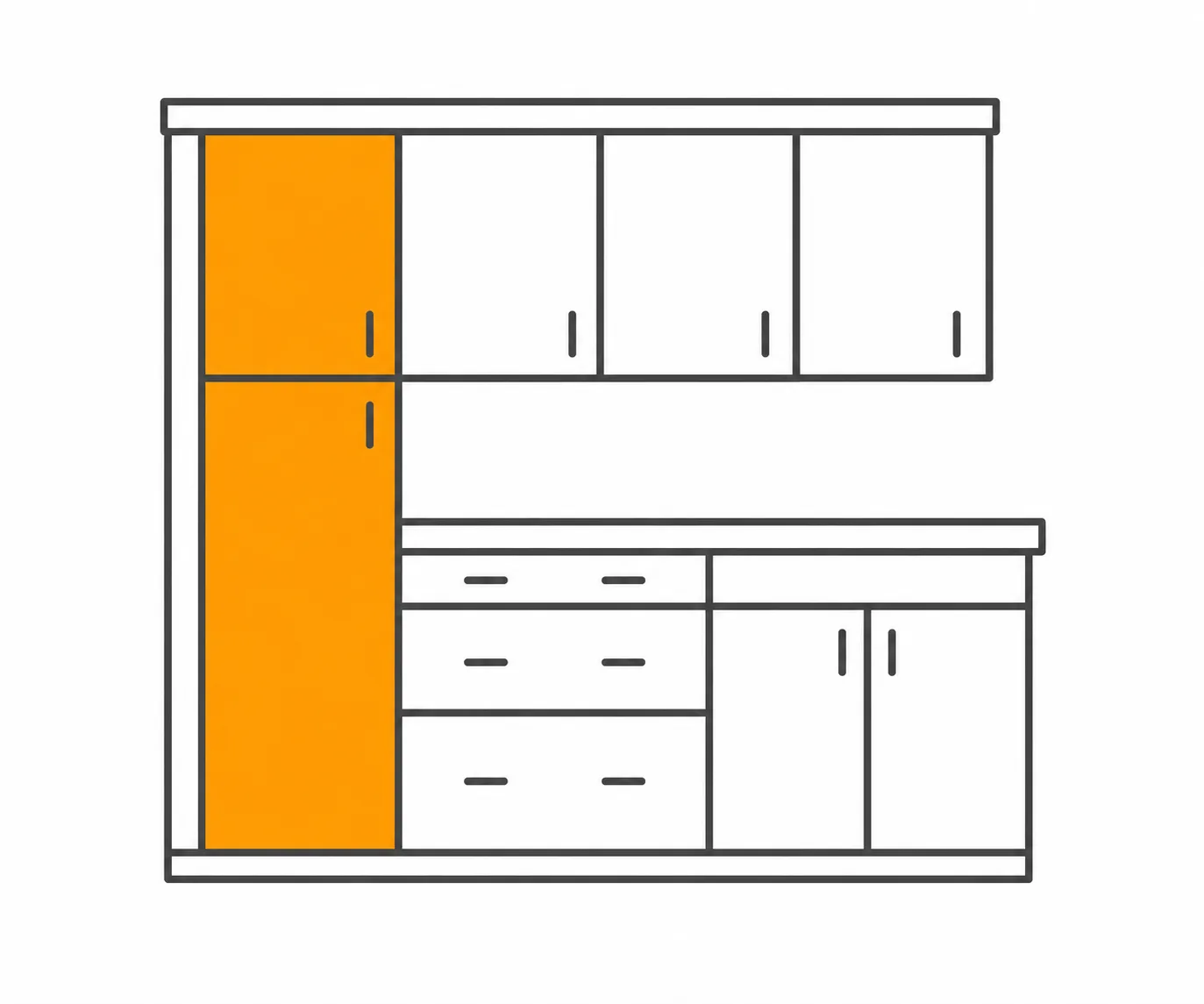
A 36″-wide, 96″-tall pantry is the largest unbroken plane of color in the kitchen, so where it stands matters more in a beige than in a white. The tall price grid also has a pattern worth knowing — depth is nearly free, width is what costs — and the tall cabinet guide lays it out.
Vanities, glass doors and trim
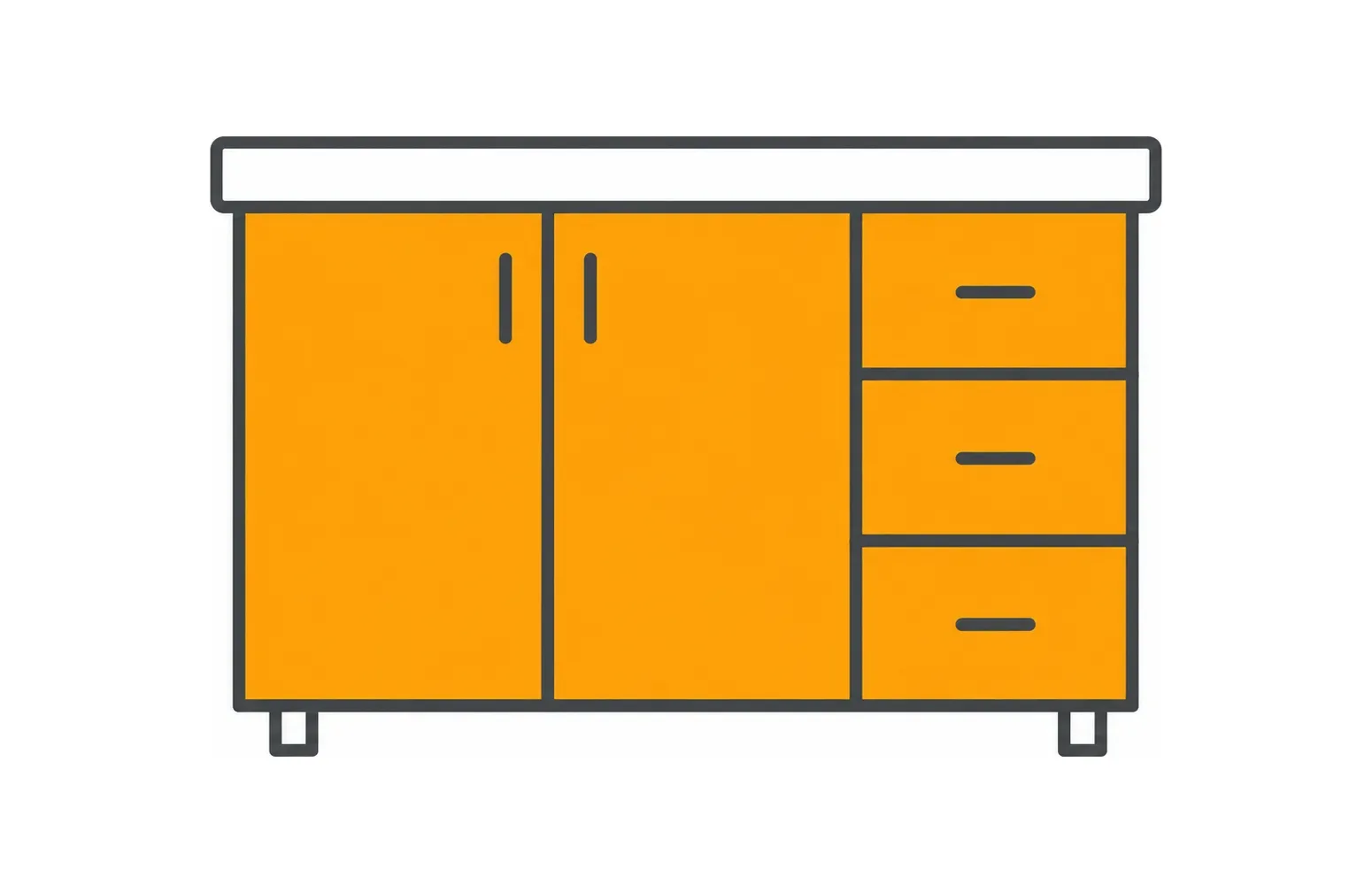
The same paint carries into the bath through the vanities, and the glass doors, crown, light rail, fillers and end panels in the decorative accessories are finished to match. In a beige, matching end panels are not a nicety — an unfinished side beside a white appliance is where the color gets caught out.
What the 10x10 package number buys — and what it leaves out
The collection page prices a 10x10 kitchen in this finish as a single package SKU, FGLN10, at $3,500.00 as of this review — the $5,384.62 struck through beside it is Fabuwood list before our discount. Unlike most 10x10 numbers, this one is itemized: an L-shaped, twelve-piece layout drawn for a 120″ × 120″ room, with the trim to finish it. It is not your kitchen, but it is a real box list, so here is what the number covers line by line — and what it leaves for the quote.
| Line | In the package number? | Notes |
|---|---|---|
| Seven wall cabinets | Yes | Including a 30″ diagonal corner wall for the inside corner and a 12″-high wall cabinet over the range |
| Four base cabinets | Yes | A sink base, a blind corner base, a double-door base with two drawers, and a single-door base with one drawer |
| Dishwasher end panel | Yes | The one finishing piece the package includes — the beige side that closes the run against the dishwasher |
| Two toe kicks and six finished cabinet ends | Yes | Enough to finish the plinth and every exposed side in that layout |
| Crown, light rail, fillers | No | Ordered by the piece from the decorative accessories page, against your ceiling |
| Countertops, sink, faucet, appliances, hardware | No | The cabinets around the appliances are sized to the models you pick |
| Drawer banks, roll-outs, a lazy Susan in the corner | No | The upgrades people are gladdest of, priced per cabinet |
| Delivery and installation | No | Pre-assembled cabinets arrive as large cartons — plan the space |
Three swaps account for most of the gap between that package and a real quote, and the grid prices make the ratios easy to see. Replacing the single-door base with a three-drawer bank of the same width (at 18″, GL B18 at $409.50 against GL DB18 at $646.75) adds about 58% on that box. Replacing the blind corner base with a lazy Susan (GL BLB36/39 at $614.25 against GL LSB36 at $1,095.25) adds about 78%. Taking a 30″-wide upper from 30″ to 42″ high (GL W3030 at $383.50 against GL W3042 at $526.50) adds about 37%. None changes the footprint; all change what you can reach. Prices are what the grid on this page displayed at the time of review, with our collection discount already applied; the grid is the price of record, and the ratios between lines are what to carry away.
Real kitchens in this finish run $4,000 to $7,000 for a 10x10-sized room depending on layout and accessories — lower for a galley, higher with an island and a pantry wall. The 10x10 guide explains how the benchmark is used, the Fabuwood cost breakdown compares the series, and Captivating Pro is where contractors and builders get trade pricing.
Reading a Linen quote line by line

A Fabuwood quote is a column of codes, and the fastest way to check it is to read each code by position. Every cabinet on this page is written the same way: finish prefix, family code, dimensions, and sometimes a suffix that changes what you get.
The prefix for this finish is GL, so every cabinet reads GL plus the rest — GL B12, GL W3942, GL TP241296 — while moldings and panels use a longer GLN- prefix. Then the family: B for base, DB for drawer base, SB for sink base, W for wall, TP for tall pantry, OC for oven cabinet. Then the numbers, in a fixed order — width, then depth or height as the cabinet needs them: GL W3942 is 39″ wide and 42″ high; GL TP241296 is 24″ wide, 12″ deep and 96″ tall.
The suffixes are where quotes get misread, because they change the cabinet without changing its size.
| Suffix | What it changes | On this page |
|---|---|---|
| FD | Full-height door — the top drawer is deleted | GL B18FD is one tall door; GL B18 has a drawer above the door |
| -12D | A 12″-deep box instead of the 24″ standard | GL B24FD-12D, for the back of a peninsula or a tight aisle |
| SDF | Single drawer front across the full width instead of two | GL SB36SDF, GL B36SDF — same price as the two-front version |
| -2 / -4 | Drawer count on a drawer base; no suffix means three | GL DB30-2 has two deep drawers; GL DB18-4 has four |
| S / D / C | Single, double or combo oven cutout on a tall oven cabinet | GL OC3384S, GL OC3384D, GL OC3384C |
| 36/39 | Box width over the wall opening it needs, on a blind corner | GL BLB36/39 is a 36″ box that needs a 39″ opening |
The code that catches nearly everyone is DB, which means drawer base here and double-door base in some other catalogs; a two-door base in this line is a plain B at 24″ and wider. Our SKU decoder extends this to every brand we carry.
Samples, lead time and the delivery day
Every Galaxy color ships in 7 days to 3 weeks, pre-assembled — doors hung, drawers fitted, hardware installed — the fastest window in the Allure line, and no different for this beige than for the whites. The cartons are full-size; plan a garage or spare room for them.
What is different with this finish is how you sample it. A door sample is $25.00 and, unlike a white, it has to be judged against what it will live next to: tape it at upper-cabinet height, set the counter sample on it, hold the trim paint chip beside it, and look at breakfast and after dark. Torn between this and Dove? Order both — undertone only shows by contrast. The sample guide has the full routine.
Then send us the room. A free 3D design returns the run drawn, the SKU list and an itemized quote in this finish, and catches the corner clearances and appliance fits a box list on its own does not. Contractors and builders should go through Captivating Pro instead.
Common questions
- Is Fabuwood Linen beige or cream?
- Beige. On its own wall it can pass for a deep cream, but next to white trim, white quartz or a white ceiling it reads as a light beige with a faint greige undertone — Fabuwood calls it a neutral beige enhanced with warm undertones. If you want cream that still counts as white, sample Dove.
- Does Galaxy Linen look yellow?
- Not in good daylight or under warm 2700–3000K bulbs — it reads creamy and earthy. Under cool 4000K-plus lighting it loses its warmth and goes gray-beige rather than yellow. The finish that yellows is a cream against a cool white; Linen is a beige, and its failure mode is muddy, not yellow.
- What countertops go with Linen cabinets?
- Cream or warm-white quartz, butcher block, travertine and limestone, and granites with beige or brown movement. Avoid cool gray quartz and cold gray granite — they take the warmth out of the beige and it goes muddy beside them.
- Can I use matte black hardware on Linen cabinets?
- You can, but it is riskier than on Dove or Frost. Black sits heavily on a soft beige unless the room already has black elements — a range, window frames, a faucet — to tie it to. Brass, bronze and satin nickel are the safer pulls.
- How much do Fabuwood Linen cabinets cost for a 10x10 kitchen?
- The FGLN10 package shows at $3,500.00 on the collection page, with the $5,384.62 Fabuwood list price struck through beside it. Real kitchens in this finish typically land between $4,000 and $7,000 depending on layout, drawer banks and accessories; the price is identical to Dove and Frost. Send a layout for an itemized quote.
Keep reading
The guides behind the numbers on this page.
- Fabuwood Cabinet Colors: The 2026 Guide to Every Finish
Linen beside the other thirteen Galaxy paints, if beige is still a maybe.
- How to Match Cabinets, Countertops, Backsplash and Flooring
The white-card undertone test — the one thing to do before picking a counter for a beige.
- White Kitchen Cabinets: Finding Your Perfect Shade
If you are wavering between this beige and an off-white, start here.
- Kitchen Cabinet Samples: How to Order and Evaluate
How to judge a beige door in your own light instead of ours.
- Fabuwood Allure Series Explained: All Six Door Styles
The Galaxy door next to its five Allure siblings.
- Fabuwood Cabinet Sizes and Specs: The Complete Dimension Guide
The published grid every SKU on this page is cut to.
- Fabuwood Cabinets Review (2026)
A dealer’s read on the box, the warranty and where the brand is thin.
- How Much Do Fabuwood Cabinets Cost?
Where a Galaxy kitchen lands against the other series, with 2026 numbers.
- How to Read Cabinet SKU Codes
The suffix table on this page, expanded to every brand we sell.
- What Is a 10x10 Kitchen? Cabinet Costs and Packages
The convention behind the package number, and its blind spots.


