






Fabuwood Galaxy Horizon cabinets: a grey stain that changes with the room
Reviewed September 2026 · Captivating Cabinets
Prices quoted in this article were read off the grid on the review date; the live price grid on this page governs.
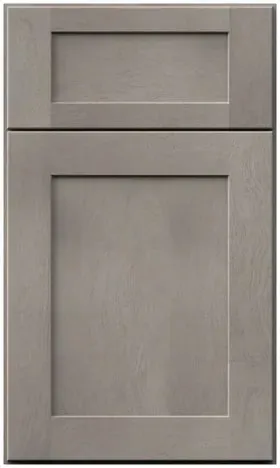
Galaxy Horizon is the one grey in the Galaxy line that you can see wood through. It is a stain, not a paint, laid over a shaker door so the grain stays visible, and the colour it leaves is a light, warm grey-taupe with a faint pink cast rather than the flat, even grey of a painted door. It also refuses to hold still: owners describe it looking cool and a little dull on a grey afternoon and noticeably warmer when the sun is on it. That behaviour is the reason people love it and the reason a few send the sample back. This guide covers what the colour really is, how a stain differs from the paints beside it, where it works, what Fabuwood itself pairs it with, the realities of living with a stained door, and what a kitchen of it costs.
Grey-taupe with a pink cast, not a blue-grey
Start with the misreading, because you will meet it. A handful of dealer pages and old blog posts describe this finish as a blue-grey or a slate. It is not, and nothing Fabuwood has published says so. The manufacturer’s own colour value for it sits on the warm side of neutral, with more red in it than blue, and the door page describes an "adaptable gray stain, accented with soft pink undertones". If you hold the sample next to a genuinely cool grey, the difference is obvious: this one leans toward taupe and mushroom, the other toward steel.
Where the blue idea probably comes from is photography. Under a cool, overcast sky, or in a picture whose white balance runs cold, a light warm grey can read silvery, and a silvery grey on a screen is easily called blue. Even Fabuwood’s own photograph of the small sample door looks paler and more neutral than its room renders do. The point is not that one image is right and the others wrong. It is that this colour moves more than most, so no single photograph, including every one on this site, can settle it for your kitchen.
Fabuwood’s own wording pulls in two directions, and it is worth knowing that before you read it. The door page says soft pink undertones. A style card calls them "soft taupe tones". The finish page describes "misty greys and silvery undertones" and a "cool, calming" feel. All three are describing the same stain in different rooms. We would summarise it as a light, muted grey with a warm taupe-pink base that can read warm or cool depending on the light and what surrounds it. Fabuwood files it as a light grey, and that matches what we see: it sits nearer the pale end of the greys than the middle.
A stain, not a paint: what that changes on the door
A paint is an opaque coat. It hides what is underneath and gives every door the same flat colour. A stain colours the surface and lets the figure of the material show through it, so each door carries its own grain pattern under the same tone. Fabuwood lists this finish as a stain in its specification book. Among the Galaxy greys, only Cobblestone, the dark grey-brown, shares that; Nickel, the other light grey, is a paint.
The Galaxy door is a five-piece shaker: ¾″ solid wood stiles and rails, 2½″ wide, joined around a ⅜″ recessed centre panel. Fabuwood’s spec book describes that panel as "MDF/veneer", which is how grain can appear on a panel whose core is MDF: the face is a wood veneer, and the stain works on it just as it does on the solid frame around it. Look closely at a sample and you may see the grain on the panel run differently from the grain on the stiles. That is expected on a veneered panel inside a solid frame.
One thing we cannot tell you is the species. Fabuwood does not publish the wood used for the frame or the veneer on this door, and we will not guess from a photograph. If a species matters to you, for allergy, for matching existing joinery or just curiosity, ask us and we will put the question to Fabuwood rather than repeat what a dealer page claims.
- Grain shows, and it varies. No two doors carry the same figure, and the tone can differ slightly between them. Fabuwood states that colour variation is normal for stained finishes.
- Wear looks different. A small knock on a painted door can show a pale chip; on a stained door it tends to read as a dent or a scratch in wood, which the grain helps disguise.
- Repairs are different. Fabuwood does not make spray cans for stained finishes. Touch-up is a kit with a fill stick, a marker and a scraper, which we cover further down.
Cool on a cloudy day, warm in the sun
The most useful description we have found of this finish did not come from Fabuwood. It came from a homeowner on Houzz who installed it with Cobblestone in 2022 and reported that on a cloudy day the cabinets can look "cold or dull", while on a sunny day they look warm, and that how they look depends on how much natural light the kitchen gets. A kitchen designer in the same discussion, whose showroom sells Fabuwood, put it more briefly: it can read warm or cool depending on the other furnishings.
Both observations fit the colour. A light grey with a small amount of warmth has no strong hue of its own to hold on to, so it borrows from whatever lights it. Warm sunlight and warm bulbs bring the taupe and pink forward; a north window, an overcast sky or a cool LED pulls it toward silver. Surroundings do the same job. Put it next to a white quartz with grey veining and it looks greyer; next to an oak floor or brass pulls, it looks warmer.
Fabuwood leans into this. Its Houzz caption for one of its own projects calls grey "almost chameleon-like", and the dealer copy you will see on many sites, ours included, repeats the chameleon line. It is a fair description, but read it as a warning as much as a selling point. If you want a colour that looks the same at breakfast and at dinner, a paint will do that better, and Nickel is the painted grey to look at.
| Condition | What tends to happen | What to do about it |
|---|---|---|
| Bright sun or a south or west window | Warmer, the taupe and pink more visible | Nothing, unless the sun is direct for hours: then think about UV (see below) |
| Overcast day or a north-facing room | Cooler and flatter, sometimes described as dull | Warm-white bulbs and warm accents bring it back |
| Cool-white LEDs after dark | Silvery, the nearest it gets to looking blue | Choose a warmer colour temperature for the ceiling and under-cabinet lights |
| Next to grey-veined white stone | Reads greyer and cleaner | A good pairing if you want the cool version |
| Next to oak, brass or copper | Reads warmer and more like wood | A good pairing if you want the warm version |
Galaxy Horizon, Nickel, Cobblestone or Stone

Most people who land on this page are choosing between three or four greys. The honest comparison is less about shade than about finish type, because the shade differences are small and the stain-or-paint difference is not.
| Finish | Stain or paint | Depth and undertone | Choose it when |
|---|---|---|---|
| This finish | Stain, grain visible | Light; warm grey-taupe with a pink cast; moves with the light | You want grey with some wood in it and are happy for it to change through the day |
| Nickel | Paint, opaque | Light to mid; slightly lighter and more neutral; holds steady | You want the same grey on every door, at every hour |
| Cobblestone | Stain, grain visible | Dark; a gray-brown | You want depth and drama, or a dark partner for this one |
| Stone (Fusion door) | Paint, opaque | Mid; a warm greige | You like the warmth here but want a paint and a different door |
Nickel is the closest in depth and the one it gets confused with in photographs. Stand the two samples together and the paint is lighter, cleaner and more even, and it stays where it is when the light changes; the stain is a touch warmer and shows grain. Cobblestone is the same kind of finish taken much darker, and Fabuwood promotes the two as a pair. Stone is the paint Fabuwood itself suggests as an alternative to this one; in our catalogue it comes on the Fusion door rather than the Galaxy shaker, so the choice there is door as well as colour. Our guide to grey shades sets out the wider family.
Where it works, and where it struggles
Fabuwood’s own style card for this stain places it in a French country kitchen, where its "soft taupe tones and delicate woodgrain" do the work that a distressed or limed finish would do in a custom kitchen. Its blog photographs it in modern farmhouse rooms with open shelving, a farmhouse sink, shiplap and wood accents, and in an industrial room. Those are the settings where a grey that shows wood feels natural rather than trend-led.
Transitional kitchens suit it too, in our experience, because the Galaxy door is plain enough to go either way and the stain adds texture a painted grey would not. It is also a comfortable choice for a bathroom vanity, where the room is small, the light is often artificial and a stained grey keeps it from looking clinical. The vanity collection uses the same door and stain.
Where it struggles is the room with little daylight, cool lighting and cool surfaces all at once: a north-facing kitchen with grey tile floors, white-and-grey stone and 5000K bulbs. Every one of those pulls the stain toward its dull, cool reading, and nothing in the room pulls it back. That room can still work, but it needs one warm element on purpose: a wood floor, warm bulbs, brass hardware or a wood open shelf. The other weak spot is the buyer who needs every door identical, for a strict modern look or simply for peace of mind. A stain will never give you that; a paint will.
What Fabuwood pairs it with, and what we would add
Fabuwood’s 2024 blog post on light grey kitchens shows this stain in a string of real rooms, and they are the safest pairings because the manufacturer chose them. We list those first, then the few things we suggest ourselves, clearly marked as ours.
| Element | Fabuwood shows | Our general advice |
|---|---|---|
| Countertop | Black countertops | A warm white or cream quartz, or a stone whose veining carries a little taupe |
| Backsplash | Marble; black marble; glass subway tile; subway tile with grey grout | Keep the grout close to the cabinet tone if the tile is busy |
| Hardware | Gold hardware; copper accents | Brushed nickel if you want the cool reading; unlacquered brass if you want warmth |
| Other cabinets | Two-tone with Frost; two-tone with Cobblestone | Keep to one partner finish per room |
| Appliances and sink | Stainless steel; a farmhouse sink | White or panelled appliances also sit well |
| Wood and texture | Open shelving, shiplap and wood accents | A mid-tone oak floor keeps it from going cold |
The black counter is the most striking of Fabuwood’s choices and the one people do not expect. It works because the stain is light: black on top makes the cabinets read paler and the grain more visible, where a dark cabinet under a dark top would merge. Gold and copper are the other surprise. Against a grey you might expect chrome, but warm metal draws out the pink and taupe and makes the whole room feel deliberate.
We have not found a wall paint that Fabuwood recommends with this finish, and we will not invent one. Bring the door sample to the paint store and test swatches against it in the room; that is quicker than any list.
Two-tone: light with Frost, or a stain pair with Cobblestone

Fabuwood photographs this stain in two-tone kitchens with two partners, and they produce opposite rooms.
With Frost, the bright white, the grey-taupe usually goes on the island or the lower run and the white goes up. The result is light and soft. The white makes the stain look warmer and more like wood by comparison, and the stain keeps an all-white kitchen from looking sterile. It suits smaller rooms and rooms where daylight is limited, because most of the wall area stays white.
With Cobblestone, it becomes a two-stain kitchen. Fabuwood’s own line is that "Galaxy Cobblestone’s blend of brown and grey pairs beautifully" with this "light grey tone". Here the dark stain usually takes the lower cabinets or the island and this one takes the uppers or the perimeter. Because both are stains from the same line, the grain runs through the whole kitchen and the two colours read as relatives rather than a contrast, which is a quieter effect than dark paint under white paint.
Two rules keep either version tidy. Split at the countertop, not part-way up a wall. And make every piece of trim match the cabinet it touches: a filler, end skin or toe kick in the wrong colour is the most common two-tone mistake, and on a quote it is one wrong prefix. The Frost collection and the Cobblestone collection use the same boxes and the same price grid.
Living with a stain: variation, sunlight and touch-up

Three facts about stained finishes come straight from Fabuwood’s specification book and warranty. None of them is a defect, and all of them are worth knowing before you order rather than after.
Doors will not match each other exactly
Fabuwood’s note on stained finishes says that because of the nature of wood and the complex finishing process, "there may be variations in color which are considered normal". The warranty adds that replacement cabinets may not match display samples or existing cabinets. In a kitchen this shows up as a door that is a shade warmer than its neighbour, or a drawer front with busier grain. Most people stop seeing it within a week. Some never do, and they are better served by a paint.
Sunlight can change the colour over time
The warranty lists colour change from exposure to UV light and sunlight as something it does not cover, and says finishes may darken or lighten over time. We have not found reports of this stain fading or yellowing specifically, but any cabinet that takes hours of direct sun every day will age differently from the one in shade. Blinds or UV-filtering window film on a sun-struck window are the practical answer.
Touch-up is a kit, not a can
Fabuwood says spray cans are not available for stained finishes. What exists is the touch-up kit, code TOUCH UP KIT, $62.40, with a fill stick for dents, a marker for scratches and a scraper to level the fill. A stain repair blends into the grain rather than disappearing under a coat of paint, so small marks go almost invisible and large ones stay visible. Buy the kit with the cabinets.
Cleaning without wearing the finish
Day-to-day care is gentle. Fabuwood’s care guidance is to blot spills rather than wipe them around, to use only mild cleaners, and never to spray cleaner directly onto the wood; put it on the cloth. The full routine is in How to Clean and Care for Your Kitchen Cabinets.
Will a grey kitchen hurt resale? A straight answer
Nobody can promise you how a colour will look to a buyer in ten years, and we will not pretend to. What we can say is this. Grey kitchens were at their most popular in the late 2010s, and this stain arrived in 2017, right in that wave. It has stayed in Fabuwood’s stocked range since then, and we have not found anyone describing it as dated. That is not proof of anything, but it is not a warning sign either.
What tends to date a grey kitchen is not the cabinet colour on its own; it is grey on grey on grey. Grey cabinets, grey tile, grey counter and chrome everything is the look that now reads as a period. A light grey stain that shows grain, set against a warm floor and warm metal, reads as a wood kitchen with a grey cast, and that has a longer shelf life. If resale is the main concern, keep the expensive, hard-to-change surfaces neutral and let the hardware and paint carry any trend; those are an afternoon’s work to swap.
What it costs and what you get
The stain costs nothing extra. It is priced the same as the other standard Galaxy finishes, box for box; in the fifteen-finish Galaxy line only Desert Oak and Natural Oak run higher, by about a fifth. So a 36″ base cabinet is GH B36 at $676.00 in this finish, the same as it is in Nickel or Frost, and a 30″ × 30″ wall cabinet is GH W3030 at $383.50.
Under the stain, every box is the Allure build: a ½″ veneered plywood box with a natural wood veneer interior, ¾″ plywood shelves, a solid wood face frame, ⅝″ solid wood dovetail drawer boxes on Blum Tandem plus Blumotion full-extension runners, Blum soft-close hinges with Quick-Release, and five-piece recessed-panel drawer fronts. Cabinets arrive pre-assembled, and the Galaxy series ships in about 2 weeks.
The 10x10 package (FGHZ10) shows $4,400.00 against a struck-through $6,769.23, the price before our 35% discount. It is the standard ten-by-ten L-shaped benchmark kitchen, useful for comparing dealers rather than as a plan for your room; the 10x10 pricing guide explains how to use it.
The spares worth adding to a first order
This is the short list we add to stained kitchens as a matter of course, priced at displayed prices on the review date. None of it is exotic; the point is only that it comes from the same production as the cabinets.
| Part | Code | Why | Price |
|---|---|---|---|
| Touch-up kit | TOUCH UP KIT | Fill stick, marker and scraper for the first knock | $62.40 |
| Spare 3″ base filler | GH BF3 | The part most often cut short on site | $26.00 |
| Spare toe kick, 8 ft | GH TK8 | Toe kicks take the most scuffs and are the easiest to replace | $55.90 |
| Spare wall end skin, 30″ high | GH SK W30 | Covers a damaged side or a future change | $50.05 |
| Total | $194.35 |
If your drawing already includes crown, add one extra length of the profile you chose (GH CM-1 is $117.00, for example); crown is the trim most likely to be miscut, and a replacement from a later batch sits right beside the original along the ceiling line.
Sample, drawing, one order, then check in daylight
Order the door sample first; it is $35.00. Look at it in the room, standing upright where the cabinets will go, at three times: mid-morning, late afternoon and after dark with the lights you plan to keep. If you are torn between this and Nickel, order both and put them side by side. Remember the sample shows one piece of grain; your doors will each show their own.
Then send us your measurements for a free 3D design. A designer replies within one business day, and the full drawing and quote come back within 24 to 48 hours, with the codes, the corner solution and every finishing part listed so the whole kitchen can go on one order. Trade buyers get trade pricing through Captivating Pro, one program with no tiers and no logins. If you would rather talk it through, call us.
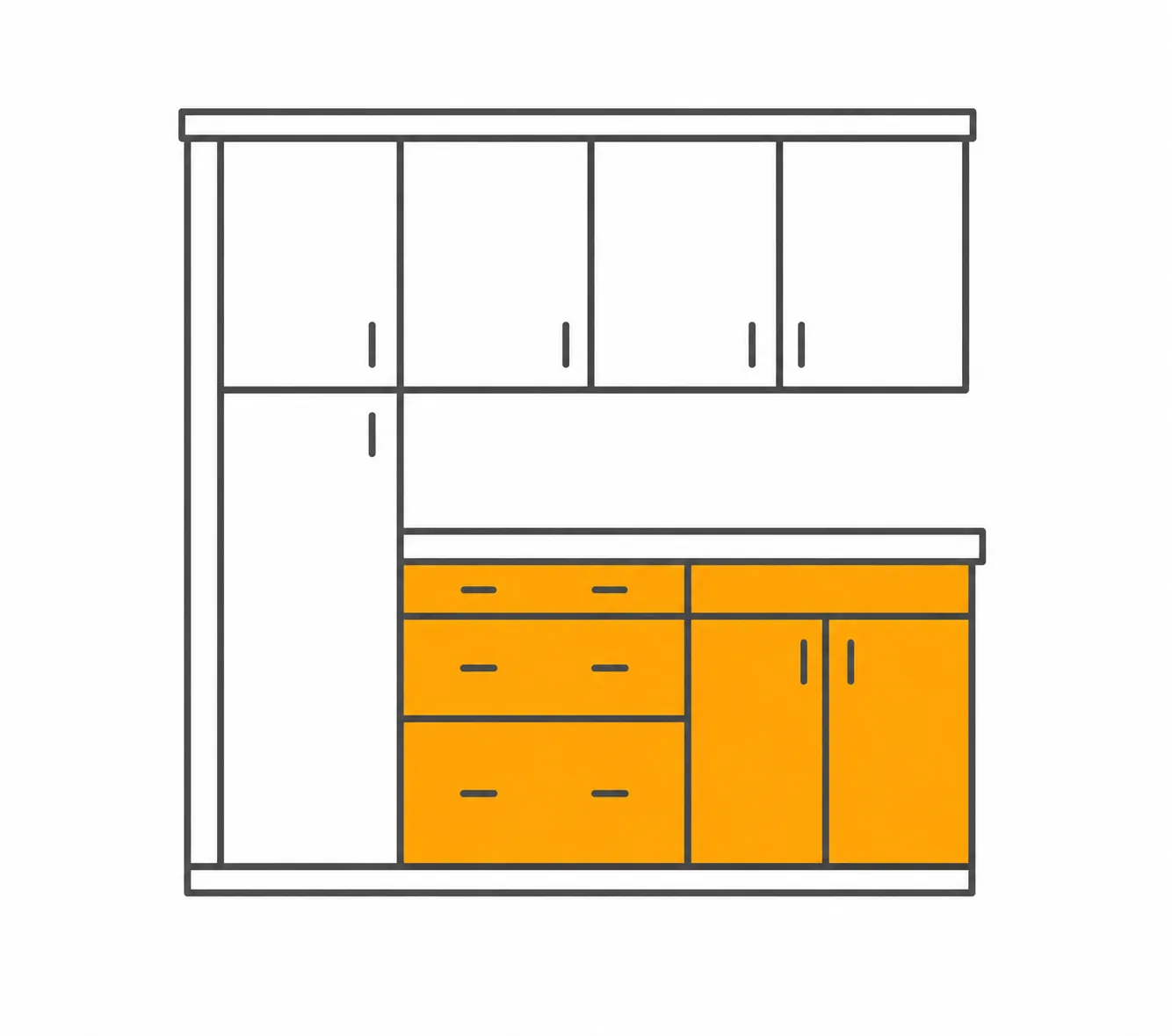
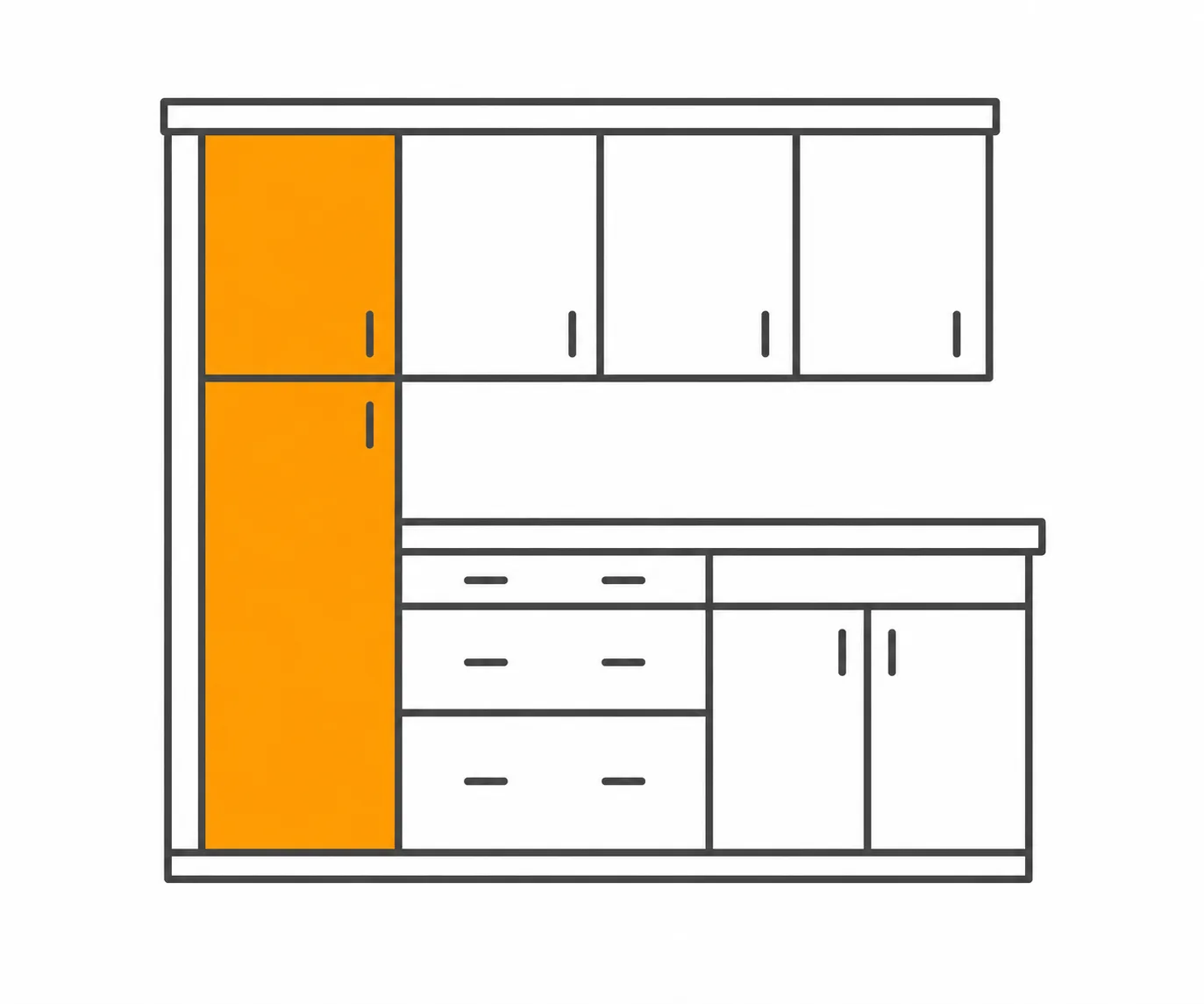
On the quote, cabinets and trim carry the GH prefix (GH B36, GH TK8, GH BEP); roll-outs, glass and hoods carry GHZ; loose parts such as the touch-up kit are listed by their bare code. When the delivery arrives, unpack the doors you can and stand them together near a window in daylight before anything is installed. That is the moment to ask the installer to swap same-size doors between boxes so that the warmest and coolest ones are not side by side. The base, wall and tall pages cover each run in detail: base cabinets, wall cabinets and tall cabinets. Pull-outs and inserts are on the accessories page, and end panels and molding on the decorative accessories page.
Common questions
- Is Fabuwood Horizon blue-grey or grey?
- Grey, and a warm one. Fabuwood describes it as a gray stain with soft pink undertones, and its own colour value sits on the warm side of neutral. It can look silvery under cool light or in a cold-balanced photo, which is where the blue-grey label comes from, but no Fabuwood description calls it blue.
- Is Horizon a paint or a stain?
- A stain. Fabuwood lists it as a stained finish, so the grain of the door shows through. The door is a solid wood frame around a ⅜″ centre panel that Fabuwood describes as MDF with a veneer face. Fabuwood does not publish the wood species.
- Why do my Horizon cabinets look different at different times of day?
- Because a light grey with a slight warm cast takes its colour from the light around it. Owners report it looks cooler and duller on overcast days and warmer in sun. Warm bulbs and warm accents such as wood or brass bring out the taupe; cool LEDs and grey stone push it toward silver.
- What is the difference between Horizon and Nickel?
- Horizon is a stain with visible grain and a warm grey-taupe cast that shifts with the light. Nickel is an opaque paint, slightly lighter and more neutral, and it looks the same on every door and at every hour. Both use the same Galaxy door, box and prices.
- Do stained cabinet doors match each other?
- Not exactly. Fabuwood says colour variation between pieces is normal for stained finishes, and its warranty notes that replacement parts may not match existing cabinets. Order everything, including spare trim, on one order, and have the installer swap same-size doors to balance the run.
- Can I touch up a stained Horizon cabinet?
- Yes, with the touch-up kit (TOUCH UP KIT, $62.40): a fill stick for dents, a marker for scratches and a scraper. Fabuwood does not make spray cans for stained finishes.
- What countertop goes with Horizon cabinets?
- Fabuwood’s own photographs show it with black countertops and with marble backsplashes. A warm white or cream quartz is our general suggestion if you want a lighter room; a stone with some taupe in its veining ties the two together.
- How much does a Galaxy Horizon kitchen cost?
- The same as the other standard Galaxy finishes. The 10x10 package shows $4,400.00 against the $6,769.23 struck through beside it; a 36″ base cabinet is $676.00 and a 30″ × 30″ wall cabinet $383.50, at displayed prices on the review date.
Keep reading
The guides behind the numbers on this page.
- Gray Kitchen Cabinets: Finding the Right Shade
Where a warm, grained grey sits against the cool and neutral painted ones.
- Kitchen Cabinet Samples: How to Order & Evaluate
The routine for a colour that looks different at noon and at nine.
- Brown Kitchen Cabinets: Stains, Shades & Pairings
How a stain behaves on a door, explained on the wood tones it is usually used for.
- Beige Kitchen Cabinets (and Greige): Shades, Pairings, and the Lines That Carry Them
The taupe side of the family, for anyone torn between a grey and a greige.
- How to Clean and Care for Your Kitchen Cabinets
The gentle routine a stained, sealed door needs, and the products that dull it.
- What Is a 10x10 Kitchen? Cabinet Costs, Packages & Layouts
Why every dealer quotes the same imaginary L-shaped room, and how to use it.


