





Fabuwood Galaxy Cobblestone cabinets: living with a dark, grained shaker
Reviewed September 2026 · Captivating Cabinets
Prices quoted in this article were read off the grid on the review date; the live price grid on this page governs.
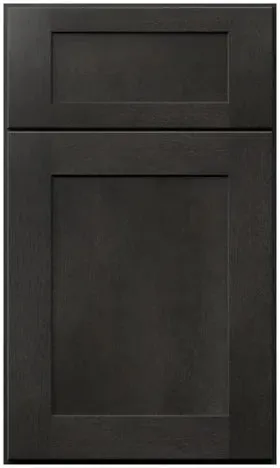
Fabuwood Galaxy Cobblestone cabinets are the darkest stained finish in the Galaxy line, and they ask different questions from every light kitchen on this site. A dark door has to be lit to be seen. It shows dust where a white door shows grime, and it makes brass look like jewellery and black pulls vanish. It is also a stain, not a paint, so the grain shows through and no two doors are quite the same. The box, drawers and hinges match every other Galaxy colour, and the prices match the Galaxy whites and grays, so this guide concentrates on the dark, grained finish and then works out what a kitchen in it costs.
A stain you can see the wood through, not a paint
Fabuwood describes the colour as an elegant cross between traditional brown and transitional dark grey, and its own finish page calls it a warm gray stain. Both descriptions are right, and each one gets half of it. In the hand, the door reads as a deep gray-brown, close to black from across the room, with the grain of the frame running through it. Put it next to something truly black and the brown comes out. Put it next to a warm wood and it looks gray.
That is worth settling before anything else, because this finish gets described three different ways online: as a charcoal, as a dark paint, and as a dark brown. It is none of those exactly. A charcoal is a cool paint with no grain. A brown stain on oak or cherry reads as wood first. This one reads as a colour first and as wood second, which is why people searching for dark brown shaker cabinets and people searching for dark gray cabinets both end up on this page.
The grain has two practical consequences. Doors vary slightly from one to the next, as stained wood always does, so a run of twenty doors has a natural movement a painted run does not. And the stain sits in the wood rather than forming an opaque film on top of it, which changes how the finish takes a knock. That comes up again below. How the ⅜″ MDF centre panel the catalog specifies for every Galaxy door carries the stain is best judged on the door sample itself. Ask your designer if the panel and frame read differently to you.
Where it sits among the Galaxy darks and grays

The Galaxy door comes in more than a dozen finishes, and six of them get cross-shopped against this one. They sort by two things, depth and finish type (paint or stain). Depth decides what the colour does to a room. Finish type decides what the door looks like up close and how it wears.
| Finish | Paint or stain | Depth and cast | Choose it when |
|---|---|---|---|
| Nickel | Paint, opaque | Light-mid gray, neutral | You want an unmistakably gray kitchen that stays bright |
| Horizon | Stain, grain visible | Light gray with some wood showing | You want gray but also want to see wood |
| Mocha | Stain, grain visible | Mid brown, muted and ashy | You want a brown that reads as wood, not as a colour |
| Truffle | Stain, grain visible | Mid-to-dark brown, warmer than Mocha | You want a traditional brown kitchen |
| Cobblestone | Stain, grain visible | Dark gray-brown, near-black at a distance | You want dark without black, and warmth without obvious brown |
| Pitch Black | Paint, opaque | Near-black, flat and even | You want a true black with no grain and no undertone |
Read the depth column and one thing stands out. There is a big gap between the mid browns and this finish, and almost none between this finish and Pitch Black. In practice, then, the choice among the darks is between two doors of nearly the same depth, and it is decided by texture and undertone.
Pitch Black is an opaque paint. Every door is the same flat black, the finish looks graphic and modern, and it shows exactly what a painted surface shows. Cobblestone is a stain. It has grain and a brown cast that warms up in lamplight, and it looks more like furniture than a graphic block. Go with Pitch Black if the kitchen is crisp, cool and minimal. Go with Cobblestone if it has wood floors, warm whites or brass, or if black feels like too much commitment. Keep them apart in the same kitchen: side by side, the gray-brown looks like a black that faded.
Looking lighter? The Cobblestone vs Nickel comparison sets this finish against the classic mid-tone gray. If you want brown that looks like wood, the Truffle vs Mocha comparison covers the two mid-brown stains. The Fusion door also has a taupe-gray paint called Stone, deeper than Nickel and about as deep as the mid browns, but it is a different door profile, so it is a different kitchen rather than a Galaxy alternative.
What a dark door shows, and what it quietly hides
Every finish has a mark it is bad at hiding. On a white door it is grime near the handles. On a dark one it is anything pale: dust, flour, dried water. Knowing which marks show on which cabinets is most of what it takes to live happily with a dark kitchen, and it is the reason the base cabinet article is organized around it.
| The mark | On this finish | Where it collects | What helps |
|---|---|---|---|
| Household dust | Shows, as a pale film | Top rails, drawer tops, the tops of uppers | A dry microfibre cloth weekly; take uppers to the ceiling or crown |
| Flour, sugar, powder | Shows immediately | Drawer fronts under the prep counter | Wipe as you go; a damp cloth, not a dry brush |
| Dried water spots | Shows as pale rings and drips | Sink base, dishwasher flank, below the kettle | Dry splashes the same day; a mat under the sink |
| Greasy fingerprints | Shows in raking light on flat rails | Around pulls, on drawers you open with your palm | Pulls long enough to use; mild soap and water |
| Everyday grime near pulls | Mostly hides | Door edges, the trash pull-out | Less wiping than a white kitchen needs |
| Small scuffs and scratches | The grain disguises most of them | Toe kick, lower drawers, the seating side of an island | A matching touch-up; ask your designer what Fabuwood supplies |
The last row is where a stain beats a paint. A scuff on an opaque dark paint shows as a scratch in a flat surface. On a grained stain the eye reads it as part of the wood. A deep gouge is a different matter: it can go through the colour into paler wood, so treat the toe kick and the seating side of an island as the places to protect. The cleaning and care guide explains what is safe on a factory finish and what strips it.
A dark run drinks light: windows, counters and lamps
A pale door bounces light back into the room, and a dark one absorbs most of what reaches it. That is the whole appeal of the finish, the calm and enclosed feeling of a dark kitchen, and it is also the one thing that can go wrong with it. A run of dark gray-brown cabinets makes a room feel smaller and dimmer unless something else puts the light back.
- The counter and backsplash become the reflectors. A white or pale stone counter over dark bases is not only a style choice; it is the surface that lights the working area. Pair a dark counter with dark bases and you need a lot of light from above.
- Under-cabinet lighting stops being optional. Whether the uppers are dark or light, the counter below them needs its own light, and puck sets sized to each wall cabinet are on the cabinet accessories page in this finish.
- Room size matters more than with any light finish. In a small kitchen, put the dark finish below the counter and keep the uppers light, open or absent. In a large, bright room a fully dark kitchen is possible and can look superb.
- Bulb colour moves the undertone. Warm 2700–3000K light brings out the brown and the grain. Cooler 3500–4000K light pushes the finish toward gray. Neither is wrong, but choose on purpose, and look at the sample under the bulbs you will actually use.
Hardware, counters and floors against a gray-brown
On a light door the hardware is a detail. On this one it is the most visible thing on the run, because a metal pull against a near-black ground is pure contrast. Start with the hardware and the rest of the choices follow.
| Surface | Lifts it | Lets it down |
|---|---|---|
| Hardware | Brass, champagne bronze and unlacquered brass stand out; polished nickel reads crisp | Matte black disappears. That is fine for a near-handleless look, but the pulls will not register |
| Counters | White or pale quartz, marble-look slabs, warm white stone, butcher block on an island | Black or very dark granite, which merges with the run and loses the edge |
| Backsplash | Warm white zellige, cream tile, pale stone continued up the wall | Busy dark tile that competes with the grain |
| Floors | Warm oak, mid-tone wood, cream or terracotta tile; the brown undertone ties into them | A floor the same depth as the cabinets, which makes the run look like it has no base |
| Walls and trim | Warm whites and soft creams | Stark blue-white, which pushes the finish toward cold charcoal |
Brown undertones get along with warm materials, which is why oak floors and brass look intentional here and would look busier next to a cool charcoal paint. If your floor is fixed and cool-toned, the finish still works, but the counter has to carry the contrast. The matching guide gives the order in which to choose the rest once the cabinet is settled.
The anchor of a two-tone kitchen
Most kitchens that use this finish do not use it everywhere. It goes on the island, or on the whole lower run, while the uppers stay light. That is the job it is best at: it grounds the room, hides the scuffs at foot level and lets a pale upper run keep the room bright. Dark below and light above is also how rooms are naturally lit, so the arrangement never looks forced.
The light partners that work: Frost for a crisp, high-contrast kitchen; Dove for a softer one; Linen when the floors and counters are warm and you want the whole room in one warm family. Nickel above a Cobblestone base works in a cool, contemporary scheme, but the contrast is smaller than it looks on a screen, so try the two samples side by side first. The pairings to avoid are Pitch Black, which is too close in depth, and a mid brown like Timber as the only other cabinet colour, which reads as two woods that do not match rather than a plan.
This finish shares its price grid with the Galaxy whites, so a two-tone kitchen with Frost or Dove costs nothing extra box for box (Linen is quoted on request). The extra cost is in the trim: every filler, panel and molding has to be ordered in the colour of the box it touches, as the 10x10 section below shows. The 27 kitchen cabinet ideas has built examples of dark-island and dark-lower kitchens.
Unchanged under the stain: box, drawers, hinges
Under the stain, nothing changes from any other Galaxy colour: the construction, the lead time and the warranty are all the same, and each box is priced the same as its twin in the Galaxy whites and grays.
- Doors: solid wood frames around a ⅜″ MDF centre panel, a five-piece recessed shaker, full overlay.
- Carcass: ½″ veneered plywood with a natural wood veneer interior. The inside is pale, so looking into a dark cabinet is easier than you might expect.
- Drawers: ⅝″ solid wood boxes with dovetail joints, behind five-piece recessed-panel drawer fronts.
- Glides and hinges: Blum Tandem plus Blumotion full-extension concealed runners, and Blum hinges with quick-release and Blumotion soft close on the doors (Lazy Susan, Easy Reach and pie-cut corner cabinets do not get the soft-close mechanism).
- Build: assembled at the factory with dowels, glue and pocket screws, so it arrives ready to hang.
- Timing and cover: typically 2 weeks, like every Fabuwood stock series, backed by Fabuwood’s limited lifetime warranty.
The Fabuwood review covers what that build is like to own, and the Allure series explainer puts the Galaxy door next to the other five Allure profiles.
Planning each run in a dark finish
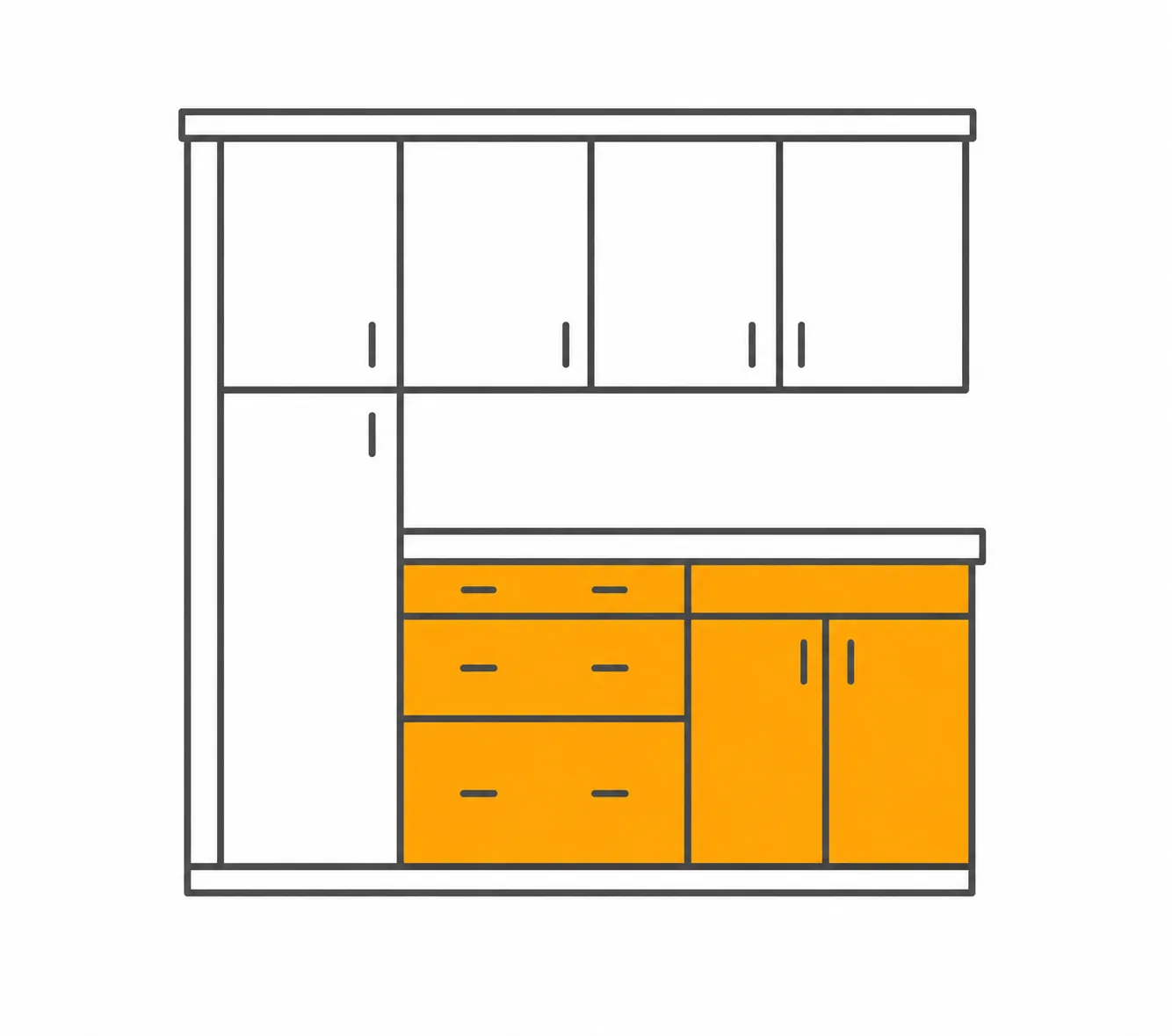
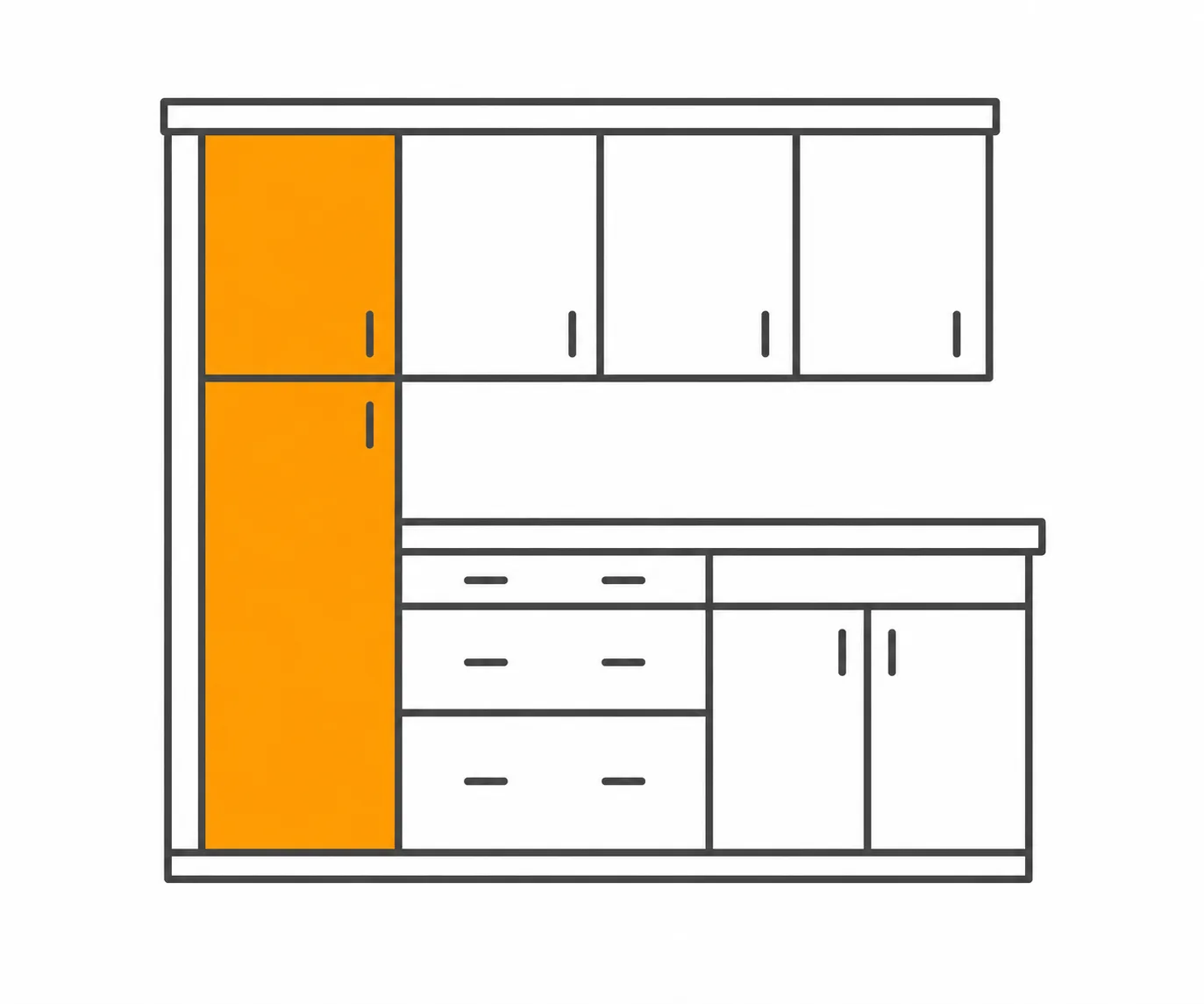
Sizes follow the usual American grid: bases 34½″ high and 24″ deep, uppers from 12″ to 42″ high, and talls from 84″ to 96″. What changes with a dark stain is where each run should go and what it should sit next to, and each type page covers that with the full grid of sizes and prices.
Base cabinets
This is where the finish does most of its work, and where it collects most of its marks. The base cabinet guide plans the run station by station, starting from what lands on the doors at each one.
Wall cabinets
Many kitchens in this finish hang light uppers or no uppers at all. When dark ones make sense (glass fronts with lit interiors, boxing in appliances, or a large bright room), the wall cabinet guide covers how to plan them and light them.
Tall cabinets
A dark tower belongs where a light one would look gloomy: in the dimmest corner, where it looks deliberate. The tall cabinet guide covers placement, seeing into the pantry, and oven towers.
Vanities, glass and trim
The same stain carries into the bathroom through the vanities. The glass fronts and the crown, light rail, fillers and panels under decorative accessories are stained to match. The hoods in this finish can put a dark focal point on a light range wall.
The 10x10 package, and what it costs to make it two-tone
The package is sold as a single line, FGCB10. It displays at $4,400.00, with $6,769.23 — the price before our 35% discount — struck through beside it. Behind it is an L-shaped layout for a room 120″ on each wall: six uppers (including a diagonal corner wall and a short, deep box over the refrigerator), four bases (sink, blind corner, a double-door base and a single-door base), and two toe kicks. Like any 10x10 it is a yardstick for comparing quotes, not your kitchen.
Most people who choose this finish want it as a two-tone kitchen, so here is what that conversion does to the number. The package itself is one finish. A two-tone version gets quoted box by box, and your designer builds that for you.
| Line | Colour it is ordered in | Effect on the price |
|---|---|---|
| Six wall cabinets | The light finish (Frost or Dove; Linen is quoted on request) | None. GC W3030 and its Frost twin are both $383.50 |
| Four base cabinets | Cobblestone | None |
| Dishwasher end panel and base finished ends | Cobblestone, because they touch the bases | None; they are ordered by the piece in either colour |
| Finished ends on the uppers | The light finish | None; same count, different colour, also by the piece |
| Toe kick | Cobblestone. A dark kick also hides shoe scuffs | GC TK8 is $55.90 per 8 ft if you need more |
| Crown and light rail | The light finish, since they sit on the uppers | Not in any 10x10; crown from $117.00 per length, light rail $149.50 |
| Under-cabinet lights | Not a colour choice | Puck sets from $74.75 (9″) to $152.75 (39″) per cabinet, plus a driver |
So a two-tone kitchen in these finishes costs what a one-colour kitchen costs, plus the lighting and molding every kitchen needs anyway. The real upgrades are the usual ones: a lazy Susan in the blind corner (GC LSB36 at $1,095.25 against GC BLB36/39 at $614.25) and drawer banks in place of door bases. Our Cobblestone vs Nickel comparison puts a typical 10x10 in either finish at $4,400 to $6,500 in cabinets. The 10x10 guide explains the benchmark, and the Fabuwood cost guide compares it across series. Prices here are the grid’s displayed figures on the review date, and the grid on the page is the price of record.
Reading a two-colour quote
On a Fabuwood quote, the prefix names the finish. The box code after it is identical from one Galaxy colour to the next. This finish is GC. Loose parts, glass fronts and hood components carry GCB. The Galaxy whites are GF for Frost and GD for Dove, and Linen is GL. A two-tone quote therefore carries two prefixes, and checking it takes only a few minutes.
| Quote line | What it is | What to check |
|---|---|---|
| GC SB36 | 36″ sink base, dark | Sized to the sink, not the run |
| GC DB30 | 30″ three-drawer base, dark | No suffix means three drawers; -2 means two deep ones |
| GC B18FD | 18″ base, full-height door, no drawer | FD is what a trash pull-out needs |
| GF W3036 | 30″ × 36″ upper, in Frost | The height is the last two digits |
| GC BEP | Base end panel, dark | Must carry the base prefix, even when it sits under a light upper |
| GC LRM | Light rail, dark | Right only under dark uppers; under light ones, order the light finish’s rail |
| GCB GDW3036 | Glass front for a 30″ × 36″ upper | Ask what the line covers (frame, glass, or both) |
The mistake to look for is a trim line in the wrong colour: a dark light rail under light uppers, or a light filler between two dark bases. It costs nothing to fix on the quote and a return to fix after delivery. The SKU decoder covers the rest of the suffixes across every brand we sell.
Judging the sample, and checking the delivery
The door sample is $35.00, and with a dark stain it needs more careful judging than a white. Put it on the floor you actually have and set the counter sample on top of it. Look at it once in daylight and again after dark under your own bulbs. Remember that the grain on that one door is a single example of how much the doors will vary. Considering Pitch Black too? Order both. The difference between them is obvious side by side and nearly invisible in photos. Door samples are final sale. The sample guide covers the full routine.
Then send us the room. The free design service returns a drawn layout, a box list and an itemized quote in 24–48 hours, one colour or two. Contractors and builders get trade pricing through Captivating Pro.
Common questions
- Is Fabuwood Cobblestone painted or stained?
- Stained. Fabuwood describes it as a warm gray stain, and the wood grain shows through the colour. That sets it apart from the other two Galaxy darks and grays it gets compared with most, Nickel and Pitch Black, which are both opaque paints.
- Is Cobblestone gray or brown?
- Both, which is the point of it. Fabuwood calls it a cross between traditional brown and transitional dark grey. At a distance it reads as near-black, next to true black it looks brown, and next to warm wood it looks gray. Warm bulbs bring out the brown; cooler ones push it toward gray.
- Cobblestone or Pitch Black: which should I choose?
- They are nearly the same depth. Pitch Black is a flat, opaque black paint with no grain: graphic, modern and even. Cobblestone is a stain with visible grain and a brown undertone, so it reads warmer and more like furniture. Choose Pitch Black for a cool minimal kitchen and Cobblestone for one with wood floors, warm whites or brass. Do not use them together.
- Do dark cabinets show dust and fingerprints?
- Dust, flour and dried water spots show more on a dark door than on a light one, mostly on top rails, drawer fronts and the sink base. Greasy prints show in raking light on flat rails. Everyday grime near the pulls hides better than on white, and the grain disguises small scuffs better than an opaque paint does.
- What hardware goes with dark gray-brown cabinets?
- Brass, champagne bronze and unlacquered brass stand out best; polished nickel is a crisp, cooler option. Matte black nearly disappears on this finish, which suits a pared-back, almost handleless look but not a kitchen where you want the pulls to register.
- How much is a Fabuwood Galaxy Cobblestone 10x10 kitchen?
- The FGCB10 package displays at $4,400.00, with $6,769.23 — the price before our 35% discount — struck through beside it. Making it two-tone with light uppers costs nothing extra box for box because it shares one price grid with the Galaxy whites; lighting and crown are extra, as on any kitchen. Send a layout for an itemized quote.
Keep reading
The guides behind the numbers on this page.
- Brown Kitchen Cabinets: Stains, Shades and Pairings
The brown half of this finish’s personality, and the stains it gets cross-shopped with.
- Black Kitchen Cabinets: Styles, Pairings and Care
If Pitch Black is the other finish on your shortlist, read the case for it first.
- Gray Kitchen Cabinets: Finding the Right Shade
The gray ladder from pale to near-black, for placing a gray-brown on it.
- Fabuwood Cabinet Colors: The 2026 Guide to Every Finish
Every Galaxy paint and stain side by side, darks included.
- How to Clean and Care for Kitchen Cabinets
Dust and water spots are the upkeep on a dark door. What to wipe them with.
- How to Match Cabinets, Countertops, Backsplash and Flooring
Contrast is the job on a dark run. This covers choosing the surfaces that supply it.
- Kitchen Cabinet Samples: How to Order and Evaluate
A grained stain varies door to door. How to judge one sample honestly.
- What Is a 10x10 Kitchen? Cabinet Costs and Packages
The benchmark behind the FGCB10 package price, and what it leaves out.
- How to Read Cabinet SKU Codes
Useful when a two-colour quote carries two prefixes.
- Fabuwood Cabinets Review (2026)
The box, the warranty and the dealer’s view of where the brand is thin.


