






Fabuwood Galaxy Indigo cabinets: the navy that chooses the rest of the room
Reviewed September 2026 · Captivating Cabinets
Prices quoted in this article were read off the grid on the review date; the live price grid on this page governs.
Fabuwood Galaxy Indigo cabinets are the finish people reach for when the kitchen is allowed one bold move, and nine times in ten that move is an island. Choosing it settles more than the island, though. A navy door narrows the hardware, the white around it, the wood underfoot and the countertop, and it behaves differently under every bulb in the house. This guide takes those decisions in the order navy forces them, prices the finish the way a real room is built, and is honest about what a saturated paint shows.
Slate navy, not royal blue: what the paint actually is

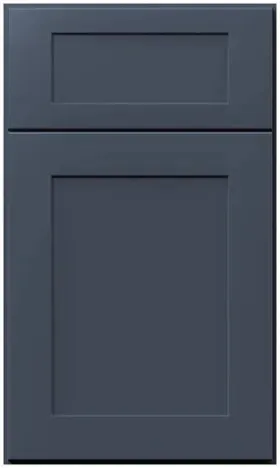
Indigo is an opaque paint with no grain showing through. The colour is a muted, greyed navy, closer to slate than to the saturated royal or marine blues in paint-store fan decks. It is dark enough to anchor a room and still reads as blue in daylight. Fabuwood’s own copy calls it a deep navy with violet undertones, and that is fair with one qualification: the violet only comes forward under warm light. Under daylight or neutral bulbs the door reads as a dusky blue-grey.
The same collection copy mentions sleek polished surfaces. That is marketing language for the whole Galaxy line, which is not a high-gloss series. Expect a smooth, low-sheen painted face rather than a lacquer shine, and look at the door sample under your own lights to judge the sheen before you order a kitchen.
The paint goes on the standard Galaxy door, a five-piece full-overlay shaker with a recessed centre panel. Fabuwood makes it, Allure is the series, Galaxy is the door and Indigo is the colour. The Fabuwood colour guide shows the rest of the palette if you are still weighing other colours.
Indigo against Pitch Black, Cobblestone, Nickel and a bright navy
Four darker Galaxy doors get compared with this one, plus the brighter navies people have seen on social media. They differ in two ways: how deep they are and whether they read as a colour or as a neutral. Every Galaxy door on this list has the same box, door profile and price, so the choice comes down to colour alone.
| Finish | Paint or stain | What it reads as | Pick it when |
|---|---|---|---|
| Nickel | Paint | Mid-grey, neutral, no colour cast | You want a darker door that commits the room to nothing |
| Indigo | Paint | Muted slate navy; a faint violet cast under warm bulbs | You want a colour that still behaves like a dark neutral |
| Cobblestone | Stain, grain visible | Dark grey-brown with wood showing | You want dark with warmth and texture rather than colour |
| Pitch Black | Paint | Near-black, flat and even | You want graphic contrast and no hue at all |
| A bright royal or marine navy (not a Galaxy finish) | Paint | Saturated, obviously blue at any distance | You want a coastal or high-colour look; not available on this door |
In practice the close call is Indigo against Pitch Black. In daylight they are nowhere near each other, since one is blue and the other is black. After dark, under dim warm light, a navy can drop so far that visitors take it for black. If you would be happy with that effect, either door works. If you want the room to read as blue at 9pm, light it properly (see below) or accept that it will darken. The black cabinets guide covers the Pitch Black side of that decision.
Against Cobblestone the difference is surface. Cobblestone is a stain with grain showing, and it looks like furniture. This navy is an even coat of colour with no wood visible. Against Nickel the difference is depth: Nickel is a mid-grey that lightens a room, and the Cobblestone vs Nickel comparison covers that end of the range. One more finish often gets mixed in: Horizon is sometimes filed beside Indigo under blues, but it is a soft grey stain with the grain visible, not a blue at all.
Metal, then white, then wood, then stone: the order navy forces
A white kitchen lets you choose the other finishes in any order. A navy one works better in sequence, because each choice narrows the next. Choose the metal first, because it has to agree with the paint over every drawer. The white comes next, since it is the next-largest surface. The wood follows because it is under your feet, and the stone comes last because a good counter can join the other three.
| Decide | What works with this navy | What to be careful with |
|---|---|---|
| 1. Metal | Brass and gold tones (the classic navy partner); polished or satin nickel for a cooler, nautical look | Matte black nearly disappears on a dark navy. That is fine if you want quiet pulls, but not if you want them to show |
| 2. The white | A soft warm white like Dove for a calm room; a crisp white like Frost for sharper contrast | A creamy beige can turn the navy slightly muddy. Hold the samples together first |
| 3. Wood | White oak and pale natural oak; mid-tone honey woods; walnut for a darker, richer room | Orange-toned oak and cherry push navy toward purple by contrast |
| 4. Stone | White marble-look quartz with soft grey or gold veining; warm white solid quartz; butcher block on the island | Busy blue-grey granite competes with the paint and makes both look like the wrong blue |
Two notes on metal. Navy with brass is the combination we draw most, and it is popular because it works: the warm metal gives a cool paint something to push against. Polished nickel suits a coastal or traditional room better than brass does, and it keeps the palette cool if the white you chose is a crisp one. Whichever you pick, carry it through the faucet and the light fittings. Mixing brass pulls with a chrome faucet over a navy sink base is the most visible half-decision in the room.
The countertop and flooring guide has the side-by-side sample method. With a navy, use it in the order above. Put the door sample down first, the pull on it, the white chip beside it, the floor sample under it and the counter sample last.
Muddy or purple: how bulbs and windows move this colour
A navy has more colour in it than a white or a grey, so it has more to lose when the light is wrong. Two failures come up again and again. Under very warm bulbs, the 2700K kind sold as soft white, the blue drains out and the faint violet cast takes over, so the island reads as muddy aubergine by evening. In a north-facing room with little direct sun, the door cools toward slate grey and can look flat.
The fixes are ordinary lighting choices, as long as they are made before the electrician arrives. Neutral-white bulbs around 3000K to 3500K keep the blue reading as blue without making the room clinical. High colour-rendering bulbs (CRI 90 or above) show the paint as it looked on the sample. Under-cabinet light above a navy run matters more than it would above a white one, because the counter bounces that light back onto the doors. The Galaxy lighting on the cabinet accessories page includes a tunable-white strip, GI LED STRIP TUNABLE WHITE 10MM at $286.00, which lets you set the temperature after the kitchen is built instead of guessing.
What a saturated paint shows, and what it hides
Every painted door shows some wear. A deep colour just shows different things from a white one, and it helps to know which in advance.
- Chips show as a pale fleck. A knock from a pot or a vacuum on a navy edge leaves a light mark that is easier to see than the same knock on white. Ask your designer about touch-up for this finish when you order, and keep it with the house paperwork.
- Dust shows on the flat top rails of drawer fronts and on the toe kick, where a white door hides it. A dry microfibre cloth once a week keeps it down.
- Fingerprints and light grease show less than on white or pale grey, which suits an island that gets leaned on all day.
- Water spots dry pale on dark paint. Wipe the sink base and dishwasher neighbours dry rather than letting drips evaporate.
None of this is a reason to avoid the finish. It is a reason to put it where it gets looked after, such as an island or a run of drawers, rather than beside a back door. The cabinet care guide has the cleaning routine and the products to keep off a painted face.
Two-tone with the navy as the low colour
Navy goes low in most two-tone kitchens. A dark colour on the island or lower cabinets grounds the room, and a light colour above keeps the ceiling where it is. The upside-down version, with navy uppers over white bases, can work in a tall bright room, but it makes the kitchen feel lower. The wall cabinet article covers the cases where navy belongs overhead.
| Partner | The look | Watch for |
|---|---|---|
| Frost | Crisp and nautical; the strongest contrast of the three whites | Can feel stark with nickel pulls; brass warms it |
| Dove | Softer and more lived-in; the combination we design most | Nothing much. It is the safe pairing |
| Linen | Warm and traditional, beige above navy | Keep the counter white or cream; grey stone makes both look tired |
| Natural Oak | Navy lowers or island with pale oak uppers or shelving; no white cabinets at all | Needs good light; two mid-to-dark surfaces in a dim room close in |
| Timber | Honey wood against navy, the warmest option | The orange in a honey tone can nudge the navy toward violet |
| Pitch Black or Cobblestone | Two darks together | We steer people away from it. They read as a mismatched pair rather than a choice |
Pricing a two-tone room is simple, because every Galaxy colour sits on the same price grid. A navy island under Dove perimeter cabinets costs the same as an all-Dove kitchen with the same boxes. The only extra is finishing, because each colour needs its own end panels, toe kick and fillers wherever it shows. The Frost vs Dove comparison helps if the white partner is still undecided.
Below the paint, nothing changes
Nothing below the paint changes when you choose a colour. The navy costs no more than the whites, ships in the same window and carries the same warranty.
- Door: a solid wood frame around a ⅜″ MDF centre panel. MDF is used for the panel because it stays flat through humidity swings, so the paint line at the frame joint holds.
- Box: ½″ veneered plywood with a natural wood-veneer interior. Open a navy door and you see pale wood inside, which makes the contents easy to see.
- Drawers: ⅝″ solid-wood boxes, dovetailed at the corners, behind five-piece drawer fronts.
- Hardware: Blum Tandem plus Blumotion full-extension concealed glides and Blum soft-close hinges, fitted as standard.
- Assembly: shipped assembled, joined with dowels, glue and pocket screws. Full-overlay doors.
- Lead time and warranty: typically 2 weeks, like every Allure series, and a limited lifetime warranty.
The Fabuwood review explains why those lines matter when you compare quotes, and the Blum soft-close explainer covers the hinge behind every door.
Pricing a navy kitchen by the linear foot
The collection sells a 10x10 kitchen in this finish as one package, FGIN10, at $4,400.00 as of this review. The $6,769.23 struck through beside it is the price before our 35% discount. A 10x10 is an L of two ten-foot walls, 20 linear feet in all, so the package works out to about $220 per linear foot of wall. That figure covers a standard base-and-upper mix, and the gaps where the range, fridge and dishwasher stand are included in the 20 feet.
That per-foot figure is useful for rough budgeting, but what you put in each foot changes it. Here is a three-foot section of wall priced four ways from the grid.
| What goes in the 36″ | Lines | Price | Per linear foot |
|---|---|---|---|
| Door base, 30″ upper | GI B36 $676.00 + GI W3630 $422.50 | $1,098.50 | About $366 |
| Drawer bank, 30″ upper | GI DB36 $1,030.25 + GI W3630 $422.50 | $1,452.75 | About $484 |
| Door base, 42″ upper to a 9′ ceiling | GI B36 $676.00 + GI W3642 $620.75 | $1,296.75 | About $432 |
| Drawer bank, 42″ upper | GI DB36 $1,030.25 + GI W3642 $620.75 | $1,651.00 | About $550 |
So a run that is all cabinets, with no appliance gaps, costs two to three times the package average per foot. Drawers add about a third to a section, and a taller upper about a fifth. For a navy island, price it as a separate item. A 96″ working island built as GI DB36, GI B24 and GI DB36 comes to $2,531.75. Two GI BEP base end panels ($149.50 each) and a navy toe kick (GI TK8, $55.90 per 8 ft length) finish it. The island with its ends is about $2,900 before the counter. The 10x10 guide explains the convention, and the Fabuwood cost guide puts Galaxy beside the other series. All prices here are what the grid displayed at review, with the collection discount applied. The grid is the price of record.
The two prefixes on the quote
Every cabinet in this finish starts with GI: GI B36, GI W3630, GI TP242496. Loose parts and some trim items carry a longer GIN prefix instead, and the 10x10 package is FGIN10. On a two-tone order this is the line to check. Every panel, filler and piece of toe kick that sits against a navy box should carry a GI or GIN code, and every piece that sits against the white half should carry that finish’s prefix. A light end panel on a navy island is the error people are most likely to notice after install. The SKU guide covers the rest of the code, and the loose parts page lists the GIN pieces.
Sample, drawing, order, delivery
Start with the door sample, $35.00 at the discounted price and final sale. Check it three ways: beside your white paint chip, under a brass or nickel pull, and after dark under your own bulbs. If you are choosing between this and Pitch Black, order both, since the difference is obvious side by side and hard to judge on a screen. The samples page lists every Fabuwood door, and the sample guide has the full routine.
Then send us the room. The free design service returns a drawing, a box list and an itemised quote in 24–48 hours, with the navy and the white drawn where they will actually go. That is the best time to try a navy island against navy lowers, because it costs nothing to switch on paper.
Everything ships pre-assembled in full-size cartons. On delivery day, open each one and check the door edges and corners in good light. A chip in navy is easy to spot, and a replacement door ordered that day usually arrives before the installer needs it. Navy carries into the bath too, and matching vanities are on the same grid.
Common questions
- Is Fabuwood Indigo navy or black?
- Navy. It is a muted, greyed slate navy that reads clearly blue in daylight. Under dim, warm evening light it can drop close to black, which is why it gets compared with Pitch Black, but side by side the two are obviously different colours.
- Do Galaxy Indigo cabinets look purple?
- Only under very warm light. Fabuwood describes the paint as navy with violet undertones, and under 2700K bulbs that violet can come forward. Neutral-white bulbs around 3000K to 3500K with a high colour-rendering index keep it reading as blue.
- Is the Indigo finish glossy?
- No. Galaxy is not a high-gloss line, even though the collection copy mentions polished surfaces. It is a smooth, low-sheen painted door. Judge the sheen on the $35.00 door sample in your own light.
- What hardware goes with navy cabinets?
- Brass and gold tones are the classic choice and the one we draw most. Polished or satin nickel suits a cooler, coastal room. Matte black nearly vanishes on a dark navy, which works for quiet pulls but not if you want the hardware to show.
- What white goes with an Indigo island?
- Dove for a softer, warmer room and Frost for crisper contrast. Both are on the same Galaxy door and grid. Linen works if the counter stays white or cream. Avoid pairing the navy with Pitch Black or Cobblestone.
- How much do Galaxy Indigo cabinets cost?
- The FGIN10 10x10 package shows at $4,400.00, about $220 per linear foot of wall including appliance gaps, with $6,769.23 struck through beside it. A cabinet-only run costs about $366 to $550 per foot depending on drawers and upper height. A 96″ three-cabinet island is $2,531.75 before end panels. The price is the same as every painted Galaxy finish.
Keep reading
The guides behind the numbers on this page.
- Fabuwood Cabinet Colors: The 2026 Guide to Every Finish
Where this navy sits in the full Fabuwood palette, and the other blues on other doors.
- How to Match Kitchen Cabinets With Countertops, Backsplash and Flooring
Run the metal-white-wood-stone order from this page against the samples on your table.
- White Kitchen Cabinets: Finding Your Perfect Shade
Choosing the white that sits above or around a navy island.
- Black Kitchen Cabinets: Styles, Pairings and Care
Read it if Pitch Black is still in the running against this navy.
- Kitchen Cabinet Samples: How to Order and Evaluate
A navy door has to be judged at night as well as by day. Here is the routine.
- How to Clean and Care for Kitchen Cabinets
Dust shows on a saturated paint before grease does. What to use on it.
- Kitchen Cabinet Styles and Color Trends for 2026
Why navy has outlasted the trend cycle that took gray with it.
- What Is a 10x10 Kitchen? Cabinet Costs and Packages
The convention behind the per-foot yardstick used on this page.
- How Much Do Fabuwood Cabinets Cost?
The Galaxy grid against the other Fabuwood series, in 2026 prices.
- Fabuwood Cabinets Review (2026)
A dealer’s view of the box and warranty behind the paint.


