





Fabuwood Galaxy Dove cabinets: the white kitchen with the edges taken off
Reviewed September 2026 · Captivating Cabinets
Most people who end up with Fabuwood Galaxy Dove cabinets started out asking for a white kitchen and then flinched at a stark one. Dove is the answer to that flinch: an off-white with a gentle warm undertone that still counts as white across a full run of cabinets, only without the clinical edge. This page is written for that buyer, and for the person planning a two-tone kitchen who needs a light finish that gets along with a Timber or Indigo island. It covers where the colour gets judged and where it can drift, how it stacks up against Frost and Linen, which counters and hardware it takes that the other warm finish cannot, what the 10x10 package actually contains, and how to read the codes on a quote.
An off-white that still counts as white
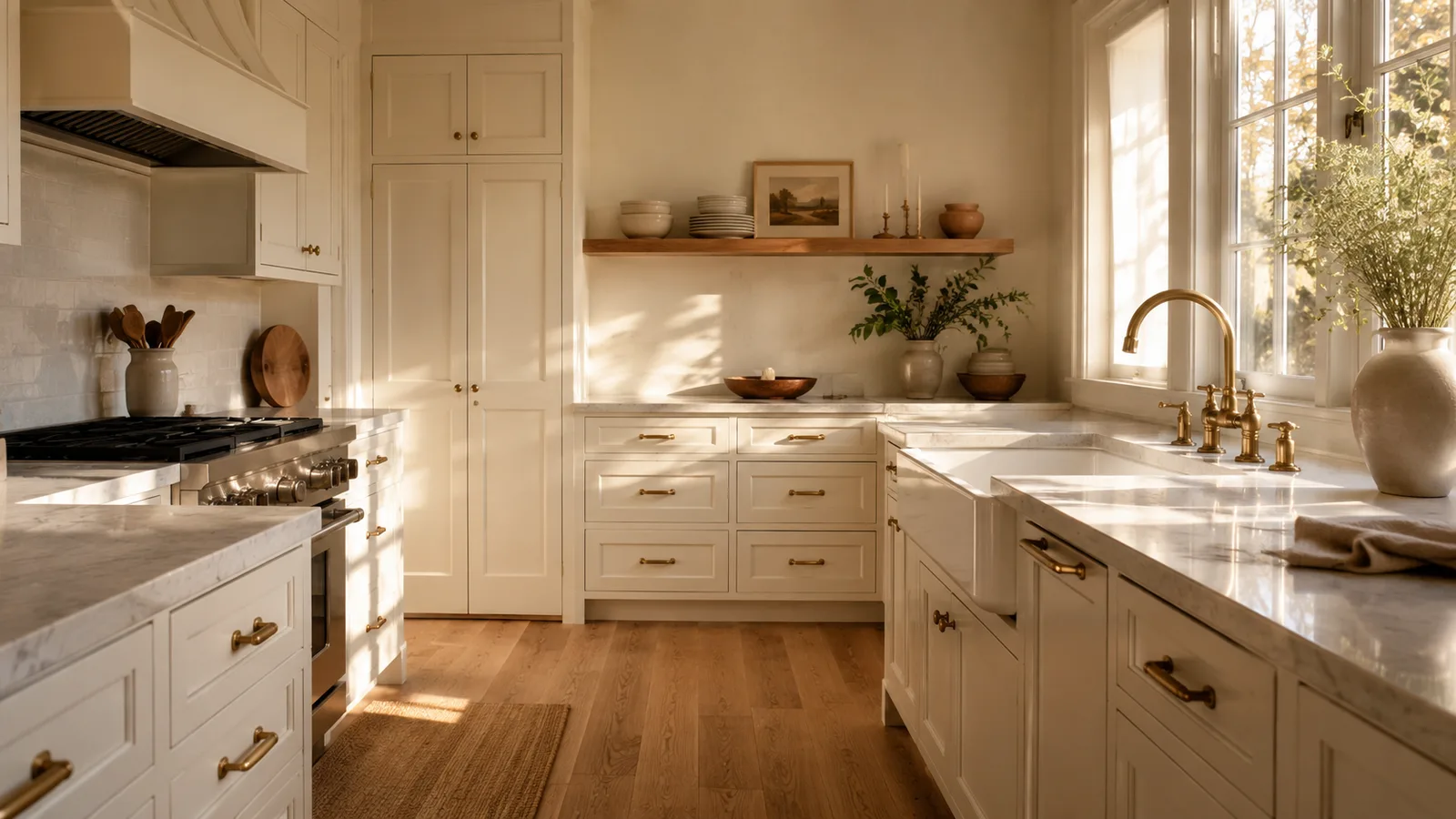
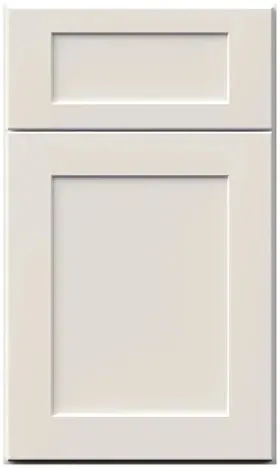
Put a Dove door on a wall by itself and nobody in the room will call it anything but white. Hold a sheet of bright printer paper against it and the warmth shows: a soft, faintly creamy cast. Fabuwood files it in the white family and describes it as the signature off-white of the line; a swatch scans to roughly #DDD7D1, a warm soft white rather than a beige. Frost, the brightest Galaxy paint, is a half-step cleaner. Linen, the beige, is a full step warmer and reads as a colour. Dove sits between them and is the one you can still call a white kitchen without a qualifier.
The door underneath is the Galaxy shaker: a five-piece recessed panel with a solid wood frame, a ⅜″ MDF centre panel that keeps the paint from cracking at the joints, and a smooth, low-sheen face. On an off-white that sheen does a specific job. A flat, chalky off-white can look like an old white that has yellowed; the polished Galaxy surface keeps Dove looking deliberate, because light skims off it the way it does off a fresh white.
The hierarchy behind the name: Fabuwood builds it, Allure is the mid-priced line, Galaxy is the door profile, Dove is the paint. The same paint on the slim-rail Luna or Echo door makes a different kitchen, which the Allure series guide sets out door by door.
Five places the off-white gets judged, and what to decide at each

A bright white is forgiving because there is nothing in it to shift. An off-white has a little warmth to lose, and it loses it in predictable spots. None of them is a reason not to buy Dove; each is a decision to make before the order rather than after.
| The spot | What happens to the colour | The decision |
|---|---|---|
| A north-facing or dim room | The warmth thins out and the door can drift faintly grey, especially late in the day | Warm bulbs, 2700–3000K, in the ceiling and under the uppers; in a genuinely dark room, sample Frost beside it |
| Cool LEDs at 4000K and above | The same drift, in any room — cool light pulls Dove toward grey the way it pulls Linen toward mud | Write the colour temperature on the electrical order, not on the day the electrician turns up |
| A white refrigerator or dishwasher in the run | A gap between the appliance white and the cabinet white — subtler than beside Linen, but not invisible | Stainless sits neutrally against Dove; for a white appliance, a panel-ready model with a matching door panel closes the gap |
| Bright white trim, ceiling or subway tile | Dove still reads as white, a shade softer; the trim looks a touch sharper than the doors | Fine as it is. If you want them to match, a warm off-white trim paint removes the contrast |
| The listing photo and the appraisal | Photographs as a white kitchen with a cosier cast — a camera sees the family, not the undertone | Nothing. This is the argument for Dove over Linen if resale is anywhere in the plan |
The grey drift is the one people worry about most and the easiest to head off, because it is a lighting decision rather than a paint one. Buy the door sample first, tape it where the uppers will hang, and look at it under the bulbs you will actually own, in the morning and after dark. Our sample routine walks through it step by step.
Frost, Dove or Linen: choose by what you are trying to avoid
The three light Galaxy paints share a door, a box, a price and a lead time, so the decision is colour alone — and people find it easier to answer as a list of things they do not want than a list of things they do.
| If the thing you are avoiding is… | Choose | Because |
|---|---|---|
| A clinical, showroom-bright kitchen | Dove | It keeps the white reading but rounds off the glare; warm floors and brass look at home beside it |
| A kitchen that reads as beige or cream in photos | Dove or Frost | Both stay in the white family on camera; Linen photographs as a colour |
| A dim room going flat or grey | Frost | With the least warmth to lose, it is the safest of the three in a north-facing kitchen; Dove needs warm light there |
| Grey quartz or matte black pulls looking wrong | Dove or Frost | Dove takes soft grey veining and black hardware cleanly; Linen fights both |
| A white kitchen, full stop | Linen | The one of the three that is not a white — a true light beige with a faint greige cast, chosen for its warmth |
Two rules follow. Never put Dove and Linen in the same room — they are close enough to look like a mismatch instead of a two-tone choice — and never decide between Dove and Frost from a screen; the gap between them is invisible until both samples are on the same wall, and obvious once they are. The Linen vs Dove comparison goes deeper on the two warm finishes, and the guide to picking a white covers undertone by window direction.
Counters, hardware and floors: the warm white that takes grey and black
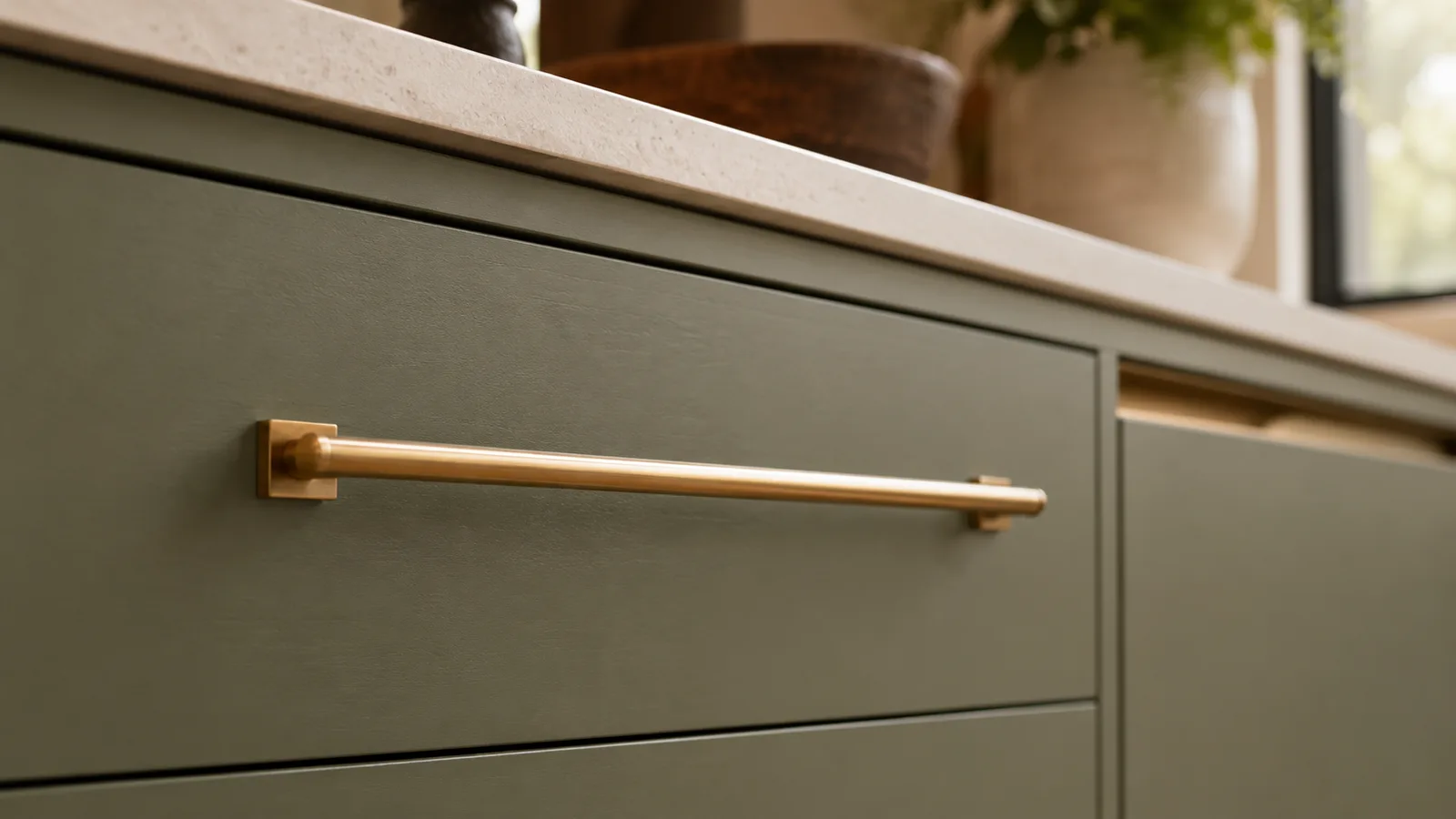
The practical advantage of an off-white over a beige is range. Linen has to be surrounded by warm surfaces or it goes muddy; Dove has enough white in it to take a cool counter and a black pull, and enough warmth to make brass and butcher block look intended. Rather than a list of what goes, here is what each overall look needs on the counter, the pull and the floor.
| The look | Counter | Hardware | Floor |
|---|---|---|---|
| Soft and warm — the most common request | Warm-white quartz, or a marble-look with cream veining | Brushed or antique brass | Pale or mid oak, warm wood |
| Clean and bright — white without the glare | White quartz, low pattern | Satin nickel or polished chrome | Light tile or pale wood |
| Modern contrast | White quartz with soft grey veining, or a light grey slab | Matte black | Grey-washed or dark wood |
| Traditional | Butcher block, or granite with warm movement | Oil-rubbed bronze or unlacquered brass | Wide-plank wood, terracotta |
The one pairing to sample before committing is the grey counter. Dove tolerates soft grey veining and a light grey slab; a cold, blue-grey quartz will start to pull the door toward the grey drift described above, particularly under cool light. The matching guide has the white-card test for a counter sample, and it takes thirty seconds.
Two-tone: Dove on the perimeter, Timber or Indigo on the island

An off-white is the easiest team player in the line for a two-tone kitchen, and this is where the Dove-versus-Frost choice becomes practical rather than aesthetic. A bright white perimeter over a dark island reads as a hard split — crisp, and sometimes cold. Dove softens the seam. Against Galaxy Timber, the weathered wood-brown, the two warm tones read as one family; against Galaxy Indigo, the deep blue, the off-white keeps the room from tipping into a nautical scheme.
Three details make the pairing work. One counter bridges both colours — a white quartz with a little soft grey or cream veining sits equally well on Dove and on the island colour, where a pure white slab can make the perimeter look dingy by comparison. Hardware runs the same finish on both: brass across a Dove-and-Timber kitchen, black or brass across Dove-and-Indigo. And the island shows its back and both ends, so its finished panels are ordered in the island colour from that collection, not in Dove.
Two combinations we steer people away from: Dove uppers over a Linen base, a near-match that looks like an error, and Dove under bright white uppers, which makes the lower half look unwashed. The kitchen ideas gallery shows several of these rooms built out, and the brown cabinet guide covers the wood-tone side of the pairing.
Under the paint: the box, the drawers and the hardware
Everything structural is shared across the fourteen Galaxy colours, so going off-white changes nothing below the surface. In brief: a ½″ select solid wood box with a natural wood veneer interior; ⅝″ solid wood drawer boxes dovetailed at the corners behind five-piece drawer fronts; Blum Tandem full-extension glides with Blumotion, and Blum Quick-Release hinges with Blumotion soft-close, both standard rather than optional; full-overlay doors; factory assembly with dowel-and-glue and pocket-screw joinery; a limited lifetime warranty; and a 7-day to 3-week lead time, quicker than the 3 to 5 weeks of the other Allure series.
One point that is specific to an off-white: that wood-veneer interior. Behind a glass door or inside an open shelf, the warm veneer sits comfortably inside a Dove frame — closer in temperature than it is to Frost, less of a contrast than it is against Linen. The Fabuwood review weighs the whole spec against the price, and the dovetail drawer explainer says why the drawer box is the line to compare across brands.
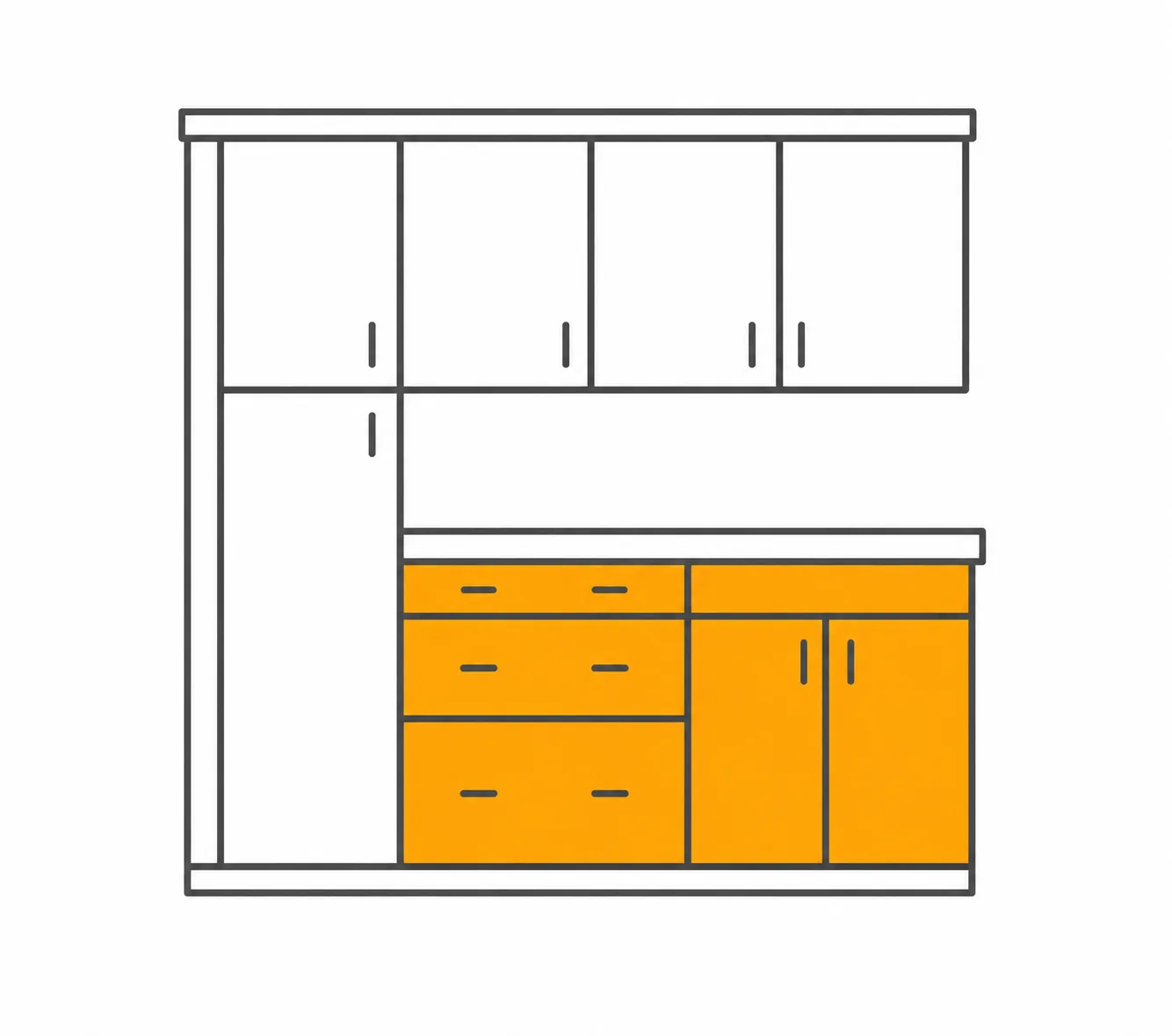
Base cabinets
The perimeter and the island are planned as two separate jobs — drawer banks on the working side of an island, 12″-deep boxes behind the seating, and the off-white meeting the dishwasher. The base cabinet guide does that with live prices.
Wall cabinets
The uppers are the light half of a two-tone kitchen and the part lit from the ceiling, which is where the warm-bulb rule matters most. Heights, the range wall, open ends and glass are in the wall cabinet guide.
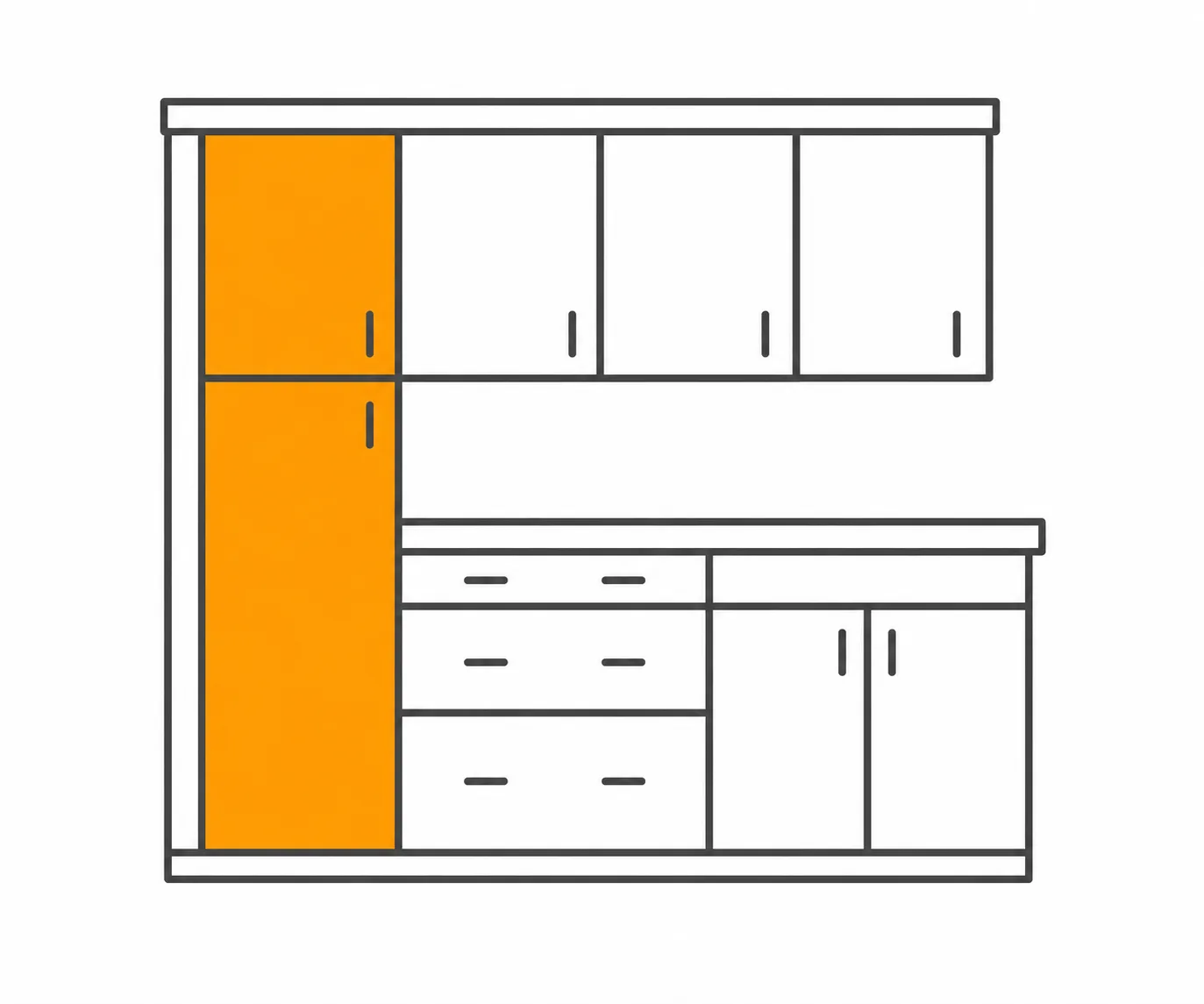
Tall cabinets
Pantries and oven towers stand on the appliance wall beside the refrigerator, so this is where an off-white meets the most stainless. The tall cabinet guide builds that wall piece by piece.
Vanities, trim and the rest
The off-white runs into the bath through the vanities; the glass doors, decorative accessories, hoods, cabinet accessories and loose parts are all finished to match.
The 10x10 package, walked around the room

The collection page sells a complete 10x10 kitchen in this finish as one line, FGDV10, showing $3,500.00 with Fabuwood’s $5,384.62 list price struck through beside it. Most 10x10 numbers you will find online are a total with nothing behind them; this one is a fixed box list, so the useful way to read it is to stand in the room and look at each wall in turn.
| Where you are standing | Below the counter | Above it | Finishing the run |
|---|---|---|---|
| The sink wall | A sink base, with the dishwasher beside it | Wall cabinets from the seven in the package | The dishwasher end panel — the one Dove side that closes the run against the appliance |
| The corner | A blind corner base | A 30-inch diagonal corner wall cabinet | Fillers where the two runs meet are ordered separately |
| The range wall | A double-door base with two drawers, and a single-door base with one drawer | A 12-inch-high wall cabinet over the range, full-height uppers either side | Six finished ends cover every exposed cabinet side in the layout |
| Along the floor | Two toe kicks, enough for both runs | — | Crown and light rail are not in the package |
Eleven cabinets, one appliance panel, two toe kicks and six finished ends. Absent, as from every 10x10 ever quoted: countertops, sink, appliances, pulls, delivery, installation, and any upgrade — a lazy Susan in that corner, drawer banks in place of the door bases, roll-outs. A real kitchen this size in this finish usually lands between $4,000 and $7,000 once those choices are made. The 10x10 pricing guide explains the convention, the Fabuwood cost breakdown places Galaxy against the other series, and Captivating Pro is the trade route for contractors and builders.
Reading the codes: a quote decoded line by line
Every product in this finish carries a code that says exactly what will arrive, and the fastest way to learn the system is to decode a real quote rather than memorise a key. Below are the lines a Dove kitchen most often contains, read out in plain English.
| Line on the quote | Read it as | What arrives |
|---|---|---|
| GD SB36 | Galaxy Dove · sink base · 36″ wide | A 34½″ × 24″ box with a false drawer front over an open bay for the bowl and the trap |
| GD B18 | Dove · base · 18″ wide | One door with a working drawer above it; a plain B code is a door base, never a drawer bank |
| GD DB30 | Dove · drawer base · 30″ | Three dovetailed drawers on full-extension glides — DB means drawers here, not double door |
| GD BLB36/39 | Dove · blind corner base · 36″ box, 39″ opening | The box is 36″ wide but needs 39″ of wall so its door clears the adjacent run |
| GD W3030 | Dove · wall · 30″ wide × 30″ high | A two-door upper, 12″ deep — on wall codes the first pair is width and the second is height |
| GD TP241296 | Dove · tall pantry · 24″ wide, 12″ deep, 96″ high | A two-door pantry; the one family whose code carries all three dimensions |
| GD OC3384D | Dove · oven cabinet · 33″ × 84″ · double | A tower cut for two stacked wall ovens; S is single, C is oven-plus-microwave |
| GD DWR6 | Dove · dishwasher end panel | The painted side that finishes the run beside the dishwasher — trim and panels keep the GD prefix |
The suffixes change the cabinet without changing its size, and they are where quotes get misread: FD deletes the top drawer for one full-height door; -12D makes the box 12″ deep instead of 24″; SDF puts one drawer front across a wide sink or door base instead of two; -2 and -4 set the drawer count on a drawer bank, with three as the default. The 273 loose parts — replacement doors, drawer fronts, shelves and hardware — carry a longer GDV prefix of their own. The SKU decoder extends the system to every brand we sell.
Samples, lead time and the day the truck comes
A Dove door sample is $25.00, and for this finish it is not optional: the colour question above is settled by one door on your wall at breakfast and again under your evening bulbs. Torn against Frost, buy both — they are indistinguishable until they are side by side and instantly different once they are.
Lead time is 7 days to 3 weeks, the shortest in the Allure line, and every cabinet arrives factory-assembled with doors hung, drawers fitted and hinges adjusted. Cartons for pre-built cabinets are big; clear a garage bay. Then send us the room: a free 3D design comes back with the run drawn, the codes above filled in and an itemised quote — and for a two-tone kitchen, with both colours in the rendering so you see the seam before it is built. Trade buyers go through Captivating Pro.
Common questions
- Is Fabuwood Dove white or off-white?
- Off-white, in the white family. On its own it reads as white with the glare taken off; next to a stark white you see the soft warm cast. Fabuwood calls it the signature off-white of the Galaxy line, and it photographs as a white kitchen.
- Does Galaxy Dove look grey?
- It can drift faintly grey in a north-facing room or under cool 4000K-plus LEDs, because those strip out the little warmth it has. In daylight or under warm 2700–3000K bulbs it reads as a clean warm white. Fix the lighting and the drift goes; in a genuinely dark room, sample Frost beside it.
- Fabuwood Dove vs Frost: what is the difference?
- Frost is the bright, neutral white; Dove is the same door with a gentle warm undertone, a half-step softer. Same price, box, hardware and lead time. Choose Frost for a dim room or a crisp look, Dove where a bright white would feel clinical beside warm floors, brass or cream walls.
- What colours go with Dove cabinets in a two-tone kitchen?
- Timber (weathered wood-brown) and Indigo (deep blue) are the islands we pair with it most, with one white quartz bridging both colours and one hardware finish throughout. Avoid Linen beside it — too close to read as intentional — and avoid a bright white above it.
- Can I use grey countertops with Dove cabinets?
- Yes, within reason. Soft grey veining and light grey slabs work; a cold blue-grey quartz can pull the door toward grey, especially under cool light. Hold a white card against the counter sample and the door together before deciding.
- How much do Fabuwood Dove cabinets cost for a 10x10 kitchen?
- The FGDV10 package shows at $3,500.00 against a $5,384.62 list price, and real 10x10-sized kitchens land between $4,000 and $7,000 depending on drawers, the corner solution and accessories. The price is identical to Frost and Linen; individual cabinets are priced live on each type page.
Keep reading
The guides behind the numbers on this page.
- White Kitchen Cabinets: Finding Your Perfect Shade
Where an off-white sits on the warm-to-cool scale, and which rooms push it either way.
- Fabuwood Cabinet Colors: The 2026 Guide to Every Finish
Dove beside Frost, Linen and the eleven Galaxy colours it gets paired with.
- How to Match Cabinets, Countertops, Backsplash and Flooring
Testing a grey-veined counter sample against an off-white door before you commit to it.
- 27 Kitchen Cabinet Ideas
Two-tone rooms with a light perimeter and a coloured island, built out and photographed.
- Kitchen Cabinet Samples: How to Order and Evaluate
The morning-and-evening routine that catches a drift toward grey before the order goes in.
- Fabuwood Cabinets Review (2026)
What the Galaxy box, hardware and warranty are worth, from the dealer side of the counter.
- What Is a 10x10 Kitchen? Cabinet Costs and Packages
How to hold the FGDV10 package up against any other dealer’s 10x10 number.
- Cabinets for House Flippers
Why an off-white kitchen photographs and appraises as a white one.


