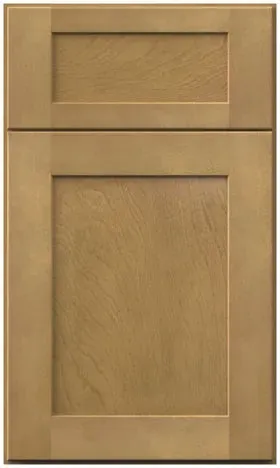


Forty-two inches: a long pair of doors, and where they swing
Reviewed September 2026 · Captivating Cabinets
Three SKUs are made this wide and every one of them is a door proposition. The sink base is $572.00 — the widest made. The standard base is $757.25. The blind corner is $767.00. There are no drawers, no shallow box, no apron sink and no rotating corner up here, so the only decision left is whether a box this wide is a good idea in the room you have, and that is decided by geometry rather than by the price list.
A 42-inch box means 21-inch doors
Divide the width by the two doors it takes and each one lands around twenty-one inches. Full-overlay doors swing on concealed hinges and open past ninety degrees, so a 21-inch door open is 21 inches of aisle you cannot stand in. That is the number to hold against your floor plan.
| Aisle between runs | With the door open | Our verdict |
|---|---|---|
| 36 inches — the tightest walkway anyone recommends | About 15 inches left to stand in | No. Split the run into narrower boxes |
| 42 inches — the usual one-cook aisle | About 21 inches left | Workable, provided nothing opens opposite |
| 48 inches — planned for two cooks | About 27 inches left | Fine |
| Against a wall, or under a window with nothing opposite | Nothing to block | Fine — this is where wide boxes belong |
The case that actually bites is two wide boxes facing each other across a galley. Both doors open into the same aisle, at the same moment, while somebody is carrying a tray. Aisle guidance of 42 inches for one cook and 48 for two is planning convention rather than code, but it is convention for a reason, and wide doors are what test it.
One wide box, or two smaller ones?
Forty-two inches of run can be closed several ways, and the money is close enough that it should not decide anything.
- One 42-inch base: $757.25. One uninterrupted cavity, two long doors, the cheapest of the three.
- An 18 plus a 24: $880.75. Shorter doors, a second stile in the middle, and two separate interiors to organise.
- A 21-inch four-drawer bank plus a 21-inch base: $1,264.25. The most expensive by a distance, and the only one of the three that gives you drawers.
We split it by default. The exception is when something long has to go in — a folding table, a leaf, trays, an ironing board — because a middle stile is exactly what stops that working, and it cannot be added later.
SB42 is the widest sink base made
At $572.00 it is also, by a wide margin, the cheapest thing at this width — a sink base has no shelf and no drawer, so you are buying a box and two doors. Three cases justify it. A large double bowl plus a disposal plus a filtered tap, all of which want room below. A sink that has to sit visibly off-centre to line up with a window. And a run where the sink cabinet is flanked by tall units and needs the visual weight to hold its own between them.
Above this width there is no sink base at all, so if a plan needs more than 42 inches under a sink, it needs a different plan — a 36 with fillers either side, or a sink cabinet flanked by a narrow base.
The blind corner at 42
BLB42/45 at $767.00 is the second largest blind corner, closing either a 42 or a 45-inch leg depending on how far it is pulled off the corner. It is $9.75 more than the standard base at the same width, which is a reminder that the money in these boxes is in the openings and the doors rather than the wall length they cover.
Blind corners at this size hold a great deal and give access to about half of it without hardware. If the corner is going to store anything you want weekly, budget for a blind-corner pull-out and confirm its required opening against the cabinet before ordering.
The mistake at this width
Choosing 42 inches on a plan view. On paper a wide box looks tidy — fewer lines, fewer seams, one clean sweep of doors. In the room it is two large doors opening into the space people are standing in, and a cavity deep enough that everything migrates to the back of it. Draw the doors open on the plan before you commit. If they cross the aisle, split the run.
Common questions
- How wide can a cabinet door be before it becomes a problem?
- Around 21 inches, which is what a 42-inch two-door box gives you. Beyond that the door takes so much aisle when open that it interferes with anyone standing at the run, especially in a galley where a door opposite does the same.
- Is a 42-inch base cabinet a good idea?
- Against a wall or under a window with nothing opposite, yes — and it is cheaper than splitting the same run. In a galley or opposite an island, split it into an 18 and a 24 instead.
- What is the widest sink base cabinet available?
- Forty-two inches, at $572.00. Nothing wider is made as a sink base, so a longer sink run has to be built from a narrower sink cabinet with fillers or neighbouring boxes.
- Do 42-inch base cabinets come with drawers?
- No. Drawer banks stop at 36 inches. At 42 the choice is a standard base, a sink base or a blind corner, all of them door boxes.
- How much aisle do I need in front of a 42-inch cabinet?
- Plan on 42 inches for one cook and 48 for two, as a working convention. With a 21-inch door open, that leaves roughly 21 and 27 inches respectively to stand in.
Keep reading
The guides behind the numbers on this page.
- Kitchen island clearance guide
The aisle numbers behind the swing table above, with the reasoning behind them.
- Kitchen dimensions to settle before buying cabinets
Measure the aisle before you choose the box, not after.
- Cabinet door overlay styles
Overlay decides how far a door projects past the box, which changes the swing.
- Blum soft-close hinges
What is carrying a 21-inch door, and how it is adjusted when it starts to sag.
- Kitchen layouts guide
Galley and L layouts, and which of them can afford a wide box.
- Types of base cabinets
A reminder of what the narrower alternatives would give you if you split the run.