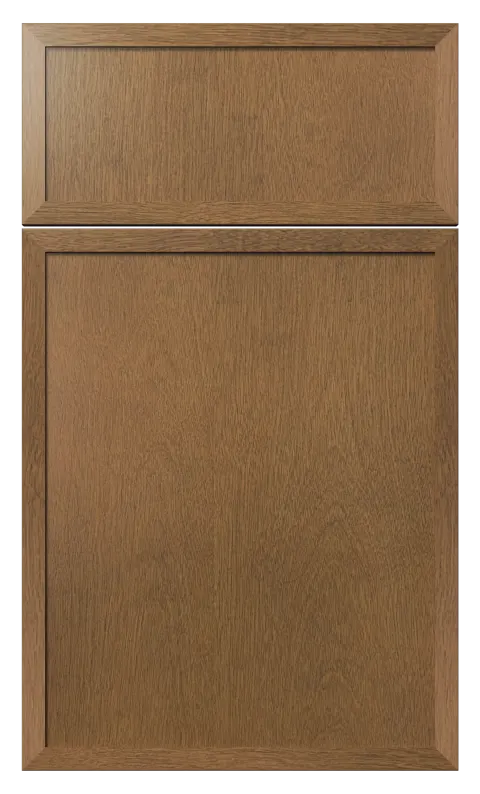


The 24-inch wall cabinet and the four ways it turns a corner
Reviewed September 2026 · Captivating Cabinets
Twenty-four inches is one of the two busiest widths on the wall, and almost all of that density is about corners. Of the thirty-three units built here, twenty are corner solutions of one kind or another — diagonal, pie cut, blind and open — because 24 inches is what a wall corner typically eats on each side. Get the corner right and the rest of the run is arithmetic.
Four corners, and what each one costs you
Every kitchen with two walls of uppers has this decision, and it is usually made by whoever is drawing the plan without explaining it to the person paying. Here is the whole set.
| Solution | Codes | Heights | Displayed price | What you get | What it costs you |
|---|---|---|---|---|---|
| Diagonal corner | WDC2415 – WDC2442 | 15, 18, 30, 36, 39, 42″ | $341.25 – $581.75 | A face set at 45 degrees with one door, and full reach into the corner | A visible angled face, and 24″ of each wall |
| Pie cut corner | WPC2415 – WPC2442 | 15, 18, 30, 36, 39, 42″ | $383.50 – $728.00 | Two doors meeting at the corner and opening as a pair, with a square elevation | The dearest corner at every height — up to $146.25 over the diagonal |
| Blind wall | WBC2430 – WBC2442 | 30, 36, 39, 42″ | $354.25 – $497.25 | A plain square face; the return cabinet covers the hidden half | Dead space you reach past, plus a filler so the door clears the return |
| No-door diagonal corner | NDWDC2430 – NDWDC2442 | 30, 36, 39, 42″ | $757.25 – $939.25 | The angled corner left open, finished inside, as a display feature | Roughly double the doored diagonal at the same height |
The default we draw is the diagonal. It reaches the corner properly, it costs least of the three closed options at every height, and the angled face gives the run a natural turn. The pie cut wins where you want the elevation to stay square and the two walls to read as continuous — it is a look, and you are paying for it. Compare them on the corner wall cabinet page.
When a blind corner is the right answer anyway
Blind units get a bad name because the far half is hard to reach. Take them seriously in two situations. When a window or a soffit sits too close to the corner for a 45-degree face to look right, and when the corner is above a run you rarely use, where hidden storage is exactly what you want for the roasting tin you touch twice a year.
Note that the blind family starts at 30 inches tall — there is no short blind box — and browse them on the blind wall cabinet page. The doorless corner units, by contrast, are the most expensive things at this width by a distance: $757.25 to $939.25 on the no-door corner listing, which is display-cabinet money for a display cabinet.
The ordinary 24, in nine heights
Away from the corner, this is the narrowest width where the front splits into two doors — two 12-inch leaves, each swinging half as far into the room as a single 24 would have. It also carries the fullest height ladder in the wall range: nine of them, 12, 15, 18, 21, 24, 30, 36, 39 and 42 inches, $227.50 to $468.00.
Those five short heights are the useful surprise. A 24 × 12 box at $227.50 closes the gap over a refrigerator or a window head; 24 × 18 at $250.25 sits above a hood; 24 × 21 and 24 × 24 fill the space under a soffit in a room where the uppers cannot run full height. All of them are 12 inches deep, which matters over an appliance — a box that shallow over a refrigerator leaves a visible step, and the flush answer at 24 inches wide does not exist. That job belongs to the 30, 33 and 36 inch refrigerator wall cabinets, which are built 24 inches deep.
Open boxes at this width
Four doorless units round out the thirty-three: NDW2430 through NDW2442, $455.00 to $503.75, finished inside and open at the front. At 24 inches wide an open bay is big enough to hold something worth looking at without turning into a shelf unit, which makes this the width we most often use when a plan wants exactly one open cabinet.
Put it at the end of the run or where the kitchen meets the dining space, and keep it away from the range. Two of them flanking a window works; five in a row is a decision you will re-make in a year.
Common questions
- What size corner wall cabinet do I need?
- A 24-inch corner unit consumes 24 inches along each wall from the inside corner, which is the standard for a kitchen with 12-inch-deep uppers. Twenty-seven and 36-inch corner options exist when the layout wants more reach or has more wall to give.
- Diagonal or pie cut corner cabinet — which is better?
- The diagonal gives you a 45-degree face, one door, easier reach into the corner, and it is cheaper at every height. The pie cut keeps the elevation square with two doors meeting at the corner, and costs up to $146.25 more. Function favours the diagonal; a strictly rectilinear elevation favours the pie cut.
- How much room does a blind corner cabinet need?
- Its own 24 inches plus roughly three inches of filler between it and the corner, so the door and pull can clear the cabinet on the returning wall. Plan for that filler in the wall measurement rather than absorbing it later.
- Can a 24 inch wall cabinet go above a refrigerator?
- Yes — the 12, 15 and 18-inch-tall boxes are made for gaps like that. They are 12 inches deep, though, so they sit back from the front of the appliance. For a flush look you need one of the 24-inch-deep refrigerator units, which start at 30 inches wide.
- How much is a 24 inch wall cabinet?
- The standard double-door boxes display between $227.50 and $468.00 depending on height. Corner versions run from $341.25, and the open corner units top the width at $939.25.
Keep reading
The guides behind the numbers on this page.
- Kitchen layouts guide
L and U shapes are corner problems first — worth reading before you pick between diagonal and blind.
- Space-saving cabinet solutions
Hardware that makes the far half of a blind corner reachable instead of theoretical.
- Wall and tall cabinet sizes and buying guide
The nine-height ladder set against ceiling heights and soffit lines.
- Kitchen dimensions guide
Reach, clearance and the numbers that decide whether a corner is usable at all.
- Cabinet SKU codes decoded
WDC, WPC, WBC and NDWDC pulled apart letter by letter.
- Kitchen cabinet terminology glossary
Blind, return, reveal and filler, defined before you argue with an installer about them.