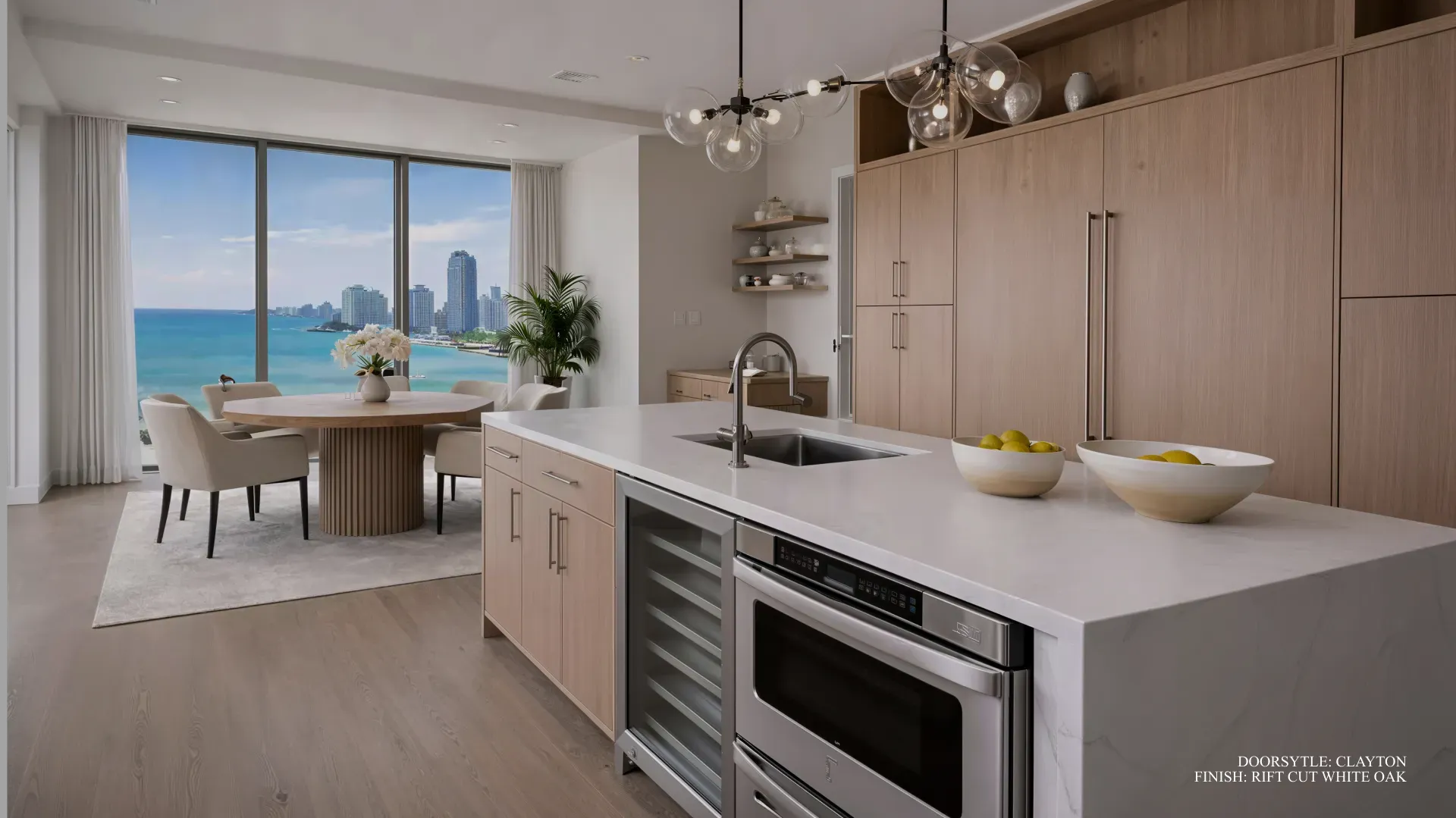

Modernform vs St. Martin
Two frameless kitchens at opposite ends of the process — one pulled from a warehouse in four slab finishes, one made for your walls in any of 49 hand-brushed colors.
Modernform vs St. Martin is really a question for the buyer who has already decided on frameless. Modernform’s European series is a full-overlay slab door in four finishes — Glossy White, Matte White, Natural Oak and Walnut — on plywood boxes, held in inventory and shipped flat-pack or factory-assembled. St. Martin’s Vista series drops the face frame too, but it’s made to order in Pennsylvania from North American hardwoods, with twelve door styles, a 49-color hand-applied finish program and Blum® hardware throughout. Below: what separates the two boxes, where each brand’s other lines fit, and how the calendar and the quote differ.
Modernform vs St. Martin at a Glance
Compared on 11 points, updated September 2026.
Swipe to compare →
| Modernform | St. Martin | |
|---|---|---|
| Frameless line | European — full access, full-overlay slab | Vista — full access, built to order |
| Door styles (frameless) | 1 — flat slab | 12 — shaker, slab & transitional profiles |
| Frameless finishes | 4 — Glossy White, Matte White, Natural Oak & Walnut veneer | 49 hand-applied paints & stains, plus custom color on request |
| Box | Plywood, no particle board (thickness not published) | ⅝″ plywood sides, maple melamine interior |
| Drawer box | Joinery not published — soft-close undermount glides | ¾″ solid birch, dovetailed, ⅜″ plywood bottom |
| Hardware | Own-brand soft-close, six-way adjustable hinges | Blum® soft-close hinges & undermount full-extension slides |
| How it ships | RTA flat-pack or factory-assembled (added charge) | Assembled, made to your order |
| Lead time | 1–3 business days to process stocked orders, then 7–14 business days freight | Several weeks from final design approval |
| Other lines | Shaker (12 colors) & Slim Shaker (2) — both framed, full overlay | Heritage framed inset (49 finishes) · NOMA stock program (12 doors) |
| Certifications / warranty | KCMA · HBA · CARB2 — warranty term not published | Warranty not published — confirm at quote time |
| Pricing | Quote-based; mid tier, typical $250–$400 per linear foot retail | Quote-based per project; no list price |
Choose Modernform if…
- The kitchen you have in mind is flat slab in white, oak or walnut — and one of those four covers it
- The schedule is tight: stocked cabinets start moving within days, not weeks after a design sign-off
- You have a crew that can assemble flat-pack framed runs, or you want the option to pay for assembly on the frameless ones
Choose St. Martin if…
- You want frameless storage without a slab door — a shaker or transitional profile on a full-access box
- The color is specific: a paint on open-grain oak, a stained rift white oak, walnut or cherry, or a custom match
- Named Blum® hardware and a published ¾″ dovetailed birch drawer box matter enough to wait for a built-to-order kitchen
Two Ways to Buy a Full-Access Kitchen
Anyone comparing these brands has usually settled the architecture question already: no face frame, doors hung straight off the box sides, drawers as wide as the cabinet itself. What is left is everything around that choice — how many door designs you can pick from, how many colors, who puts the box together, and whether the cabinets exist yet on the day you order them.
Modernform answers with inventory. Its European series is one door, a full-overlay slab, sold in the four finishes contemporary kitchens are most often drawn in, and held in stock by a maker that says it turns out more than 10,000 kitchens a month. St. Martin answers with a factory schedule. Vista is cut, finished and assembled after your design is approved, which is slower and priced per project, but it opens the frameless box to door profiles and colors a stocked slab program will never carry.
Modernform European Against St. Martin Vista, Box by Box
Modernform publishes the materials but not the measurements. The European box is plywood with no particle board anywhere, the doors are full overlay, and every unit comes with soft-close undermount full-extension glides and six-way adjustable soft-close hinges — standard, not an option. The hardware is the brand’s own rather than Blum®, and neither the panel thickness nor the way the drawer boxes are joined appears on its spec sheet. That doesn’t mean either is weak; it means you should ask for both figures on the quote, which we will request from the factory for you.
St. Martin prints the numbers. Vista uses ⅝″ plywood sides with a maple melamine interior, ¾″ plywood shelves edged in solid maple, ⅞″ solid wood doors, and ¾″ solid birch drawer boxes dovetailed at the corners on ⅜″ plywood bottoms. Every hinge and every slide is Blum® soft-close. On a spec-for-spec reading, that is the heavier kitchen — and it has to be, because nothing about a built-to-order line is priced to compete with a stocked one.
One point in Modernform’s favor that the spec rows hide: KCMA, HBA and CARB2 certification. KCMA is the industry’s structural and finish-durability test, and CARB2 caps formaldehyde emissions from composite panels, so a certified box has passed an outside check rather than resting on the brand’s own description.
One Slab in Four Finishes, or Twelve Doors in Forty-Nine
The European lineup is short and deliberate. Glossy White throws light around a small or north-facing room and shows fingerprints like any gloss; Matte White is the quieter, easier-to-live-with version of the same door. Natural Oak and Walnut are real wood veneers over an engineered slab — the normal way a frameless flat door is made, but not a solid plank. Mixing a white upper run with oak or walnut bases is the combination we draw most, and it costs nothing extra because all four sit on the same box.
Vista is where frameless stops meaning “slab.” Its twelve profiles — Castine, Fontana, Hampton Square, Montauk, Newport, Bellrose, Lakeland, Lakeland II, Greenfield, Pipestone, Mystic and Savannah — include shaker and transitional doors alongside flat ones, and each can be ordered in any of the 49 finishes: sixteen paints on smooth hardwood, the same sixteen over open-grain oak, and seventeen stains on rift white oak, walnut and cherry. Every coat is brushed on with water-based finish and sanded between stages, and a custom color match is available when none of the 49 is right. A Sage Green shaker on a full-access box, or a Dark Brown Walnut slab, is an ordinary Vista order and not something the European series can supply.
Flat-Pack, Assembled, or Built for Your Walls
Modernform ships either way: ready-to-assemble, which is cheaper to freight and easier to stack in a garage, or factory-assembled for an added charge. On the European series we steer nearly everyone to the assembled option. A frameless kitchen has no face frame to hide a box that is a hair out of square, and the gaps between slab doors are only a few millimeters, so a cam-lock box built on site shows its mistakes across the whole wall. The Shaker and Slim Shaker lines are framed and far more forgiving if your crew wants to assemble those.
St. Martin takes the question off the table. Vista boxes are made to the dimensions on your approved design and arrive built, which is a real advantage on a frameless job and a real cost in time. Stocked Modernform orders typically process in one to three business days and then spend seven to fourteen business days in freight; a Vista order runs several weeks from the day the drawings are signed. Treat both as the usual pattern rather than a promise, and ask for current timing when you quote.
What Else Each Brand Brings to the Project
Modernform’s other two collections are both framed and full overlay: Shaker, a five-piece recessed-panel door the brand lists in 12 colors, and Slim Shaker, the same idea with narrower rails in Dove White or Sage Green. They matter here mostly for mixed projects — a slab kitchen with a shaker laundry room or a more traditional bath vanity can stay with one brand, one order and one delivery.

St. Martin’s alternatives sit on either side of Vista. Heritage is framed inset, doors flush inside a solid wood face frame, in the same 49 finishes; we cover that decision in our Heritage vs Vista comparison. NOMA is the brand’s stock program and the closest thing it makes to a Modernform-style fast order: frameless full-access boxes with Blum® hardware and ¾″ plywood sides, but only twelve stock doors — the Plane slab in five finishes, the Line slim frame in five, and the Frame door in two. If one of those twelve suits the room, it is the shorter route to St. Martin construction. A Plane or Line door in any other finish becomes a built-to-order order again.
Pricing, Warranty and Seeing the Doors First
Neither maker publishes a 10×10 price. On our cost estimator Modernform sits in the pre-assembled mid tier at a typical $250–$400 per linear foot at retail for cabinets only, with RTA coming in below that and our Captivating Pro trade program taking 20–40% off retail. St. Martin is quoted from the design, and built-to-order construction with hand-applied finishes generally carries a premium over a stocked line for a comparable kitchen — how much depends on door style, finish and layout, so we won’t print a gap we haven’t priced. Neither brand publishes a warranty term either; we confirm current coverage in writing with each quote.

Order doors before cabinets. Vista samples are $35 each, and we stock nine of the twelve styles as samples, in any of the 49 finishes; NOMA stock doors are also $35. Modernform door samples ship nationwide too, and they matter most on the two veneers and the gloss, which never look the same on a screen. Then send one set of measurements to our free 3D design service and ask for the same frameless layout drawn in the European series and in Vista — a designer replies within one business day and both itemized quotes follow within 24–48 hours.
Ready to price your own layout in Modernform or St. Martin?
Get a free 3D rendering and an itemized quote so you can compare real numbers, not list prices.
See Modernform or St. Martin in Your Kitchen
Our designers render your actual layout in either line, free — so you’re comparing more than a spec sheet.
Get Free 3D DesignNo obligation · Ready in days
Modernform vs St. Martin FAQ
Common questions about how these two compare.
It depends on the door and the deadline. Modernform’s European series is a stocked full-overlay slab in Glossy White, Matte White, Natural Oak or Walnut, shipped RTA or assembled on a short lead time. St. Martin Vista is built to order with twelve door styles, 49 hand-applied finishes, published ¾″ dovetailed birch drawers and Blum® hardware, and takes several weeks from design approval. If one of the four slab finishes is your kitchen, Modernform is the faster, leaner route; if it isn’t, Vista is.
From St. Martin, yes — Vista includes shaker and transitional profiles on a full-access box, and NOMA’s Line slim-frame door is stocked in five finishes. Modernform’s shaker doors (Shaker and Slim Shaker) are framed only; its frameless European series is slab.
Assembled, in most cases. Frameless boxes have no face frame to hide a small squareness error, and the reveals between slab doors are only a few millimeters, so a factory-assembled box is worth the added charge. Modernform’s framed Shaker and Slim Shaker lines are more forgiving if you want to assemble them yourself.
No. Modernform ships its own soft-close hardware — six-way adjustable hinges and undermount full-extension glides, standard on every cabinet. St. Martin uses Blum® soft-close hinges and undermount full-extension slides on every Vista, Heritage and NOMA opening.
Yes, if one of its twelve stock doors fits. NOMA is St. Martin’s stock program on frameless full-access boxes — Plane slab in five finishes, Line slim frame in five, and Frame in two. Any other door-and-finish pairing is built to order with a Vista-style lead time. Confirm current NOMA timing with us at quote time.
Neither brand publishes a specific warranty term. Modernform does carry KCMA, HBA and CARB2 certification. We confirm each manufacturer’s current coverage in writing on the quote, so the term you are buying against is on paper before you order.