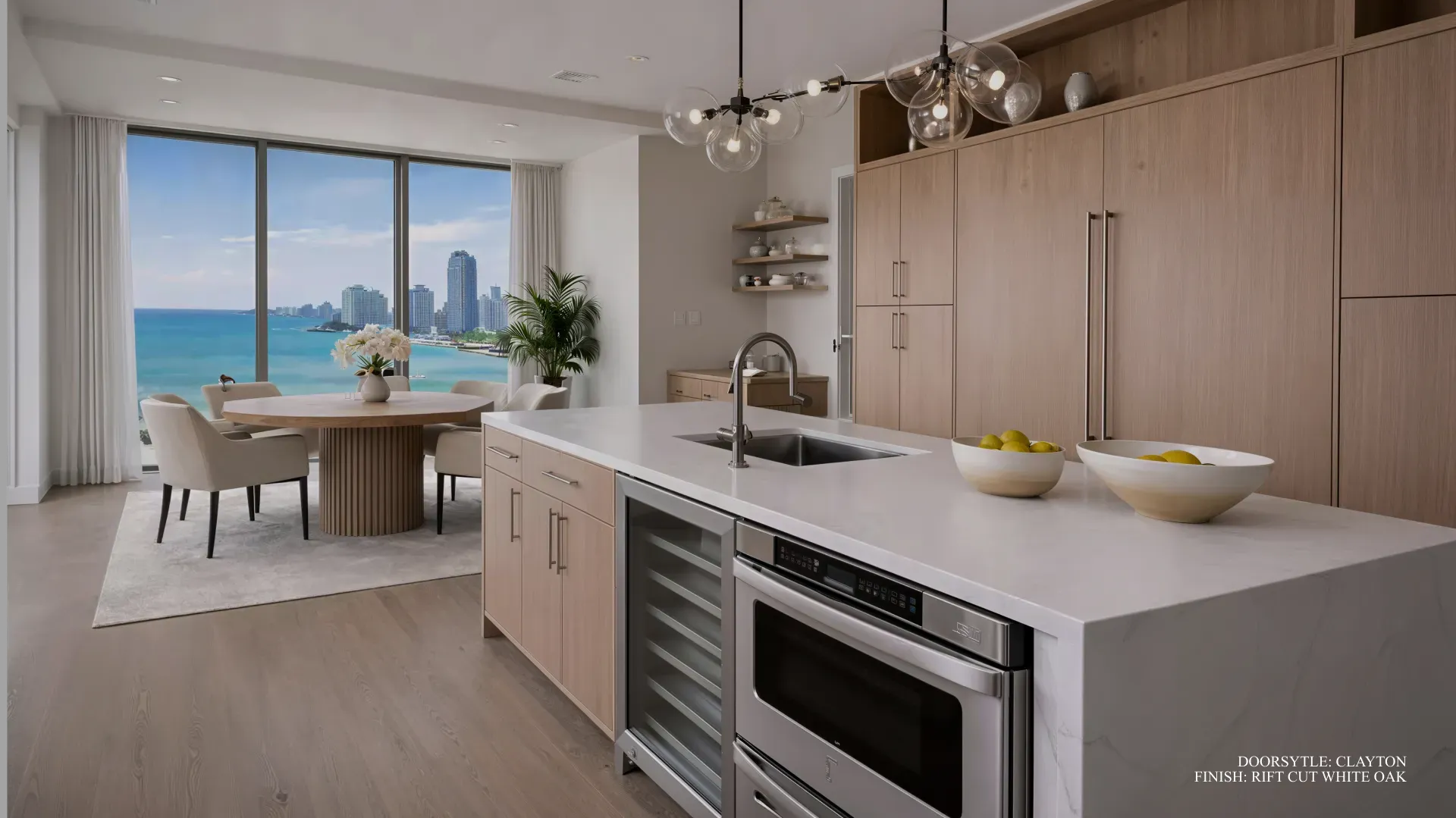

St. Martin Heritage vs Vista
Same finishes, same hardware — the real choice is framed inset or frameless full access.
Heritage vs Vista isn’t a quality question — both draw from St. Martin’s same 49-finish paint-and-stain program and the same Blum® soft-close hardware. It’s a construction question: Heritage is framed inset, doors set flush inside a solid wood face frame, while Vista is frameless full access, doors spanning the full cabinet opening for a flush European look and more interior storage.
Heritage vs Vista at a Glance
Compared on 9 points, updated August 2026.
Swipe to compare →
| Heritage | Vista | |
|---|---|---|
| Construction | Framed inset, built to order | Frameless full access, built to order |
| Door styles | 11 inset styles — shaker, beaded & slab profiles | 12 full-access styles — shaker, slab & transitional profiles |
| Finishes | 49 hand-applied paint & stain finishes | 49 hand-applied paint & stain finishes (same program) |
| Face frame | Solid wood, 7/8" thick × 1 1/2" wide | None — full access, doors span the full opening |
| Doors | 7/8" solid wood frame with HDF center panel | 7/8" solid wood |
| Drawer boxes | 3/4" solid birch, dovetailed, 3/8" plywood bottom | 3/4" solid birch, dovetailed, 3/8" plywood bottom |
| Cabinet sides | 5/8" plywood, maple melamine interior | 5/8" plywood, maple melamine interior |
| Hardware | Blum® soft-close hinges & undermount slides | Blum® soft-close hinges & undermount slides |
| Positioning | Framed inset, traditional | Frameless full access, modern |
Choose Heritage if…
- You want doors set flush inside a solid wood face frame — the traditional inset look a factory-built kitchen can’t replicate
- A classic or transitional kitchen is the goal, and the face frame itself is part of that design
- You’re fine trading a little raw interior storage for that furniture-grade fit and finish
Choose Vista if…
- You want the flush, handle-less look of European frameless cabinetry
- Maximizing drawer width and shelf depth matters more than a visible face frame
- Your kitchen is modern or transitional, not traditional
Heritage vs Vista at a Glance
Heritage vs Vista isn’t a question of which St. Martin line is built better — both share the same 49-color finish program and the same Blum® soft-close hardware, so the quality bar doesn’t move between them. What changes is how the box is put together: Heritage is framed inset, the most exacting and traditional construction in cabinetry, while Vista is frameless full access, the flush European-style approach that trades the face frame for more usable interior space.
If you already know you want a classic kitchen with doors set flush inside a wood frame, Heritage is the obvious lane. If you’re after a clean, contemporary look with maximum drawer and shelf capacity, Vista is built for that instead. Neither is the “upgrade” version of the other — they’re two different answers to the same brief.
Framed Inset vs Frameless Full Access
Heritage builds around a 7/8" solid wood face frame, 1 1/2" wide, with doors and drawer fronts set perfectly flush inside it — the inset fit that takes the most precision to manufacture and install. Behind that frame, doors use a 7/8" solid wood frame around an HDF center panel, across eleven inset styles spanning shaker, beaded, and slab profiles.
Vista removes the face frame entirely. Doors and drawers span the full cabinet opening instead of sitting inside a frame, using 7/8" solid wood doors across twelve styles — shaker, slab, and transitional profiles including Castine, Fontana, Hampton Square, and Newport, among others. That full-access opening is where the extra interior space comes from: no frame means no lip cutting into the usable width of every drawer and shelf.
Structurally, the two lines share the same box behind the door: 5/8" plywood sides with a maple melamine interior, and 3/4" plywood shelves with solid maple edging. The frame — or the absence of one — is really the only architectural difference between them.
Finishes and Hardware: What’s Identical
Finishes are a non-issue in this decision — both lines draw from the same 49-color St. Martin program, hand-applied with water-based brush finishing and multi-stage sanding across paint grade hardwood, paint grade oak, and stained rift white oak, walnut, and cherry. Whatever palette you land on, it’s available on both.
Hardware is identical too: Blum® soft-close hinges and Blum® undermount, full-extension drawer slides on every opening in both lines, along with matching 3/4" solid birch dovetailed drawer boxes with 3/8" plywood bottoms. If you’re weighing finish selection or hardware quality, that part of the decision is already made for you — it’s the same on both lines.
Storage and Everyday Use
This is where the two constructions actually diverge day to day. Because Vista has no face frame, its drawers and roll-outs open to the cabinet’s full width instead of losing an inch or more to a frame lip — noticeable in base cabinets and especially narrow runs. Heritage’s face frame costs a little of that raw interior space, but it’s also what gives inset doors their flush, furniture-like reveal, a look full-access construction can’t reproduce.
Neither line is more durable or better hardwared than the other — both meet in the same drawer box, the same plywood sides, the same Blum® slides. The real trade is storage efficiency versus a traditional face-frame look, not build quality.
Cost and Value
Neither Heritage nor Vista publishes list pricing — both are built to order, and the finish, door style, wood species, and layout you choose all move the number. That’s typical at this quality tier; get a quote for your actual kitchen rather than assuming one construction type costs more than the other.
What we can say from working with both lines: because inset doors and face frames require tighter tolerances to build and install correctly, framed construction generally commands a premium over frameless full-access lines industry-wide for a comparable finish and door count. But the only number that matters is the one on a quote for your layout — ask your dealer to price the same kitchen in both Heritage and Vista before you decide.
Which Should You Choose?
Choose Heritage if the inset look is the whole point — face-frame construction and doors flush inside a solid wood frame, with the traditional character that only comes from that build. It’s the pick for a classic or transitional kitchen where the frame itself is part of the design.
Choose Vista if you want the flush, contemporary look of European frameless cabinetry and the extra interior storage that comes with it — wider drawers, deeper shelves, and a handle-less face with the right door style. Both lines ship with the same finish program and the same Blum® hardware, so get quotes for your layout in both before deciding; the right pick comes down to the kitchen you’re picturing, not which line is “better.”
Ready to price your own layout in Heritage or Vista?
Get a free 3D rendering and an itemized quote so you can compare real numbers, not list prices.
See Heritage or Vista in Your Kitchen
Our designers render your actual layout in either line, free — so you’re comparing more than a spec sheet.
Get Free 3D DesignNo obligation · Ready in days
Heritage vs Vista FAQ
Common questions about how these two compare.
Construction. Heritage is framed inset — doors sit flush inside a solid wood face frame, the traditional look. Vista is frameless full access — no face frame, so doors and drawers span the full cabinet opening for a flush, modern look and more interior storage. Both use the same 49-finish program and Blum® hardware.
Neither line publishes list pricing — both are built to order, and price depends on your finish, door style, and layout. Framed inset construction like Heritage tends to command a premium over frameless full-access lines industry-wide because of the tighter tolerances the face frame requires, but the only reliable number is a quote for your specific kitchen from your dealer.
Yes. Both draw from St. Martin’s full 49-finish program — hand-applied paint and stain across paint grade hardwood, paint grade oak, and stained rift white oak, walnut, and cherry.
Vista, with twelve full-access door styles — including Castine, Fontana, Hampton Square, Montauk, and Newport — versus Heritage’s eleven inset styles across shaker, beaded, and slab profiles.
Yes, in practical terms. Because Vista has no face frame, drawers and roll-outs open to the cabinet’s full width instead of losing space to a frame lip — a real difference in base cabinets and narrow runs. Heritage trades that space for the inset door’s flush, furniture-like reveal.
Yes. Both Heritage and Vista use 3/4" solid birch dovetailed drawer boxes with 3/8" plywood bottoms, running on Blum® undermount, full-extension soft-close slides.