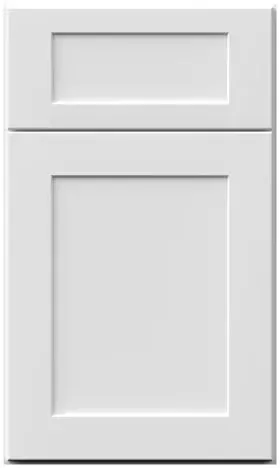


Fabuwood Galaxy Frost glass door cabinets: sizes, contents and light
Reviewed September 2026 · Captivating Cabinets
A Fabuwood Galaxy Frost glass door cabinet is a complete wall cabinet with a glass front, ordered as its own box at its own width and height. That one sentence settles most of the confusion on this page, and getting it right is the difference between a box list that works and a delivery day that does not.
These are cabinets, not replacement doors

The most common misunderstanding we field is someone assuming they can buy a glass front now and put it on a solid upper they already own. That is not what this page sells. Each line here is a finished unit — box, glass front, hardware — at a fixed width and height, and it takes the place of a solid wall cabinet in your plan.
| Family | SKU pattern | Sizes listed here |
|---|---|---|
| Wall glass door cabinet | GF GDW + width + height | 15″, 18″, 24″, 30″ and 36″ wide, at 30″, 36″, 39″ and 42″ high |
| Double door wall glass cabinet | GF GDWD + width + height | GF GDWD1860 — 18″ wide by 60″ high, a full-height glass column |
| Diagonal corner wall glass | GF GDWDC + width + height | 24″ wide at 30″, 36″, 39″ and 42″ high |
Read GDW3036 as 30 wide by 36 high and the rest of the list falls open. Practically, this means glass is a layout decision: if a solid W3036 is sitting in your box list and you want glass in that spot, the fix is changing the line before the order ships. Compare the heights against the solid wall cabinets so a glass unit lines up with its neighbors instead of sitting proud by three inches.
What the glass actually shows
Here is the fact nobody on the first page of search results will tell you: the interior of these boxes is a natural wood veneer finished interior, not the paint on the front. Behind a solid door that is irrelevant. Behind glass it is the entire look, and it surprises people who expected a white cube.
It is not a flaw — a warm veneer background is often what keeps an all-white wall from going flat, and it is the reason a single glass front reads as a feature rather than a hole. But decide about it deliberately. If you want a different background you can line or paint the interior back panel before anything goes on the shelves, and that is a five-minute job on an empty cabinet and a miserable one on a full one.
On contents, the rule is repetition. Matched glassware, a stack of white bowls, one row of the same thing. Glass rewards uniformity and punishes variety, which is why the cabinets that photograph well hold six identical items and the ones that do not hold groceries. And be honest about the household: a glass front is a standing commitment to keeping one cabinet tidy. If that is not going to happen, buy the solid door and spend the money elsewhere.
Placement follows from that. Not over the sink, where the dish rack lives. Not beside the trash pull-out. Put it where the eye already goes — flanking the range, beside a window, at the end of a run where a wall turns.
An unlit glass cabinet is a dark rectangle
At night, a wall of lit white cabinetry with one unlit glass front in it reads as a gap. The fix is two parts, both on the neighboring page: GF LED CAB INT 48″ STRIP for a full-height or wide unit, or the GF LED 2-1/4″ PUCK for a corner or a short cabinet where no strip length fits.
Both need the driver, GF LED DRIVER, and both need a switch — the wireless one, GF LED WLS SWITCH, is the option that does not require running a new switch leg. Decide now whether interior lights share a circuit with the undercabinet bars or get their own control, because that is an easier conversation to have with the electrician before the drywall than after. The accessory and LED guide covers how the driver gets sized to a whole run.
How many, and where they belong

Two is usually the right number. A symmetrical pair flanking a range or a window looks composed; a single unit at the end of a run works like a full stop. Four scattered across a wall looks like indecision, and at that point you have paid extra to make the kitchen busier.
If you are only doing one, do the corner. The diagonal corner units — GF GDWDC2430 through GDWDC2442 — occupy the worst storage in an upper run: deep, dark, awkward to reach past the door. Turning that volume into display costs you almost nothing you were actually using, and it puts the feature at the point where two runs meet, which is where a kitchen naturally wants an accent.
The tall one is a different tool. GF GDWD1860 is 18″ wide by 60″ high — a vertical glass column rather than a second row of dishes. It works beside a refrigerator or at the end of a run where the cabinetry needs a vertical element, and it is the piece to consider when the room has the height for it. Crown across the top ties it into the rest of the run; see the crown, filler and skin options for the profile and the skins that finish the exposed side.
Common questions
- Can I just buy the glass doors and put them on my existing cabinets?
- Not from this page. Each listing is a complete wall cabinet with a glass front at a set width and height, meant to replace a solid unit in your plan. Swap the line in the box list before the order ships rather than trying to retrofit a door afterward.
- What sizes are available?
- Widths of 15″, 18″, 24″, 30″ and 36″ at heights of 30″, 36″, 39″ and 42″, plus a 24″ wide diagonal corner unit in the same four heights and an 18″ by 60″ double-door column.
- What does the inside of the cabinet look like through the glass?
- A natural wood veneer finished interior — not painted to match the front. Many people like the warmth it adds behind glass. If you want a different background, line or paint the back panel while the cabinet is still empty.
- Do I need to light a glass cabinet?
- You will want to. An unlit glass front reads as a dark gap in a lit wall after sunset. The 48″ interior light strip or a 2-1/4″ puck, plus the LED driver and a switch, handle it — all on the cabinet accessories page.
- How many glass cabinets should a kitchen have?
- One or two. A symmetrical pair flanking the range or a window, or a single unit at the end of a run. More than that and the accent stops being an accent.
- What should go behind the glass?
- Matched, repeated items you actually use — glassware, a stack of the same bowls, one row of the same plate. Skip anything with packaging on it. If nobody in the house will keep one cabinet tidy, order the solid door instead.
Keep reading
The guides behind the numbers on this page.
- Glass Cabinet Doors: Buying Guide and Styles
Glass types, mullion patterns and where glass belongs in a run.
- Glass Cabinet Doors
The short version, if you are still deciding whether to do it at all.
- Wall and Tall Kitchen Cabinets: Sizes and Buying Guide
Upper cabinet heights, so a glass unit lines up with what is beside it.
- How to Read Cabinet SKU Codes
Reading GDW3036 as thirty wide by thirty-six high, and the rest with it.
- Kitchen Cabinet Molding Types
Finishing the top of a run that now has a feature in it.
- White Kitchen Cabinets: Finding Your Perfect Shade
Breaking up a wall of white without changing the paint.
- Small Kitchen Design and Layout Ideas
Where glass earns its place in a small room, and where it costs you.
- 27 Kitchen Cabinet Ideas
Real runs using one or two glass fronts as the accent.


