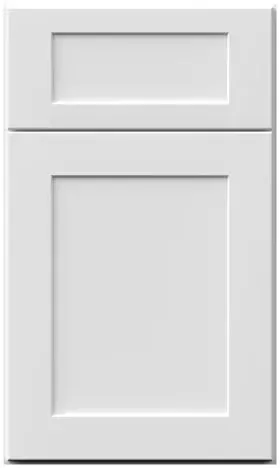


Fabuwood Galaxy Frost decorative accessories: fillers, skins, crown and posts
Reviewed September 2026 · Captivating Cabinets
Nobody plans a kitchen around trim, and then trim is the reason the job stops on a Friday afternoon. The Fabuwood Galaxy Frost decorative accessories list is not a box of upgrades — it is the set of parts that lets a grid of 3-inch cabinets meet a wall that is neither square, plumb, nor a multiple of three.
Cabinets step in 3 inches; your wall does not
Base cabinets in this line run 9″ to 48″ wide in 3″ increments. Your kitchen wall measures whatever the framer left you, and it is almost never a clean multiple of three. The difference has to go somewhere, and the somewhere is a filler.
Fillers do a second job people forget: clearance. Two cabinets meeting at an inside corner need a strip between them so their doors do not collide, and a cabinet that dies into a refrigerator needs room for the door to swing past the appliance handle. Neither is a remainder you can measure off a plan — both are gaps you design in deliberately.
| Piece | SKU | What it does |
|---|---|---|
| Base filler | GF BF3 | A 3″ wide strip that closes a base run into a wall or an appliance, scribed on site to follow the wall |
| Wall filler | GF WF636 | 6″ wide by 36″ high — the same job above the counter, cut down to the height of the uppers beside it |
| Tall filler | GF TF696 | 6″ wide by 96″ high — the full-height version, for a pantry or an oven tower |
The naming is worth thirty seconds because it unlocks the whole page: type code, then width, then height. WF636 is a wall filler, 6 wide by 36 high. TF696 is 6 by 96. BF3 carries only a width because base height is fixed at 34½″. Our guide to reading cabinet SKU codes applies the same logic to the rest of the catalog.
One habit that saves reorders: buy the wide one and cut it down. A 6″ filler ripped to 1¾″ on site is a filler. A 3″ filler that needed to be 4″ is a phone call and another week.
End skins are the detail that gives away a budget job

A skin is a thin finished panel applied to an exposed cabinet side so it reads like the doors instead of like the back of a box. This page lists them by cabinet height — GF SK W42 is the wall cabinet skin for a 42″ high unit — because a skin that is short is worse than no skin at all.
Where they go is the part people underestimate. The end of every run. Both sides of a peninsula. The side facing a doorway, which is often the first cabinet anyone sees. The side beside a refrigerator, which is visible from across the room. Each one is a cheap part next to the cabinet it finishes, and each one is the difference between cabinetry and cabinets that were installed. The end panel and scribe guide walks through the same decisions with drawings.
Crown molding, and how much of it to order

Crown ships as a length of stock — 96″ is the standard stick — and it is priced by the piece, which means you are buying linear feet rather than buying "crown for the kitchen". Measure the top run of every wall cabinet, remember the short returns at each end of a run, then add 10 to 15 percent. Outside corners eat length, and a miter cut backwards costs a whole stick.
Profiles are listed by number — this page carries Profile 4, GF CM-4, a cove. Use one profile through the whole kitchen, including across the top of the range hood if it is getting crown; two profiles in one room is a mistake nobody can name and everybody notices. Our molding types guide covers what each profile is for, and the hood page shows the shells that crown gets carried across.
Pilasters, posts and columns
These are the applied pieces — vertical trim on the face of a run, or a post under a counter overhang. They are a style choice rather than a requirement, and the heights are the tell: everything here is cut to match a cabinet you already own.
- Wall pilasters — GF PP-W30, PP-W36, PP-W39 and PP-W42, in heights that match the wall cabinets they flank.
- Tall pantry pilasters — GF PP-TP84, PP-TP90, PP-TP93 and PP-TP96, matched to 84″, 90″ and 96″ towers.
- Base pilaster — GF PP-BASE, the below-counter version, usually flanking a range or a farmhouse sink.
- Posts — GF SP3X3 is a 3″ × 3″ post, GF SP36 and GF SQP36 are 36″ lengths, and GF CP36 is a corner post for the outside corner where two runs meet at 90°.
- Columns — GF CLM-3012 through GF CLM-4212, read as height by depth: 30″, 36″, 39″ and 42″ tall at 12″ deep, with GF CLM-BASE as the matching base block and an oversized custom column when nothing standard lands.
Notice the 39″ in both lists. It sits alongside the familiar 30, 36 and 42, and the same odd height turns up in the glass-front wall cabinets. It is the size to remember when a 36″ upper leaves a visible band of wall and a 42″ will not fit — a case that comes up constantly on 8-foot ceilings with a soffit.
An opinion, since nobody else will give you one: pilasters read traditional. Beside a range in a classic white kitchen they look intentional; in a flat modern room they look like something added to fill a gap. Columns and posts are different — those usually hold up an island overhang, and the only question is whether you want the leg visible.
What to add to every order
Prices here run from $7.80 to $1,098.50 — a filler costs less than lunch, a custom oversized column is four figures. Almost everything below is at the cheap end, which is what makes leaving it off so expensive.
- A filler at every inside corner, in both directions.
- A filler wherever a run dies into a wall, an appliance or a doorway — ordered wide, to be cut down.
- A skin for every exposed cabinet side, ordered to that cabinet’s height.
- Crown for the full top run, plus 10 to 15 percent for miters.
- Scribe molding if the walls or ceiling are visibly wavy — ask us, because it is not always on the page.
If you would rather not count this yourself, send the room dimensions: a free 3D design comes back with the trim itemized, not just the boxes. The pieces also appear in context across the full collection, and the ordering thread continues on the cabinet accessories page.
Common questions
- How many fillers do I need?
- One at every inside corner in both directions, and one wherever a run ends at a wall, an appliance or a doorway. A typical L-shaped kitchen needs three or four. Order them wide — a 6″ filler cut down to 2″ works, and a 3″ filler that needed to be 4″ does not.
- What does WF636 mean?
- Wall filler, 6 inches wide, 36 inches high. The pattern is type code, then width, then height — so TF696 is a tall filler 6 wide by 96 high. BF3 lists only a width because base cabinet height is fixed at 34½″.
- Do I need an end skin if the cabinet side is already finished?
- If the side will be seen — at the end of a run, on a peninsula, beside a fridge, facing a doorway — order the skin. It is what makes the side read like the doors. Order it to the height of the cabinet it covers; GF SK W42 is the 42″ wall version.
- How much crown molding should I order?
- Measure the top of every wall cabinet including the short returns at the ends of each run, then add 10 to 15 percent. It ships in 96″ sticks, outside corners consume length, and a miter cut the wrong way costs a full piece.
- What is the difference between a pilaster and a column?
- A pilaster is applied flat to the face of a cabinet run and is decoration. A column stands free — usually under an island or peninsula overhang — and is often doing real work. Pilasters are listed by matching cabinet height; columns are listed as height by depth, such as CLM-4212 for 42″ tall by 12″ deep.
- Can I order trim after the cabinets arrive?
- Yes, and it costs you a second delivery plus another lead time while the installer waits. Trim is the cheapest part of the order and the part most likely to hold up the job, so it belongs on the first shipment.
Keep reading
The guides behind the numbers on this page.
- Cabinet End Panels, Scribe Molding and Fillers Explained
The long version of this page, with the diagrams that make it obvious.
- Kitchen Cabinet Molding Types
Crown, light rail and valance, and which profile belongs where.
- How to Read Cabinet SKU Codes
Read BF3, WF636 and TF696 as dimensions on sight.
- Kitchen Cabinet Terminology Glossary
Pilaster, scribe, skin and post, defined without the sales language.
- Wall and Tall Kitchen Cabinets: Sizes and Buying Guide
The cabinet heights your pilasters and skins have to match.
- Important Kitchen Dimensions Before Buying Cabinets
The six measurements that decide how much filler a room needs.
- Free 3D Kitchen Design
What we send back, and why the trim is itemized on it.
- 27 Kitchen Cabinet Ideas
Finished runs where you can see the trim doing its job.


