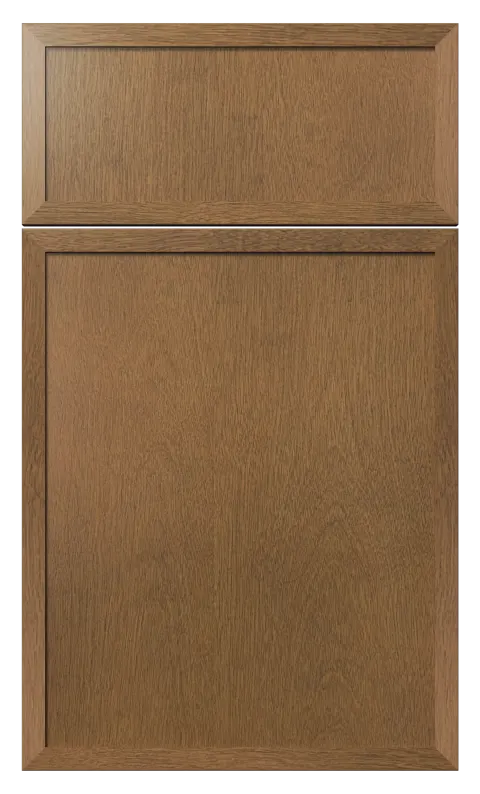


Nine inches: the narrowest box on the grid, and when it beats a filler
Reviewed September 2026 · Captivating Cabinets
Walls do not divide evenly into three-inch cabinets. Almost every run ends with an awkward remainder, and the 9-inch base exists to eat one — it is the smallest cabinet the base board is made in, and the last width where the honest answer might still be "use a filler instead". Two SKUs live here and neither has a drawer, so the decision is narrower than it looks: you are choosing between a door, a dead strip of wood and a pull-out rack.
The job: nine inches nothing else wants
A remainder shows up in three places. At the end of a run against a wall, where the last cabinet cannot land flush. Beside a range, where the appliance opening pushes the rest of the run off the grid. And at an inside corner, where a door has to clear the pull on the cabinet round the bend.
Nine inches is where that remainder becomes worth cabinetting. Below it you are paying for two box ends and a door to protect an opening barely wide enough for a cutting board. At nine, the cavity finally holds the flat, tall, annoying things a kitchen has nowhere else to put — sheet pans, cooling racks, cutting boards, platters, pot lids on their edges.
| Option | Displayed price | What you get | Where it wins |
|---|---|---|---|
| A 9-inch base, B09FD | $273.00 | A full-height door over a full-height cavity, no top drawer | Beside a range or an oven bay, where trays have to live somewhere |
| Filler strips, BF3 and BF6 | $26.00 and $43.55 | A clean scribed reveal at the wall and nothing behind it | Two short gaps rather than one, or a corner that needs door clearance |
| A filler pull-out, SPO-BF3 or SPO-BF6 | $334.75 and $380.25 | A three- or six-inch pull-out rack in the same gap | A gap next to the cooktop, where oils and bottles earn the money back |
A six-inch pull-out plus a three-inch filler closes the same nine inches for $406.25 and gives you the most useful nine inches in the kitchen. A cabinet costs $273.00 and gives you the most storage. A three-inch and a six-inch filler together cost $69.55 and give you nothing but a straight line — worth reading how a filler is scribed and where it fails before you decide the gap does not deserve a box. All three are defensible; only one of them is free.
What the catalog actually offers here
Two boxes, and that is the whole width. B09FD is the 24-inch-deep version at $273.00; B09FD-12D is the same face on a 12-inch-deep box at $266.50. Both are full-height door — FD in the SKU means the door runs the whole height of the box with no drawer above it. There is no 9-inch sink base, no 9-inch drawer bank, no corner unit and no specialty box. If you want drawers this narrow, the answer is that they start at twelve.
Both are pre-assembled, both are built on the same half-inch plywood box with a veneer interior, and both hang on the same soft-close hinges as the rest of the run. The door is the smallest one in the kitchen and it is the one people slam hardest; the soft-close is doing real work at this width.
What actually fits inside
Less than nine inches. A framed cabinet gives back a couple of inches to the face frame and the stiles, so plan on a clear opening in the six-inch neighbourhood rather than the nine on the label. The listings do not publish that figure, so if you are buying to fit a specific insert — a tray divider kit, a spice pull-out, a bin — get its required interior width first and confirm it against the cabinet.
What works without measuring: sheet pans, wire cooling racks, thin cutting boards, muffin tins, pizza stones, a folding step stool. What does not: anything that needs to lie flat, and anything you will want to reach past. Stored on edge, this box is excellent. Stored in a stack, it is a hole you drop things into.
The mistake at this width
Burying it. A 9-inch box dropped into the middle of a symmetrical run reads as a mistake — the eye compares door widths along a straight line, and the narrow one is the first thing anyone notices. Put it at the end of a run, tight against the range, or beside the refrigerator, where it looks deliberate and where the tall thin things you keep in it are also the things you reach for while cooking.
The second mistake is ordering it to save the cost of two fillers. It is not a filler substitute at $273.00; it is a cabinet. Buy it because you want the storage.
Common questions
- Is there such a thing as a 9-inch base cabinet?
- Yes — it is the narrowest base width made, and it comes in one configuration: a full-height door, in either 24-inch or 12-inch depth. There is no drawer version, no sink version and no corner version at this width.
- What actually fits in a 9-inch cabinet?
- Anything flat that can stand on edge: baking sheets, cooling racks, cutting boards, platters, pot lids, muffin tins. Expect a clear opening a couple of inches narrower than the box, and confirm the exact figure before buying any insert that has to slide inside.
- Should I use a 9-inch cabinet or just fillers?
- Fillers cost $26.00 for three inches and $43.55 for six, so closing the gap with dead wood is about $52.00 against $273.00 for a real box. Use fillers when the gap is at a corner or split across two short reveals; use the cabinet when the nine inches is in a spot you would actually reach into.
- Does a 9-inch base cabinet come with a drawer?
- No. Both 9-inch SKUs are full-height door boxes. The narrowest drawer base on the board is a 12-inch three-drawer bank, and the narrowest drawer-over-door base is also 12 inches.
- What is a 12-inch-deep base cabinet for?
- It is a standard-height base built on a shallow box, used where full 24-inch depth would intrude — the back of a peninsula, a walkway, a narrow galley leg, or a run behind a dining chair. At this width it displays for $266.50.
Keep reading
The guides behind the numbers on this page.
- Types of base cabinets
The whole base family in one place, so you can see what the 9-inch box is and is not.
- End panels, scribe molding and fillers explained
Read this before deciding the gap does not need a cabinet — it covers how a filler is scribed and where it fails.
- Space-saving cabinet solutions
What to do with the narrow, tall and awkward parts of a kitchen when square footage runs out.
- Beam-mounted pull-out cabinet accessories
How the filler pull-outs mount, which matters when you are choosing one over a 9-inch box.
- Small kitchen design
Where the remainder inches usually turn up, and how to plan a run so there are fewer of them.
- Cabinet sizes and specs
The full size table, if you want to check what else the grid offers before committing to the narrow box.