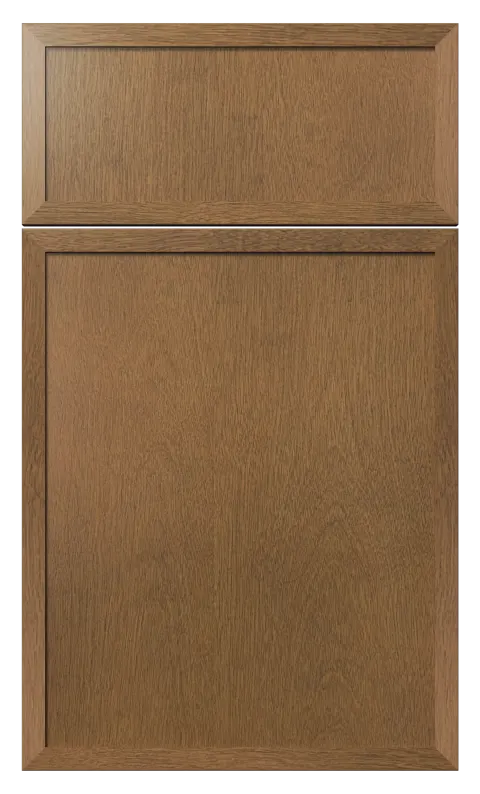


The 15-inch wall cabinet, with the door and without it
Reviewed September 2026 · Captivating Cabinets
Fifteen inches is the first width in the wall range where you get a real choice about the front of the cabinet. Eleven units are built here in three families — six ordinary single-door uppers, four open boxes with a finished interior, and one wine rack — and the interesting decision is not which width but whether the door stays on.
Three families, one width
The doored units run the standard six heights, W1515 through W1542, from $182.00 to $325.00. The open ones — coded NDW, for no-door wall — start at 30 inches tall and run to 42, $328.25 to $445.25. And there is a single lattice unit, WR1515, at $321.75.
"Matching interior" in the open units’ name is doing real work. A cabinet built to be closed does not need a pretty inside; one built with the front left open does, and these are finished inside to match what you see on the outside of the run. That is most of what you are paying for, and it is why an open box is not simply a cheaper cabinet with a part left off.
The open boxes do not come short
The doored units at this width include a 15″ and an 18″ high box for shallow work — over a window, under a soffit, above a hood. The open ones do not: they begin at 30 inches. So if the plan calls for a short open shelf above a counter, this width will not give you one, and the alternatives are the 18″-wide open shelf units, a 15″ wine rack, or a piece of open shelving that is not a cabinet at all.
That is a real constraint and it catches people who sketch an elevation before checking the catalog. On a job we are drawing, this is the point where a plan either moves to 18 inches or the open bay moves to full height.
Where an open box is the wrong call
Two places. Beside a range, because everything on an open shelf within a few feet of a cooktop collects a film that closed doors would have stopped, and a finished interior is harder to scrub than a plate. And directly over a sink, where splash and steam do the same thing more slowly.
Put the open bay at the end of a run, at the transition to a dining space, or flanking a window — somewhere the eye lands and the grease does not. That placement rule is worth more than any argument about which items look good on display.
For everything else at this width, the doored version is the default and the single-door wall cabinets page carries the whole ladder.
Common questions
- What does matching interior mean on a cabinet?
- It means the inside of the box is finished to match the outside, because the unit is built with no door and the interior is on show. It is the main reason an open cabinet costs more than the doored version of the same size, not less.
- How much more do open kitchen cabinets cost?
- At 15 inches wide, between $94.25 and $120.25 more than the same box with a door — about 36 to 40 per cent. The gap holds fairly steady across the height ladder.
- What fits in a 15 inch wall cabinet?
- Dinner plates fit flat, which is the practical line 12-inch boxes fall short of. Also mugs two deep, cereal boxes upright, and a stack of mixing bowls at 12 inches of depth.
- Can I get a 15 inch open shelf cabinet in a short height?
- No. The doorless units here start at 30 inches tall. For a short open bay you need to move to the 18-inch width, where the open shelf family lives, or use a wine rack.
- Are open cabinets a bad idea near a stove?
- Near a cooktop, yes — airborne grease settles on anything that is not behind a door, and a finished cabinet interior is a poor thing to scrub weekly. Keep open bays at the far end of a run or across the room from the range.
Keep reading
The guides behind the numbers on this page.
- Kitchen cabinet ideas
Where open bays land well in a real elevation, rather than in a styled photograph.
- Glass cabinet doors
The middle option: display without the dust, if the open box is one step too far.
- Cabinet care guide
What settles on an open shelf near a range, and how to get it off without damaging the finish.
- Types of kitchen cabinets
How the no-door and open-shelf families sit inside the wider catalog.
- Match cabinets, countertops, backsplash and flooring
An open bay puts the backsplash on show — worth reading before you frame one.