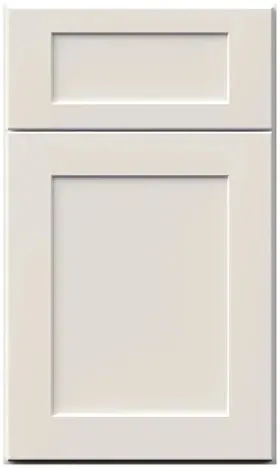
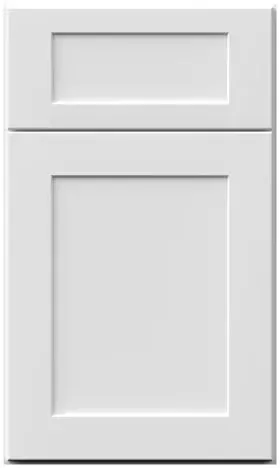
Fabuwood Frost vs Dove
One Galaxy shaker door, painted a true white or a softened one.
Fabuwood Frost vs Dove sounds like a big decision and is narrower than it looks: both are paints on the same Galaxy shaker door, over the same box, at the same price. Frost is the brightest, most neutral white Fabuwood makes; Dove is its warm off-white. What decides it is the room you are putting them in — the trim, the appliances, the windows and the island — and that is what this page works through.
Frost vs Dove at a Glance
Compared on 12 points, updated September 2026.
Swipe to compare →
| Frost | Dove | |
|---|---|---|
| Door | Galaxy five-piece recessed panel, ⅜″ MDF center | Same Galaxy door, same profile |
| Color family | White — Fabuwood’s brightest paint | White — Fabuwood’s signature off-white |
| Undertone | Neutral: no yellow lean, no gray lean | Gentle warmth, a faintly creamy cast |
| Next to bright white trim | Matches it cleanly | Doors look a shade softer than the trim |
| Next to off-white trim or beige walls | Makes them look dingy or yellow | Sits comfortably beside them |
| Safest lighting | Any, including dim north-facing rooms | Daylight or warm 2700–3000K bulbs |
| Island partners we draw most | Indigo, Nickel, Pistachio Green | Timber, Indigo |
| Hardware | Takes anything; brass adds warmth it lacks | Brass and bronze first; matte black also works |
| Box and drawers | ½″ veneered plywood box, ⅝″ dovetail drawers | Identical Allure construction |
| Lead time | 7 days – 3 weeks, pre-assembled | 7 days – 3 weeks, pre-assembled |
| Warranty | Limited lifetime | Limited lifetime |
| Typical 10×10 cabinets | $4,000–$7,000 | $4,000–$7,000 — one shared price grid |
Choose Frost if…
- The kitchen is dim, north-facing or lit with cool 4000K fixtures you are keeping
- Trim, ceiling, tile or appliances are already bright white and you want everything to match
- You want a crisp split against a dark island such as Indigo, or maximum brightness in a small room
Choose Dove if…
- A bright white felt clinical when you pictured it next to your floors, walls or brass fixtures
- The existing trim or walls are off-white or beige and you are not repainting them
- The plan is a wood-tone island, especially Timber, and you want the seam between the colors softened
One Galaxy Door, Two Different Whites
Start with what doesn’t change. Both finishes are sold on the Galaxy door: a five-piece recessed-panel shaker with a solid wood frame around a ⅜″ MDF center panel, which is what keeps a painted panel from cracking at the joints as the seasons change. The face is smooth and polished rather than chalky, so light skims off either color the same way. Box, drawers, hinges, glides, warranty, price and lead time are all identical, so every word below is about paint.
Frost is the reference point. It is the brightest paint in the Galaxy line and, more importantly, the most neutral — it doesn’t tip toward yellow or toward gray, so the cabinets pick up the room around them instead of adding a cast of their own. It is also Fabuwood’s best-selling finish, largely because it behaves so predictably.
Dove starts from that white and adds a little warmth. Fabuwood files it in the white family and calls it the signature off-white of the line; a swatch scans at roughly #DDD7D1, which is a soft warm white, not a cream. On a full wall of cabinets with nothing to compare it to, no visitor will call it anything but white. The warmth only shows when something whiter sits beside it — which is exactly why the trim, the ceiling and the appliances end up deciding this choice.
Let the Trim, Tile and Appliances Choose
Most remodels keep something: the window casings, the ceiling, a white range, a subway-tile backsplash that is only five years old. Walk the room and list every white surface that is staying. That list answers the question faster than any swatch, because a white cabinet is always judged against the white next to it.
Frost is the easy call when those surfaces are already bright white. Doors, trim and appliance enamel line up, and the room reads as one clean color. The catch runs the other way: Frost is merciless to anything slightly off. Builder-beige walls read yellow beside it, and an older off-white trim paint suddenly looks like it needs washing. If the walls and trim are warm and are not being repainted, Frost will pick a fight with them.
Dove handles the opposite situation. Beside cream walls, warm oak floors or aged trim it looks deliberate rather than mismatched. Put it next to crisp white casings and the doors simply read a touch softer than the trim, which most people never notice. The one spot to think about is a white refrigerator or dishwasher in the run: the enamel will look whiter than the doors. Stainless sits neutrally against Dove, and a panel-ready appliance with a painted door panel removes the gap entirely.
Frost vs Dove in North Light, South Light and Under LEDs
Window direction matters more for Dove than for Frost, and the reason is simple: Dove has a small amount of warmth, and cool or weak light can wash it out. In a north-facing kitchen or under 4000K-and-up ceiling fixtures, Dove can slide toward a faint gray by late afternoon. Frost has no warmth to lose in the first place, so it holds its color in the dimmest rooms we design.

Southern and western light reverse the problem. A bright white in a sun-filled kitchen can edge toward glare, especially on a long run of uppers, and Dove takes that edge off without anyone reading the cabinets as colored. Bulbs are the lever you control: warm 2700–3000K lamps in the ceiling cans and under the uppers keep Dove reading as a clean warm white after dark, and they don’t hurt Frost either.
A practical rule from our design work: if the room is dark and the fixtures are not changing, Frost is the safer pick. If the room is bright, or you are relighting it anyway, Dove becomes a real option instead of a gamble.
Islands, Counters and Pulls for Each White
For a two-tone kitchen the perimeter color sets the mood of the seam. Frost against a dark island gives a sharp, graphic split — our most-drawn versions are Frost over a Galaxy Indigo island, Frost with Nickel, and Frost with Pistachio Green. Dove turns the same move into something gentler: over a Galaxy Timber island the off-white and the warm honey wood read as related tones, and over Indigo it keeps a navy-and-white room from feeling nautical. What we steer people away from is mixing the two whites — Dove bases under Frost uppers make the lower half look like it wasn’t cleaned.
Counters follow the same logic. White quartz beside Frost can make the cabinets and counter merge into one bright plane, which some people love and others find sterile; wood or a warm metal brings it back. Dove prefers a counter with a bit of cream or soft gray in the veining. Test a cold blue-gray slab against a Dove door before committing, because that kind of stone tends to pull the paint toward gray.
Hardware is where Frost is least fussy — satin nickel disappears on it, matte black looks graphic, brass supplies warmth the paint doesn’t have. Dove is at its best with brass or bronze, and it carries matte black cleanly too. One small detail favors Dove behind glass: the natural wood-veneer interior is nearer in temperature to Dove than to Frost.
Price, Construction and Delivery: No Tiebreaker Here
Don’t expect the quote to help. Frost and Dove sit on one Galaxy price grid, so the same layout prices the same to the cent — a GD W3030 in Dove costs what the GF W3030 costs in Frost, and a typical 10×10 kitchen in either lands around $4,000–$7,000 in cabinets depending on drawers, the corner solution and accessories. Only Desert Oak and Natural Oak break out of that grid in the Galaxy line; both whites sit in the standard group.
The build is shared as well: ½″ veneered plywood boxes with a natural wood-veneer interior, ⅝″ solid wood drawer boxes dovetailed at the corners, Blum® Tandem full-extension glides with Blumotion and Blum® Quick-Release soft-close hinges, factory assembly with dowel, glue and pocket screws, and a limited lifetime warranty. Galaxy is also the quickest-shipping door in the Allure line at 7 days to 3 weeks, versus 3–5 weeks for the other Allure series, and that applies to both colors.
Neither paint is tougher than the other. Both are factory-applied finishes on the same polished face, and both wipe clean with a damp cloth. As with any painted door, a knocked corner shows more readily than it would on a wood stain, so open cartons on delivery day whichever white you order.
Deciding With Two Doors on the Wall
On a screen these two look nearly the same, and in your kitchen they are obviously different once they sit side by side, so buy both door samples (a Dove sample is $25) and tape them to the cabinets or wall where the new run will go, touching the trim you are keeping. Look at them at breakfast, again in late afternoon, and once more with only the evening lights on. Then take a phone photo: a camera shows both as white, which tells you how the kitchen will look in listing photos whichever you choose.
If Frost wins against your trim and still looks good after dark, the decision is made — it is the lower-risk white. If Frost looks harsh next to your floors or walls and Dove holds up under your bulbs, go with Dove. And if you are planning an island in a second color, send us the layout for a free 3D design; seeing the perimeter and island rendered together shows the seam before anything ships. Our Linen vs Dove comparison covers the step beyond Dove, for anyone who finds even the off-white too bright.
Ready to price your own layout in Frost or Dove?
Get a free 3D rendering and an itemized quote so you can compare real numbers, not list prices.
See Frost or Dove in Your Kitchen
Our designers render your actual layout in either line, free — so you’re comparing more than a spec sheet.
Get Free 3D DesignNo obligation · Ready in days
Frost vs Dove FAQ
Common questions about how these two compare.
It is an off-white that Fabuwood still classes as a white, describing it as its signature off-white. On a full run of cabinets it reads as white; the soft warm cast only becomes visible when a brighter white such as Frost, a white ceiling or white trim sits beside it.
Frost. It is neutral, with no warmth for dim or cool light to strip out, so it holds its color in the darkest rooms. Dove can slide toward a faint gray in weak northern light or under 4000K-plus fixtures unless you run warm 2700–3000K bulbs.
Yes. They share one Galaxy price grid, so an identical layout prices identically in either paint. A typical 10×10 kitchen runs roughly $4,000–$7,000 in cabinets; confirm the exact figure on a quote for your own box list.
Frost. Its bright, neutral white sits closest to white enamel. Beside Dove, a white refrigerator or dishwasher will look whiter than the doors; stainless or a panel-ready appliance with a matching door panel avoids that.
We advise against it. The two are close enough that the pairing looks like a mismatch rather than a choice, and the warmer Dove bases tend to look dingy under brighter uppers. For two-tone, pair either white with a real contrast — Indigo, Timber, Nickel or Pistachio Green.
No. Door, box, drawers, Blum® hardware, factory assembly, limited lifetime warranty and the 7-day to 3-week lead time are identical. The only thing you are choosing is the paint color.