
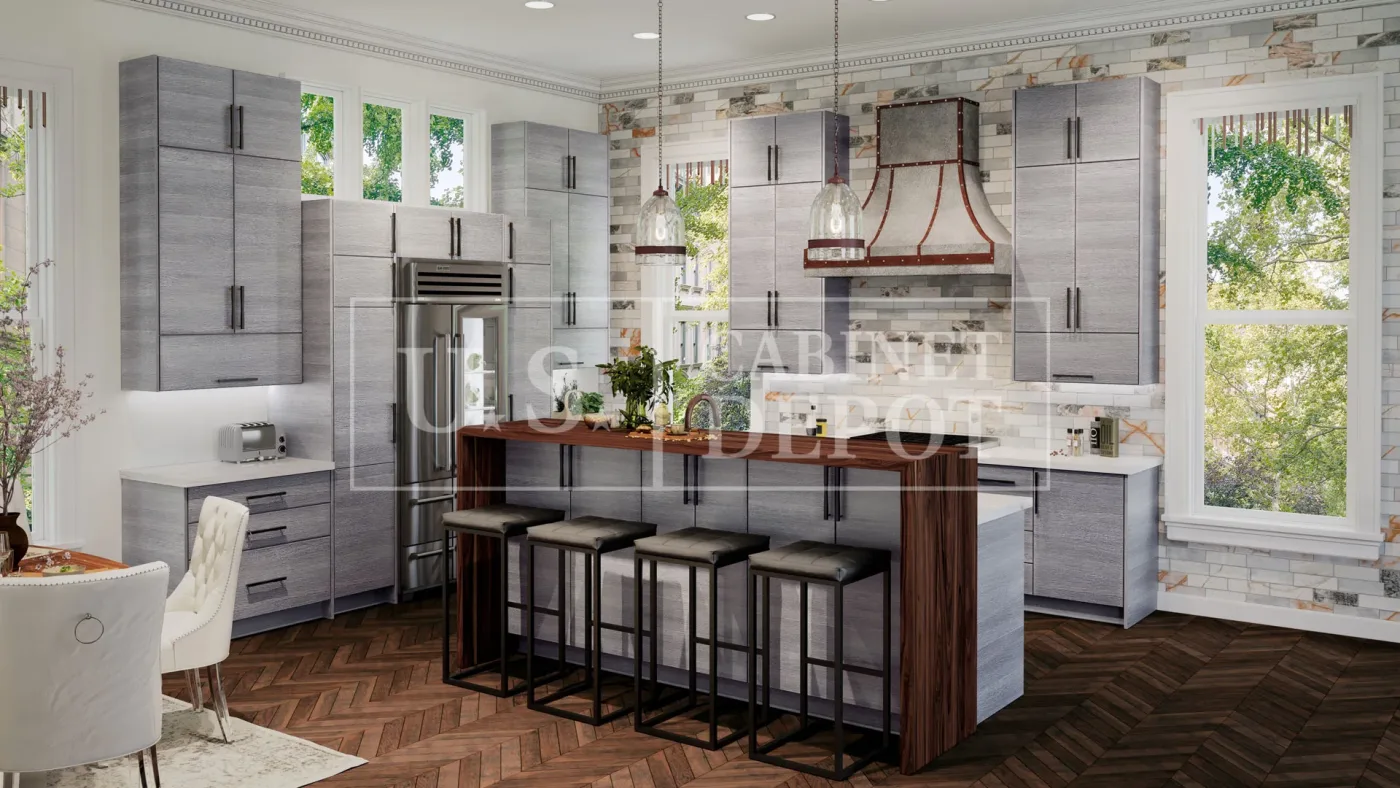
US Cabinet Depot vs Kitchen Cabinet Distributors
One brand changes the box when you change the door style; the other changes it when you change the budget. Knowing which is which settles most quotes.
US Cabinet Depot vs Kitchen Cabinet Distributors comes down to how each catalog is organized. USCD spreads 28 finishes over seven series, five framed and two true frameless, and holds one plywood spec across every framed door. KCD keeps 17 finishes in four collections, splitting them into a Premier tier built on plywood sides with solid wood fronts and an Essential Builder tier that trades down to particleboard and MDF. Below: what that means for the box you actually receive, the modern-kitchen options, the paperwork, and the quote.
US Cabinet Depot vs Kitchen Cabinet Distributors at a Glance
Compared on 12 points, updated September 2026.
Swipe to compare →
| US Cabinet Depot | Kitchen Cabinet Distributors | |
|---|---|---|
| Assembly | RTA or factory-assembled on every series | RTA or assembled, same construction either way |
| Box architecture | Framed (5 series) plus frameless full-access (Palermo, Torino) | Framed with full-overlay doors throughout; no frameless line |
| Cabinet box | Framed: ½″ furniture-grade plywood, UV-coated · Frameless: 18mm plywood-composite, melamine in & out | Premier: plywood sides, UV-coated birch interior · Essential: particleboard sides, plywood back |
| Doors | Framed: 5-piece full overlay · Frameless: PET gloss or textured melamine slab | Premier: solid wood doors & drawer fronts · Essential: engineered MDF |
| Drawer box | Framed: ⅝″ solid hardwood dovetail · Frameless: metal-sided altamax | Dovetail on full-extension glides (Premier) |
| Hinges | Framed: concealed 6-way soft-close, no brand published · Frameless: Hettich Sensys 110° | Soft-close standard on Premier; maker not named |
| Lineup | 7 series: Shaker, Oxford, Edgeline, Casselberry, Haven, Palermo, Torino | 4 collections: Brooklyn, Shaker, Oslo (Premier) + Essential (Builder) |
| Finishes | 28 | 17 |
| Warranty | Limited lifetime, published (cabinetry, hinges, glides) | Confirm the current term with your dealer at quote time |
| Certifications | CARB2 (KCMA not published) | KCMA · CARB2 · TSCA VI · E1 |
| Warehouses | 8 U.S. locations; in-stock items ship in 1–3 business days | 4 regional DCs: Raleigh, Houston, Reno, Apopka FL |
| Typical 10×10 cabinets | $2,500–$4,500 (Shaker, RTA, our pricing) | Quote-based; no public price list |
Choose US Cabinet Depot if…
- The design calls for a real frameless box: Palermo’s gloss white slab or Torino’s horizontal woodgrain, with Hettich hinges and full-access interiors
- You want the same plywood framed box whether the budget lands on Unfinished Shaker or a glazed Casselberry door
- A published lifetime warranty and a posted 10×10 price band make the budget conversation easier
Choose Kitchen Cabinet Distributors if…
- Stained rift white oak or walnut on a slim full-overlay door (Oslo) is the look, and a framed box is fine underneath it
- Solid wood doors across the Premier tier, plus KCMA certification, need to show up on the submittal
- One catalog has to cover both a client-facing Premier kitchen and an Essential-tier rental turn
Seven Doors on Two Boxes, or Four Collections on Two Tiers
Put the two catalogs side by side and they look like they were designed by people answering different questions. USCD asked “which doors do our dealers sell?” and built seven of them: Shaker in eleven finishes, Oxford’s beveled recessed panel in five, the skinny-shaker Edgeline in White and Ridge, Casselberry’s hand-glazed raised panel in two, Haven’s pillowed bevel in five, then the frameless Palermo and Torino slabs. KCD asked “what does each buyer pay for?” and built a ladder: three Premier collections for the kitchens people live in, and an Essential Builder line for spec homes, flips, and multi-family units.
That difference in logic is the useful thing to understand before looking at a single spec row. On a USCD quote, moving between series changes the door and sometimes the whole cabinet architecture. On a KCD quote, moving between Premier and Essential changes the materials the box is made from. Neither approach is wrong, but a buyer who assumes both brands work the same way can end up comparing a frameless USCD box to a builder-grade KCD one and wondering why the numbers look strange.
Where Each Catalog Lets the Box Change
All five USCD framed series sit on the same Capital collection spec: ½″ furniture-grade plywood with a UV-coated interior, ¾″ × 1¾″ solid hardwood face frames, ⅝″ solid hardwood dovetail drawers on undermount soft-close glides, and concealed six-way adjustable hinges. The cheapest way into the brand, Shaker Unfinished, ships on that exact box. The door material does vary, though. Haven’s three painted finishes are HDF, and Casselberry Saddle is the only door USCD builds entirely in solid birch, so if solid wood fronts are the priority, read the series notes before ordering.
KCD holds its door story steadier and moves the box instead. Brooklyn, Shaker, and Oslo all get solid wood doors and drawer fronts, plywood sides with a birch veneer interior, dovetail drawers, and soft-close hardware as standard. Essential drops to particleboard sides with a plywood back and MDF doors, which is how it reaches builder pricing. MDF takes paint well and the tier is sold openly as what it is. The practical rule for a KCD quote is to check which tier each line item is written in; for a USCD quote, check which series.
Palermo and Torino Against Oslo: Two Routes to a Modern Kitchen
This is the clearest split between the brands. USCD’s altaeuro line is genuinely frameless: doors mount straight to the box edge, there is no face frame narrowing the opening, and the construction changes to 18mm plywood-composite boxes finished in grey linen melamine, metal-sided altamax drawers rated 88–132 lb, and Hettich Sensys hinges. Palermo comes in a single high-gloss white PET slab; Torino offers three horizontal textured woodgrains, Dark Wood, White Pine, and Grey Wood. One trade-off to know: the frameless drawers are metal-sided, not dovetailed.

KCD reaches the modern look from the other direction. Oslo is a slim-profile, full-overlay door on the brand’s framed Premier box, finished in real stained rift white oak and walnut plus a white. Installed, the fronts read flat and nearly continuous, and the wood is actual wood rather than a printed or textured surface. What you give up is the full-access interior and the wider drawers that come with frameless construction. So the question to ask is which matters more to you: stained real wood on the door, or the frameless box behind it.
Warranty and Certification Point in Opposite Directions
On the warranty, USCD has the clearer answer. It publishes a limited lifetime warranty for the original purchaser in residential use, and it names cabinetry, hinges, and glides as covered. We have not verified a current KCD warranty term that we are comfortable printing here, so we confirm it on the order at quote time. That is not a warning sign. It means you should ask for the term to be written on your quote and not rely on a number from a forum thread.
Certification runs the other way. KCD lists KCMA certification, which means independent testing of structure and finish, along with CARB2, TSCA VI, and E1 emissions compliance. USCD publishes CARB2 compliance on both its framed and frameless lines and does not publish KCMA certification, so we don’t claim it for them. For a homeowner that gap rarely changes the outcome. On a multi-unit job where a submittal reviewer checks the stamps, it can.
Stock, Freight, and How Each Price Reaches You
USCD ships from eight U.S. warehouses. In-stock items leave in 1–3 business days, then travel 7–14 business days by tracked freight, and the core Shaker colors (White, Grey, Navy, and Black) are always stocked. KCD runs four regional distribution centers in Raleigh, Houston, Reno, and Apopka, Florida, so most orders take a reasonably short freight leg. Both brands will ship any order flat-pack or assembled. For small jobs, USCD’s larger warehouse count tends to help; on KCD orders, the thing to plan is getting the Premier-versus-Essential split right on the first quote.
On price, USCD is the brand we can put a number on: a 10×10 Shaker kitchen typically lands at $2,500–$4,500 in RTA form at our pricing, with assembled quotes stepping up from there. KCD publishes no price list, so every KCD kitchen is quoted from the layout, and Essential comes in meaningfully below Premier. Because of that, the fair comparison is USCD Shaker against KCD Premier on the same drawing. Adding Essential to the comparison only makes sense when a builder-grade box is acceptable for the job.
US Cabinet Depot vs Kitchen Cabinet Distributors: Matching the Brand to the Job
We point customers to USCD when the kitchen spans a range of styles, when a true frameless box is required, or when a lifetime warranty on paper helps close the sale. It is also the easier choice on a traditional job, since Casselberry’s glazed raised panel has no equivalent in KCD’s catalog. We point them to KCD when Oslo’s real walnut or rift oak is the reason they called, when solid wood Premier doors and a KCMA stamp matter to the client, or when one contractor is running a remodel and a rental turn off the same account.
We sell both brands and quote them the same way: send measurements, a designer replies within one business day, and a 3D design with an itemized quote follows in 24–48 hours. If you are undecided, ask for your layout in USCD Shaker and in KCD Premier. Seeing the same kitchen priced and rendered in both usually answers the question faster than any spec sheet.
Ready to price your own layout in US Cabinet Depot or Kitchen Cabinet Distributors?
Get a free 3D rendering and an itemized quote so you can compare real numbers, not list prices.
Related Reading
- US Cabinet Depot Cabinets Review: Lines, Spec Book and Prices
- KCD Cabinets Review 2026 From an Authorized Dealer
- Framed vs Frameless Cabinets Explained by a Dealer Who Sells Both
- KCD Oslo Walnut and the European Wood Kitchen Look for Less
- How Much Do KCD Cabinets Cost and Why There Is No Public Price List
See US Cabinet Depot or Kitchen Cabinet Distributors in Your Kitchen
Our designers render your actual layout in either line, free — so you’re comparing more than a spec sheet.
Get Free 3D DesignNo obligation · Ready in days
US Cabinet Depot vs Kitchen Cabinet Distributors FAQ
Common questions about how these two compare.
No. All four KCD collections use a framed box with full-overlay doors. Oslo is the closest match in look, a slim-profile door in stained rift white oak, walnut, or white. USCD’s Palermo and Torino are true frameless full-access cabinets built on 18mm plywood-composite boxes, with Hettich Sensys hinges and metal-sided drawers.
No. USCD’s least expensive option, Shaker Unfinished, uses the same ½″ plywood box, hardwood face frame, and dovetail drawers as every other USCD framed series. KCD’s Essential Builder Series is a separate tier with particleboard sides, a plywood back, and MDF doors, priced for builder and multi-family work. The KCD tier that matches USCD’s framed construction is Premier.
US Cabinet Depot has 28 finishes across seven series. KCD has 17 across four collections: Brooklyn (6), Shaker (6), Oslo (3), and Essential (2). USCD covers more door styles, including a glazed raised panel and a high-gloss slab. KCD is the one to look at for stained real-wood walnut and rift oak.
USCD publishes a limited lifetime warranty covering cabinetry, hinges, and glides for the original purchaser in residential use. For KCD, we confirm the current warranty term with you at quote time and write it on the order, so you are not relying on third-party listings.
KCD lists KCMA certification along with CARB2, TSCA VI, and E1 compliance. USCD publishes CARB2 compliance for its framed and frameless lines but does not publish KCMA certification, so we don’t claim it. If the KCMA stamp is required for your project, KCD is the brand of the two that has it.
Yes. Every USCD series ships either RTA or factory-assembled from its eight U.S. warehouses. KCD orders ship either way from four regional distribution centers, with the same construction whichever you pick. RTA saves on freight; assembled saves on labor.