

When a Galaxy Frost vanity decorative onlay works, and when it fights the door
Reviewed September 2026 · Captivating Cabinets
An onlay is ornament made separately and applied to a surface — a carved or routed piece fixed onto a door or a panel face so the flat becomes figured. A Galaxy Frost vanity decorative onlay, GF VDO at $425.75 against a $655 list, is the one part in this range that does nothing functional at all. It exists to change how a vanity reads, which makes it the only line item here worth arguing about on taste.
Applied ornament, not carved ornament

The distinction matters because it explains both the price and the limits. A carved door is cut from the door. An onlay is a separate component, made flat and fixed on afterwards with adhesive or pins, which is how ornament has been produced affordably since long before cabinets were catalogued. It sits proud of the surface by a fraction of an inch, and that shadow line is the effect you are buying.
Three things are not published anywhere we can verify, and we will not invent them: the finished dimensions of this piece, the substrate it is made from, and whether it arrives painted in the same Frost as your doors or as raw material to be finished on site. All three change what you get for $425.75, and all three are a single question to us before you order. Ask for the size and the finish state in writing.
One thing we can tell you from the price band: at more than $400 this is a real component rather than a trim strip. Price it against a cabinet, not against a molding.
The honest problem: it argues with the door it lands on
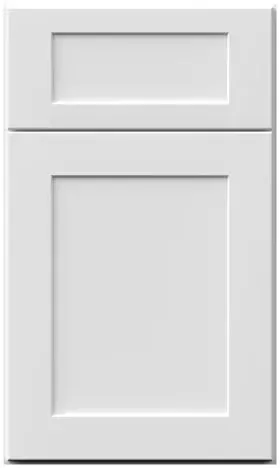
This door is a shaker: a recessed center panel inside a five-piece frame, polished flat. Its whole appeal is restraint — square edges, one shadow line, nothing competing. An onlay adds a second, curvier shadow inside the first, and in a lot of rooms those two details do not get along.
The failure looks specific when you see it: the eye reads the recessed panel, then reads the ornament inside it, and neither is allowed to be the point. In a small bathroom, where you stand two feet from the door rather than eight, that competition is at close range and there is nowhere to look away to. Our view is that a shaker door in a small bath is finished as designed, and an onlay there reads as a decision made in a showroom rather than in the room.
The broader argument is in shaker versus slab and in contemporary versus transitional: every style has a native amount of detail, and adding more rarely reads as more expensive. It usually reads as unsure.
The rooms where it earns its place
There are real cases for it, and they have something in common: the vanity is already trying to be furniture rather than casework.
- A vanity standing on a platform and feet. Once the box is up on legs it has stopped being a built-in, and ornament belongs on furniture. The platform and foot assemblies are the parts that get it there.
- A large primary bath with height to spare. Ornament needs distance and a tall room to sit in. Across eight feet in a room with molding and a framed mirror, it works the way it is meant to.
- A period house where flat shaker would be the anachronism. In a Victorian or a colonial, plain cabinetry can read as the modern intrusion rather than the safe choice.
- A single accent, not a scheme. One onlay on one focal vanity is a gesture. The same detail repeated on every door in a bathroom is a pattern, and patterns date faster than plain surfaces do.
Three practical consequences nobody mentions
Assume you want it. Three things change about the vanity afterwards.
Cleaning gets slower. Every profile in a bathroom collects dust, and near a shower it collects the film that hairspray and steam leave behind. A flat door wipes in one pass; a figured one needs a brush at the edges. Our care guide covers what is safe on a painted finish and what strips it.
Touch-ups get harder. A chip on a flat painted face can be blended by almost anyone. A chip on an applied edge shows a hard line, and paint sits differently where the two pieces meet. If the bathroom belongs to children, weigh that.
And resale gets narrower. Plain white shaker is the most broadly acceptable cabinetry there is, which is a large part of why people buy this finish. Ornament is a taste, and tastes divide a buyer pool. That is not an argument against it in a house you are staying in — it is a clear argument against it in a flip.
Common questions
- What is a decorative onlay?
- Ornament produced as its own component and then fixed onto a door or panel with adhesive or pins, rather than cut out of the door itself. It sits slightly proud of the surface, and the shadow line it throws is the effect you are paying for.
- What size is it and is it painted to match?
- We cannot confirm the finished dimensions, the substrate or whether it ships finished in Frost or as raw material, so ask us for all three in writing before ordering. Anyone who answers those from memory rather than from the spec sheet is guessing.
- Will it look right on a shaker door?
- Sometimes. It works on a vanity that is already reading as furniture — up on a platform and feet, in a large or period room. It works badly at close range in a small bathroom, where the recessed panel and the ornament compete and neither wins.
- Can it be removed later if I change my mind?
- Not cleanly. An applied piece pulled off a painted door takes finish with it and leaves an outline. Test the position with a paper template taped to the door for a week before you commit.
- Is there a cheaper way to get the same effect?
- Yes — hardware. Changing knobs and pulls shifts how a vanity reads for a fraction of $425 and is completely reversible. Try that first if what you want is warmth rather than ornament specifically.
Keep reading
The guides behind the numbers on this page.
- Shaker vs Slab Cabinets
Why each door style has a native amount of detail worth respecting.
- Contemporary vs Transitional Kitchen Cabinets
Where ornament belongs on the style spectrum, and where it jars.
- Kitchen Cabinet Molding Types
The applied-trim family an onlay is one member of.
- How to Clean and Care for Kitchen Cabinets
What a profiled surface costs you in a steamy room, weekly.
- Kitchen Cabinet Terminology: Parts and Abbreviations
Onlay, applique, appliqué and overlay, finally separated.
- White Kitchen Cabinets: Finding Your Perfect Shade
Why a match between an applied part and a door is worth confirming.


