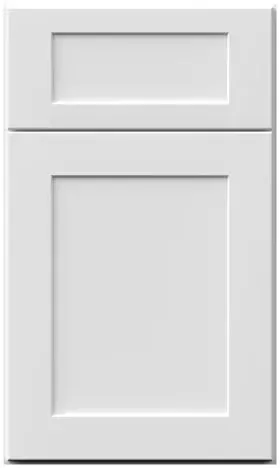



Reading a Fabuwood Galaxy Frost vanity side panel code before you order one
Reviewed September 2026 · Captivating Cabinets
Every code on this page ends in a cabinet size — V24 through V60, plus TP1821 for the tall pantry — and that trailing code carries more weight than anything else on the line item. A Fabuwood Galaxy Frost vanity side panel is catalogued against the box it belongs to, not against the room, so the code has to follow the cabinet you actually buy. It is also the one page in this range where we want you to check the part description with us before you order, for a reason we will get to in the second section.
Six families, and what the letters are telling you
This is not one part in six sizes. It is six code families running the same widths, and the letters split into two decisions: what sits in front of the P names the profile, and what follows it names what is underneath.
| Code pattern | Reads as | Price band |
|---|---|---|
| GF VPTF V24 → V60 | Vera profile, taper foot | $387 – $491 |
| GF VPCF V24 → V60 | Vera profile, cove foot | $387 – $491 |
| GF SPTF V24 → V60 | Shaker profile, taper foot | $387 – $491 |
| GF SPCF V24 → V60 | Shaker profile, cove foot | $387 – $491 |
| GF VPF / GF SPF V24 → V60 | The same two profiles with no foot | $218 – $322 |
| Anything ending TP1821 | The tall-pantry size, 18″ wide by 21″ deep | $410 – $579 |
The roughly $170 step between the footed families and the flat ones is the feet — the same money you would spend buying bun feet separately. Vera against shaker is the profile: shaker keeps the clean stepped line that matches the door, Vera carries more decorative shaping.
The tell is that these price by cabinet width
Here is what makes us pause. A part that finishes an exposed end is the same piece of material whether it closes out a 24″ vanity or a 60″ one — every bath box in this line shares one height and one depth, so those two numbers set the price and width never enters into it. Here the price climbs about $100 from V24 to V60, and width-driven pricing means the part spans the cabinet rather than standing beside it.
Follow the codes back to the manufacturer and that is what you find. Fabuwood catalogues this family as vanity platforms with feet, in two platform profiles — Vera and shaker — crossed with two foot styles, taper and cove. Distributor listings for identical codes carry titles like "Shaker Platform With Taper Feet For V24" at 24⅜″ W × 5″ H × 22⅛″ D. Note the ⅜″: wider than the 24″ cabinet, because a plinth shows a small reveal past the box it carries.
Better you hear that here than find it on the truck. If you need a flat finished end, ask us to quote that part against your specific cabinet rather than ordering off this list. If you want a vanity standing on feet like furniture, you are in the right place.
If what you actually need is a finished exposed end

Cabinet sides leave the factory as a working surface. Against a wall that is invisible and correct. In a bathroom, where a vanity usually ends in open floor on at least one side, it is the detail that quietly marks a job as cheap: a slightly flatter sheen and a visible band on the edge, read from the doorway without knowing what you are looking at.
Two costs come attached to fixing it, and both get missed on quotes. The countertop overhangs the finished side by roughly ¾″ to 1½″, and it has to come down on the face rather than stop short of it, so the fabricator and the cabinet order have to agree first. The second is the toe kick: stopping at the toe recess and carrying on down to the floor are two separate looks. Our guide to end panels, scribe molding and fillers covers how those parts divide the work.
Which profile and foot we would pick
Assuming you do want the furniture look, this is a style call rather than a performance one. Three opinions.
- Shaker profile with a taper foot is the default. It repeats the flat, square language of the Galaxy door instead of arguing with it.
- Vera profile with a cove foot is the traditional end of the range. It belongs in a room with paneled walls and a framed mirror, not in a builder-grade hall bath where it reads as costume.
- The footless versions give you a finished plinth without raising the cabinet 5″. If the height math above is what stopped you, that is the family to ask about.
Five things to settle before the order goes in
- Confirm which part you are buying — platform assembly or finished end — in writing, by description and not only by code.
- Pin the trailing code to the width you are genuinely ordering. Upsize a vanity late in the job and this part upsizes with it.
- Get the finished counter height in numbers — cabinet, anything under it, plus the top — and check it against 36″.
- Agree the countertop overhang with whoever templates the stone, and settle the toe-kick treatment in the same conversation.
The rest of this range is quicker to specify: the bun feet that sit under a platform, the decorative onlay for the door face, and four interior parts — an organizer pull-out, a U-shaped under-sink unit, a grooming organizer and a door-mounted appliance rack. All seven sit together on the vanity accessories page, and the cabinets they attach to are on the vanities page.
Common questions
- What does the V24 or V60 at the end of the code mean?
- It names the cabinet the part is built for, not the part itself. V24 through V60 are vanity widths and TP1821 is the tall pantry at 18″ wide by 21″ deep. Because the code follows the cabinet, changing your vanity width late in a job changes this line item too.
- What is the difference between the VPTF, VPCF, SPTF and SPCF codes?
- Two profiles crossed with two feet. VP is the Vera profile and SP the shaker; TF is a taper foot and CF a cove foot. The VPF and SPF codes are the same two profiles with no foot attached, which is why they run roughly $170 less.
- Are these flat panels I can cut down on site?
- No. Nothing in this range is a sheet of material to be cut. Each part is built to a specific cabinet size, which is what the trailing code is telling you, and the only site work intended is scribing to a wall.
- Do I need one for every side of my vanity?
- Only for sides that people see. An end hidden by a wall, a tub or a neighboring cabinet needs nothing at all, and nobody should be selling you a finishing part for a face that never comes into view. Count the exposed ends in the room first, then count line items.
- What do these cost?
- Sale prices on this page run about $218 for the narrowest footless version to about $579 for a tall-pantry size, with most vanity widths landing between $387 and $491. Prices step up with the cabinet width the part is built for.
Keep reading
The guides behind the numbers on this page.
- Cabinet End Panels, Scribe Molding and Fillers Explained
Which of the three parts solves which gap, with the measuring order.
- How to Read Cabinet SKU Codes
Why a part code names a cabinet, and how to sanity-check a quote line.
- Kitchen Cabinet Terminology: Parts and Abbreviations
Plinth, toe kick, reveal and scribe, defined in plain language.
- Fabuwood Cabinet Sizes and Specs
The box dimensions you need for the finished-height arithmetic.
- Fabuwood Bathroom Vanities: Sizes, Styles and Buying Guide
The vanity widths these parts are ordered against.
- Fabuwood Cabinets Price List
Where accessory line items sit next to the cabinets themselves.


