

Finished sides, panels and pull-outs: the parts that make a vanity look built in
Reviewed September 2026 · Captivating Cabinets
The gap between a vanity that looks built in and one that looks like a box shoved against a wall is almost always a single part: a finished exposed side. Galaxy Frost vanity accessories cover that side, plus the pull-outs that make the inside worth opening. This page is about which part you need and how it is ordered — line items that are easy to leave off a quote and expensive to add after delivery.
Why the exposed side is the whole game

Cabinet sides ship as a working surface, not a display surface. That is fine when the side is buried against a wall or another cabinet, which is how most kitchen boxes live. In a bathroom it usually is not: a vanity floats between a door and a tub, or ends at a walkway, and at least one side is in full view from the doorway.
A side panel is a piece of the same painted material, made to be seen, that covers that side. It is what makes the cabinet read as furniture rather than as casework, and it is the detail that gives away a budget job when it is missing — you see it immediately as a slightly different sheen and a visible edge band on the side of an otherwise nice vanity.
They are also the fix for a side you cannot move. Next to a doorway casing or a tub apron with an awkward reveal, a panel plus scribe gives you something to cut to. Our guide to end panels, scribe molding and fillers walks through how the three parts work together on a run.
Flat panel or shaker panel
This range carries both, and the choice is not just taste — it changes how the vanity reads from across the room.
| Profile | SKU pattern | Choose it when |
|---|---|---|
| Flat / tall panel | GF VPTF V24 → V60, GF SPTF V24 → V60, plus TP1821 for a tall pantry | The side is a quiet surface: tight against a wall, in a narrow bath, or where a stone waterfall or tile is doing the visual work. It is also the safer pick beside a shower, where a recessed panel gives water somewhere to sit. |
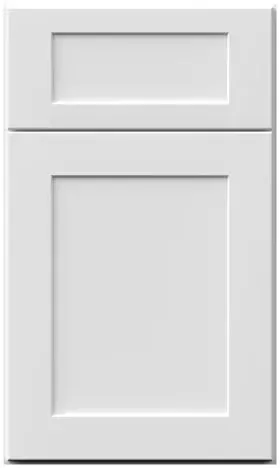
| Shaker panel | GF VPCF V36 → V60, plus TP1821 | The side is on show — a vanity that ends in open floor, or an island-style piece in a large bath. The recessed panel repeats the door line, so the side matches the front instead of just matching the color. |
Our default is a shaker panel where the side is genuinely on display and a flat panel everywhere else. Two reasons: a flat panel costs less, and a recessed panel next to a door reads busy when the two are only inches apart. If the vanity sits in a corner with only the front visible, you need neither — do not let anyone sell you a panel for a side nobody sees.
How a panel is actually ordered
A panel is not a sheet of material you cut down. It is catalogued against the cabinet it finishes, which is what the trailing code means: V24, V30, V36, V42, V48 and V60 map to the vanity they belong beside, and TP1821 is the tall-pantry version. You order the panel that matches the box, so the height and depth arrive correct and the only site work is scribing to the wall.
That also means the panel follows the cabinet, not the room. Change the vanity from 36″ to 42″ late in the job and the panel changes with it — a mismatch you will not notice on a purchase order and will notice on install day.
Note the two code families in the list. VPTF and VPCF are the vanity panels; SPTF is the plain side panel in the same heights. If your quote carries one where you expected the other, ask before it ships rather than after. Codes across the whole catalog are decoded in our cabinet SKU guide and the terminology glossary.
The inside: pull-outs, and the one built for a trap

A bathroom cabinet is mostly dead volume. The bowl and the trap eat the middle, the doors block the corners, and whatever goes in the back never comes out. The organizers in this range each target one of those problems.
- GF UVTCPO-30 BLUM — a U-shaped sink-base organizer. The cut-out in the middle is the point: it slides around a P-trap instead of stopping at it, which is the only way to use the floor of a sink cabinet. Order it once the drain position is known, not before.
- GF VOPO-24 BLUM — a vanity pull-out at 24″, on Blum runners. The general-purpose fix for a door cabinet where the back half has become a graveyard.
- GF VGO12FD BLUM — a 12″ full-door garbage pull-out. Worth its own narrow cabinet in a shared bath; the full-door version means the front is a door, not a false panel, so it disappears into the run.
- GF VASR-30 — an appliance storage rack sized for a 30″ cabinet. Built for the hairdryer and straightener problem: hot tools with cords, stored somewhere that is not a drawer full of everything else.
- GF VDO — a decorative onlay. Trim applied to a door or panel face when you want the vanity to read a step more formal than plain shaker. Skip it in a small bath; it reads fussy at close range.
Line items here span roughly $43 to $1,557 — an onlay and a full-height panel are not remotely the same purchase. Decide panels first, since they are structural to how the room looks; pull-outs can be added later, though they are cheaper to fit before the countertop is set.
A short checklist before the order goes in
Most of the omissions we catch on bath quotes are on this page rather than the cabinet page, because panels and organizers are the parts people assume are included.
- Walk the room and count the visible cabinet sides. Every one of them needs a panel; every one that does not, does not.
- Decide flat or shaker for each visible side, then match the trailing code to the cabinet width you are actually buying.
- Confirm the countertop overhang and the toe-kick treatment with the fabricator.
- Wait on the U-shaped organizer until the plumber has set the drain, then order to the trap position.
- Add the garbage pull-out at the design stage if you want it, because it usually wants a dedicated 12″ cabinet in the run.
If you would rather have this drawn than counted, send dimensions and photos and we will lay it out — a free 3D design catches the missing panel before you have paid for anything. The cabinets these parts attach to are on the vanities page, lowered versions are on the accessible base cabinets page, and kitchen-side organizers, lighting and moldings live under cabinet accessories and decorative accessories.
Common questions
- Do I need a side panel for my vanity?
- Only for sides that are visible. Cabinet sides ship as a working surface rather than a display surface, so an exposed side without a panel shows a different sheen and a visible edge. A side buried against a wall or another cabinet needs nothing.
- What is the difference between the flat and shaker vanity panels?
- The flat panels (VPTF and SPTF codes) are a smooth painted surface; the shaker panels (VPCF codes) carry a recessed panel that repeats the door line. Use shaker where the side is genuinely on show, flat where it is quiet or near water.
- What size panel do I order?
- The one that matches your cabinet. The trailing code — V24 through V60, or TP1821 for the tall pantry — names the cabinet the panel belongs to, so height and depth come correct and the only site work is scribing to the wall.
- Will a pull-out organizer fit around the plumbing?
- The U-shaped sink-base unit is built for exactly that: the cut-out clears a P-trap so the floor of the cabinet becomes usable. Order it after the drain is roughed in, because trap position decides whether it fits.
- Can I add these after the vanity is installed?
- Organizers and pull-outs, yes — though they are easier to fit before the countertop is set. Panels are harder, because scribing a panel against a finished wall and an installed top is fussier than doing it during the install.
- What do these parts cost?
- Line items on this page currently run from about $43 to about $1,557. A decorative onlay sits at the bottom of that band and a full-height panel near the top, so price the specific part rather than the category.
Keep reading
The guides behind the numbers on this page.
- Cabinet End Panels, Scribe Molding and Fillers Explained
The three finishing parts that separate cabinetry from boxes.
- Beam-Mounted Pull-Out Cabinet Accessories
How a pull-out mounts, and why the mounting style decides fit.
- Space-Saving Cabinet Solutions
Organizers that earn their price in a small cabinet.
- Kitchen Cabinet Terminology: A Glossary of Parts and Abbreviations
Look up onlay, scribe, toe kick and the rest in one place.
- How to Read Cabinet SKU Codes
Why a panel code carries the cabinet it belongs to.
- Fabuwood Bathroom Vanities: Sizes, Styles and Buying Guide
The cabinets these parts are ordered against.
- Why Blum Soft-Close Hinges Are Worth the Investment
The hardware brand behind the pull-outs on this page.


