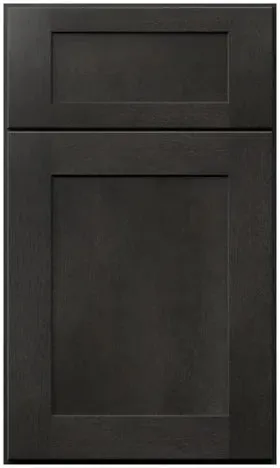



Galaxy Cobblestone vanity cabinets: living with a dark bathroom vanity, from splatter to bulbs
Reviewed September 2026 · Captivating Cabinets
A dark vanity is the most common way to give a white bathroom some weight, and the most common way to be surprised by it a month later. Galaxy Cobblestone vanity cabinets are Fabuwood's Galaxy shaker in a gray-brown stain dark enough to read as near-black across the room, with the grain still visible up close. This page is about owning one: which everyday marks show on a finish this deep and which disappear into it, how much of it a small room can take, and what the top, the floor, the bulbs and the pulls need to be for the box to look like furniture rather than a shadow.
Why the dark goes low in a bathroom

Rooms read heaviest at the floor and lightest at the ceiling, and a bathroom is mostly pale surfaces — porcelain, tile, mirror, white trim. Put the one dark element at knee height and the room gains a base without losing any of its brightness at eye level. That is why dark bases are the standing choice for vanities, the same way this finish is most often specified for islands and lower runs in kitchens: it grounds the room without closing it in.
The Cobblestone collection copy calls the colour a cross between traditional brown and transitional dark grey, and that is the useful way to think about it. Beside a white tub and chrome it leans gray; beside a warm oak floor and brass it leans brown. It is not black — Galaxy Pitch Black is the finish for that — and it is not a cool blue-gray charcoal. Because it is a stain rather than an opaque coat, the grain of the frame shows through, so the door has texture at arm's length and reads as a solid dark block only from the doorway.
Do dark vanities show dust and water spots? What this one shows, and what it hides
Every finish hides some dirt and advertises the rest. A white vanity hides powder and shows grime around the pulls; a dark one reverses most of that. The table is sorted by what happens in a bathroom rather than a kitchen, because the residue is different — less grease, far more toothpaste, soap and mineral water.
| Mark | On this finish | Why | What to do |
|---|---|---|---|
| Toothpaste and soap splatter below the bowl | Shows | Pale specks on a dark face are the highest-contrast mark in the room | A damp microfiber pass on the doors under the basin, twice a week |
| Hard-water rings and drip lines | Shows | Dissolved minerals dry white; the false front and top rail catch the drips | Dry splashes the same day; a mild vinegar-water wipe, then dry |
| Face powder, talc, dry shampoo | Shows | Fine pale dust settles on every horizontal edge of the shaker frame | A soft dry brush along the rail tops before any damp cloth |
| Lint and dust along the toe kick | Shows in low sun | Raking light from a window picks out anything on a dark horizontal | The vacuum's brush head along the kick weekly |
| Blond or gray hair | Shows | Light strands against a dark door | Same as the lint |
| Skin oil and grime around the pulls | Mostly hides | Oil darkens a surface; on a finish this deep there is nowhere darker to go | An occasional wipe; this is where dark earns its keep |
| Hairline scratches and small dings | Mostly hides | A scratch exposes lighter wood, but the grain lines around it break it up | Touch up only what you can see standing; confirm the product with your designer |
The pattern is simple: anything pale that lands on the doors shows, and anything that darkens them does not. In a family bathroom with a toothpaste-happy seven-year-old, that is a real maintenance difference from a white box, and it is worth being honest with yourself about it before ordering. In a primary bath used by two adults, or a powder room guests use twice a week, most owners find the trade easy — the pull zones that turn a white vanity gray by spring stay clean-looking for years. The cabinet care guide covers which cleaners are safe on a finished door; avoid anything abrasive on a stain, since scrubbing a spot can leave a dull patch that shows worse than the spot did.
How much dark a room can carry: builds sized by bathroom, not by wall
On a light finish the question is simply what fits the wall. On a finish this deep there is a second question — how much dark surface the room can take before the vanity starts to dominate it. A 60″ run of near-black in a spacious primary bath is a piece of furniture; the same 60″ in a narrow, windowless hall bath is most of what you see from the door. The table sets the common bathrooms against a build we would actually draw, with the displayed price for the cabinets alone.
| Bathroom | Build | Cabinets | How the dark reads |
|---|---|---|---|
| Powder room, often windowless | GC VSB24-34 | $438.75 | Small enough to be a jewel-box moment; keep the walls and top light |
| Small hall bath, one window | GC VSD30DL or GC VSD30DR | $757.25 | The drawer fronts and pulls break the dark face into bands |
| Hall bath, 36″ wall | GC VSD36DL or DR — or GC VSB36-34 alone | $783.25 — or $490.75 | The plain sink base is two broad dark doors; the combo is busier and lighter-looking |
| Family bath, 48″ wall | GC VSD48 — or GC VSB30-34 + GC VDB18-34 | $975.00 — or $1,134.25 | At this width the top colour starts to matter more than the cabinet |
| Primary bath, 60″ wall | GC VSD60DOUBLE or GC VSD60SINGLE | $1,046.50 or $1,196.00 | Reads as a dresser; this is the room the finish is happiest in |
| Primary bath, 72″ wall | GC VSB30-34 × 2 + GC VDB12-34 | $1,524.25 | Break the run visually with a mirror per bowl rather than one long glass |
| Over the toilet | GC WVS2430 | $490.75 | Dark at eye level: fine in a large room, heavy in a small one |
Two things push a small bathroom toward the smaller or busier build. Pulls and drawer seams interrupt a dark face and make it read as several pieces, which is why a combo looks lighter than a plain sink base of the same width even though it is the same colour. And the wall cabinet is the one box here we talk people out of in small rooms: a dark upper at head height closes in the space in a way a dark base never does. If one is needed there, a lighter finish above the toilet is a legitimate two-tone choice. Which side of a combo the bowl belongs on, and how the one-bowl and two-bowl 60″ options differ, are finish-neutral questions answered in the Fabuwood vanity buying guide.
The top, the floor and the bulbs around a dark gray-brown vanity
A dark cabinet absorbs light instead of bouncing it, so the things around it have to do the bouncing. Three surfaces decide whether the vanity looks rich or like a gap in the room.
- The top. A white or warm-white quartz, or a marble with soft gray veining, makes a bright shelf that separates the dark base from the tile and throws light back up into the basin. A black or very dark top turns the vanity into one block — striking in a large room with good light, oppressive in a small one. Mid-gray tops are the only real miss: they sit too close in value to the cabinet and neither reads.
- The floor. The brown half of this colour shows most against the floor. Warm oak or a walnut-toned plank brings it out and makes the vanity look like stained furniture; a cool gray porcelain pulls it toward charcoal. Neither is wrong, but pick the floor with the door sample lying on it, because the vanity will read differently on each.
- The bulbs. Put light on the face of the person, not down onto the cabinet: sconces either side of the mirror at 2700–3000K. A single downlight over a dark vanity puts the doors in their own shadow and makes the basin area dim. Under-cabinet or toe-kick strip lighting is a nice touch on a finish this deep, since it lifts the box off the floor visually at night.
One practical upside: the interior of the box is a natural wood veneer, lighter than the stained outside, so opening a door does not mean peering into a dark cave for the spare toothpaste. The countertop and flooring guide walks through contrast pairings in more depth.
Hardware on a dark vanity: what pops and what vanishes
On a white door almost any pull is visible. On this one, the metal either becomes the jewellery of the vanity or disappears into it. Brass, champagne bronze and polished nickel all catch light against the dark stain and read clearly from the doorway — brass and champagne warm up the brown side of the colour, polished nickel sharpens the gray. Matte black pulls vanish almost completely; that is a valid choice if you want a quiet, near-handleless face, but know that you are choosing it, and expect people to feel for the pull in a dim room.
Match the pulls to the faucet rather than to the towel bars, because the faucet sits right above them and the eye compares the two. Longer bar pulls on the drawer fronts of a combo also help the dark face read as horizontal bands, which makes a narrow bathroom feel wider. If you are torn between two metals, tape both to a $25.00 door sample and look at it with only the vanity lights on.
The boxes, the prices and what ships with them
The range is the same as every Galaxy colour: bases 34½″ tall and 21″ deep, with no lowered accessible box offered in Cobblestone. Sink bases run GC VSB21-34 to GC VSB42-34 at $422.50 to $542.75; door-under-drawer vanity bases GC VB12-34 to GC VB30-34 at $364.00 to $555.75; full-height single-door bases GC VB12FD to GC VB36FD at $328.25 to $490.75; drawer bases GC VDB12-34 to GC VDB33-34 at $601.25 to $877.50, with no 30″ size; sink-and-drawer combos from $757.25 to $1,196.00; and the one wall cabinet, GC WVS2430, at $490.75.
Everything arrives pre-assembled, typically in 7 days to 3 weeks, with the limited lifetime warranty, dovetailed solid-wood drawer boxes and Blum soft-close hinges and runners — the construction shared with the base, wall and tall cabinets in the Cobblestone collection. A side of the vanity that faces the room needs a factory finish in the same stain; the listings describe a finished-side option at $96 per side, and the panel and platform families are on the vanity accessories page. If the room is small and dark and you are wavering, the Cobblestone versus Nickel comparison is the honest next read. Our design service will draw the bathroom from a photo and a tape measure in 3–5 business days, and trade buyers should start at Captivating Pro.
Common questions
- Do dark bathroom vanities show dust and water spots?
- Pale marks, yes: toothpaste splatter, dried hard-water drips, face powder and lint all show on a finish this dark, mostly on the doors under the basin and the tops of the rails. Skin oil and grime around the pulls, and small scratches broken up by the grain, mostly do not. A twice-weekly damp microfiber pass handles it.
- Is Galaxy Cobblestone black, brown or gray?
- None of the three exactly. It is a very dark gray-brown stain with the grain visible — Fabuwood describes it as a cross between traditional brown and transitional dark grey. It leans brown beside warm wood and brass and gray beside chrome and white tile. Galaxy Pitch Black is the actual black.
- Is a dark vanity a bad idea in a small bathroom?
- Not if it stays low and the rest of the room stays light. Keep the top, walls and tile pale, choose a combo with drawers rather than a plain two-door box so the face is broken up, and skip a dark wall cabinet over the toilet. A windowless room also needs good mirror lighting at 2700–3000K.
- What countertop goes with a dark gray-brown vanity?
- A white or warm-white quartz, or a softly veined marble look, gives the clearest contrast and bounces light into the basin. A black top makes one dark block, which suits large bright rooms. Avoid mid-gray tops; they sit too close in value to the cabinet.
- What hardware looks best on a Cobblestone vanity?
- Brass, champagne bronze and polished nickel all read clearly against it. Matte black nearly disappears, which works only if you want a quiet, almost handleless look. Match the pulls to the faucet directly above them.
- How much does a Galaxy Cobblestone vanity cost?
- Cabinets only, at the displayed prices: a 24″ sink base is $438.75, a 36″ sink-and-drawer combo $783.25, the 48″ combo $975.00, and the 60″ combos $1,046.50 (two bowls) or $1,196.00 (one bowl). Tops, sinks and faucets are separate.
Keep reading
The guides behind the numbers on this page.
- How to Clean and Care for Cabinets
The soft-cloth routine that keeps pale splatter and water rings off a dark door.
- Brown Kitchen Cabinets: Stains, Shades and Pairings
Where a gray-brown stain sits against the warmer browns, and what each pairs with.
- Gray Kitchen Cabinets: Finding the Right Shade
The charcoal end of the gray range, and why undertone matters more the darker you go.
- Fabuwood Cobblestone vs Nickel
The same door two rungs lighter, for a bathroom that cannot carry this much depth.
- How to Match Cabinets, Countertops, Backsplash and Flooring
Choosing the pale top and the floor that let a dark base look intended.
- Fabuwood Bathroom Vanities: Sizes, Styles and Buying Guide
Every vanity configuration the brand builds, whatever the finish.
- Kitchen Cabinet Samples: How to Order and Evaluate
Why a dark sample has to be judged at night, under the bulbs you will actually fit.


