

Galaxy Dove glass doors: the cheapest second tone an off-white kitchen can have
Reviewed September 2026 · Captivating Cabinets
The usual reason to buy a glass front is to break up a wall of white. The reason to buy one from the Galaxy Dove glass doors list is different, and better: on an off-white kitchen a glass cabinet is a small, cheap place to introduce a second tone — a navy back panel, a walnut lining, black knobs, a shelf of amber glassware — without committing to a second cabinet color. A Timber island is a two-tone kitchen for thousands; a lined back panel behind a $139.75 glass unit is a two-tone kitchen for the price of paint, and it can be changed on a Saturday. This page is about using it that way.
What goes behind the glass decides what the off-white frame looks like

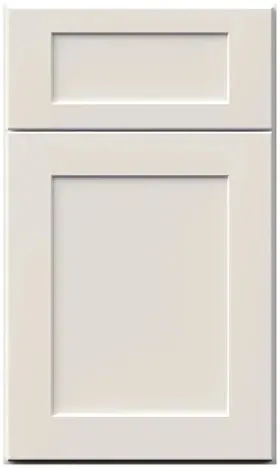
The frame is Dove: a soft white with a warm undertone that still counts as white. Every Allure Galaxy box ships with a natural wood veneer inside — the interior is not painted — so the default view through the glass is a warm tan behind a warm white: a coherent pair, and the reason a single glass unit reads as depth rather than as a hole. Change what is behind or on the glass and you change how the frame reads. This is the lever, and it costs almost nothing to pull.
| Treatment | What the frame reads as | Cost | Where it belongs |
|---|---|---|---|
| Veneer as shipped | Warm white over warm wood; the quiet default | Nothing | Everywhere, unless the plan needs contrast |
| Back panel lined navy or charcoal | The white looks crisper and a shade brighter by contrast; the unit becomes a shadow box | Paint, or a sheet of lined board | One or two units, flanking the hood, in a kitchen with an Indigo island or black hardware |
| Back panel lined in walnut or oak veneer | Repeats a Timber island or a wood hood inside the perimeter | A veneer sheet | A Dove-over-Timber kitchen with no other wood on the upper wall |
| Back panel painted white | A bright window; the frame reads warmer here than anywhere else in the room | Paint | Only if you want the warmth noticed — most people do not |
| Matte black knobs on the glass doors alone | A graphic accent Dove carries cleanly, where a beige would not | Hardware | When the rest of the run is brass, or the same black |
| Clear glassware, amber bottles, wood bowls on the shelves | The contents supply the color; the frame stays white | Things you already own | Any unit, any plan |
Line the back while the box is empty; with the shelves loaded it is an afternoon’s job instead of ten minutes. Decide about the shelves at the same time — tan veneer shelves against a navy back look unfinished unless their front edges get the same color.
What white dishes do to an off-white frame
The thing nobody warns you about: a stack of bright white plates behind a Dove door is the near-match problem in a box. The plates are a colder white than the frame, so the frame reads a shade creamier than it does over a solid door two feet away, and on a kitchen chosen because it reads as white, that is exactly the effect you did not buy. The fix is not to avoid dishes; it is to notice which ones. Stoneware in cream, clear or smoked glass, wood, a row of the same amber bottles — anything that is not a brighter white than the door — leaves the frame reading white. If the collection is bright white china, line the back navy, and the plates become the bright thing on purpose.
On repetition the rule is the same in every finish: six of one thing beats twenty of everything, and a glass front is a standing promise to keep one cabinet tidy. If nobody in the house will keep it, a solid upper in the same size costs more and disappoints less.
This is also where a Dove kitchen photographs. In a listing photo the whole room reads as a white kitchen; the glass units are where the camera finds depth and a second color, and that is worth more at resale than a third row of solid doors. The 27 kitchen cabinet ideas round-up has rooms where a pair of glass fronts does the work of the whole photograph.
Which glass cabinet size for which spot on the wall
Each line here is a whole wall cabinet — box, glass front, hardware — at one width and one height, and it takes the place of a solid upper in the box list; it is not a door to fit onto a cabinet you own. The SKU carries both dimensions: GDW1836 is 18″ wide, 36″ high. Rather than the whole grid, here are the units for the spots a glass front usually goes, in each of the three common upper heights.
| Spot | 30″ uppers | 36″ uppers | 42″ uppers |
|---|---|---|---|
| Either side of a 36″ hood, 15″ wide | GDW1530 $97.50 | GDW1536 $117.00 | GDW1542 $139.75 |
| Either side of a 30″ hood, 18″ wide | GDW1830 $117.00 | GDW1836 $139.75 | GDW1842 $162.50 |
| Over a coffee or bar counter, 24″ | GDW2430 $165.75 | GDW2436 $201.50 | GDW2442 $234.00 |
| A display pair over a sideboard run, 30″ | GDW3030 $201.50 | GDW3036 $234.00 | GDW3042 $279.50 |
| One wide statement unit, 36″ | GDW3630 $234.00 | GDW3636 $279.50 | GDW3642 $321.75 |
| The upper corner, 24″ diagonal | GDWDC2430 $100.75 | GDWDC2436 $117.00 | GDWDC2442 $139.75 |
| A column beside the refrigerator | GDWD1860, 18″ × 60″, $188.50 | same unit | same unit |
The 39″ height is the answer for an 8-foot ceiling with a soffit or a built-up crown, where 36″ stops short and 42″ does not fit: GDW1539 $126.75, 1839 $146.25, 2439 $107.25, 3039 $126.75, 3639 $146.25, and the corner GDWDC2439 at $126.75. Three of those — the 24″, 30″ and 36″ widths — currently list below their own 36″-high neighbors, which we quote as shown but would confirm on a written quote before anyone plans a wall around it.
Keep the unit at the same height as the solid uppers on either side so it shares their top line; the upper cabinet height guide walks the ceiling arithmetic. And before comparing these numbers with another quote, have us confirm what the SKU ships as — the titles say “Wall Glass Door Cabinet”, the prices sit well under a solid cabinet of the same size, and two quotes only line up when both sides mean the same thing.
Lighting inside a glass cabinet without greying the door
An unlit glass front is a dark square after sunset. On an off-white wall it is also the one place the finish can be pushed grey from the inside, because the interior light shines out through the door and onto the frame. So the color of the strip matters twice. A cool 4000K strip turns the veneer grey-brown and pulls the Dove frame toward the grey it can drift to in a dim room anyway; at 2700–3000K the veneer stays golden and the frame stays white with a little warmth, and that is the only range we put behind glass on this finish. A navy-lined back follows the same rule — cool light makes navy look black, warm light lets it read blue.
Everything needed is on the cabinet accessories page — the 48″ interior strip (GD LED CAB INT, $221.00) for a wide or tall box, a $71.50 2-1/4″ puck for a corner unit, the $204.75 driver and the $221.00 wireless switch. No color temperature is published for either fixture; get the spec from us, or fit the $286.00 tunable strip and dial it in. Give the interior lights a switch of their own: what you want at nine in the evening is not what you want at seven in the morning.
Where glass belongs in a two-tone plan
On an all-Dove kitchen, glass goes where the eye already lands: flanking the hood, in the upper corner, as one column by the refrigerator. On a two-tone plan add one consideration — the island. The glass units usually sit on the wall the island faces, which means they are seen with the island in the same frame, and they should agree with it. Indigo island: line the backs navy, or leave the veneer and keep the glassware clear. Timber island: veneer or a wood lining, never a painted white back, which would make the frame look creamier next to the wood. Two units, occasionally three; four reads as a hutch.
What gets ordered with it: a wall skin at $50.05 for an exposed side and the crown the rest of the wall uses, both on the decorative accessories page; the stemware rack, STMW30 or STMW36 at $403.00 and $425.75, under it if the unit holds glassware; and, if the glass flanks a hood, the hood in the tone the plan has already chosen. A free 3D design places the glass in the run and shows it with the island from the doorway — the view that decides it — against the rest of the Dove collection.
Common questions
- Can I buy just the glass doors for off-white cabinets I already own?
- No — every SKU here is a whole wall cabinet with a glass front, at one width and one height, meant to take the place of a solid upper in the box list; the interior is the standard veneer rather than Dove paint. Change the line before the order ships.
- Is the inside of a Fabuwood glass cabinet painted to match the door?
- No. It is the natural wood veneer interior that every Allure Galaxy box has, which reads as a warm tan behind the off-white frame. Line or paint the back panel before the shelves go in if you want a navy, wood or white backdrop instead.
- What size glass cabinet goes either side of a 36 inch range hood?
- Usually 15″ wide at the height of the neighbouring uppers: GDW1530 at $97.50, GDW1536 at $117.00 or GDW1542 at $139.75. Beside a 30″ hood the 18″ units — $117.00, $139.75 and $162.50 — do the same job. Keep the height equal to the run so the glass shares its top line.
- Should the light inside a glass cabinet be warm or cool with off-white cabinets?
- Warm, 2700–3000K. Cool light greys the veneer and pushes the Dove frame toward grey from the inside. The 48″ interior strip, a puck, the driver and a switch are on the cabinet accessories page; get the color-temperature spec, or fit the tunable strip.
- What should I put in glass front cabinets with off-white doors?
- Anything that is not a brighter white than the door: clear or smoked glass, cream stoneware, wood, matching amber bottles. Bright white plates make the frame read creamier by contrast; if that is the collection, line the back panel navy so the plates become the accent on purpose.
- How much is a 24 inch corner glass cabinet?
- GD GDWDC2430 is $100.75 at 30″ high, GDWDC2436 $117.00, GDWDC2439 $126.75 and GDWDC2442 $139.75. It replaces the diagonal corner upper, which is the least useful storage on the wall and the most visible spot for display.
Keep reading
The guides behind the numbers on this page.
- Glass Cabinet Doors: Buying Guide and Styles
Seeded, frosted and reeded glass each hide part of a lined back; clear shows all of it.
- 27 Kitchen Cabinet Ideas
Rooms where one or two glass fronts supply the second color.
- Black Kitchen Cabinets: Styles, Pairings and Care
Black as an accent on a light kitchen — knobs, a lined back — without a black cabinet.
- Fabuwood Cabinet Colors
Indigo and Timber, the island colors a lined glass back is usually matching.
- Wall and Tall Kitchen Cabinets: Sizes and Buying Guide
How an 8-, 9- or 10-foot ceiling picks the upper height, and therefore the glass unit.
- White Kitchen Cabinets: Finding Your Perfect Shade
Why bright white contents shift how an off-white frame reads.
- Kitchen Cabinet Samples: How to Order and Evaluate
Getting a door sample and using it for the lights-off test.


