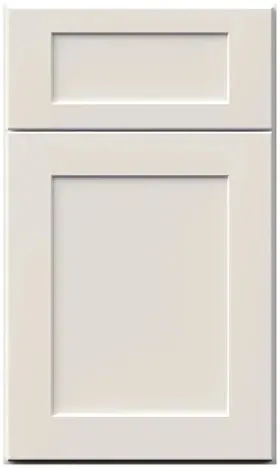


Galaxy Dove hoods: the one place an off-white kitchen gets its second tone
Reviewed September 2026 · Captivating Cabinets
Stand in the doorway of a finished kitchen and the range wall is the photograph. On an off-white kitchen that wall is where the question of a second tone gets answered, because the hood is the one large object on it that comes in something other than the cabinet color. The Galaxy Dove hoods list has every shell in a matched off-white and most of them in Timber or Walnut at the same price, which turns a hardware purchase into a design decision: does the range wall stay one soft white, or does the hood carry the wood the island already has — or the wood the kitchen has nowhere else? This page settles that first, then prices the parts that make the hood work.
Match the island, match the cabinets, or make the hood the warm thing

Three plans cover nearly every Dove kitchen we draw, and each one points at a different shell.
| The plan | The hood | Why | 36″ shell price |
|---|---|---|---|
| All Dove, one color | Matched shell, no tone suffix — RHA363021 or RHE36 | The wall reads as one soft white mass with the crown carried across; the hood is the focal point by shape, not color | $2,418.00 / $2,788.50 |
| Dove perimeter, Timber island | Timber shell — RHE36, RHS36 or RHF36 TIMBER | The hood repeats the island, so the room has one wood tone in two places, above and below | $2,788.50 / $2,944.50 / $4,043.00 |
| Dove perimeter, Indigo island | Matched shell | Indigo is not a hood tone on this list, and a wood hood over a navy island is a third color | $2,418.00 (RHA) and up |
| All Dove, no island, wants warmth | Walnut shell — RHS36 or RHCA36 WALNUT | The hood becomes the single warm object; cheaper than a wood island and easier to live with | $2,944.50 / $3,532.75 |
| Dove with black hardware and a black range | Matched, or Walnut | Dove carries matte black cleanly; a Walnut hood over a black range is warm on graphic, and it works | as above |
The third row is the one people get wrong. Dove goes over an Indigo island as often as over a Timber one, and the instinct is to give the navy-island kitchen a wood hood for warmth. It ends up as three ideas on one wall. Keep the hood off-white, let the island be the color, and put any wood in a floating shelf or the light bars instead.
One caution on the Timber row. The Timber offered on these shells and on the light bars is a tone name; we would set a Galaxy Timber door sample beside the shell tone before promising an exact match to a Timber island, and we will do that for you.
Which hood family for which look
Five shell families, each in three widths. The matched version has no suffix; Timber and Walnut are listed at the same price wherever they are offered, so the tone is free and the family is the price.
| Family | Shape from the doorway | Widths | Tones | From |
|---|---|---|---|---|
| RHA wall-mount | A plain box; RHA363021 reads as 36″ wide, 30″ high, 21″ deep | 36″, 42″, 48″ | Matched only | $2,418.00 |
| RHE chimney | A tapered canopy with a chimney above — the classic wood-hood silhouette | 30″, 36″, 42″ | Matched, Timber | $2,609.75 |
| RHS slim | The lightest profile; the one for a hood that should stay quiet | 30″, 36″, 42″ | Matched, Timber, Walnut | $2,785.25 |
| RHCA curved glass | A glass canopy on the shell; the only family besides RHA with a 48″ | 36″, 42″, 48″ | Matched, Timber, Walnut | $3,532.75 |
| RHF designer | The most sculpted shell, and the priciest | 30″, 36″, 42″ | Matched, Timber | $3,812.25 |
Read the table by the plan, not the price. An all-Dove wall wants RHA or RHE, matched, with the crown carried across. A Timber-island kitchen wants RHE or RHS in Timber — the chimney shape if the room leans classic, the slim if it leans modern. Walnut only exists on RHS and RHCA, so a walnut hood is a slim or a curved-glass hood by definition. Only RHA carries its height and depth in the SKU; for the others, ask for the spec sheet, because shell height sets the ceiling on the uppers beside it.
Prices climb with width inside each family: RHS at $2,785.25, $2,944.50 and $3,159.00 for 30, 36 and 42; RHCA at $3,532.75, $3,789.50 and $4,062.50 for 36, 42 and 48; RHE from $2,609.75 to $2,941.25; RHF from $3,812.25 to $4,277.00; RHA from $2,418.00 to $2,596.75.
Shell and blower: what a working hood costs
A shell on its own is a wooden box. Air is moved by the internal blower, sold separately — 250 CFM for $419.25, 400 for $903.50, 600 for $1,787.50 — and the cheapest working hood on the page is the 36″ RHA shell plus the 250 unit, $2,837.25, before anything above it. The listing called Duct Cover, GD RHBB DCT at $263.25, is not trim for the pipe above the shell: it is a recirculating kit for a hood that cannot vent outside, and GD RHBB FLTR at $71.50 is its charcoal refill. A vented hood needs neither — the chimney-style shells hide the duct in stacks that trim on site, and the plain box takes a bridge wall cabinet or a soffit above it.
Which blower is not a catalog question. It is set by the cooktop, by how far the duct travels and through how many elbows, and by whether the house can give back the air a 600 CFM unit removes — in a tightly sealed house that means make-up air, which is your installer’s call. Short and straight to an outside wall behind the range, 250 or 400 is realistic; a run that climbs through the ceiling and turns twice is where the 600 earns its price. And if the range wall has no route to the outside, the range moves, and every cabinet on that wall moves with it — so that is the first question, not the last.
- A 36″ Timber chimney over a Timber island, complete: RHE36 TIMBER $2,788.50, plus the 400 CFM blower $903.50 — $3,692.00.
- A 36″ Walnut slim as the one warm object on an all-Dove wall: RHS36 WALNUT $2,944.50, plus 400 CFM $903.50 — $3,848.00.
- A 48″ curved glass over a pro range, the top of the page: RHCA48 $4,062.50, plus 600 CFM $1,787.50 — $5,850.00.
Set any of those beside the FGDV10 10×10 kitchen, $3,500.00 and the hood is plainly the most expensive single object in a small kitchen. That is the argument for choosing its tone on purpose, in the first drawing, rather than defaulting to the matched shell because it was listed first.
Hood width for a 30-inch range, and what the extra six inches do to the uppers
A hood should cover at least the full cooktop, and most people go one size up — a 36″ shell over a 30″ range — because the edges of a cooktop are where the smoke gets away. The extra six inches come out of the cabinets beside it: a 36″ hood between two 15″ uppers fills 66″ of wall, and a 42″ pushes those uppers to 12″ or widens the fillers. Change the width late and the wall is redrawn, not adjusted. Mounting height above the cooktop is dictated by the appliance manual and local code; that number plus the shell height decides whether the wall cabinets beside it are 30″, 36″ or 42″ tall.
The finishing parts come from the decorative accessories page: fillers to close the gap between shell and uppers, skins on any side the hood leaves exposed, and — on a matched shell only — the same crown profile carried across the top, which is what makes an all-Dove range wall read as one piece. On a Timber or Walnut shell, leave the crown to the cabinets and let the hood be its own object; off-white crown over a wood shell looks like a hat.
A glass-front cabinet on each side of the hood is the classic symmetrical arrangement; on this finish it is also where the second tone can echo — a navy-lined back beside a matched hood over an Indigo island, or veneer beside a Timber shell. The range-wall measuring list sets out what to record before any of it is drawn.
How the range wall photographs, and why that matters at resale
Dove is bought by people who want a white kitchen without the clinical edge, and a fair number of them are thinking about the listing photos three years out. The range wall is the shot. A matched off-white hood photographs as a white kitchen, soft-edged, with the crown line the only detail — calm, and safe. A Timber or Walnut hood photographs as a white kitchen with a wood focal point, which is the picture people save, and it reads as a design choice rather than a color risk because the cabinets around it are still unmistakably white. Either way the kitchen stays in the white family, which is the whole point of the finish; a beige could not make the same promise with a wood hood on the wall.
Hardware finishes the picture. Brass on the doors with a Walnut hood is the warm version; matte black pulls with a matched hood is the graphic version, and Dove is the one warm light finish that carries black without looking like a mistake. Pick the hardware and the hood tone together — the 2026 styles and colors guide has the pairings we see most — and sample the shell tone beside a Dove door under the bulbs you will use, at 2700–3000K, before the order goes in.
Common questions
- Should a range hood match off-white cabinets or contrast with them?
- It depends on the island. All-Dove kitchen: match it, and carry the crown across so the wall reads as one piece. Timber island: a Timber shell, so the wood appears above and below. Indigo island: match it — a wood hood over a navy island is a third color. No island and the room wants warmth: a Walnut RHS or RHCA shell as the one warm object.
- Does the Fabuwood hood come with the blower?
- No. Shells are wood housings; the internal blower is its own line — $419.25 (250 CFM), $903.50 (400) or $1,787.50 (600) — and the recirculating kit ($263.25) and its charcoal refill ($71.50) are separate too, needed only if the hood cannot vent outside. The cheapest working combination is the 36″ RHA shell plus the 250 CFM unit, $2,837.25.
- How much does a 36 inch wood range hood cost from Fabuwood?
- Shells: RHA $2,418.00, RHE $2,788.50, RHS $2,944.50, RHCA $3,532.75, RHF $4,043.00, with Timber or Walnut at the same price where offered. Add a blower: a complete vented 36″ hood runs from $2,837.25 to $5,830.50 depending on which shell and which blower.
- Is there a walnut hood that works over off-white cabinets?
- Yes — six shells come in Walnut, RHS30/36/42 and RHCA36/42/48, at no premium over the matched version. Over Dove a walnut shell works as the single warm object on an off-white wall; over a bright white it reads sharper. Keep it the only walnut on the wall — not walnut bars and a walnut shelf as well.
- 400 CFM or 600 CFM: which blower goes in a wood hood?
- Neither number comes off a product page. It is set by the cooktop, by how far and through how many turns the duct travels, and by whether the house can supply make-up air. Short and straight to an outside wall, 250 or 400 usually does it; long with elbows is the 600’s job, at $1,787.50. We work it through with your installer from the layout and the range model.
- Is a 36 inch hood right for a 30 inch range?
- Usually, yes — one size up catches what escapes at the cooktop’s edges, and every family lists a 36″. Those six inches come out of the flanking uppers, so fix the width before the wall is drawn, and take the mounting height from the appliance manual and local code.
Keep reading
The guides behind the numbers on this page.
- Fabuwood Cabinet Colors
Dove next to Timber, Indigo and the wood tones, before two of them share a range wall.
- Black Kitchen Cabinets: Styles, Pairings and Care
The black-range, black-hardware version of an off-white kitchen, and what it wants over the range.
- Brown Kitchen Cabinets: Stains, Shades and Pairings
How walnut and weathered-brown tones behave beside a warm white.
- Kitchen Cabinet Molding Types
What the crown profile you run across a matched shell actually is.
- Important Kitchen Dimensions Before Buying Cabinets
The numbers that fix the hood width and the height of the uppers either side.
- Free 3D Kitchen Design
Seeing a Timber hood over a Dove wall from the doorway before you buy either.
- Kitchen Cabinet Styles and Color Trends for 2026
Warm-white kitchens with wood and black accents, photographed.
- Fabuwood Cabinets Price List
A $2,800 to $6,100 hood in proportion to the cabinet order around it.


