
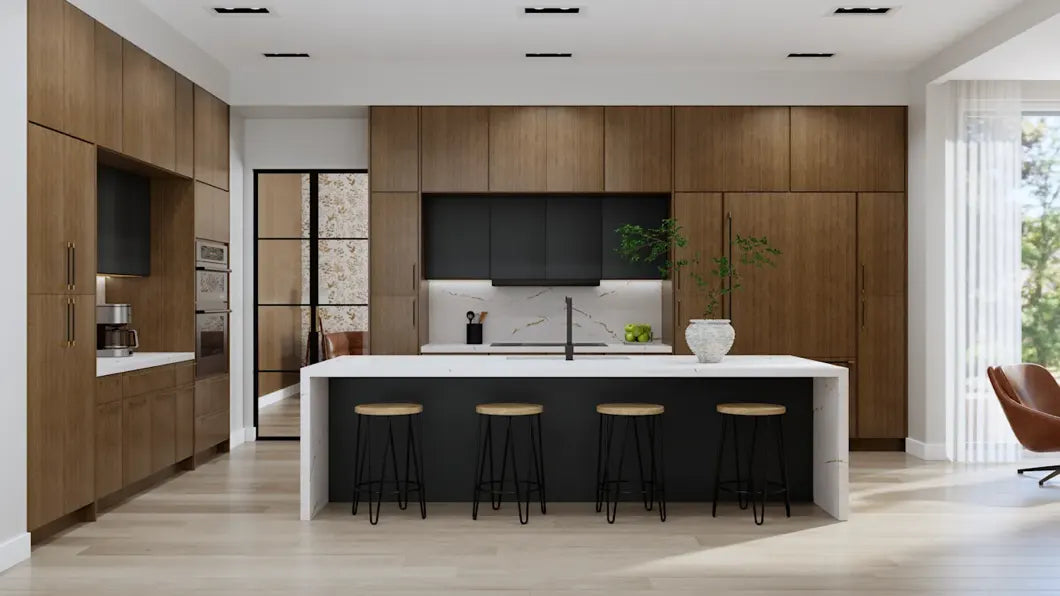
Fabuwood vs Cubitac
Two all-wood brands that both ship on Blum® soft-close — the real split is pre-assembled boxes versus ready-to-assemble value.
Fabuwood vs Cubitac is a closer match-up than most brand comparisons, because both run all-wood boxes, Blum® soft-close hardware, and CARB2-certified materials. The difference is workflow and lineup: Fabuwood ships every cabinet pre-assembled across three series with a limited lifetime warranty, while Cubitac — “For the People™” — leans on ready-to-assemble construction across four value-tiered collections (Imperial, Prestige, Basic, Presto). Here’s the line-by-line.
Fabuwood vs Cubitac at a Glance
Compared on 11 points, updated August 2026.
Swipe to compare →
| Fabuwood | Cubitac | |
|---|---|---|
| Assembly | Pre-assembled — dowel, glue & pocket-screw joinery | Ready-to-Assemble — cam-lock, ~10–15 min per cabinet (pre-assembled sometimes available) |
| Box construction | ½″ select solid wood, natural wood-veneer interior | ¾″ all-plywood boxes |
| Door material | Solid wood frames around a ⅜″ MDF center panel | Shaker, flat-panel, recessed-panel & slab doors across tiers |
| Drawer box | ⅝″ solid wood dovetail | Solid wood dovetail |
| Hardware | Blum® — Blumotion hinges, Tandem plus concealed runners | BLUM soft-close hinges & undermount slides |
| Lines / tiers | 3 series — Allure (framed, 6 collections), Illume & Ovela (frameless) | 4 collections — Imperial, Prestige, Basic, Presto |
| Finishes | 55+ across all series | 20+ colors across 18 door styles |
| Warranty | Limited lifetime (manufacturer) | Limited lifetime per manufacturer; confirm current terms with dealer |
| Certifications | CARB2 | CARB2 · meets or exceeds KCMA standards |
| Delivery | Galaxy in as little as 7 days; typically 2–4 weeks | Quick-ship RTA; typically 2–4 weeks |
| Typical 10×10 cabinets | $4,000–$9,000 depending on series | ≈ $3,500–$7,000 depending on collection (market pricing) |
Choose Fabuwood if…
- You want cabinets that arrive assembled — no shop time between delivery and install day
- You want a true frameless European option (Illume, Ovela) alongside a framed line, not just RTA tiers
- A published limited lifetime warranty and 55+ finishes give you room to budget and design
Choose Cubitac if…
- You’re set up for RTA and want the freight, storage, and price advantages that come with flat-pack
- ¾″ all-plywood boxes are the spec you want on the box, at a value-tier price point
- A four-step lineup — from budget Basic to premium Imperial — lets you match cabinet cost to the room
Fabuwood vs Cubitac at a Glance
These two get cross-shopped constantly, and for good reason — on paper they overlap more than most brand pairs. Both are all-wood, both ship Blum® soft-close hardware as standard, both use solid wood dovetail drawer boxes, and both carry CARB2 certification. If you were only reading a hardware and materials checklist, you’d have a hard time telling them apart.
The honest differences are structural, not qualitative. Fabuwood ships every cabinet pre-assembled and organizes its catalog into three architecturally distinct series (framed Allure plus frameless Illume and Ovela). Cubitac builds primarily ready-to-assemble and stacks its catalog into four value tiers — Imperial, Prestige, Basic, and Presto — so you step up in price and finish depth rather than switching box architecture. Neither approach is cutting corners; they’re built for different buyers.
Construction and Hardware, Side by Side
Fabuwood builds its framed Allure series on ½″ select solid wood boxes with natural wood-veneer interiors, solid wood door frames around a ⅜″ MDF center panel, and ⅝″ solid wood dovetail drawer boxes. The hardware is the headline: Blum® Blumotion soft-close hinges with Quick-Release, and Tandem plus Blumotion full-extension concealed runners — a hardware family you’d normally see in kitchens costing far more.
Cubitac’s spec is close enough that the two are genuinely comparable. Its cabinets use ¾″ all-plywood boxes, solid wood dovetail drawer boxes, and — importantly — the same Blum brand for soft-close hinges and undermount slides. Where Fabuwood specs a ½″ solid wood box, Cubitac specs a thicker ¾″ plywood box; where Fabuwood uses an MDF center panel (standard for painted doors, since solid-wood panels are most likely to crack paint at the joints as they move), Cubitac spans shaker, flat-panel, recessed-panel, and slab door styles across its tiers. Both meet CARB2, and Cubitac states its cabinets meet or exceed KCMA standards.
The upshot: this isn’t a premium-versus-budget construction gap. It’s two well-built all-wood boxes with the same hardware pedigree, specced slightly differently. What actually separates them day to day is how the cabinets show up at your door.
Pre-Assembled vs RTA: the Real Decision
Fabuwood ships pre-assembled only — finished boxes joined at the factory with dowel, glue, and pocket-screw joinery. That means zero shop time before install, but heavier freight and more storage volume. Cubitac is built primarily ready-to-assemble, using cam-lock joinery that runs roughly 10–15 minutes per cabinet, with pre-assembled sometimes available. Flat-pack RTA is cheaper to ship, easier to move into a tight unit or upstairs kitchen, and denser to store.
For a homeowner doing one kitchen, pre-assembled usually wins on sanity — the boxes are square and finished before they arrive. For a contractor or a hands-on remodeler comfortable assembling cabinets, Cubitac’s RTA economics compound across a job, and assembly quality becomes something you control rather than pay a factory to guarantee. Neither is the “right” answer in the abstract; it depends on who’s building the boxes.
Which Costs More?
Fabuwood publishes real ranges: a standard 10×10 kitchen typically lands at $4,000–$7,000 in framed Allure and up to roughly $9,000 in the frameless lines, backed by the manufacturer’s limited lifetime warranty. Cubitac isn’t priced on our brand page, but market pricing generally runs from around $3,500 for an entry Basic layout up to roughly $7,000 for a premium Imperial kitchen — the RTA discount is a real part of why the entry point sits lower.
Warranty is worth a direct question before you buy. Cubitac’s own site now publishes a limited lifetime warranty as part of its “For the People” pledge, but some dealers still list shorter limited terms from before that change, so confirm the exact coverage written on your order rather than assuming. Fabuwood’s limited lifetime terms are clear. As always, the only comparison that settles it is quoting your actual layout in both brands on comparable tiers.
Which Should You Choose?
Choose Fabuwood for assembled convenience, Blum® hardware on every opening, a genuine frameless European option, 55+ finishes, and published pricing with a lifetime warranty behind it. It’s the easier brand to buy once and the safer recommendation for a homeowner managing their own remodel.
Choose Cubitac if RTA fits how you buy and build: ¾″ all-plywood boxes, the same Blum soft-close hardware, and a four-tier lineup that lets you dial cabinet cost from budget Basic up to premium Imperial. We no longer carry Cubitac, but we’ll draw and price your room in Fabuwood with free 3D design — a designer replies within one business day, and the plan and itemized quote follow in 24–48 hours.
Ready to price your own layout in Fabuwood or Cubitac?
Get a free 3D rendering and an itemized quote so you can compare real numbers, not list prices.
See Fabuwood or Cubitac in Your Kitchen
Our designers render your actual layout in either line, free — so you’re comparing more than a spec sheet.
Get Free 3D DesignNo obligation · Ready in days
Fabuwood vs Cubitac FAQ
Common questions about how these two compare.
Neither is categorically better — they’re parallel all-wood brands with a lot of overlap. Both use Blum® soft-close hardware, solid wood dovetail drawers, and CARB2-certified materials. Fabuwood ships pre-assembled across three series with a limited lifetime warranty and 55+ finishes; Cubitac is primarily ready-to-assemble across four value tiers (Imperial, Prestige, Basic, Presto). The right pick depends on assembly workflow, lineup, and budget.
Yes — this is one of their biggest similarities. Fabuwood ships Blum® Blumotion soft-close hinges and Tandem plus concealed runners standard across every series. Cubitac uses BLUM soft-close hinges and undermount slides on its cabinets. Both give you quiet, self-closing doors and drawers from the same hardware maker.
Cubitac is built primarily ready-to-assemble (RTA), using cam-lock joinery that takes roughly 10–15 minutes per cabinet, with pre-assembled sometimes available. Fabuwood, by contrast, ships pre-assembled only. That assembly difference is the biggest practical gap between the two brands.
Usually at the entry point. Fabuwood’s published 10×10 range runs $4,000–$9,000 depending on series. Cubitac isn’t listed on our brand page, but market pricing generally starts lower — around $3,500 for a Basic layout up to roughly $7,000 for premium Imperial — helped by RTA freight savings. Quote your actual layout in both on comparable tiers for a true comparison.
Cubitac’s manufacturer site now states a limited lifetime warranty as part of its “For the People” pledge. Because that coverage was introduced fairly recently, some dealer listings still reference older, shorter limited terms — so confirm the exact warranty written on your order. Fabuwood’s limited lifetime warranty is published by the manufacturer as well.
Cubitac is organized into four value tiers. Imperial is the premium line (Madison shaker, Bergen flat panel, Montclair recessed panel, Artisan slab); Prestige is the mid-range shaker option; Basic is the budget-friendly entry tier; and Presto is a modern, frameless-style slab collection. All four share the same all-wood, Blum-equipped, CARB2 construction — the tiers differ mainly by door style and finish depth.