

Choosing white shaker base cabinets: sizes, drawers and the corner problem
Reviewed September 2026 · Captivating Cabinets
Base cabinets are where a kitchen budget goes and where a bad layout hurts every day. Fabuwood Galaxy Frost base cabinets come in 3″ width steps from 9″ to 48″, all at the standard 34½″ height and 24″ depth — so the real decisions are not size, they are what goes behind each door.
Drawers beat doors almost everywhere

A door base gives you a shelf you have to kneel and reach into. A three-drawer base of the same width gives you three surfaces that come to you on Blum full-extension glides. It costs more per box, and it is the upgrade people are gladdest they made.
The practical rule: drawers for pots, pans, lids, utensils, dishes and food storage — that is most of a kitchen. Doors for the sink cabinet, the trash pull-out, small appliances that are too tall for a drawer, and the corner. A common spec is drawer banks flanking the range and door bases everywhere plumbing or bulk dictates.
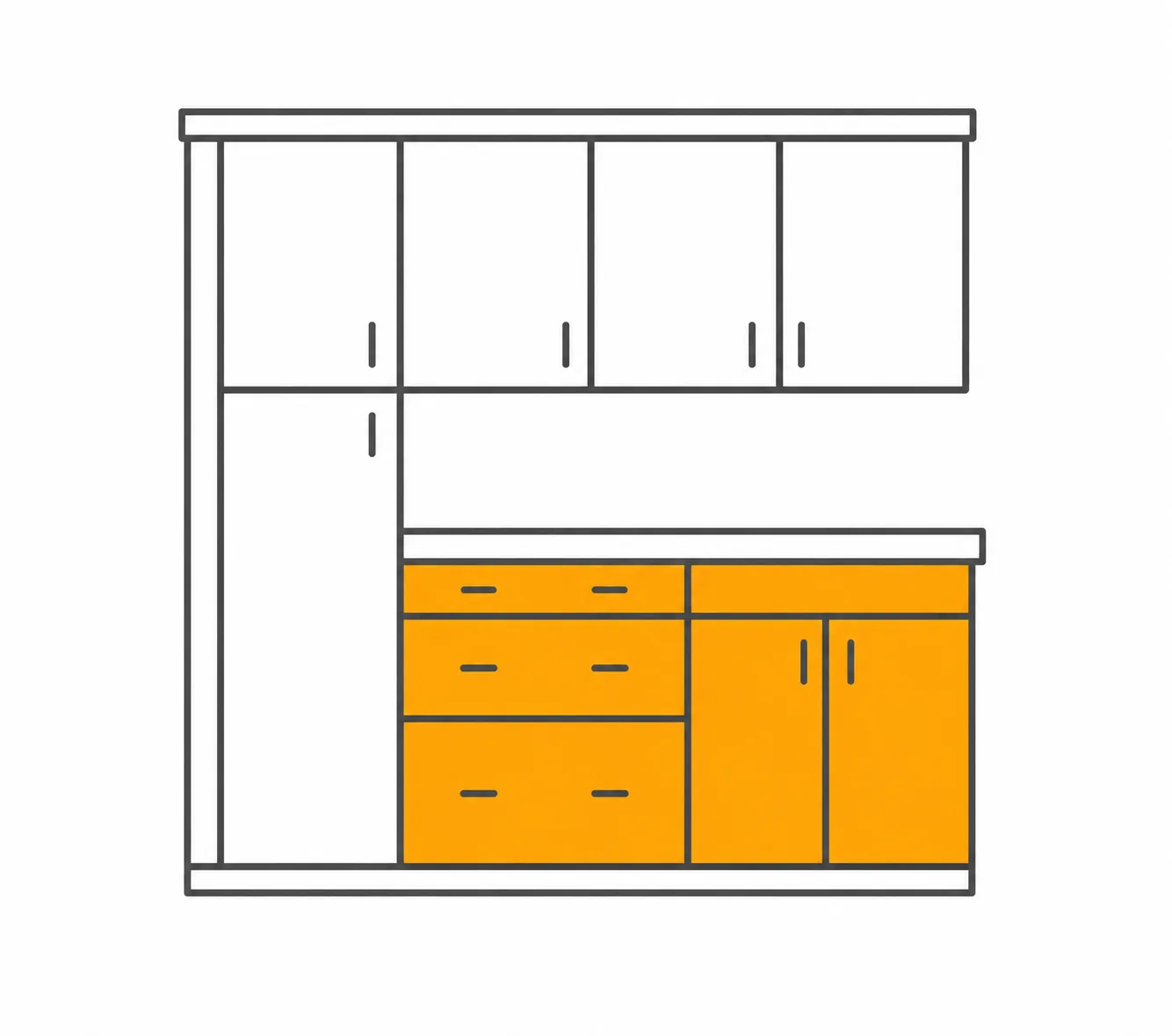
- 2 Drawer Base — two deep drawers; best under a cooktop for pots
- 3 Drawer Base — the workhorse: one shallow utensil drawer over two deep ones
- 4 Drawer Base — narrow widths, for spices, foil and baking sheets on edge
- Single / double door base — an adjustable shelf behind a door; cheapest per cubic inch
- Full-height door base — no top drawer, for taller items and a cleaner face
Sink bases and the corner problem

Sink bases are a false front over an open bay — no top drawer, because the bowl and trap live there. Size to the sink, not the run: a 33″ farmhouse sink needs a 36″ farm sink base, and an undermount needs enough side clearance for the clips. Get the sink model settled before the cabinet order goes in; changing it after is the most common revision we see.
Corners are where layouts go wrong. There are three answers and they trade cost against usable space. A blind corner is cheapest and buries a third of the cabinet behind the adjacent door. A lazy Susan spins the whole corner out to you at a higher price. An easy-reach or diagonal corner splits the difference with an angled face. If the corner holds anything you use daily, pay for the Susan.
Getting the widths right the first time
Cabinets step in 3″ and walls do not, so every run has a remainder. Fillers absorb it — a 2″ or 3″ filler scribed to the wall at the end of a run, and one at any inside corner so the doors clear. Ordering a run with no fillers and hoping is the fastest way to a job that stops.
Where the layout allows, size up: one 36″ base costs less per inch of storage than two 18″ bases and gives you a more open interior with one less face frame in the middle. Where it does not, the 9″ and 12″ widths exist to close out against a wall or an appliance.
Full detail on every configuration is in our base cabinet types guide, and the width and depth filters above this article list what is orderable in this paint right now.
The three specs worth comparing on a quote
Bases take more abuse than anything else in the room, and three lines on a spec sheet predict how they age. Everything else is marketing.
| Spec | What you get here | Why it decides the cabinet |
|---|---|---|
| Drawer box | ⅝″ solid wood, dovetailed four corners | Stapled butt joints are what fail first in a drawer that carries pans |
| Glides | Blum Tandem plus Blumotion, full extension | Half-extension runners lose you the back third of every drawer |
| Box | ½″ veneered plywood, veneer-finished interior | A base carries the counter — a thin box telegraphs every fastener |
All three are standard, not upgrade lines, which is not true of every brand quoting a similar per-box price. The full construction table for the series is on the collection page.
Before the base order goes in
Bases are the cabinets a layout gets wrong, because they are the ones that have to meet plumbing, appliances and walls all at once. Three things settle before you order: the sink model (it sizes the sink base, not the other way round), the hinge side of every door in a corner or against a wall, and where the fillers go.
Send measurements or a floor plan and we will draw the base run first — it is the row everything else hangs off. A free 3D design comes back with the box list and an itemized quote.
Common questions
- What sizes do these bases come in?
- Widths run 9″ to 48″ in 3″ increments, all at the standard 34½″ height and 24″ depth, across single- and double-door, drawer, sink and corner configurations. Use the width filters above to narrow the table to what is in stock.
- Should I order drawer bases or door bases?
- Drawers everywhere you store pots, pans, lids, utensils and food; doors at the sink, the trash pull-out, for tall small appliances, and in the corner. Drawer bases cost more per box but you never lose the back half of the cabinet.
- Which corner cabinet should I use?
- A lazy Susan if the corner stores anything you reach for daily, an easy-reach or diagonal corner as a middle option, and a blind corner only when budget rules and you can afford to lose the buried volume. All three need the full diagonal clear on both walls.
- How do I handle a run that is not a multiple of 3 inches?
- Order fillers. A 2″ or 3″ filler scribed to the wall closes out a run, and an inside corner needs one so adjacent doors and drawer fronts clear each other. Fillers come in the same paint.
- Do the drawers have dovetail joints?
- Yes — ⅝″ solid wood drawer boxes with dovetail construction at all four corners, on Blum Tandem plus Blumotion full-extension glides, standard on every unit.
Keep reading
The guides behind the numbers on this page.
- Types of Base Cabinets: Sizes and Standard Dimensions
Every base configuration, including the three corner solutions.
- What Dovetail Drawers Tell You About Cabinet Quality
The joint to check first when comparing two quotes.
- Why Blum Soft-Close Hinges Are Worth the Investment
What is standard here that other brands bill as an upgrade.
- Cabinet End Panels, Scribe Molding and Fillers Explained
How to close out a run that is not a multiple of 3 inches.
- Important Kitchen Dimensions Before Buying Cabinets
The six measurements to take before anything is ordered.
- Kitchen Layouts Explained, Single-Wall to G-Shaped
Which layout your room can actually take.
- Fabuwood Allure Series Explained: All Six Door Styles
Where Galaxy sits against Luna, Nexus, Fusion, Onyx and Elite.
- Fabuwood Cabinet Sizes and Specs: The Complete Dimension Guide
Every width, height and depth in the catalog, in one table.
- Fabuwood Cabinets Review (2026)
Construction, warranty and where the brand actually falls short.
- Fabuwood Cabinets Price List (2026)
Discounted pricing line by line and finish by finish.
- How Much Do Fabuwood Cabinets Cost?
Real 2026 numbers by series, with what drives a quote up.
- Fabuwood Cabinet Colors: The 2026 Guide to Every Finish
All fourteen Galaxy colors side by side if this white is not the one.


