


Galaxy Pistachio Green double oven cabinets: who actually needs two ovens
Reviewed September 2026 · Captivating Cabinets
The double-oven tower is the cheapest of the three oven builds in this line, because it is mostly opening: one tall space for two stacked wall ovens and very little cabinet around it. The Fabuwood Galaxy Pistachio Green double oven cabinet comes as GPG OC3384D, OC3390D, OC3393D and OC3396D — 33″ wide, full depth, 84″ to 96″ tall, $1,599.00 to $1,748.50. The cabinet is the easy part. The appliances inside it are among the most expensive in the kitchen, and a second oven is only worth that if it gets used. So before the tower, the question most kitchen pages skip: does this household need two ovens?
The households that really use the second oven
A second oven earns its place when two things regularly need to cook at different temperatures at the same time. That describes some households every week and others twice a year.
- Frequent bakers, who want bread or pastry at one temperature while dinner roasts at another.
- People who host big meals often — not just at the holidays — when a roast, sides and dessert all compete for the same shelf.
- Large families cooking two trays of everything, most nights.
- Batch cooks who fill the freezer at the weekend.
The pattern on the other side is just as common: a couple or small household who uses the top oven for a few days in December and the rest of the year keeps baking trays in it. If that sounds like your house, the tower is paying for an appliance you will mostly store things in, and one of the alternatives below will give you more for less. Be honest about the last twelve months of cooking, not the kitchen you imagine.
Living with two: the oven that gets used every day
In most double-oven kitchens one oven does the daily work and the other waits for the occasions. It is almost always the upper one that gets used, because it sits nearer eye level: you can see through the glass, and a tray comes out without bending. The lower oven, closer to the floor, becomes the overflow, the proving oven for dough, or the place a dish is kept warm while the rest of the meal finishes.
That pattern is worth knowing before buying the appliances. If the two cavities differ in size or features, put the one you will use daily at the top. Some double ovens have a smaller second cavity that heats up faster, which suits a household that often cooks small quantities; others are two identical ovens, which suits a household that cooks two big things at once. The appliance sheet shows which you are buying, and your cooking habits tell you which you need.
It also reframes the height question. Because the tower fixes where both ovens sit, a household of shorter cooks may find the upper oven comfortable and the lower one a stoop, while a tall household finds the reverse. Stand where the tower will go, mime taking a heavy roasting tin out at both heights, and see which one you would actually use.
Four ways to get a second oven, priced on the cabinet side
Appliance prices vary too much by brand to quote, so this table prices only the cabinetry each option needs. It shows how the choice moves money between the cabinets and the appliances.
| Route | Cabinet it needs | Cabinet price | Also needs |
|---|---|---|---|
| Double wall oven in a tower | GPG OC3396D | $1,748.50 | A separate cooktop and a base for it |
| Wall oven plus speed oven or microwave above | GPG OC3396C (combo tower) | $1,836.25 | A separate cooktop and a base for it |
| Single wall oven in a tower, plus a range elsewhere | GPG OC3396S | $1,920.75 | Room for both a tower and a range |
| A range with two ovens in it | No tower; ordinary base cabinets either side | — | A hood above the range |
Two things stand out. The double tower is the cheapest of the three towers, because it is least cabinet. And the combo route — an oven with a speed oven or a combination microwave above it — gives many households a genuinely usable second cavity, with a microwave thrown in, for a similar cabinet price. That option has its own page, the combo oven tower.
Two wall ovens means a separate cooktop
With both ovens in the wall, the burners have to go somewhere else, and that is a second decision with its own cabinet. A cooktop needs a base beneath it: most often a wide drawer base, so the pans live right under the burners, with a hood above. In this line that means a drawer base such as GPG DB36 at $1,030.25, or GPG DB30 at $845.00, on the base cabinet page — check the cooktop maker’s sheet for how deep its body drops below the counter before choosing drawers under it.
So a double-oven kitchen buys a tower, a cooktop base and a hood, where a range kitchen buys a range and a hood. That is not an argument against it — a cooktop at counter height with ovens at eye height is a pleasure to cook in — but it is the real comparison, and it is why the double tower tends to suit larger kitchens with the wall space for both.
What the tower costs you in storage

A 33″ oven tower takes 33″ of wall from floor to ceiling line. In a double tower nearly all of that height is appliance, with only a small cabinet above and a little space below the ovens. The same 33″ of wall could have held a base cabinet with drawers and an upper cabinet above it. In a small kitchen that trade is expensive; in a large one it barely registers.
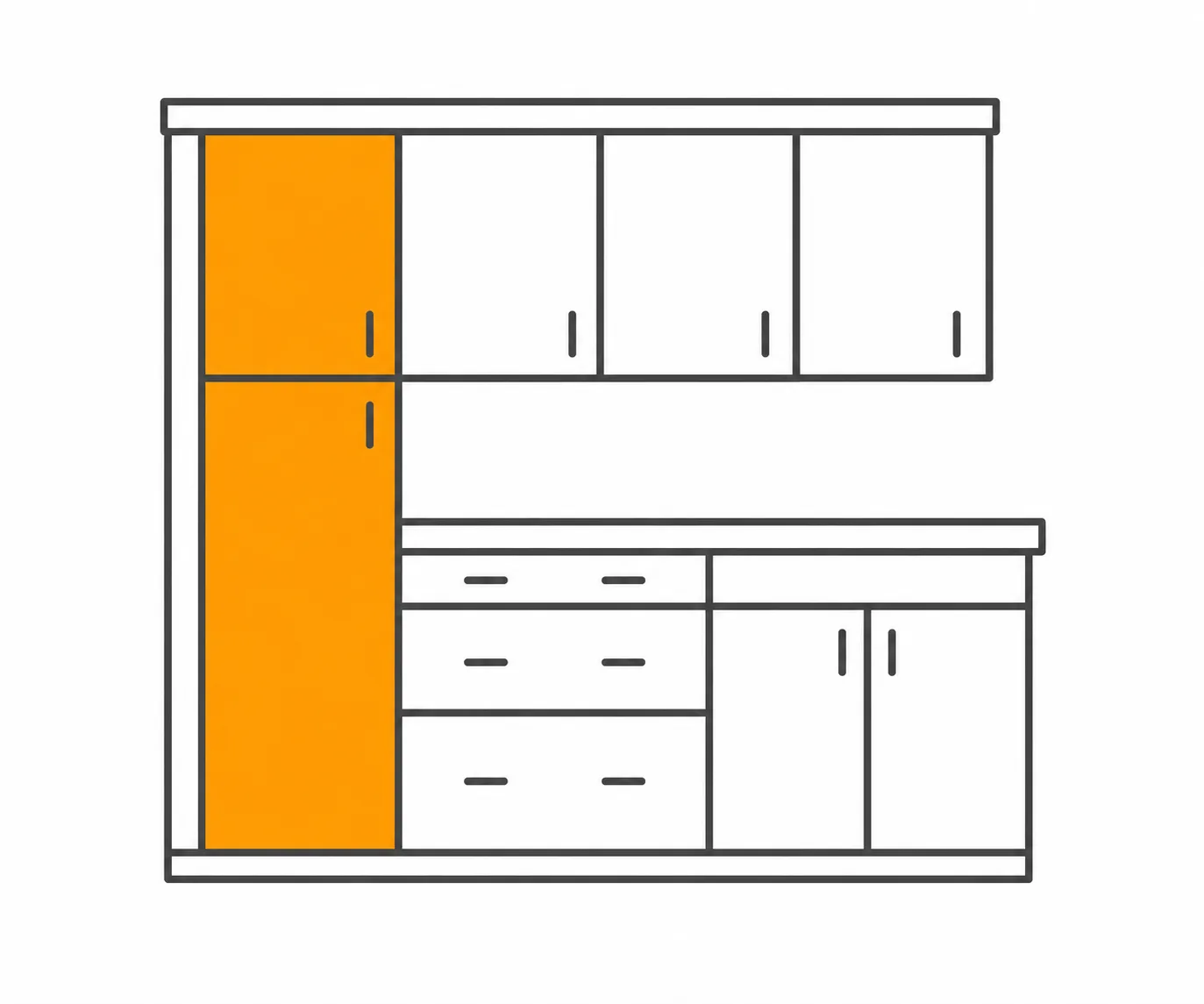
The usual answer is to pair the tower with a pantry, as in the picture. A double door pantry or a single door pantry beside it gives back the storage the ovens took and builds the tall wall described on the oven cabinet page.
Resale, and a green tower
Double wall ovens are something buyers of larger homes often expect, and in that kind of house leaving them out can be noticed. In a modest kitchen they are a nice extra, not a requirement, and a buyer is at least as likely to value the counter and storage the tower took. Either way, nobody values a second oven that the owner never used.
Colour matters here because the double tower is one of the largest single blocks of cabinet in the room, with the stainless or black of two ovens set into it. In an all-green kitchen it sits comfortably. In a kitchen split into green bases and pale wall cabinets, many people order the oven tower in the lighter upper colour so the tall wall does not become a column of green; switching this one box to Frost, Linen or Dove leaves the price where it is. Try a door sample against the oven you are buying, and see the green cabinet guide on how much of this colour a room can carry.
If the answer is yes
Buy the ovens first and send us their installation sheet to compare with this tower’s opening before you pay, since that opening is made at the factory and cannot be altered on site. Choose a height that finishes level with your wall cabinets — 84″, 90″, 93″ or 96″, at $1,599.00, $1,673.75, $1,677.00 and $1,748.50. Confirm the electrical supply with your electrician, because two ovens in one tower have their own requirements on the appliance sheet. Then plan the neighbours: fillers, the pantry, and where a hot tray lands.
The box itself is the line’s ½″ veneered plywood behind a solid wood face frame, delivered built in seven days to three weeks. All tall cabinets are on the tall cabinets page, and every other piece in this green in the collection. Our free 3D design lays out the tower, the cooktop and the pantry together, with a designer in touch inside one business day, and contractors get trade pricing through Captivating Pro.
Common questions
- Is a double wall oven worth it?
- If you regularly cook two things at different temperatures at the same time — frequent baking, big family meals, batch cooking — yes. If the second oven would mostly be used at the holidays, a combo tower with a speed oven, or a range with two ovens, usually gives more for less.
- How much is a double oven cabinet in this finish?
- $1,599.00 at 84″, $1,673.75 at 90″, $1,677.00 at 93″ and $1,748.50 at 96″, all 33″ wide. It is the cheapest of the three oven towers because it is mostly opening.
- Do I need a separate cooktop with a double wall oven?
- Yes. With both ovens in the wall, the burners go in a cooktop set into the counter, usually over a wide drawer base, with a hood above. Check the cooktop’s below-counter depth before choosing drawers.
- Does a double oven add resale value?
- In larger homes buyers often expect one. In a modest kitchen it is a pleasant extra, and the counter and storage the tower takes may matter as much to a buyer.
- Which oven gets used more in a double wall oven?
- Usually the upper one, because it sits nearer eye level and a tray comes out without bending. The lower oven tends to become the overflow, the proving oven or the warming oven, so if the two cavities differ, put the one you will use daily at the top.
- Double wall oven or wall oven with a microwave above?
- If the second cavity would mostly reheat and occasionally roast, a combo tower with a speed oven or combination microwave above the oven often does the job. The combo tower runs $1,677.00 to $1,836.25.
- Should the oven tower be green in a two-tone kitchen?
- It can be, but in a two-tone plan the oven wall often looks calmer in the paler top colour, so it does not become a full-height block of green. Changing its finish does not change the price.
Keep reading
The guides behind the numbers on this page.
- Kitchen Layouts Guide
Which plans have the wall space for a tower and a separate cooktop.
- Types of Base Cabinets
The drawer bases that usually sit under a cooktop.
- Wall and Tall Kitchen Cabinets: Sizes and Buying Guide
How oven towers relate to the pantries and uppers around them.
- How Much Do Kitchen Cabinets Cost?
Where an oven tower sits in the budget for a whole kitchen.
- Green Kitchen Cabinets: Sage, Pistachio, and Moss Shades and Pairings
Balancing a large block of green against lighter finishes.


