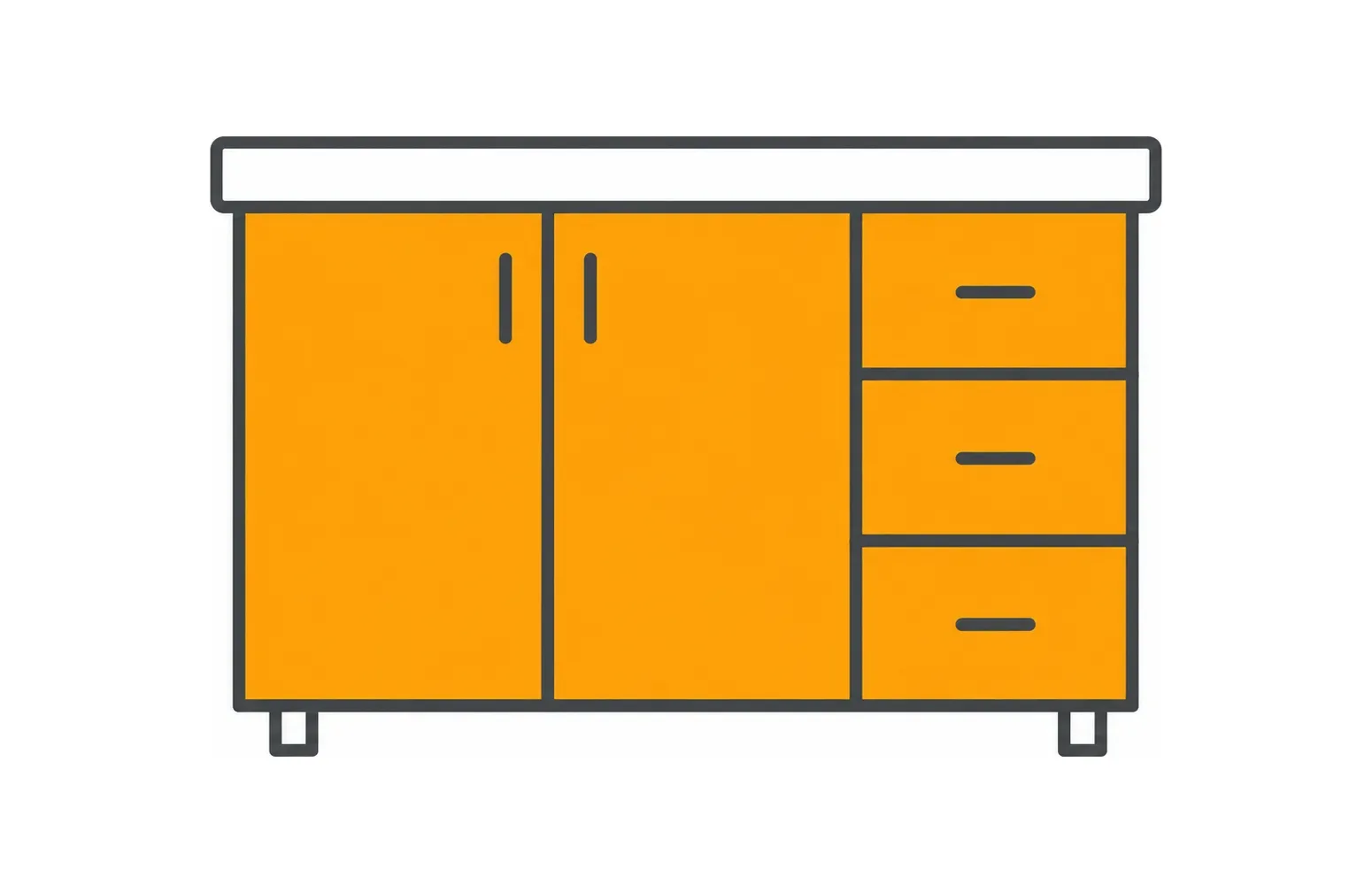


Trying green in the smallest room first: a Galaxy Pistachio Green vanity as the colour test
Reviewed September 2026 · Captivating Cabinets
Most people who order a green cabinet do not start in the kitchen. They start here, under a basin, because a Galaxy Pistachio Green vanity is a few hundred dollars of colour in a room with a door that closes, and a kitchen is several thousand dollars of colour in the room everybody walks through. That is a sensible order to do things in, and this page is written for it. It covers what the trial really costs, what this particular green does under the close, artificial light of a bathroom (it is quieter than its name, and the light changes it more than most finishes), four ways to place it in the room, which box to buy for a first attempt, the tops and metals it wants, a straight answer on resale, and how to read the result if the next question is the kitchen.
Why the bathroom is where a colour gets tried first

Scale is the whole argument. A hall bath takes one cabinet; a kitchen takes fifteen to twenty-five. The commonest first green vanity we see is a 30″ sink-and-drawer combo, GPG VSD30DL or GPG VSD30DR at $757.25, and that single line is the colour decision. Get it wrong and the fix is one cabinet, one top and an afternoon. Get a kitchen wrong and the fix is the kitchen.
The second argument is exposure time. A door sample tells you a great deal, and nobody should skip it — the Pistachio door is $25.00 through the Fabuwood sample page — but a sample is a rectangle you look at deliberately. A vanity is a colour you meet twice a day without thinking about it, at 7am under the fixture and at 11pm under the same fixture, for months. That is the test a kitchen buyer really wants and cannot get from a sample: what does this colour feel like on the four-hundredth morning. A bathroom answers it for the price of one box.
And the third is that the bathroom is allowed to be bolder. Nobody expects a powder room to be neutral; a coloured vanity there reads as a choice, where the same colour on every kitchen door reads as a commitment. So even people who will never put green in a kitchen are well served here. The rest of this page assumes one of two readers: someone who wants a green bath and nothing more, and someone running a trial. The advice is the same for both until the last section.
What a grey-sage does under bathroom light
Start by resetting the expectation the name sets. This is not a bright, minty or nutty green. Sampled from the swatch it averages #929488, which is a mid-value grey with a clear green cast, and our green cabinet guide calls it a quiet gray-sage. It is not olive (no brown-yellow weight) and not teal (no blue). The closest thing we sell to it is NOMA Evergreen Fog, a frameless slab that measures almost the same from its swatch. If you have been scrolling saturated sage kitchens on a phone, expect the real door to look greyer than those pictures.
Greyed colours are the ones light pushes around most, and a bathroom is where light is least forgiving. Three general rules help, and they apply to any muted green rather than to anything Fabuwood publishes about this paint:
- Warm bulbs pull a grey-green towards yellow-olive; cool bulbs pull it towards plain grey. A 2700K fitting will make the vanity look warmer and a little greener than the sample did on a cloudy afternoon; a 4000K+ fitting can take most of the green out. If the colour is the point, a middle temperature around 3000K–3500K usually keeps it recognisably sage.
- Bathrooms are often windowless, so there is no daylight to average things out. What the fixture over the mirror does to the door is what the door is. That is why the night reading in the callout above matters more here than it would in a kitchen.
- Big white surfaces bounce light back onto the cabinet. A vanity surrounded by white tile, a white top and a white bath reads lighter and cooler than the same door against a painted wall. Hold the sample against the actual tile if it is already up.
One worry people raise and can mostly set aside: a green vanity will not make faces in the mirror look green. It sits below the counter line, lit from above, and reflects very little of its colour up to head height. Green paint on the walls around the mirror is a different matter, which is one reason a coloured vanity with pale walls is the calm version of this room.
Four ways to put the green in a bathroom, costed

How much of the room goes green decides more about the result than which green it is. These are the four arrangements we draw most often, from the lightest touch to the fullest, with the cabinet cost of each for a 30″ to 36″ bath. Tops, basins and taps are extra in every row.
| Arrangement | What is green | Cabinet lines | Cabinets |
|---|---|---|---|
| The single note | Only the vanity; walls, tile and top all pale | GPG VSD30DR | $757.25 |
| Vanity and frame | The vanity, plus the mirror framed in the same paint | GPG VSD30DR + mirror molding lengths at $87.75 each | $757.25 + $87.75 a length |
| Vanity and wall cabinet | Base and a 24″ cabinet over the toilet or beside the mirror | GPG VSD36DR + GPG WVS2430 | $1,274.00 |
| Green and wood | The vanity, with oak or walnut on the mirror, shelf and floor | GPG VSB30-34 or GPG VSD30DR | $461.50 – $757.25 |
The single note is the right trial. It gives you the most information for the least money, and if you end up loving it, adding a frame or a wall cabinet later is easy because the paint comes from the same line. The framed version is the one that makes a bathroom look designed rather than furnished: the mirror molding is a rabbeted profile the glass sits into, sold by the length at $87.75, and a green frame over a green vanity ties the two heights of the room together. How many lengths a mirror needs depends on its size, so send us the dimensions before you order.
The wall-cabinet version doubles the colour, which is lovely in a large bath and heavy in a small one; in a room under about 5′ × 8′, keep the green below the counter and let everything above it stay pale. The wood version is the warmest of the four and the one that suits this colour best in our view, because a grey-sage next to raw oak looks less grey. The 24″ vanity wall cabinet is the only upper in the bath family, at $490.75.
Which box to buy for a first green vanity
There are 38 vanity cabinets in this finish, all 34″ tall and 21″ deep, and they sort into six families. For a trial the choice is simple: buy the box your bathroom needs anyway, not the cheapest one, because a colour experiment on a cabinet that frustrates you every morning is not a fair experiment. Here is the family list, with the case for each.
| Family | Widths | Price range | Buy it when |
|---|---|---|---|
| Sink-and-drawer combos | 30″ (DL/DR), 36″ (DL/DR), 42″, 48″, 60″ single, 60″ double | $757.25 – $1,196.00 | You want one cabinet that does everything, which is most bathrooms |
| Sink bases | 21″ – 42″ | $422.50 – $542.75 | A powder room, or a budget trial: doors below, a false front over the trap |
| Drawer bases | 12″ – 27″, then 33″ | $601.25 – $877.50 | Built beside a sink base, where the plumbing has gone and drawers can run |
| Full-height door bases | 15″ – 36″ | $341.25 – $490.75 | Towels, rolls and tall bottles; the cheapest way to add storage width |
| Door-and-drawer bases | 12″ – 30″ | $364.00 – $555.75 | A small companion box with one working drawer |
| Vanity wall cabinet | 24″ × 30″ | $490.75 | Storage above the counter, over the toilet or between two mirrors |
Two gaps worth knowing before you plan: the drawer bases skip 30″ (a 27″ stack plus a filler, or the 33″, are the workarounds), and there is no 12″ full-height door base in this colour, which matters only if you were planning the grooming tower on the accessories page. There are no accessible, lowered vanity bases in this finish either.
If the bathroom is a trial for a kitchen, one purchase is smarter than the rest: a combo with a drawer stack. Drawers are where you will handle the finish most — the edges of a drawer front take fingers, rings and the odd knock — so a combo tells you how this paint wears as well as how it looks. At 36″, GPG VSD36DL or DR is $783.25, only $26.00 more than the 30″. At the top end, the 60″ double GPG VSD60DOUBLE is $1,046.50 and the single-bowl 60″ with drawers either side, GPG VSD60SINGLE, is $1,196.00. The full list is on the vanities page.
Tops, taps and wood: what a grey-sage vanity wants beside it

A neutral vanity takes its temperature from the room. A coloured one sets it, so the top and the metal are doing more work here than they would on white or grey. Muted greens are easy partners because they are already half grey, and most of the advice comes down to one principle: give this colour warmth and it looks more like sage; give it more cold and it looks more like grey.
Metal first, because it is the cheapest thing to change and the most visible at arm’s length. Brass and warm gold are the classic partner and the one our green guide calls the safest for nearly every sage we sell; on this door they bring the green forward. Matte black works too, and reads more graphic and modern, especially with black tap fittings to match. Brushed nickel and chrome are the quietest choice and push the colour back towards grey — fine if that is the aim, a slight waste of the green if it is not.
For the top, the choice is between contrast and softness. A clean white quartz is the crispest partner and makes the green look deliberate. A warm white or cream, especially with a faint beige vein, is gentler and flatters the sage in the colour. Real or imitation marble with grey veining sits between the two; with this finish the grey in the stone and the grey in the paint talk to each other, which is pleasant as long as the vein is not also green-grey. Avoid a top in the same mid-value as the door — a mid-grey concrete or a greige quartz — because two mid-tones meeting at the counter edge blur into one another.
Then wood, which is the ingredient most green bathrooms are missing. White oak on a mirror frame, a floating shelf or the floor warms the whole palette; walnut is richer and darker and suits a larger room; a butcher-block or teak shelf over a toilet does the same job for very little money. Terracotta or cream zellige tile belong in the same family. The matching guide walks through choosing tile and floor around a cabinet colour, and the method is the same in a bath: build the board around the door, not the other way round.
Will a green vanity date the bathroom, or hurt resale?
The honest answer has two parts. First, colour in general dates faster than neutral, and green is having a moment that will not last forever. Anybody who tells you a coloured cabinet is timeless is selling something. Second, the risk is much smaller than it looks, for three reasons that are specific to a vanity.
- It is one cabinet. If a buyer in eight years dislikes it, replacing or repainting a single vanity is a modest job — nothing like a kitchen. That is the same logic our green guide gives for keeping the boldest colours on an island: put colour where it is cheapest to change.
- This is the muted end of green. A greyed sage at this depth behaves more like a warm neutral than a statement colour, and pairs with the white tops and brass or nickel that most bathrooms already have. A saturated emerald or a bright mint would be a far bigger bet.
- Bathrooms are allowed personality. A green powder room or hall bath reads to most visitors as a style decision, not a mistake, provided everything around it is calm and well made. What hurts a bathroom at sale is damage and dirt, not a colour.
If you plan to sell within two or three years, the safe version is the single note: green vanity, white or cream top, pale walls, classic metal. If you plan to stay, choose the arrangement you like and stop worrying. In neither case is this the finish to pick if you actively dislike the idea of changing a vanity one day — that is a vote for Frost or Dove, and there is no shame in it.
Reading the result: from a green vanity to a green kitchen
Say the trial worked. After a few months you still like walking into the bathroom, the colour has held up under daily hands and the lighting has not turned it into something you did not choose. What carries across to a kitchen, and what does not?
What carries is the paint, the door and the price grid. The kitchen cabinets in this finish use the same five-piece shaker door — a solid wood frame around a ⅜″ MDF centre panel — on the same ½″ veneered plywood box with ⅝″ dovetail drawers and Blum soft-close hardware, and they price the same as Galaxy’s other standard finishes. Only the two oak stains, Desert Oak and Natural Oak, run roughly 20% higher. So the colour you tested is the colour you get, at no premium for choosing it.
What does not carry is the quantity. A kitchen has far more of the colour, in daylight rather than under one fixture, and at eye level on the uppers. That is why the most common next step from a green vanity is not an all-green kitchen but a two-tone one, which Galaxy makes easy because every finish shares the same door:
- Green lowers under Frost uppers: the brightest contrast, and the version that keeps a small kitchen light.
- Green lowers under Linen or Dove: softer and warmer, with the off-white taking the edge off the grey in the green.
- A green island in a Timber or Natural Oak kitchen, or the reverse: wood and sage are the most natural pairing in this palette. Natural Oak carries that ~20% premium.
- Green everywhere, with pale stone and brass: the enveloping version our green guide describes. Order a second door sample and hold it at upper-cabinet height before committing.
Every kitchen box in this colour is on the Pistachio collection page, by type: base cabinets, wall cabinets and tall cabinets. Whether you are drawing one bath or a bath and a kitchen, our free design service will lay it out: a designer replies within one business day, and the full design and quote follow within 24–48 hours. Contractors and designers placing several of these can get 20–40% through Captivating Pro, one program with no tiers. Or call us with the wall width and we will talk it through.
Common questions
- Is a green bathroom vanity a good idea?
- For most bathrooms, yes, if the green is muted and the rest of the room is calm. It is a single cabinet, so it is the cheapest place in a house to commit to a colour and the easiest to change later. A greyed sage like this one pairs with the white tops and brass or nickel fittings most bathrooms already have.
- What colour is Pistachio Green really?
- Quieter than the name. Sampled from the swatch it averages #929488, a mid-value grey with a clear green cast — a greyed sage, not a bright nut-green, not olive and not teal. It measures almost the same as NOMA Evergreen Fog. Judge it from a $25.00 door sample in your own bathroom light before ordering.
- What countertop goes with a sage green vanity?
- White quartz for crisp contrast, or a warm white or cream with a soft beige vein for a gentler look. Grey-veined marble works if the vein is not itself green-grey. Avoid a top in the same mid-value as the door, such as mid-grey concrete or greige quartz, because the two blur together at the counter edge.
- Brass, black or nickel hardware on a green vanity?
- Brass or warm gold brings the green forward and is the safest choice. Matte black reads more graphic and modern. Brushed nickel and chrome are the quietest and push this colour towards grey. Pulls are ordered separately — cabinets ship undrilled — so pick them beside the countertop sample.
- Will a green vanity hurt resale?
- Rarely, and much less than a coloured kitchen would. It is one cabinet that a future owner can replace or repaint cheaply, this is the muted end of green, and buyers read a coloured bathroom as a style choice. If you are selling within two or three years, keep everything around it pale and classic.
- How much does a green shaker vanity cost here?
- Cabinets only, displayed prices at review: sink bases $422.50–$542.75, a 30″ sink-and-drawer combo $757.25, a 36″ combo $783.25, and 60″ combos $1,046.50 (double bowl) or $1,196.00 (single). Top, basin, faucet and pulls are extra. This finish prices the same as the other standard Galaxy colours.
- Can I use the vanity to test a colour before doing the kitchen?
- Yes, and it is the order we would suggest. The kitchen cabinets in this finish use the same door, box and paint, at the same price as other standard Galaxy colours. Live with the vanity for a few months, then decide between an all-green kitchen and a two-tone one with Frost, Linen, Dove, Timber or Natural Oak.
Keep reading
The guides behind the numbers on this page.
- Green Kitchen Cabinets: Sage, Pistachio, and Moss Shades and Pairings
Every green we sell measured from its swatch — where this grey-sage sits, and what it is nearly identical to.
- Kitchen Cabinet Samples: How to Order & Evaluate
A colour trial only works if the sample is judged where the vanity will stand. This is the method.
- Fabuwood Bathroom Vanities: Sizes, Styles and Buying Guide
The full configuration list behind the size table on this page.
- How to Match Kitchen Cabinets With Countertops, Backsplash and Flooring
Choosing a top and a tile around a coloured box rather than a neutral one.
- Kitchen Cabinet Styles and Color Trends for 2026
Where muted greens sit in the current cycle, for anyone weighing how long this look will last.


