
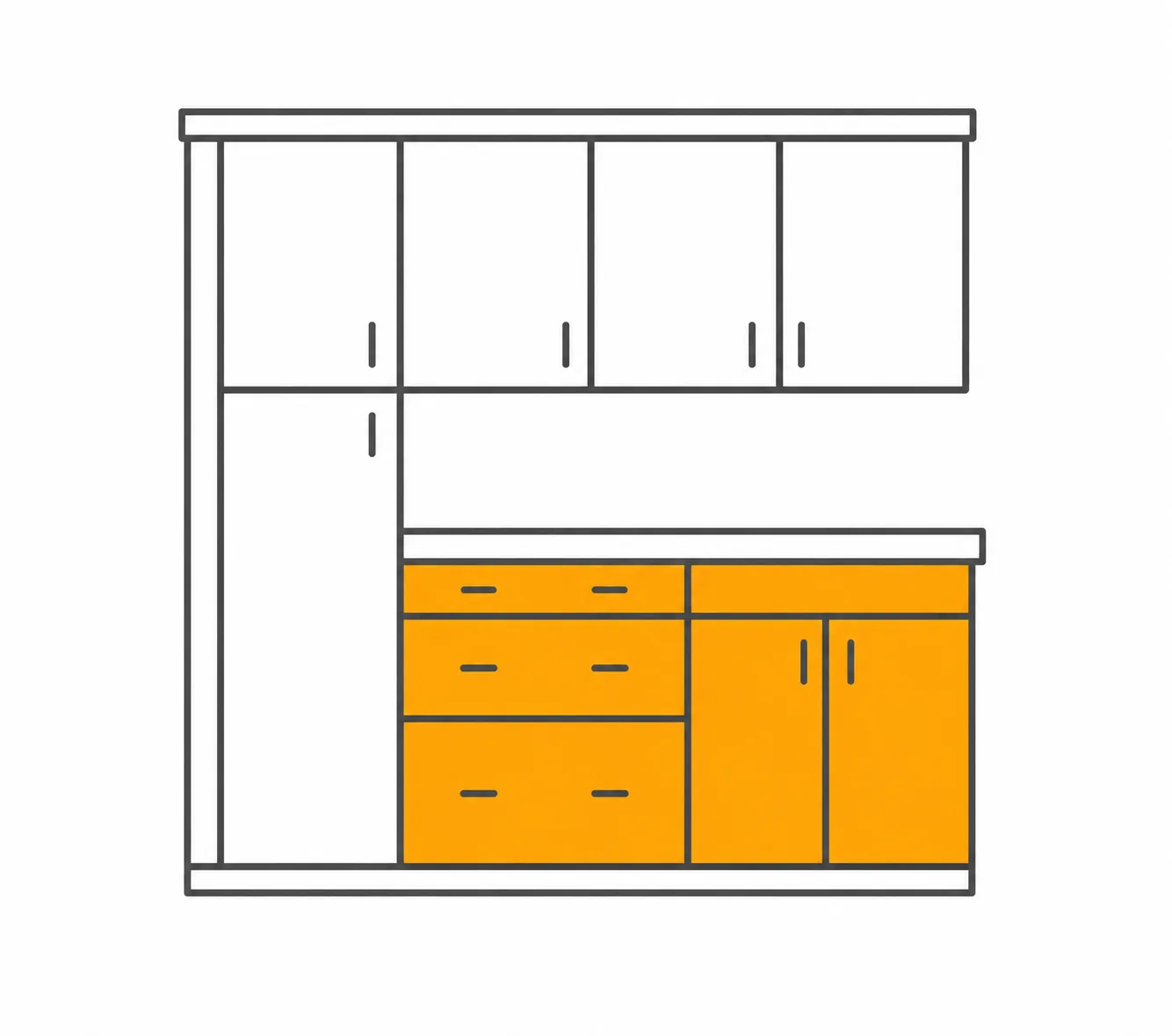


Galaxy Pistachio Green base cabinets: the half of the kitchen where the green meets everything else
Reviewed September 2026 · Captivating Cabinets
Upper cabinets hang against a painted wall. Base cabinets are surrounded. A stone top sits on every one of them, the floor runs along their feet, the sink drops into one, the dishwasher slots between two, and nearly every pull you will buy is fixed to one of their fronts. So choosing Galaxy Pistachio Green for the lower half of a kitchen is really choosing five neighbours for it, and because this is a muted gray-sage that takes its cue from what surrounds it, those neighbours decide how green it looks. This page goes through them one by one, then covers the island question, what a run costs and what to check before ordering. Every box here is 34½″ high and 24″ deep unless its code says otherwise.
The countertop draws a line along the top of the green

Whatever top you choose runs along the upper edge of every base cabinet in the room, so it is the neighbour the green is compared with most often and at closest range. A white counter over a sage run is a stripe of maximum contrast; a cream one is a softer stripe; a wood one warms the whole half. The table is our read of the five tops people most often put on these bases.
| Top | What you see | Good for | Watch for |
|---|---|---|---|
| Bright white quartz | A crisp, clean line; the green reads clearly as colour beneath it | Two-tone rooms with Frost uppers, darker rooms that need brightness | Can look a little clinical if the uppers and walls are also stark white |
| Warm white or cream quartz | A gentle contrast; the sage looks warmer and more green | Almost every version of this kitchen, and our first suggestion | Next to a stark white sink, a cream top can look off-white; see the sink section |
| Marble or marble-look with veining | Movement across the top; the vein colour steers the green | Rooms that want some age and character | Gray veins pull the doors grayer, warm or gold veins pull them greener — pick deliberately |
| Butcher block or solid oak | The warmest possible neighbour; relaxed and natural | Islands in particular, and cottage or farmhouse kitchens | A wood top plus a wood floor plus wood shelves is a lot of wood — keep one of the three pale |
| Dark soapstone-look or black | Heavy, dramatic, very traditional | Large bright rooms | The green loses contrast against a dark slab and the lower half gets heavy; test it with samples first |
Whatever you choose, use one countertop material across every base run in the room, including the stretch under any lighter uppers. Two different stones either side of a green run is the fastest way to make a kitchen look assembled from leftovers. If the island top is going to differ (wood on the island, stone on the perimeter is common and works well), make the difference obvious rather than subtle. The matching guide sets out the order to choose surfaces in.
The pulls live down here, so choose them for the green
Walk around a finished kitchen and count the hardware. Most of it is on the lowers, because drawers are where people put their pulls: a three-drawer base like GPG DB24 carries three, a standard base like GPG B18 carries two (a drawer front over a door). A modest range wall of four base boxes can easily carry ten pieces, all at hand height and all in front of the green. On a white kitchen hardware is jewellery; on a colour it is part of the colour.
Brass, bronze and gold
The pairing most people imagine when they imagine a sage kitchen, and it earns its reputation: a warm metal warms the green around it and makes the colour read as sage rather than gray. Unlacquered or brushed brass looks more considered than shiny gold. Cup pulls on the drawers with knobs on the doors is the traditional version; long slim bars on everything is the modern one.
Matte black
Equally good, and a different room. Black draws every pull as a sharp line and makes the green look more deliberate and more graphic. It is the better choice if the rest of the kitchen leans modern, if your tap and light fittings are already black, or if you simply find brass too sweet.
Nickel, chrome and stainless
These keep the green cool and quiet, closer to gray. Nothing wrong with that if you want the colour understated, but combined with a gray counter and stainless appliances they can make the doors disappear. If you choose a silver metal, give the room a warm counter or a wood floor.
Size and spacing
On drawer banks, centre one pull per drawer and keep the same pull on every drawer in the run, whatever its height. On the painted rail of a shaker drawer front, a pull of roughly a third of the drawer width looks right; very long bars suit only very wide drawers. Hold a pull against the door sample before buying fifty of them.
Floor and toe kick: the other surface every base cabinet touches
The floor is the second neighbour, and after the counter it is the one that most changes how green this finish looks. A light or mid oak floor is its natural partner: warm wood below a gray-sage is what makes the photographs look the way they do. Walnut and darker woods work too, but the lower half of the room gets heavier. Cool gray tile, gray-washed plank and gray LVP are the floors to be careful with, for the same reason as a gray counter — they drain the colour out of the doors sitting on them.
Where cabinet meets floor you also get a choice most people never realise they are making. A GPG TK8 toe kick ($55.90 for eight feet, or the thicker GPG TK8-3/4 at $58.50) in the same green carries the colour right down to the floor, so the run reads as one solid painted plinth. Leave the recess unpainted or dark instead and the cabinets appear to float slightly, which lightens a long run. With a colour, the matching kick looks more built-in and more intentional; with a light floor, the shadow version looks lighter. Either is fine, but decide it rather than letting it happen.
The exposed side of a run is the third floor-level decision. A GPG BEP base end panel ($149.50) repeats the shaker frame on the side of the cabinet, so the green end reads like furniture. A GPG SK BASE end skin ($62.40) is a flat painted board, correct in colour but plain. Anywhere the end of a run faces into the room — a peninsula, the end of an island, the run beside a doorway — spend the extra. Against a wall, the skin is fine. The end panel guide shows both installed, and every trim piece in this colour is on the decorative accessories page.
The white sink, the dishwasher and the stainless in between
The sink wall is where the green meets the most other materials at once, so it is worth planning as a small composition rather than a list of boxes.
- An apron-front sink in white fireclay on a green run is a classic for good reason: the white front drops into the colour like a panel of the counter. It sits on a farm sink base — GPG FS30, FS33 or FS36 at $806.00, $815.75 and $825.50 — which is cut for the exposed apron. Pair a white sink with a warm-white rather than a cream counter, or choose a biscuit sink to match a cream top, so the two whites do not argue.
- An undermount sink hides in a standard sink base instead: GPG SB30 at $461.50, SB33 at $468.00, SB36 at $490.75. The SB36SDF version, at the same $490.75, runs one false drawer front across the full width, which reads calmer on a colour than two small ones.
- A stainless dishwasher is one of the few cool gray things that will sit directly against the green. It will not clash, but it is a flat silver interruption in the run. A GPG DWR6 dishwasher panel ($201.50) gives a finished green edge on the exposed side; without it you see a raw cabinet side next to the appliance.
- The range works the same way. A stainless range between two green drawer banks is perfectly good; a black or colour-matched range is a louder choice that makes the green run look more continuous. Whichever you choose, carry the same metal finish into the tap, if you can, and the pulls.
Under the sink and beside it, the storage you add does not show, but it is what you will notice every day: a GPG ROD-B36 BLUM E roll-out ($240.50) behind the sink base doors, and a GPG TC18 BLUM trash pull-out ($734.50) within one step of the sink. Both are on the accessories page.
Green perimeter, green island, or both
The base run is the page most people land on when they are thinking about a green island, so here is the short version of that decision. A green island under a light perimeter is the lowest-commitment way to use this colour: one free-standing block, easy to judge, easy to change. Green bases all round with lighter uppers is the next step up. A green island inside a green perimeter is a whole-green kitchen, and at that point the island needs something to set it apart — a different top (wood on a stone-topped kitchen), different pulls, or a Timber or Natural Oak finish on the island itself.
Whichever you choose, the island’s order differs from the perimeter’s in three ways. The ends face the room on both sides, so both get GPG BEP panels rather than skins. The seating side often uses shallower boxes: the 12″-deep GPG B36FD-12D ($477.75) or B30FD-12D ($442.00) gives storage under the overhang without stealing knee room. And where people sit at the island you can add a GPG KD30 knee drawer ($172.25), or build a drawer bench seat into a peninsula (GPG DBS30 at $383.50, DBS36 at $425.75). Check the aisle widths in the island clearance guide before the island goes on the drawing — a green island that pinches the walkway is still a pinched walkway.
A green range wall, priced, and the same wall in oak
A practical example at displayed prices on the review date: the base run on a ten-foot range wall, running from a wall at one end to an open end at the other, with a 30″ range in the middle. It is drawer-led, because drawers either side of a range are what cooks actually use.
| Position | Code | Width | Price |
|---|---|---|---|
| Against the wall | GPG BF3 — filler | 3″ | $26.00 |
| Outer left | GPG B18 — single door base with drawer | 18″ | $409.50 |
| Left of the range | GPG DB24 — three-drawer base | 24″ | $705.25 |
| Range | No cabinet | 30″ | — |
| Right of the range | GPG DB24 | 24″ | $705.25 |
| Outer right | GPG B18 | 18″ | $409.50 |
| Open end | GPG BEP base end panel | — | $149.50 |
| Along the floor | GPG TK8 × 2 | 16 ft | $111.80 |
| Run total | 117″ | $2,516.80 |
Swap both outer B18s for GPG DB18 drawer bases ($646.75 each) and the run becomes all drawers for $2,991.30. For a pan drawer beside the range, the two-drawer GPG DB24-2 ($724.75) gives two deep drawers instead of three; for utensils and spices, a four-drawer base such as GPG DB21-4 ($832.00) splits the height finer. Wider single doors are on the double door base page, corners on the lazy Susan and blind corner pages.
Now the comparison people ask for. That exact run costs exactly the same in Frost, Dove, Linen, Nickel or any other standard Galaxy paint; the colour is a prefix change, not a price change. In Natural Oak or Desert Oak it runs roughly 20% more, on the order of $500 on this wall, because those are real oak veneers rather than paint. That is the honest price of the "green or wood on the bottom half" decision, and it is smaller than most people expect. If you are torn, a green perimeter with an oak island captures most of both for a fraction of the difference. Every base width from 9″ to 48″ is priced on the base cabinet page, and the base cabinet types guide defines each family.
Hand height: how a painted green base run wears
The lower half of a kitchen takes the knocks: shoes against the toe kick, wet hands on the sink doors, splashes down the drawer fronts beside the range, a vacuum along the plinth. A mid-light sage is kinder than white to most of this — fingerprints and light scuffs show less on a mid-value colour than on a bright one — though dried water spots below the sink can show on any painted door and are worth a wipe with a dry cloth. Clean with warm water, a drop of dish soap and a soft cloth, dry afterwards, and keep abrasive pads, ammonia, bleach and melamine sponges away from the paint. The cabinet care guide has the full routine, and the GPG TOUCH UP KIT ($62.40) is worth adding to the first order rather than the second.
What is behind the green fronts is the same across every Galaxy paint. The box is ½″ veneered plywood with a solid wood face frame; shelves are ¾″ plywood; drawers are ⅝″ solid wood with dovetail joints on Tandem plus Blumotion full-extension concealed runners; hinges are Blum soft-close with Quick-Release. The interior of a standard base is a natural wood veneer, so the drawers and cupboards open onto warm wood rather than more green. Every box arrives pre-assembled with drawers fitted, in 7 days to 3 weeks. Why dovetails matter most in the half of the kitchen you open all day is argued in what dovetail drawers tell you.
Before the base order goes in
Order a door sample ($25.00 displayed; ask your designer about credit against the order) along with samples of your countertop and floor. Stand the door upright where the run will go, the counter sample on top of it, the floor sample at its foot, and hold a pull against it. That little stack is the base run in miniature, and it will tell you more than any photograph.
Then send us the room. The free 3D design comes from a designer who replies within one business day; the full layout and quote follow within 24 to 48 hours, with the green rendered next to the counter and floor you have chosen so the proportions are visible before anything is built. Trade buyers go through Captivating Pro for 20% to 40% off. Uppers are covered on the wall cabinet page, and the colour, partners and resale on the collection page.
Common questions
- What countertop goes best with sage green base cabinets?
- Warm white or cream quartz is our first suggestion, because it brings the green forward. Bright white quartz is the crisper option, veined marble works if you choose the vein colour deliberately, and butcher block suits an island. Cool gray stone tends to drain the colour out of a gray-sage.
- Should the hardware on green cabinets be brass or black?
- Both work. Brass warms the green and makes it read as sage; matte black sharpens it and suits a more modern kitchen. Nickel and chrome keep it cool and gray-leaning. Whichever you choose, use one metal throughout the room, including the tap.
- Does a green kitchen work with a white farmhouse sink?
- Very well. A white fireclay apron sits in the green run like a panel of the counter. It goes on a farm sink base — $806.00 to $825.50 for the 30″ to 36″ widths — and looks best under a warm-white rather than cream counter, so the two whites agree.
- Should the toe kick be the same colour as the cabinets?
- A matching green toe kick (GPG TK8, $55.90 for eight feet) makes the run read as one solid painted base and suits a colour well. A dark or unpainted recess makes the cabinets appear to float and lightens a long run. Both are correct; decide it on purpose.
- Are green base cabinets more expensive than white ones?
- No. Every standard Galaxy paint is priced identically, so a green run costs the same as the same run in Frost or Dove. The two oak finishes, Natural Oak and Desert Oak, run about 20% higher.
- Green island or green perimeter?
- A green island under a light perimeter is the lowest-commitment option and easy to change later. Green bases all round under lighter uppers is the next step. If both island and perimeter are green, give the island a different top, pulls or a wood finish so it stands apart.
- How tall and deep are these base cabinets?
- 34½″ high and 24″ deep, giving a 36″ counter height once a standard 1½″ top is fitted. Twelve-inch-deep versions, coded -12D, suit the seating side of an island or a tight aisle.
Keep reading
The guides behind the numbers on this page.
- Types of Base Cabinets: Sizes and Standard Dimensions
The base families on this page named and measured, for decoding the quote.
- Kitchen Island Clearance Guide
The aisle widths to check before a green island goes on the drawing.
- What Dovetail Drawers Tell You About Cabinet Quality
Why the drawer box matters most in the half of the kitchen you open fifty times a day.
- How to Clean and Care for Kitchen Cabinets
Keeping painted lowers looking new where hands, feet and splashes hit them.
- How to Match Cabinets, Countertops, Backsplash and Flooring
The sequence for choosing the other surfaces once the cabinet colour is fixed.
- Fabuwood Cabinet Sizes and Specs: The Complete Dimension Guide
Every width, height and depth these codes are cut from, in one reference.


