
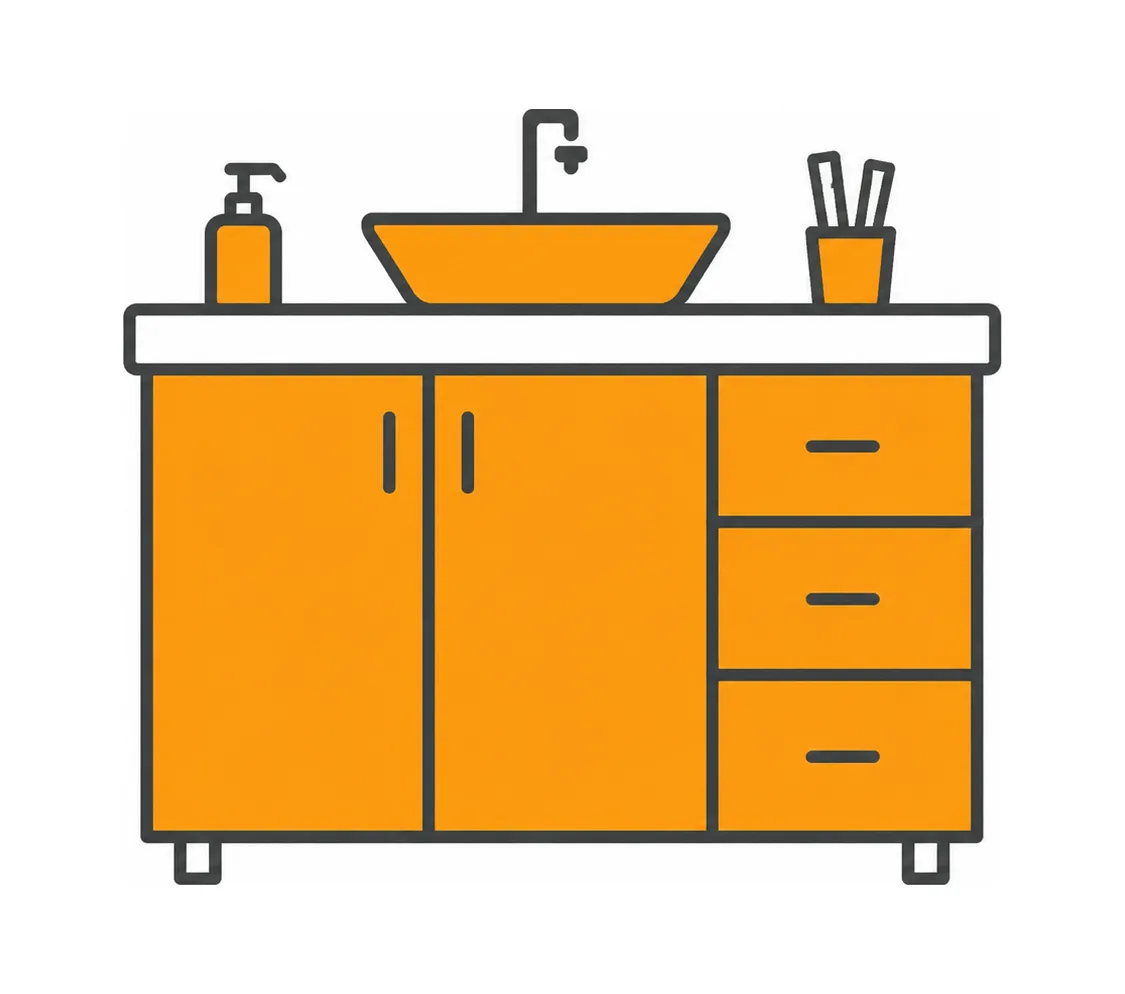


Built-in or furniture? Dressing a Galaxy Pistachio Green vanity with the parts that change how it reads
Reviewed September 2026 · Captivating Cabinets
A white vanity is a fixture. A Galaxy Pistachio Green vanity is closer to a piece of painted furniture, and that raises a question a neutral box never does: do you want it to look built in, or to look as though it was carried into the room? Almost everything in this department exists to answer that question one way or the other. Forty-five of its 49 listings change the outside of the cabinet — what it stands on, what its feet look like, what is applied to a door — and four change the inside, where nobody sees them. So this page sorts them by the look they produce rather than by code, and prices each look in full, before turning to the hidden half and to the one cost of colour that only shows up at floor level.
The question a coloured vanity raises
On a neutral cabinet the difference between built-in and freestanding is subtle, because white or grey disappears into white tile and a pale floor. On a green one it is not subtle at all. The colour draws the eye down to where the cabinet meets the floor, and whatever is there — a shadowed recess, a solid plinth, four turned feet — becomes part of the look. That is why the furniture question is worth answering on purpose here, and why the answer should come from the room rather than from the catalogue.
Some rough guidance from the bathrooms we draw. A modern or minimal room, a family bath and anything that gets mopped all suit the built-in reading. A period house, a powder room, a primary bath with a freestanding tub, or any room where the vanity is the main decorative object suit the furniture reading. In between is a hall bath where either works and the decision comes down to taste and cleaning habits. Colour pushes slightly towards furniture, because a painted sage vanity on feet is one of the classic looks of the cottage and country bathroom, but nothing here requires it.
What is in this department, sorted by the look
Read the 49 listings by what they do to the cabinet’s silhouette. Prices below are the displayed figures at review; the widths match the vanity sizes, V24 to V60, plus a TP1821 size for the 18″ × 21″ bath tall cabinet.
| Look | Parts | Listings | Displayed price |
|---|---|---|---|
| Built-in | None — the vanity’s own recessed toe kick | 0 | $0 |
| Solid plinth, flat face | GPG SPF and GPG VPF, V24–V60 and TP1821 | 14 | $217.75 – $409.50 |
| Plinth with a profiled face | GPG SPCF, VPCF (titled “Shaker”) and GPG SPTF, VPTF (titled “Tall”) | 28 | $386.75 – $578.50 |
| Turned feet | GPG TBF taper and GPG CBF cove, titled “for Platform” | 2 | $42.90 each listing |
| Ornamented door | GPG VDO decorative onlay | 1 | $425.75 |
| Hidden: fitted interiors | GPG UVTCPO-30 BLUM, GPG VOPO-24 BLUM, GPG VGO12FD BLUM, GPG VASR-30 | 4 | $240.50 – $1,556.75 |
One honesty note before any of this is ordered. The 42 plinth-type listings are titled “Side Panel”, and the product copy on them reads like panels for covering a cabinet end, while the trade reads the same Fabuwood letters as vanity platforms whose final letters name the face. The two bun-feet listings are titled “for Platform”, which supports the second reading, and they are priced by vanity width, which a cabinet end would not be. We have not seen enough to settle it from a product page. Tell us the vanity and the look you are after, and we will confirm which part each code ships as before it goes on the order.
Look one: built-in, and the parts you do not need
Every vanity box arrives with a recessed toe kick in its height. Install it on the floor, run the top wall to wall or into an alcove, and it reads as fitted cabinetry. That costs nothing on this page, and it is the right answer more often than people expect: the recess sits in shadow, which keeps splashes and mop water off the paint, and it lets you stand close to the basin with your toes under the box.
The one part this look sometimes does need is not in this department. If the vanity ends in open floor rather than against a wall, the exposed side has to be finished, and on a coloured cabinet an unfinished side is far more obvious than on white. Finished ends, skins and fillers are sold with the kitchen parts under decorative accessories, in the same paint. The end panel guide explains which one you want.
Look two: a solid plinth under the box
A plinth replaces the shadowed recess with a solid base, so the vanity reads as a single block standing on the floor. It is the most restrained version of the furniture look and the easiest to live with. The flat-faced parts are the cheapest in the department, from $217.75 at 24″ through $234.00 at 30″, $253.50 at 36″, $269.75 at 42″ and $289.25 at 48″ to $321.75 at 60″. The profiled versions cost more — $386.75 at 24″, $406.25 at 30″, $422.50 at 36″, $442.00 at 42″, $455.00 at 48″ and $490.75 at 60″ — and within a width the “Shaker” and “Tall” faces price the same, so choose by what the room already has.
Two arithmetic checks come with any plinth. It raises the finished counter height, so it has to be settled before the fabricator templates the top. And on a 24″ powder-room vanity it can cost almost as much as the cabinet: the profiled plinth at $386.75 against GPG VSB24-34 at $438.75. That is a fair trade in a room people look at for a minute and use for a minute. In a family bath the same money buys a drawer stack.
Look three: turned feet, and the taper-or-cove call

Feet are what make a painted vanity look like a washstand. GPG TBF is a taper bun foot and GPG CBF a cove bun foot, $42.90 a listing each, and both are titled as feet for a platform. The listings do not say whether that price buys one foot or a set, and a vanity needs at least four corners, so confirm the count before budgeting.
Taper against cove is a style decision, and the colour makes it easier to see. A taper foot narrows towards the floor; it reads lighter and a little more modern, and suits a clean shaker door in a room with matte black or brushed metal. A cove foot is fuller and curved; it reads traditional, and it is the one that belongs in the country-house version of a green bathroom with brass taps, cream tile and a painted or oak-framed mirror. Pick the foot that matches the tap: a straight-lined modern mixer wants the taper, a cross-handle bridge tap wants the cove.
Feet also show floor. The visible gap under a footed vanity makes a small room look bigger, which is the case for them in a tight powder room, and it also shows every piece of dust and every stray hair on the tile underneath. If nobody in the house sweeps under furniture, the solid plinth is kinder.
Look four: ornament on the door, and a frame round the mirror
GPG VDO, the decorative onlay at $425.75, is a carved piece applied to a door face. The listing publishes no dimensions, no profile name and no count, so it is not a part to design around without a confirmed drawing. Where it works is a single powder-room vanity already standing on feet, in a room with nothing else carved in it. On this colour an applied carving shows as a soft shadow rather than a hard line, which is gentler than the same piece on a white door; it is still a strong statement, and one onlay is almost always enough.
The more useful furniture part is not in this department at all. Mirror molding — GPG MIRROR MOLDING at $87.75 a length, filed with the decorative moldings — is a rabbeted profile the glass sits into, and four mitred lengths make a painted frame in exactly the vanity’s green. A green vanity under a green-framed mirror is the single most convincing way to make the pair read as a set of furniture rather than a cabinet with a mirror hung over it. Send the mirror size and we will tell you how many lengths it takes.
The cost of taking the colour to the floor

Every furniture-style part on this page moves painted surface down to the floor, where the toe kick used to hide it in shadow. That has one cost on any finish and a second one on a colour. The general cost is water: a plinth face or a painted foot stands in every splash off the bath and every pass of a wet mop. Wipe, do not flood, and the parts will be fine; a bathroom that gets sluiced down should keep the recessed toe kick.
The colour-specific cost is scuffs. A shoe, a vacuum head or a bucket leaves a pale or dark mark at floor level, and on a mid-value sage both kinds show — lighter marks read against the green, darker ones against the grey in it. It is a thirty-second clean with a damp cloth, as the care guide describes, and a chip is what the factory touch-up kit on the loose parts page is for. Just go in knowing the base of a furniture-style green vanity is part of the look and part of the cleaning.
Where each part is covered in detail
Each part on this page has its own page with fit checks and a plain verdict. For the cabinets themselves, see the vanities page; the kitchen side of this finish is on the collection page. If you want the furniture question answered by a person, send us the bathroom — the drawing is free, a designer replies within one business day, and the design and quote follow within 24–48 hours. Contractors fitting out several baths can get trade pricing through Captivating Pro.
Side Panel
The 42 plinth-type codes by width, the flat-against-profiled price step, and how to confirm which part a code ships as.
Bun Feet
Taper or cove, how many a vanity needs, and the height sum to finish before the top is templated.
Decorative Onlay
The one carved piece in the department: where it earns its place on a painted door, and what to confirm first.
U-Shaped Sink Base
Which drain positions the U clears, and the photograph to send before ordering.
Organizer Pull-Out
A 24″ sink base divided up, and the households that actually use the compartments.
Garbage Pull-Out
The 12″ full-door unit, the cabinet it needs, and why that cabinet has to be confirmed in this colour.
Appliance Storage Rack
Hot-tool storage for a 30″ vanity, against the alternative of buying drawers.
Common questions
- How do I make a bathroom vanity look like furniture?
- Take away the recessed toe kick and give it a base: a solid plinth for a restrained look, or turned feet for a washstand look. Then frame the mirror above it in the same paint or in wood. An applied onlay on one door is the last and most optional step. A coloured vanity carries the furniture look more easily than a white one.
- Taper or cove bun feet on a vanity?
- Taper feet narrow towards the floor and read lighter and more modern; they suit straight-lined taps and black or brushed metal. Cove feet are fuller and curved and read traditional; they suit brass, bridge taps and cream tile. Both are $42.90 a listing here; the listing does not state whether that is one foot or a set, so confirm the count.
- Should a green vanity sit on feet or keep its toe kick?
- Feet or a plinth for a powder room or a primary bath where the vanity is the decorative centrepiece. Keep the toe kick for a family bath, a rental, or any room that gets mopped, because the recess keeps water and scuffs off the paint. Decide before the countertop is templated, since a base raises the finished height.
- Are the “side panel” listings end panels or vanity platforms?
- It is not settled from the listings. The titles say side panel and the product copy reads like end cladding, while the trade reads the same codes as platforms, the bun feet are titled “for Platform”, and the parts are priced by vanity width. Tell us the vanity and the look, and we will confirm which part each code ships as before ordering.
- Can I get a mirror frame to match the vanity colour?
- Yes. Mirror molding in this finish is $87.75 a length and is filed with the decorative moldings rather than in the vanity department. It has a rabbet the glass sits into; four mitred lengths frame a mirror. Send us the mirror size and we will confirm how many lengths it takes.
- Which vanity accessory hides a bathroom bin?
- The U-shaped pull-out, GPG UVTCPO-30 BLUM at $646.75, which is shaped to pass the trap in a 30″ vanity sink base. Whether it fits depends on where the drain leaves the wall, so photograph the plumbing and send it with the order.
Keep reading
The guides behind the numbers on this page.
- Cabinet End Panels, Scribe Molding and Fillers Explained
The finishing parts that are not in the vanity department, and why an exposed green side needs one.
- How to Read Cabinet SKU Codes
SPTF against VPCF against TBF — the codes say more about a plinth than its title does.
- Space-Saving Cabinet Solutions
Which pull-outs people actually use once the novelty wears off.
- How to Clean and Care for Your Kitchen Cabinets
Painted feet and plinths live at mop height; this is how to keep them clean without wearing the finish.
- Green Kitchen Cabinets: Sage, Pistachio, and Moss Shades and Pairings
Brass, oak and cream: the pairing logic behind every furniture-style choice on this page.


