
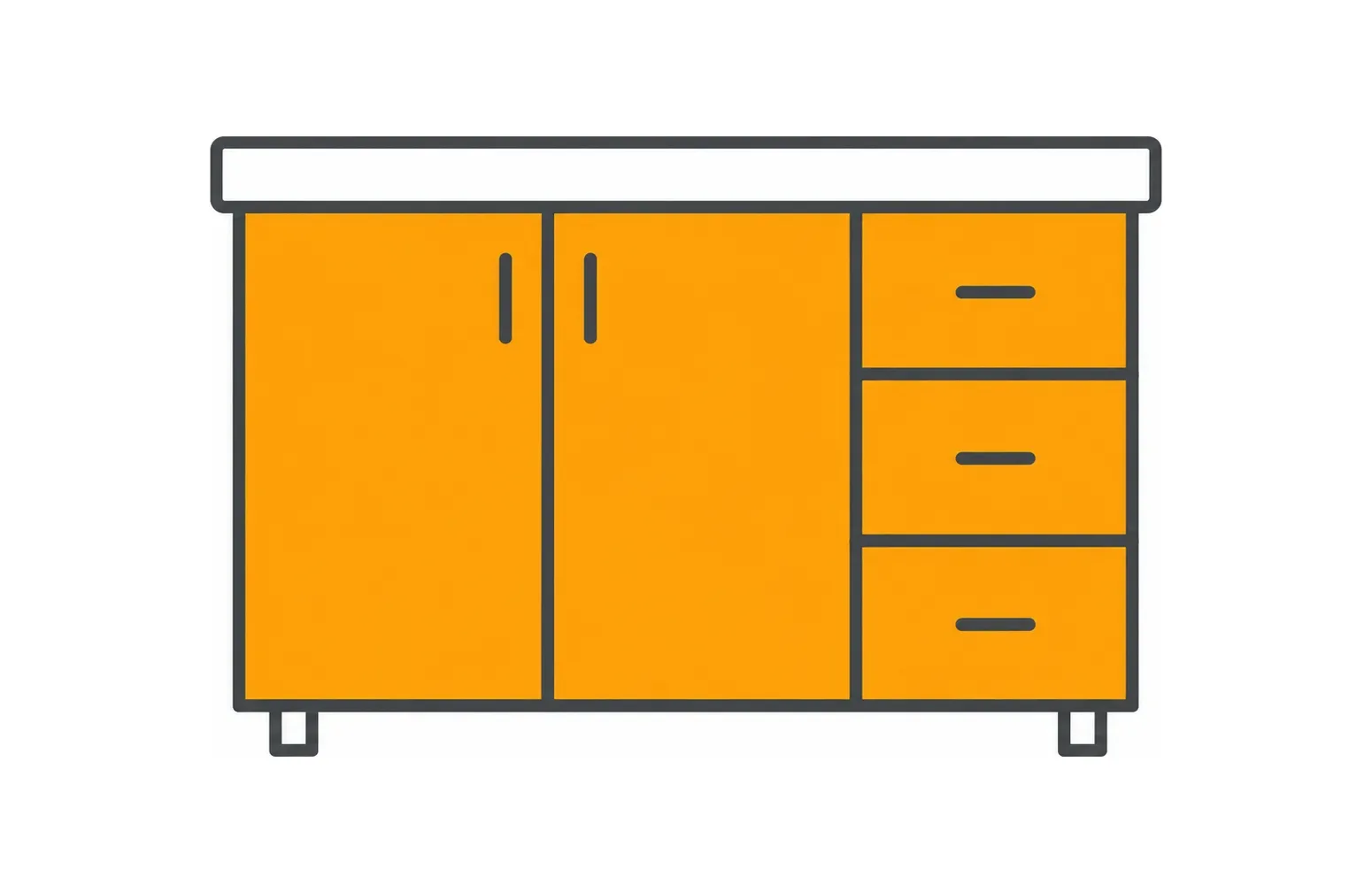


The hair-tool drawer: planning a Galaxy Pistachio Green drawer stack for heat, cords and weight
Reviewed September 2026 · Captivating Cabinets
Ask anyone who has lived with a bathroom for a year what they wish they had, and the answer is rarely more shelves. It is somewhere for the hairdryer. The Galaxy Pistachio Green vanity drawer base is the box that answers that question — a stack of drawers from top to bottom, no door, nothing hiding at the back — and this page plans it around the awkward things it ends up holding: tools that are hot when you put them away, cords that tangle, chargers that need power, and bottles heavy enough to test a drawer bottom.
Why the appliances belong in drawers, not on the counter or behind a door

Grooming appliances are the worst-shaped objects in a bathroom. A hairdryer is heavy at one end and has a cable; a straightener is long, thin and hot; an electric toothbrush and a shaver each come with a charger. Left on the counter they take the landing space either side of the bowl. Put behind a door they end up in a tangle on the cupboard floor, and you kneel to unpick them every morning.
A drawer solves both problems for the same reason: it brings the whole contents up to hip height and shows them from above. You lift out the dryer rather than digging for it, and the cable stays with it. In this line the drawer boxes are ⅝-inch solid wood with dovetailed corners, on full-extension concealed runners with Blumotion soft close — which matters for this use more than it would for towels, because a full-extension drawer lets you reach the tool at the very back without pulling the drawer off its runner.
Heat: the rule for anything that was plugged in five minutes ago
The rule is simple and worth stating plainly: nothing goes into a drawer while it is still hot. A straightener or curling tongs can stay hot enough to mark a finish for a good while after switching off, and a closed drawer holds that heat against whatever the tool is lying on. Cabinet makers do not design drawer interiors as heat surfaces, and we have no published heat rating for these ones, so do not treat the drawer as one.
Two habits make the drawer safe to use. First, a cooling spot outside it: a heat-resistant mat or a wall-mounted holder near the outlet, where the tool rests until it is cool to the touch. Second, a heat-resistant pouch or silicone holder inside the drawer, so even a tool put away warm does not sit straight on the drawer bottom. Both are small, inexpensive third-party items that we do not sell; both protect the drawer, the cable and the tool.
Humidity is the other half of the story. A drawer next to a shower gets warm, damp air every morning. The care guide covers keeping a painted face and a wood interior in good shape; in a bathroom the short version is to run the extractor fan and wipe condensation off the fronts rather than letting it dry on.
Power in a drawer is an electrician’s job, not a cabinet option
The obvious next step is an outlet inside the drawer, so the dryer and the toothbrush charger live plugged in and ready. In-drawer power units exist and they work well, but they are not a cabinet part: they are made by specialist electrical manufacturers, they need a supply run into the back of the cabinet, and in a bathroom they have to meet the electrical code for wet rooms, which in the US includes ground-fault protection for bathroom outlets.
That makes it a job for a licensed electrician working to your local code and the unit maker’s instructions. It also means holes in the cabinet back and possibly the drawer box, which is worth talking to us about before anyone drills, so the cut lands where it should and you know what it does to the box. Plan it at rough-in, while the wall is open — adding a circuit after the tiles are up is where the cost goes.
The simpler alternative is to keep the outlet on the wall above the counter, where it is normally required anyway, and use the drawer only for storage. A tool that cools on a wall holder and then goes into a divided drawer does not need power inside the box. Separately, the vanity accessories page lists a vanity appliance storage rack, GPG VASR-30 at $240.50, described as being for a 30-inch width. There is no 30-inch drawer base in this finish, so if the rack interests you, ask us which box it is designed for before building a plan round it.
Which drawer takes which load
A drawer stack is only as good as its allocation. The mistake is to fill it top-down in the order things come out of the moving box. The better approach is to sort by weight and frequency, because the top drawer is the one you open most and the bottom one takes the heaviest load best.
- Top drawer — small and daily. Toothbrush, razor, contact lenses, the things you use without thinking. Divide it; a shallow tray with compartments stops the jumble.
- Middle drawer — the tools. Hairdryer, straightener, brushes, lying flat in holders, with cables loosely coiled rather than wrapped tight round the handle (tight wraps are what break cables at the joint).
- Bottom drawer — tall and heavy. Bottles standing upright, refills, the big bottle of mouthwash. Weight low keeps the stack steady and the runners happy.
Two people sharing a bathroom? Give each a drawer at the same height rather than one each at top and bottom. It avoids the morning argument about who gets the drawer you do not have to bend for. Drawer count per width is not stated in the listings, so confirm how many you are getting before you allocate them on paper.
Seven widths, and which ones take a hairdryer
The stack comes in 12, 15, 18, 21, 24, 27 and 33 inches. There is no 30 or 36-inch drawer base in this finish, so if your plan needs drawers at those widths, a 27 or 33 plus a filler, or a sink and drawer combo, is the route.
| Width | Code | Price | What it suits |
|---|---|---|---|
| 12″ | GPG VDB12-34 | $601.25 | Narrow slot beside a bowl; small items and one slim tool |
| 15″ | GPG VDB15-34 | $627.25 | A single hairdryer laid diagonally; brushes alongside |
| 18″ | GPG VDB18-34 | $672.75 | Dryer and straightener side by side in holders |
| 21″ | GPG VDB21-34 | $718.25 | One person’s full kit with room for dividers |
| 24″ | GPG VDB24-34 | $760.50 | Two people’s tools in one drawer, split down the middle |
| 27″ | GPG VDB27-34 | $802.75 | A proper grooming station for a primary bath |
| 33″ | GPG VDB33-34 | $877.50 | The widest stack; beside a sink base on a long wall |
The "what it suits" column is our planning judgement from typical tool sizes, not a published internal dimension — measure your own dryer, nozzle on, and check it against the box with us if it is a large salon model. Every width is on the vanities page alongside the rest of the family.
Three or four fronts in a colour: the stack as the face of the run
A drawer stack has more horizontal lines than any other vanity box: each five-piece recessed-panel front adds a rail top and bottom. In a white bathroom that detail almost disappears; in a colour it is the part of the vanity people notice, because the shadow lines of each front read against the painted face. That is mostly a good thing — a drawer stack in this sage looks like a piece of furniture rather than a plumbing enclosure — but it makes the hardware line important.
Centre every pull on its front and keep them all the same length, so they form a clean vertical column. Mixing a long pull on the deep bottom drawer with short ones above can work, but only if it is deliberate. And if the stack sits next to a sink base with a false front, match the top pull to that false front’s position so the line across the top of the run is unbroken. The full height base page has more on choosing the metal for a greyed sage; the green guide covers the wider palette.
Drawer stacks cost more than any other single-width vanity box, and that is honest: every drawer is a dovetailed box on its own pair of runners. If the budget is tight, one stack beside the bowl and a full-height box on the other side is a sensible split. For trade buyers, Captivating Pro pricing takes 20 to 40 percent off, one program, no tiers.
Common questions
- Can I put a hot straightener or curling iron in a vanity drawer?
- Not while it is hot. Let it cool on a heat-resistant mat or wall holder first, and use a heat-resistant pouch or silicone holder in the drawer. We have no published heat rating for the drawer interiors, so do not treat them as a heat surface.
- Can I get an outlet inside a vanity drawer?
- In-drawer power units exist but they are specialist electrical products, not cabinet options. They need a licensed electrician, a supply into the cabinet and code-compliant ground-fault protection. Talk to us before anyone cuts into the box.
- Is there a 30-inch vanity drawer base?
- Not in this finish. The drawer stack comes in 12, 15, 18, 21, 24, 27 and 33 inches, from $601.25 to $877.50. For 30 inches, use a 27 with a filler or look at the 30-inch sink and drawer combo.
- What size drawer base fits a hairdryer?
- In our planning experience 15 inches takes a typical dryer laid diagonally and 18 inches takes a dryer and a straightener side by side. Drawer heights and inside dimensions are not published, so measure a large dryer with the nozzle on and check it with us.
- Which drawer should hold the heaviest items?
- The bottom one. Keep daily small items in the top drawer, tools in the middle, and tall heavy bottles low, where the weight keeps the stack steady.
- How are the drawers built?
- Each is a ⅝-inch solid-wood box with dovetail joints on full-extension concealed Tandem plus Blumotion soft-close runners, behind a five-piece recessed-panel front.
Keep reading
The guides behind the numbers on this page.
- Dovetail Drawers and Cabinet Quality
Why the joint in each drawer corner matters when the drawer carries weight.
- Soft-Close vs Self-Closing Cabinet Drawers
The runner under every drawer in the stack, explained.
- How to Clean and Care for Kitchen Cabinets
Keeping painted fronts and wood interiors right in a steamy room.
- Fabuwood Bathroom Vanities: Sizes, Styles and Buying Guide
Where the drawer stack sits among the vanity configurations.
- Green Kitchen Cabinets: Sage, Pistachio, and Moss Shades and Pairings
Hardware and material pairings for this family of greens.


