

Building a bath run from Galaxy Linen vanities: width by width, one bowl or two
Reviewed September 2026 · Captivating Cabinets
Most bathroom cabinet orders reach us as a wall width and a question: one bowl or two? This page answers that width by width, using the boxes Fabuwood Galaxy Linen vanities are actually made in — sink base, drawer base, full-height door and the sink-and-drawer combos — with the code and the displayed price beside each build. Then it covers what a beige bathroom vanity cabinet changes that a kitchen never asks about: what the plumber needs to know about the combos, and how the box reads beside a white toilet, a white basin and a wall of white tile.
How tall is a Fabuwood vanity cabinet? 34½ inches, 21 deep, and no lowered box in this color
Every base on this page is 34½″ tall and 21″ deep. The -34 at the end of a code like GL VSB30-34 is the height — the store listing rounds it to 34″ — and with a 1¼″ top the deck finishes a little under 36″. There is no second height. Fabuwood builds a lowered 32½″ box for accessible work in some Galaxy colors, and this beige is not one of them, so a job that needs a 34″ finished surface cannot get there by picking a different code off this page. Say so early and we will look at the finish and the top thickness together.
The depth is the number to carry into every other decision: these are 21-inch-deep vanity cabinets, not 24. A bath top is normally cut at 22″, so a kitchen slab template is wrong here by two inches, and the bowl, trap and supply valves share a shallower bay than a kitchen sink base — which is why rough-in position matters more in this room. The one upper on the page is a different animal: GL WVS2430 is 24″ wide, 12″ deep and 30″ tall, and its listing says both sides ship finished.
- Vanity base, GL VB12-34 to GL VB30-34 — one door under one drawer. $364.00 to $555.75.
- Vanity sink base, GL VSB21-34 to GL VSB42-34 — two doors under a false front, the bay left open for the bowl and trap. $422.50 to $542.75.
- Vanity drawer base cabinet, GL VDB12-34 to GL VDB33-34 — a stack of full-extension soft-close drawers, no plumbing. $601.25 to $877.50; the list skips 30″.
- Full-height base, GL VB12FD to GL VB36FD — one uninterrupted door, no drawer. The cheapest box here at $328.25 for the 12″.
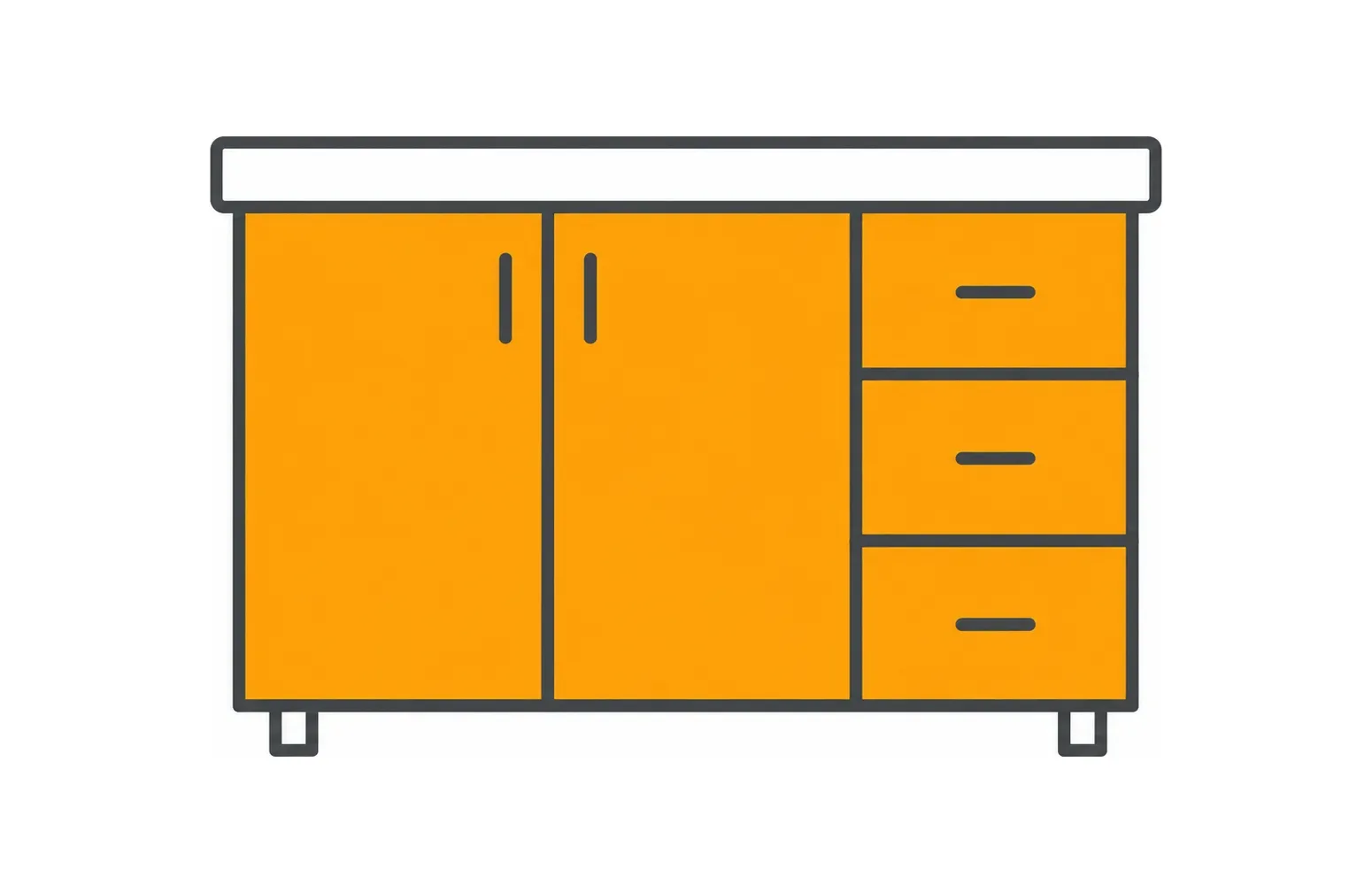
- Sink and drawer combo, GL VSD30DL through GL VSD60SINGLE — bowl and drawer stack in one carcass. $757.25 to $1,196.00.
- Vanity wall, GL WVS2430 — the only upper, $490.75.
What size vanity cabinet for a 36, 48 or 60-inch wall?

Walls come in every width; the boxes come in 3″ steps. The table pairs common wall widths with a one-bowl build and, where the width allows, a two-bowl build, using only codes that exist in this finish. Prices are for the cabinets alone.
| Wall width | One bowl | Two bowls | What to know |
|---|---|---|---|
| 24″ | GL VSB24-34, $438.75 | — | Powder-room width; the 21″ and 27″ sink bases bracket it. |
| 30″ | GL VSD30DL or DR, $757.25 — or GL VSB30-34 alone, $461.50 | — | The combo adds a drawer stack for about $296 over the plain sink base. |
| 36″ | GL VSD36DL or DR, $783.25 — or GL VSB36-34 alone, $490.75 | — | The plain 36-inch vanity sink base has no drawers; GL VSB24-34 + GL VDB12-34, $1,040.00, costs more but puts the stack on either side. |
| 42″ | GL VSD42, $874.25 | — | No DL/DR version at this width; confirm the bay split on the spec drawing. |
| 48″ | GL VSD48, $975.00 — or GL VSB30-34 + GL VDB18-34, $1,134.25 | GL VSB24-34 × 2, $877.50, no drawers | Two-piece gives a full 18″ stack; one-piece gives one cut-out and no seam. |
| 54″ | GL VSB30-34 + GL VDB24-34, $1,222.00 | GL VSB27-34 × 2, $903.50, no drawers | Two bowls in 54″ cost every drawer and most of the deck. Go single. |
| 60″ | GL VSD60SINGLE, $1,196.00 | GL VSD60DOUBLE, $1,046.50 — or GL VSB24-34 × 2 + GL VDB12-34, $1,478.75 | The width where the catalog forks — the 60-inch double sink cabinet is argued below. |
| 72″ | GL VSB36-34 + GL VDB18-34 × 2, $1,836.25 | GL VSB27-34 × 2 + GL VDB18-34, $1,576.25 — or GL VSB30-34 × 2 + GL VDB12-34, $1,524.25 | An 18″ stack between two 27″ bases is the layout most couples like best. |
Two habits hide in that table. We put the drawer stack between two bowls rather than at the ends, because the middle is where two people stand, and we favor a 30″ sink base wherever the width allows it, because that is the width the under-sink organizer on the vanity accessories page is built for. Nothing here needs a filler except an odd wall.
A 60-inch double sink vanity, cabinet only: why the single bowl costs more
At 60″ the one-piece combo comes two ways, and both are sold as the cabinet only — no top, no bowls, no faucet — so the prices compare like with like. GL VSD60DOUBLE carries two bowls side by side at $1,046.50. GL VSD60SINGLE carries one bowl in the middle with a bank of drawers on each side, at $1,196.00. People expect the double to cost more; it is the single that carries more drawer boxes, and drawer boxes — ⅝″ solid wood, dovetailed, on Blum Tandem plus Blumotion runners — are the expensive component in any cabinet in this line. The extra $149.50 buys the second drawer bank and the counter a second basin would have taken.
Set the three-piece alternative beside them. Two 24″ sink bases with a 12″ drawer base between come to $1,478.75 — more than either one-piece cabinet, with two seams under the top and a single narrow stack. The one-piece double is the cheapest route to two bowls in this finish by a wide margin; the one-piece single is the cheapest route to a centered bowl with real drawers. Three pieces earn their place only when the bowls have to sit at the ends of the wall.
The plumbing follows the bowl count: a double needs a second drain and a second set of supplies, and the trap under each bowl takes the floor of that bay with it. Shared bath, every morning, two people — the double is right. Anyone else gets more from the single, because the width goes into drawers opened daily.
Combo cabinets: the drawer stack tells the plumber where the drain goes
GL VSD30DL and GL VSD36DL put the stacked drawers on the left and the bowl on the right; the DR versions mirror that. On a remodel, the existing drain usually settles the choice before taste gets a vote. If the old drain stub sits right of the cabinet's center line, the bowl belongs on the right and you want DL; left of center, DR. Moving a drain across a cabinet is a floor-opening job, and choosing the handing to match the stub is free.
On new work the order reverses — the cabinet is decided first and the plumber roughs to it. What they need is the bay split, because the drain has to land under the bowl, not under the middle of a 30″ carcass. Get the sink-bay width off the Fabuwood spec drawing for the exact code and hand it over in writing; a drain roughed to the cabinet center on a combo ends up behind the drawer stack. Supply valves want the same treatment, set close to the wall and on the bowl side.
At 42″, 48″ and 60″ the codes carry no handing letter, which normally means a centered bowl; confirm the bay dimensions on the drawing. And with any combo, choose the sink before the cabinet is set: an undermount and a drop-in need different cut-outs and different clearance to the stack beside them.
A beige vanity beside white tile: making it read on purpose

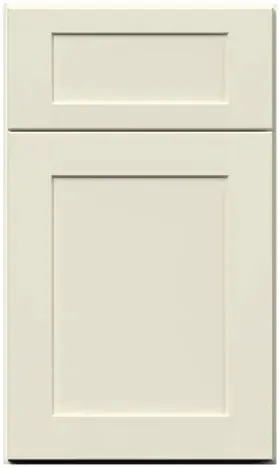
A kitchen gives a beige cabinet company — wood floors, a stone top, a painted wall. A bathroom gives it porcelain. The toilet is white, the basin is white, and the tile usually is too, so the vanity is the only large colored surface in the room, and the Linen finish reads as exactly what it is: a light beige with earthy, slightly greige undertones. There is no room in a bath for it to pass as a soft white the way it sometimes can in a kitchen. That is not a warning, it is the decision — you are choosing the vanity as the warm object in a white room. Searches for a cream shaker vanity bring a lot of people to this finish, and in a bright, south-facing bath it does glow creamy; with the door shut and the lights on it is beige, and you should buy it as beige.
When it works, it works because the whites around it are warm: tile with a cream or handmade cast, a top in cream quartz or a stone with beige movement, brass or bronze on the pulls and the faucet, and bulbs at 2700–3000K over the mirror. When it fails, one of those was cold — a blue-white gloss subway tile, a gray quartz top, a 4000K vanity strip — and the beige goes muddy against the porcelain beside it. Bathrooms are also the rooms most likely to have no window, so the dim-room rule for this color applies here with the door shut. Matte black hardware is a bigger gamble on this beige than on an off-white; warm metals are the safe pairing.
The check is cheap and specific. A door sample is $25.00: tape it to the tile beside the toilet, put the actual bulbs in the actual fixture, and look at it at night. If you are torn between this beige and a softer white, the Linen versus Dove comparison sets out where each one stops working, and the guide to matching cabinets to counters and tile covers the white-card test in the photo above.
Drawer base or full-height door: the 12-inch boxes, the wall cabinet and what ships with them
The three 12″ boxes are worth knowing on their own. GL VB12FD, at $328.25, is a single full-height door with shelf behind it, and it is the cheapest cabinet in this beige — beside a sink base it is where the spare rolls and refill bottles stand. GL VDB12-34, at $601.25, is a drawer stack in the same footprint, and it is what we specify when the counter is losing the war with hair tools. GL VB12-34, at $364.00, is the door-under-drawer compromise. All three also come at 15″, 18″ and 21″.
GL WVS2430 is the answer for the wall over the toilet, where an open shelf collects clutter and a medicine cabinet is too small; hang it so the bottom clears the head of anyone seated below.
Whatever you build from this page ships pre-assembled — no flat-pack, nothing to square up on site — in 7 days to 3 weeks with a limited lifetime warranty, on the same five-piece door, ½″ select solid wood box and Blum soft-close hinges and runners as the base, wall and tall cabinets in the full Linen collection. Any side of a vanity that faces the room needs finishing in the same beige: the product listings describe a finished-side option at $96 per side, and the panel and platform families are on the vanity accessories page — confirm which of the two your quote carries. To have the layout drawn from a wall width and a photo, our design service does that at no charge, and contractors doing this every month should start at Captivating Pro.
Common questions
- Is there an ADA-height Galaxy Linen vanity?
- No. Every base in this beige is 34½″ tall; the lowered 32½″ box Fabuwood builds for accessible work is not offered in this color. If a job needs a 34″ finished surface, talk to us before ordering, because no code on this page gets there on its own.
- How much does a beige bathroom vanity cabinet cost in this finish?
- Cabinet only, before the top and the bowl: a plain sink base is $422.50 at 21″ up to $542.75 at 42″, a drawer base $601.25 to $877.50, a full-height door box $328.25 to $490.75, and the sink-and-drawer combos $757.25 to $1,196.00. A 48″ single-bowl wall built as GL VSD48 is $975.00. Those are the displayed prices; each listing shows the list figure beside it.
- How do I build a 72-inch double vanity in this finish?
- Two 27″ sink bases with an 18″ drawer base between them — GL VSB27-34, GL VDB18-34, GL VSB27-34 — is $1,576.25 in cabinets. Two 30″ sink bases around a 12″ drawer base is $1,524.25 and gives each bowl the width the U-shaped organizer is built for.
- What does a 60-inch double sink vanity cost, cabinet only, and why is the single bowl dearer?
- Drawers. GL VSD60SINGLE puts a centered bowl between two drawer banks; GL VSD60DOUBLE gives that width to a second basin instead. Dovetailed drawer boxes on Blum runners are the costly component, so the single lists higher — $1,196.00 against $1,046.50.
- Will a beige vanity look dirty next to white tile and a white toilet?
- Only if the whites around it are cold — blue-white gloss tile, a gray top, 4000K bulbs. Against cream-cast tile, a warm stone or cream quartz top, brass hardware and 2700–3000K lighting, it reads as a deliberate warm piece in a white room. Tape a $25.00 door sample to the tile and judge it under the real lights.
- How deep are Fabuwood vanity cabinets, and what countertop depth do they need?
- The boxes are 21″ deep and 34½″ tall, so a 22″ top gives a normal overhang. A kitchen-depth slab at 25½″ would hang 4½″ past the doors. Write 21″ deep and 34½″ tall on the fabricator's work order rather than describing it as a standard vanity.
Keep reading
The guides behind the numbers on this page.
- Fabuwood Bathroom Vanities: Sizes, Styles and Buying Guide
The same configurations across every Fabuwood finish, if this beige is not the one.
- Fabuwood Cabinet Colors
Where Linen sits among the brand's beiges, off-whites and whites.
- How to Match Cabinets, Countertops, Backsplash and Flooring
The white-card undertone test, and which tops keep a warm cabinet warm.
- Fabuwood Linen vs Dove
The finish most people cross-shop against this one, decided honestly.
- Kitchen Cabinet Samples: How to Order and Evaluate
Judging a door sample in a windowless room under the bulbs you will use.
- Fabuwood Cabinet Sizes and Specs
Bath box depths against kitchen depths, in one table.
- How to Read Cabinet SKU Codes
What DL, DR, FD and the -34 suffix are each telling you.


