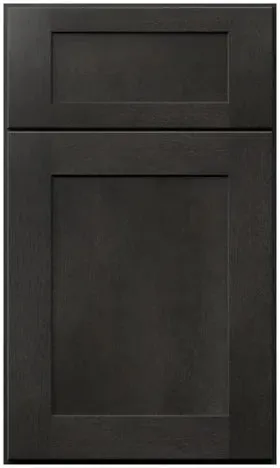



Does carving read on a dark door? Light, grain and the Galaxy Cobblestone decorative onlay
Reviewed September 2026 · Captivating Cabinets
On a white door, a carved ornament shows itself through shadow. On a dark one, shadow has nowhere to go: the recesses are already dark, so the carving reads only where light catches its raised edges. That is the thing to understand before ordering the Galaxy Cobblestone decorative onlay, GC VDO at $425.75. It can look rich on this finish, but only in the right light, and only if the piece takes the stain the same way the door does.
Does carving show on dark wood? Only where the light rakes across it

An onlay is a separately made ornament fixed to the face of a door, standing a little proud of it. On pale finishes the eye reads it from the shadows it throws. On a dark gray-brown stain those shadows barely register, and what you see instead is a set of highlights: the top of each curve catching the light.
That means the light source decides whether the onlay exists. A sconce beside the mirror, a window to one side, or a vanity light bar that reaches the door at an angle will bring the carving out. A single ceiling fixture straight above flattens it to a dark shape on a dark door. Before ordering, stand where you will usually see the vanity and look at which way the light falls on the doors.
Stain match and grain direction on an applied piece
This is where a stained finish is harder than a painted one. Paint covers wood evenly. Stain soaks in, and how much it soaks in depends on the wood and on which way the grain runs. A carved piece has end grain on every curve, and end grain drinks stain, so the ornament can come out darker or more uneven than the flat door it sits on.
The catalog does not say whether GC VDO arrives finished in Cobblestone, what it is made of, or its size. Ask your designer all three in writing before ordering. If it comes finished, hold it against a Cobblestone door sample ($25.00) in the bathroom light. If it comes raw, do not stain it on site to match by eye; get the factory answer first.
Which vanity suits an applied ornament
The onlay belongs on a vanity that already looks like furniture: one standing on a platform with feet, in a larger bathroom, with a framed mirror and some trim on the walls. On a built-in box with a toe kick in a small room, a single ornament on a dark door tends to look like a mistake rather than a choice.
Traditional rooms suit it best. Cobblestone's brown side leans that way already, which is why an onlay works better here than on a cool charcoal. In a pared-back modern bath, leave it off and let the grain be the detail.
Brass hardware on a dark vanity does most of the same job
Most people looking at an onlay want the vanity to feel richer. On this finish, warm metal gets you most of the way for less. Brass, champagne bronze or antique brass knobs and pulls stand out strongly against the dark gray-brown and catch the same raking light the onlay needs. Matte black hardware nearly vanishes on Cobblestone, which suits a minimal look but adds nothing decorative.
So the order we suggest is: hardware first, then a footed platform if you want furniture, and the onlay only if the room still asks for more. Hardware is not sold on this page; ask your designer to add it to the quote.
Living with a carved piece on a dark door
Dust settles in carving, and on this finish pale dust sits in the recesses where it is easy to see. A soft brush once a week keeps it clear. Hairspray film builds on raised edges too; a barely damp cloth, then dry, as the care guide describes.
Removal is not clean: an adhered piece takes finish with it when pulled off. Tape a paper cut-out to the door for a week, look at it morning and evening, and then decide.
Common questions
- Does a carved onlay show up on a dark door?
- Yes, but through highlights rather than shadows. It needs light coming from the side, such as a sconce or window; straight-down ceiling light makes it look flat.
- Does the onlay come stained to match Cobblestone?
- The catalog does not say, nor does it give the size or material. Ask your designer for all three in writing before ordering.
- Why can a carved piece look darker than the door?
- Stain soaks into end grain more than flat grain, and a carving has end grain on every curve. That is why the finish state of the onlay matters more with a stain than with paint.
- What hardware looks best on a dark gray-brown vanity?
- Brass, champagne bronze and antique brass stand out well. Matte black nearly disappears on this finish, which is fine for a minimal look.
- Is an onlay the same as an applique?
- In practice, yes: both are ornaments made separately and fixed to a surface. Molding differs because it runs along an edge instead of sitting on a face.
- Can I remove the onlay later?
- Not cleanly. Pulling off an adhered piece damages the finish underneath. Test with a paper template on the door for a week first.
Keep reading
The guides behind the numbers on this page.
- Kitchen Cabinet Molding Types
Applied ornament and trim, and how each is attached.
- Brown Kitchen Cabinets: Stains, Shades and Pairings
How stain behaves on wood, and why it differs from paint.
- Kitchen Cabinet Samples: How to Order and Evaluate
Judging a finish match in the room's own light.
- Contemporary vs Transitional Kitchen Cabinets
Which style register an ornamented vanity belongs in.
- Shaker vs Slab Cabinets
How much detail a shaker door already carries.
- Black Kitchen Cabinets: Styles, Pairings and Care
Hardware that shows on dark doors and hardware that vanishes.
- Fabuwood Cabinet Colors
Where Cobblestone sits among Fabuwood's finishes.


