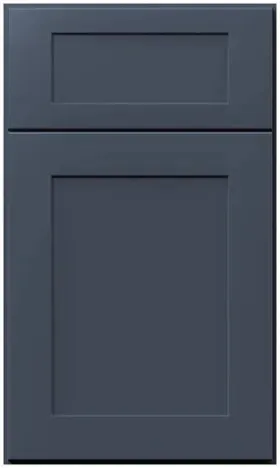


Galaxy Indigo decorative accessories: finishing all four faces of a navy island
Reviewed September 2026 · Captivating Cabinets
Prices quoted in this article were read off the grid on the review date; the live price grid on this page governs.
Most Indigo orders are for an island, and an island has no back wall to hide against. The Galaxy Indigo decorative accessories list is mostly about that: the seating side, the two ends, the corners and the floor line of a navy block that everyone walks around. This page works round the island one face at a time, prices what each face needs, and then covers what changes when the navy climbs onto the perimeter walls.
An island is a piece of furniture, and it is seen from behind

A perimeter run shows one face. An island shows four, and in an open plan the one guests see first is usually the back, the seating side, where the stools go. On a white island a plain panel there disappears. On a saturated navy it becomes the largest single surface of colour in the house, so what it is made of shows.
Indigo is a flat paint with no grain, so any depth on that surface has to come from shape rather than wood figure. That is the thread through this whole page: texture on the big faces, clean edges on the corners, and a floor line that is kept as deliberately as the top.
The seating side: a flat panel, or cladding that catches light
There are two ways to close the back of an island. A flat panel is quick: GI PAN-1/4 at $263.25, the ½″ and ¾″ plywood panels at $448.50 and $516.75 (or $806.00 and $910.00 in the 48″ × 120″ size), and the refacing panels GI REP2496 at $295.75, REP3096 at $341.25 and REP30120 at $594.75. The 1½″ and 3″ thick versions of the 30″ panels run $367.25 to $890.50. Cladding is the other way: narrow profiled pieces that give the navy a pattern of light and shadow.
| Part | Size as listed | Price | How it reads on flat navy |
|---|---|---|---|
| GI RFP696 reeded interlocking panel | 6″ × 96″ | $250.25 | Fine vertical ribs. Each rib throws a thin shadow, so the paint reads as a textured column rather than a slab. |
| GI SFP696 side-slat interlocking panel | 6″ × 96″ | $250.25 | Wider slats. Bolder than reeded and more modern at a distance. |
| GI BPP-12 beaded panel plank | 12″ wide | $126.75 | A cottage bead. It keeps a navy shaker island traditional. |
| GI SHL-8 shiplap | 8 ft | $169.00 | Horizontal lines that make a long island look longer. |
| GI BM3/4 batten / BM1 1/4 beaded molding | 8 ft pieces | $44.20 / $57.85 | Applied over a flat panel to make board-and-batten or a frame. The cheapest way to add relief. |
Put a number on the favourite. Reeded panels are 96″ long, and an island back is roughly counter height minus the kick. Running them vertically, each stick cuts into two strips. A 96″-long island needs sixteen 6″ strips, which is eight sticks, or $2,002.00. A single REP3096 at $341.25 covers the same face flat if its 30″ dimension suits your island. Confirm the fit with your designer, because the island height and the kick depth decide it.
Two cautions about paint. A stool footrest scuffs a dark opaque finish, and a pale scuff on navy shows at ten paces. Leave room for a counter overhang deep enough that knees and shoes stay off the panel. And every site-cut end of a cladding piece is raw, so plan cuts to land at the floor or under the counter edge, where nobody looks.
The two ends: skin, end panel or post
An island end is usually one cabinet side. The cheapest cover is the GI SK BASE end skin at $62.40, which is a thin, finished face. The GI BEP base end panel at $149.50 is listed as the decorative alternative; ask your designer for its drawing, because the list gives no profile. On a navy island seen from the dining table, the end panel is usually the one to buy: a flat skin on a large dark surface reads as the side of a box, and a panel with some depth reads as the end of a piece of furniture.
Posts are the next step up. GI SP3X3 (a 3″ × 3″ square post) is $344.50, the 36″ square post SP36 is $425.75, the 36″ corner post CP36 is $312.00 and the square pilaster post SQP36 is $594.75. Where an island has a seating overhang at one end, a post at each outside corner makes it look like a table. Whether a post can carry any weight is a question for your installer, not the price list. Treat these as trim unless you are told otherwise.
The base pilaster, GI PP-BASE at $227.50, is the flat version: it adds a column of shadow at the corner without standing proud. It suits a navy island with a traditional crown elsewhere in the room.
Outside corners and the floor line

Outside corners are where an island gets knocked by chairs, hips and vacuum cleaners, and where two panels meet in a seam. GI OCM8 outside corner molding is $62.40 for 8 ft, and the 1¼″ version is $78.00. The inside corner molding ICM8 is $59.80. A corner molding closes the seam in the finish, so a knock lands on trim rather than on the edge of a door.
The toe kick is the part that tells you whether an island was designed or simply delivered. GI TK8 is $55.90 for 8 ft, TK8-3/4 is $58.50, and the cap and ¾″ clip are $7.80 and $10.40. On an island the kick runs all four sides, so measure the full perimeter and round up to whole sticks. A navy kick shows dust and mop splashes as a pale haze in the way a white one does not. If that bothers you, set the kick back a little further, which your installer can do, and it falls into shadow.
Where the floor is not flat, GI SM8-S scribe molding at $39.00 or the decorative SM8-D at $41.60 closes the gap, and GI QRM quarter round is $62.40. GI BBM baseboard molding at $188.50 carries a navy baseboard past a tall cabinet. White oak floors are the classic partner for navy: the warm floor stops the blue from feeling cold. The countertop, backsplash and flooring guide covers the rest of that pairing.
When the navy runs the perimeter too
Some kitchens take Indigo all the way round, and then the list picks up the parts every perimeter needs. The dishwasher panel GI DWR6 is $201.50. The 12″ × 96″ refrigerator end panel GI REP1296 is $224.25, with REP1-1/2 at $250.25, REP3 at $325.00 and the two end caps, RFPEC and SFPEC, at $97.50 each. Plain fillers run from $26.00 (GI BF3, WF330) to $156.00 (TF3120). The overlay fillers GI OLF330 to OLF396, at $71.50 to $230.75, stand in the plane of the doors rather than behind it. Wall skins are $50.05 at every height, the microwave skin is $50.05, the tall skins are $126.75 and $169.00, and SK WD is $169.00.
Crown is where a full navy wall meets the ceiling, and a dark crown under a white ceiling draws a hard line. That can look crisp, or it can make an 8-foot ceiling feel lower. Seven profiles are listed: CM-1 at $117.00, CM-3 at $123.50, CM-4 at $139.75, CM-6 and CM-9 at $152.75, CM-7 at $295.75 and CM-8 at $367.25. A small profile keeps the line thin. GI STRM-8 and STKM-8 at $133.25 each and MEX-8 at $289.25 stack the crown up to a higher ceiling. The tops of the crown and the uppers are where a navy kitchen collects visible dust, so a crown run to the ceiling also means one less ledge to wipe.
The light rail GI LRM ($149.50) hides the under-cabinet bars, and the valances (VAR36 at $91.00, VAR54 at $100.75, VARP36 to VARP54 at $217.75–$234.00, VST96 at $188.50) bridge a window. On a two-tone kitchen, none of this is ordered in Indigo: the crown, rail and valance belong to the white uppers, and the Frost vs Dove comparison is the place to pick which white.
Floating shelves on a navy wall: which wood, which metal
The floating shelves are the one part of this list that decides a material rather than a colour. GI LED FLS24 to FLS60 cost $487.50 to $1,027.00 in the standard finish, the same in Timber, and $585.00 to $1,098.50 in Walnut. The stainless steel shelf, SSFLS36, is $510.25.
Navy commits the room’s metal, and the shelf is where that shows. Brass or gold hardware on navy is the classic pairing, and it wants a warm shelf: Timber, which reads close to white oak, is the natural partner. Brushed nickel or matte black hardware reads cooler, and there the stainless shelf repeats the pulls and the appliances. Walnut on navy is dark on dark. It is handsome in a bright room and heavy in a dim one. Choose the hardware first, then the shelf that agrees with it, and use one wood tone only.
Pilasters, columns and the decorative extras are here too: wall pilasters $201.50–$243.75, tall pantry pilasters $455.00–$464.75, columns CLM-3012 to CLM-4212 at $217.75–$260.00, the column base at $299.00, the 96″ column at $624.00, the oversized custom column at $1,088.75, mirror molding at $87.75 and the drawer panels DWR1-1/2 and DWR3 at $123.50 and $130.00. Send the plan for a free 3D design and the island’s four faces come back itemised against the full Indigo collection.
Common questions
- How do I finish the back of a navy kitchen island?
- Either a flat panel (GI PAN-1/4 at $263.25, or a refacing panel from $295.75) or cladding. Reeded or slat interlocking panels at $250.25 per 6″ × 96″ stick give a flat navy paint some relief; a 96″-long island back takes about eight sticks, $2,002.00, run vertically. Confirm the panel height against your island with a designer.
- Should an island end use an end skin or an end panel?
- On a navy island that is seen from the dining area, usually the GI BEP base end panel at $149.50 rather than the $62.40 SK BASE skin. The skin is a thin finished face, which reads as the side of a box on a large dark surface. Ask your designer for the end panel’s drawing before ordering, since the list does not show its profile.
- Does a navy toe kick show dirt?
- More than a white one: dust and mop splashes show as a pale haze on dark paint. GI TK8 is $55.90 for 8 ft in the Indigo finish. Setting the kick back slightly puts it in shadow, and a designer or installer can plan for that.
- Can I add posts or legs to the corners of an Indigo island?
- The list has several: GI SP3X3 at $344.50, the 36″ square post at $425.75, the 36″ corner post at $312.00 and the square pilaster post at $594.75. Treat them as decorative. Whether a post can support a counter overhang is a question for your installer.
- What crown molding looks best on navy cabinets under a white ceiling?
- A small profile such as CM-1 ($117.00) or CM-3 ($123.50) keeps the navy-to-white line thin. The larger CM-7 and CM-8 ($295.75 and $367.25) make a bold band that suits a high ceiling. On a two-tone kitchen the crown goes on the white uppers and comes from their collection.
- Which floating shelf goes with navy cabinets and brass hardware?
- Timber, which reads close to white oak and warms up the blue, at the same price as the standard shelf ($487.50–$1,027.00). The stainless SSFLS36 at $510.25 suits brushed nickel or black hardware. Walnut on navy is dark on dark and needs a bright room.
Keep reading
The guides behind the numbers on this page.
- Cabinet Skin Panels and Gables
Skin, gable and end panel compared on a real island end.
- Cabinet End Panels, Scribe Molding and Fillers Explained
Where each finishing part lands on an elevation, drawn out.
- Kitchen Island Clearance Guide
The walkway and overhang dimensions that keep stools off a painted back.
- Kitchen Cabinet Molding Types
The crown, light rail and valance profiles before you choose one for navy.
- How to Match Cabinets, Countertops, Backsplash and Flooring
White oak, marble-look quartz and warm whites: what surrounds a navy island.
- How to Clean and Care for Kitchen Cabinets
Scuffs on a dark island back and dust on a dark kick.


