

Galaxy Horizon glass cabinets as furniture: the pair, the hutch, the corner and the end piece
Reviewed September 2026 · Captivating Cabinets
Prices quoted in this article were read off the grid on the review date; the live price grid on this page governs.
Put glass in a painted door and you get a cabinet with a window in it. Put glass in a stained door, with the grain running up the stiles, and the result reads as something older: a dresser, a china cabinet, a hutch someone’s grandmother owned. That is the real reason to choose Galaxy Horizon glass door cabinets, and it changes how to plan them. Furniture is composed, not scattered, so this page is built around four compositions that work, what each costs, and the handful of decisions a stained glass front asks for that a painted one does not.
Why a grained frame around glass reads as a piece of furniture

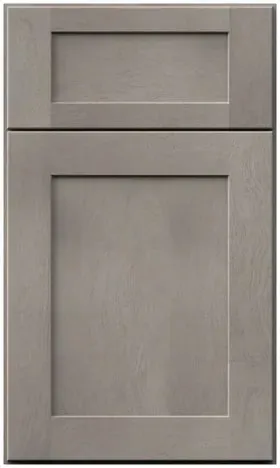
Glass-front cabinets in wood are older than fitted kitchens. The dresser and the china cabinet were free-standing pieces with a solid lower half for linens and a glazed upper half for the good plates, and the wood frame round the glass was part of the point. A five-piece shaker door with a solid-wood frame is the direct descendant of that idea, and on this finish the grain stays visible through the stain, so a glass front here looks like one of those pieces rather than like a gap in a painted wall.
Fabuwood’s own description of this colour leans the same way. One of its style cards for the finish, titled “Refined French Charm”, says its “soft taupe tones and delicate woodgrain bring a timeless elegance to French country style”. French country kitchens are built out of furniture: open shelves, a big sink, a dresser with glass above. That is the tradition a glass upper in this grey-taupe belongs to.
The practical consequence is that glass here should be placed the way a piece of furniture is placed: centred on something, in a pair, or anchoring an end. One glass door dropped halfway along a run of solid doors reads as an afterthought on any finish, and on a stained one it also breaks the continuous grain of the run for no reason. The four arrangements below are the ones that hold together.
The pair: two glass uppers flanking a window or the hood
The simplest composition is two matching glass cabinets either side of a central feature. Over the sink, that is the window; over the range, the hood. The pair turns the whole wall into a symmetrical front, and a symmetrical front is how most of the old dressers were built.
Choose narrow units for a pair. A 15″ or 18″ glass upper each side of a window keeps the glass subordinate to the view, and the price is modest: GHZ GDW1530 is $97.50 at 30″ tall, GDW1536 $117.00, GDW1542 $139.75; the 18″ versions are $117.00, $139.75 and $162.50. Match the height to the solid uppers either side so the tops line up under one crown.
Beside a hood, a pair of glass uppers is a stronger statement, and one to weigh against what else is on that wall. Grease and steam reach the cabinets next to a range before any others, and a glass front shows what they leave on the glass and on the things behind it. If the pair goes by the hood, keep the display to things that wash, and plan to wipe the glass weekly.
The hutch: glass uppers stacked over a separate counter run
The hutch composition treats one stretch of wall as a separate piece: a short run of base cabinets with its own worktop, and a matching run of glass uppers above it, often with a different backsplash or a mirror behind. It works on a wall away from the cooking, in a dining area or an open-plan room, and it is where a stained glass cabinet looks most like the furniture it came from.
Make the uppers taller than the kitchen’s own. At 42″ the glass units read as a cabinet rather than a shelf: GHZ GDW3042 is $279.50 and GDW3642 $321.75, with the 24″ GDW2442 at $234.00. A pair of 30″ or 36″-wide 42″ units over a 60″ or 72″ counter makes a proper hutch. The 18″ × 60″ double-door unit, GHZ GDWD1860 at $188.50, is the tall narrow option. Its code mirrors the 18″ × 60″ wall-with-drawers cabinet in the line, so ask whether it is meant to pair with that cabinet before you plan it as a standalone.
A valance under the uppers and a crown over them turn the stack into one piece. The decorative accessories page has the standard valance at $91.00 for 36″ and the premium one from $217.75, and seven crown profiles from $117.00.
The corner display

Where two wall runs meet, a diagonal corner cabinet turns its face to the room, and a glass door in that face makes the corner a small display case. It is the least used cabinet in most kitchens, which makes it the right place for things you want to see more than you want to reach.
The diagonal corner glass units come in the same four heights: GHZ GDWDC2430 at $100.75, GDWDC2436 at $117.00, GDWDC2439 at $126.75 and GDWDC2442 at $139.75. Glassware looks best here, and the corner is the one spot where a light inside the box does double duty, because it throws a glow onto both walls. The diagonal corner glass page lists them in one place.
The end piece: one glass cabinet where the kitchen meets the room
In an open plan, the last wall cabinet of a run is the one the living or dining side sees. A glass front there faces the room rather than the cook, which is a good reason to make it glass: it holds the serving pieces, the good glasses, the things that go to the table, and it softens the edge of the kitchen for people sitting beyond it.
An end piece has one extra requirement: its outer side is on show. Order a wall skin for it at the same time, $50.05 for a 30″, 36″, 39″ or 42″ height, so the exposed side is finished in the same stain. A 24″ or 30″ glass unit is the usual choice: GHZ GDW2436 at $201.50, GDW3036 at $234.00, or GDW3042 at $279.50 at 42″.
| Composition | Units | Glass-line total |
|---|---|---|
| The pair, beside a sink window | Two GHZ GDW1836 | $279.50 |
| The hutch, over a 72″ counter | Two GHZ GDW3642 | $643.50 |
| The corner display | One GHZ GDWDC2436 | $117.00 |
| The end piece | One GHZ GDW3036 + one wall skin | $284.05 |
Read those totals with the caveat in the last section. The glass line prices far below the solid cabinet of the same size, and the gap is large enough that it may be a glass-ready door rather than a whole cabinet.
Two woods in one cabinet: the stain outside, natural veneer inside
Every box in the Allure line has a ½″ veneered plywood case with a natural finished interior. Behind a solid door that is a quality note. Behind glass it is visible, and on this finish it means the cabinet shows two woods at once: the grey-taupe stain on the frame, and a lighter natural veneer inside.
On a painted kitchen that inside wood is the only grain in sight. Here it sits beside the grain of the frame, and the two do not match, because they are not meant to. Most people like it: it is how old furniture was built, finished outside and plain inside. If you do not, the fix is a back panel. GH PAN-1/4 at $263.25 is flat panel stock in this finish, cut to the back of the box, which puts the stain on the back wall and leaves the veneer only on the shelves.
Either way, look before you decide. The $35.00 door sample shows the outside. Ask us for a photo of a natural interior beside it before you decide whether to line the back.
Order the glass doors with the solid doors they sit between
Fabuwood’s spec book describes colour variation between stained doors as normal. On a run of solid doors that variation is spread along the wall and nobody notices. A glass unit breaks that pattern: it is the one door people look at closely, and its frame sits directly between two solid ones. If it arrives in a later order it can be a shade away from its neighbours, and the difference will be right where the eye goes.
So decide on the glass before the cabinet order goes in, and put the glass units on the same order as the solid ones. Changing a solid upper for glass later is possible, but it is the one change to this kitchen that is most likely to look like a change.
A fixed light for a finish that moves
This grey-taupe changes with the light. Homeowners who have it describe it looking cooler and flatter on a grey day and warmer in sun, and a kitchen designer on the same forum thread said it reads warm or cool depending on what surrounds it. A glass cabinet is the one place in the room where you can give the finish a light that does not change.
The parts are on the accessories page: a 48″ interior strip at $221.00, a single 2-1/4″ puck at $71.50, or puck sets sized to the cabinet from $91.00 for 15″ to $146.25 for 36″. They need the $204.75 driver and, if the display is to be lit on its own, the $221.00 wireless switch. Hold the sample and a bulb together at night before choosing warm or cool; on a finish that already shifts, the interior light will pull the frame around it one way or the other.
What the listing tells you, and what to confirm
These are listed as wall glass door cabinets in five widths (15″, 18″, 24″, 30″ and 36″) and four heights (30″, 36″, 39″ and 42″), plus the diagonal corner unit and the 18″ × 60″ double door. The titles do not name the glass type, the mullion pattern, or whether the glass is supplied, and the listings describe an open frame that accepts glass.
The prices point the same way. GHZ GDW3036 is $234.00, while the solid 30″ × 36″ double-door wall cabinet, GH W3036, is $451.75. The diagonal corner glass unit GDWDC2436 is $117.00 against $510.25 for the solid WDC2436. That gap is too large for a cabinet with different doors; it reads like a glass-ready door frame for the cabinet. We are not going to guess on your behalf. Ask us what a given line covers, box, door and glass, before it goes on a quote.
One more oddity. On our list the 39″-high units price below their 36″ neighbours at three widths: GDW2439 at $107.25 against $201.50, GDW3039 at $126.75 against $234.00, and GDW3639 at $146.25 against $279.50. That looks like a pricing anomaly rather than a specification, so confirm the 39″ price before designing around it. The full grid is on the glass door wall cabinets page, and the rest of the finish is in the Horizon collection.
Common questions
- Where should glass front cabinets go in a kitchen?
- Where furniture would: in a matching pair either side of a window or hood, stacked over a separate counter run as a hutch, in a diagonal corner facing the room, or as the last cabinet where the kitchen meets a dining space. One glass door halfway along a solid run is the arrangement that rarely works.
- Do glass cabinet doors match the other stained doors?
- They are the same finish, but Fabuwood treats colour variation between stained doors as normal and says later orders may not match. Order the glass units on the same order as the solid doors beside them, because the glass frame is the door people look at most closely.
- What is inside a glass door cabinet in a stained kitchen?
- A natural finished veneer interior, like every Allure box, so you see two woods: the grey-taupe stain on the frame and lighter veneer inside. If that is not the look you want, a ¼″ panel in the finish, GH PAN-1/4 at $263.25, lines the back.
- Does a French country kitchen suit glass-front cabinets?
- Yes, and Fabuwood’s own style card for this finish ties its taupe tones and woodgrain to French country. The look is built from furniture shapes, so a hutch-style stack of glass uppers over a counter run or a symmetrical pair round a window suits it best.
- How much is a corner glass wall cabinet?
- The 24″ diagonal corner glass units are $100.75 at 30″ tall, $117.00 at 36″, $126.75 at 39″ and $139.75 at 42″. Those prices sit far below the solid corner cabinet, so confirm whether the line is a complete cabinet or a glass-ready door before ordering.
- Does an end glass cabinet need a finished side?
- If its outer side is visible, yes. A wall skin in the finish is $50.05 for any of the four upper heights and should go on the same order as the cabinet.
Keep reading
The guides behind the numbers on this page.
- Glass Cabinet Doors: Buying Guide
Clear, seeded, frosted and reeded glass, and the mullion patterns.
- Transitional Kitchen Cabinets Guide
Stained pieces in a painted room, and why the mix reads as furniture.
- Wall and Tall Kitchen Cabinets: Sizes and Buying Guide
Which upper heights suit which ceilings, before you pick a 36″ or 42″ glass unit.
- Gray Kitchen Cabinets: Finding the Right Shade
Warm and cool greys, and why the light in the room decides between them.
- Kitchen Cabinet Samples: How to Order and Evaluate
Checking a stained sample by day and at night before ordering glass.


