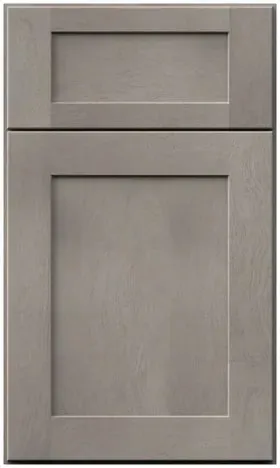


Galaxy Horizon trim, planned joint by joint: why a stained kitchen cannot caulk its way out
Reviewed September 2026 · Captivating Cabinets
Prices quoted in this article were read off the grid on the review date; the live price grid on this page governs.
Every piece of trim in a kitchen exists to meet something: a wall, a ceiling, a floor, another cabinet, another length of itself. On a painted kitchen the installer runs a bead of caulk along each of those meetings, paints over it, and the joint disappears. The Galaxy Horizon finish is a stain, with the grain showing through, and caulk has no grain. A painted-over bead is not an option either, because there is no paint to match. So on this finish the joints have to be planned rather than hidden, and this page walks the decorative list seam by seam: where each one falls, which part closes it, and what that part costs.
What changes when the finish is a stain, not a paint

Three facts about this finish decide how its trim goes on. First, it is a stain over wood, so a joint shows as a change in the grain as well as a line. Second, Fabuwood does not make spray-can touch-up for stained finishes; its spec book says so in as many words, and what it sells instead is a touch-up kit with a fill stick, a marker and a scraper. Third, Fabuwood calls colour variation between stained parts normal, and says parts ordered later may not match what is already installed.
Put together, those three mean the installer’s usual escape routes are narrower. A gap cannot be filled and sprayed. A mismatched later piece cannot be painted to agree with its neighbour. And a joint that falls in the wrong place stays there. None of this makes the finish hard to trim; it just moves the work from the day of installation to the day of planning. A kitchen trimmed out in this grey-taupe with its joints thought through looks more like furniture than a painted one does, because the grain runs continuously through every piece.
The rest of this page follows the seams in the order an installer meets them: the wall, the ceiling, the places where two lengths join, the corners, the floor, and finally the panels that butt against a cabinet box.
At the wall: scribe molding, and a filler wide enough to cut
No wall is straight. A cabinet box is, so wherever a run meets plaster there is a tapering gap, wider at the top or the bottom depending on how the wall leans. Painted kitchens often close it with caulk. Here it is closed with wood.
Scribe molding is a thin strip that is cut to follow the wall’s wobble and fixed to the cabinet edge. The scribe molding comes in two faces, both in 8-foot lengths: GH SM8-S, the simple profile, at $39.00, and GH SM8-D, the decorative one, at $41.60. At that price it is the cheapest part on the list, and the one most often left off. Order one length for every vertical meeting with a wall, plus one more.
Where the gap is bigger than a strip can cover, it is a filler’s job. A filler is a piece of finished wood that closes the space between a cabinet and a wall, and the installer rips it down to the exact width on site. The wall fillers run from GH WF330 at $26.00 (3″ wide, 30″ tall) to WF642 at $78.00 (6″ × 42″); the base fillers are GH BF3 at $26.00 and BF6 at $43.55; the tall fillers are GH TF396 at $84.50, TF696 at $152.75 and TF3120 at $156.00 for a 120″ run. The overlay fillers, which sit out in the plane of the doors rather than back at the face frame, go from GH OLF330 at $71.50 to OLF642 at $172.25, with tall versions from $208.00 (OLF384) to $230.75 (OLF396).
The planning rule on a stain is to order the filler wider than the gap you drew, not the same width. A filler cut down on site has a fresh edge, and on a stained part that edge sits against the wall, where scribe covers it. A filler ordered to the exact nominal width leaves no room to follow the wall, and the only way to close what is left is caulk.
At the ceiling: building up the crown, and where its miters land

The top of the wall run is the other long seam. Ceilings sag, and the gap between the top of the uppers and the ceiling changes along the wall. On paint, the crown goes up and the leftover gap is caulked. On this finish the gap is closed by building the crown up in layers, so that the top layer can be scribed to the ceiling.
There are seven crown profiles: GH CM-1 at $117.00, CM-3 at $123.50, CM-4 at $139.75, CM-6 and CM-9 at $152.75, CM-7 at $295.75 and CM-8 at $367.25. Under them sit the build-up pieces, which are what make a stained crown work: GH STRM-8, the starter top molding, and GH STKM-8, the stacked top molding, are $133.25 each for 8 feet, and GH MEX-8, the molding extension, is $289.25 for 8 feet. A starter piece lifts the crown off the face frame so it has something to sit on. A stacked piece adds height where the uppers stop short of the ceiling. The extension is for the bigger gaps. The crown titles do not state a length, so confirm what each profile ships in when you total the run.
Then the miters. Every outside corner of the wall run, and both ends of a run that stops in the room, needs a pair of 45° cuts that meet at a point. On paint a slightly open miter is filled and nobody sees it. On a stain it shows as a dark line with a grain change across it. Two things help: fewer corners, and corners where the eye does not linger. A crown that returns around the end of a run beside a doorway is seen by everyone who walks in. One that dies into a wall or a tall pantry is not. If the plan gives you the choice, end runs against something.
Where two lengths meet: the splice nobody plans
Most of the linear trim on this list comes in 8-foot lengths, and most kitchen walls are longer than eight feet. Somewhere along a 12-foot run of toe kick, scribe or top molding there will be a joint between two pieces, and on a stain that joint is visible in a way it is not on paint. The pieces are finished together, but two lengths laid end to end rarely carry the same grain, and the join line itself reads.
The fix is to decide where the splice goes before the installer does. Put it where it is covered or unseen: behind the fridge, under the dishwasher opening, in the shadow at an inside corner, or directly above a cabinet stile rather than in the middle of a door. Keep it off the range wall and off the wall with the window, which are the two walls everybody looks at. For the crown, which is the most visible of all, try to buy the longest single run a wall allows and make any joint over a wall-cabinet partition.
How much to order follows from the same thinking. Measure each run, round up to whole 8-foot lengths per wall rather than across walls, and add one length of each profile as waste. The extra length is not waste if a miter goes wrong: a second attempt from the same order carries the same finish, and a replacement ordered later may not.
Corners, inside and out
Where a run turns, or where a cabinet side meets another surface at a right angle, a corner molding covers the edge. On a painted kitchen an outside corner is often left bare and touched up. On this finish a small molding is the kinder option, because a bare corner is exactly where a knock takes the stain off and exposes paler wood.
The corner moldings are GH OCM8, the outside corner molding, at $62.40 for 8 feet, a wider GH OCM8-1 1/4″ at $78.00, and GH ICM8, the inside corner, at $59.80. Batten molding GH BM3/4 at $44.20 and beaded molding GH BM1 1/4 at $57.85 cover flat joints, such as where two panels meet on an island back. Mirror molding at $87.75 frames a panel or a mirror inset.
The exposed end of a run is a corner too. The skins are thin finished panels that clad a box side where it will be seen: GH SK W30, W36, W39 and W42 for wall cabinets and SK MC for a microwave cabinet are $50.05 each, SK BASE is $62.40, SK T12D is $126.75, and SK TALL and SK WD are $169.00. The base end panel, GH BEP at $149.50, is the heavier choice where a base run ends in the room. A skin meets its box at the front edge, which is a seam; ordering the skins with the cabinets means the skin and the door beside it came off the same finishing line.
At the floor: toe kick, its cap, and what meets the boards

The floor seam gets the most abuse in the kitchen: mops, boots, the vacuum. The toe kick is GH TK8 at $55.90 for 8 feet, or GH TK8-3/4 at $58.50 in the ¾″ version. The toe kick cap, GH TKC, is $7.80, and the ¾″ clip, GH TKC-3/4, is $10.40. Ask your installer to fix the kick so it can come off again without damage, because on a stain the kick is the part most likely to need a repair and it is far easier to mend on a bench.
Where the kick meets the floor, a quarter round, GH QRM at $62.40, covers the gap over uneven boards or tile. The base board molding, GH BBM at $188.50, is the choice where a cabinet run meets a room’s baseboard and you want the two to read as one. On a stained run, match the baseboard to the cabinets only if it is in the same room and the same light. A stained kick beside a painted room baseboard is honest; a stained baseboard beside a stained kick from a different batch is a near-match that looks like a mistake.
If you have a wood floor, give it a thought now. A light stain on a warm wood floor is a pairing we often suggest (our advice, not a Fabuwood photograph), and the floor seam is where the two meet. The quarter round decides whether that meeting is a clean line or a gap.
Panels that butt a box: the refrigerator, the dishwasher, the island back
The last set of seams are where a flat panel meets a cabinet face. The refrigerator panels close the sides of a fridge alcove: GH REP1296, the 12″ × 96″ refrigerator end panel, at $224.25, and REP1-1/2 and REP3 at $250.25 and $325.00. The dishwasher panel, GH DWR6 at $201.50, closes the exposed side of a dishwasher at the end of a run, and the drawer panels GH DWR3 and DWR1-1/2 are $130.00 and $123.50.
For bigger surfaces there are refacing panels, 24″ and 30″ wide: GH REP2496 at $295.75, REP3096 at $341.25, and thicker 1½″ and 3″ versions at $367.25 and $409.50; the 120″-tall REP30120 runs $594.75, $835.25 and $890.50 by thickness. Flat panel stock is GH PAN-1/4 at $263.25, and the plywood panels run from $390.00 to $910.00 for a 48″ × 120″ sheet. Textured backs are on the list too: the reeded GH RFP696 and slatted GH SFP696 interlocking panels at $250.25 each for 6″ × 96″, their end caps at $97.50, the beaded plank BPP-12 at $126.75 and shiplap SHL-8 at $169.00. A reeded or slatted island back in a stain shows grain along every rib, and it is one of the places where this finish looks better than a paint.
The seam rule for all of them is the same. A panel that sits flush beside a door should come in the same order as the door, and the joint between them should be tight enough that nothing needs filling. If it has to be filled, use the fill stick from the touch-up kit, not caulk. Ask about the refrigerator end panels and the refacing panels when the appliance models are known, not before.
Parts that touch should come in one order
Everything above comes back to one point. A stained finish varies a little from one production run to the next, and Fabuwood says so plainly. On a painted kitchen that is a small risk. On this one, a scribe strip or a skin ordered six months after the doors can sit a shade away from them, and the two touch along their whole length.
So the trim order goes in with the cabinet order, and it is generous: an extra length of each profile you use, an extra skin of the size you use most, one more filler than the plan needs. What you do not use becomes your repair stock. Keep it indoors. Be aware that pieces on a sunny wall will change a little with the light over the years, and Fabuwood’s warranty does not cover colour change from sun; a spare from the same batch will still be closer than anything ordered later, but it will look slightly fresher than the pieces that have been up for five summers.
For a knock or a scratch, the Fabuwood touch-up kit is the tool: a fill stick for chips, a marker for scratches and a scraper to level the fill. It is not a respray, and on a light stain a careful repair blends; a heavy one does not. The $35.00 door sample is worth ordering early for this reason too: it is the only piece of this finish you can practise on.
| Seam | Part | Quantity | Cost |
|---|---|---|---|
| Wall, vertical | GH SM8-S scribe | 3 lengths | $117.00 |
| Wall, filler | GH WF336 + GH BF3 | 2 + 2 | $120.90 |
| Ceiling | GH STRM-8 starter + GH CM-3 crown | 3 + 4 | $893.75 |
| Outside corner | GH OCM8 | 1 length | $62.40 |
| Run end | GH SK W36 + GH SK BASE | 1 + 1 | $112.45 |
| Floor | GH TK8 + GH TKC | 3 + 2 | $183.30 |
| Floor, uneven boards | GH QRM | 2 | $124.80 |
That is $1,614.60 of trim for a modest L. It is small money next to the cabinets and it decides whether the room reads as fitted or assembled. Full-kitchen help, including the trim take-off, comes from the design service; trade buyers get trade pricing through Captivating Pro. Everything else in the finish is in the Horizon collection.
Common questions
- Can you caulk the gap between stained cabinets and the wall?
- You can, but it shows: caulk has no grain and cannot be painted to match a stain. The better fix is scribe molding cut to follow the wall, GH SM8-S at $39.00 or SM8-D at $41.60 per 8 feet, with a filler ripped down on site where the gap is wider than a strip covers.
- Where should two pieces of crown molding be joined?
- Over a wall-cabinet partition, away from the range wall and the window wall, and never in the middle of a door. Buy the longest single piece a wall allows. On a stain the join line and any grain change show, so decide where it falls on the drawing rather than on the ladder.
- Will cabinet trim ordered later match my stained cabinets?
- It may not. Fabuwood treats colour variation between stained parts as normal and says replacements may not match what is installed. Order all trim with the cabinets, plus a spare length of each profile, and keep the spares indoors as repair stock.
- How do you touch up a stained cabinet?
- With Fabuwood’s touch-up kit: a fill stick for chips, a marker for scratches and a scraper to level the fill. Fabuwood does not make spray cans for stained finishes. Practise on the $35.00 door sample first.
- How much trim do I need for a kitchen?
- Measure each run, round up to whole 8-foot lengths per wall, then add one length of every profile. A modest 12-foot L with scribe, fillers, a starter-and-crown stack, a corner, two end skins, toe kick and quarter round comes to about $1,614.60 at displayed prices.
- What is the difference between an outside corner molding and a skin?
- An outside corner molding (GH OCM8, $62.40 for 8 feet) covers the edge where two surfaces meet at a right angle. A skin is a thin finished panel that covers a whole cabinet side, from $50.05 for a wall cabinet to $169.00 for a tall one.
Keep reading
The guides behind the numbers on this page.
- Cabinet End Panels, Scribe Molding and Fillers Explained
The three parts that close the wall seam, and when each one is the right call.
- Kitchen Cabinet Molding Types
Crown, light rail, scribe and batten, with what each profile is for.
- Cabinet Skin Panels and Gables
What finishes an exposed box side, and where a skin beats an end panel.
- How to Clean and Care for Kitchen Cabinets
Looking after a stained face so the trim needs the touch-up kit less often.
- Brown Kitchen Cabinets: Stains, Shades and Pairings
How stained finishes behave differently from paint, across a range of tones.


