

Galaxy Horizon tall cabinets: the stained wall the rest of the house sees
Reviewed September 2026 · Captivating Cabinets
Prices quoted in this article were read off the grid on the review date; the live price grid on this page governs.
Galaxy Horizon tall cabinets are often the only part of the kitchen that can be seen from the next room. In an open plan, the pantry wall or the oven tower tends to stand at the edge of the kitchen, facing the dining table, the sofa or the hall, while the base run hides behind an island and the uppers sit back against the far wall. That changes what the tall run has to do. A stain is a wood finish, so it will be read against every other piece of wood in view: the floor, the stair, the table, the doors. This page plans the tall run from that side: how the grey-taupe gets along with the house’s other wood, the two leaves of a double pantry as the biggest side-by-side match in the room, one wide pantry against two narrow ones, the height ladder and its price, oven towers against stainless steel, and the finishing parts that belong on the same order.
The kitchen face the living room sees

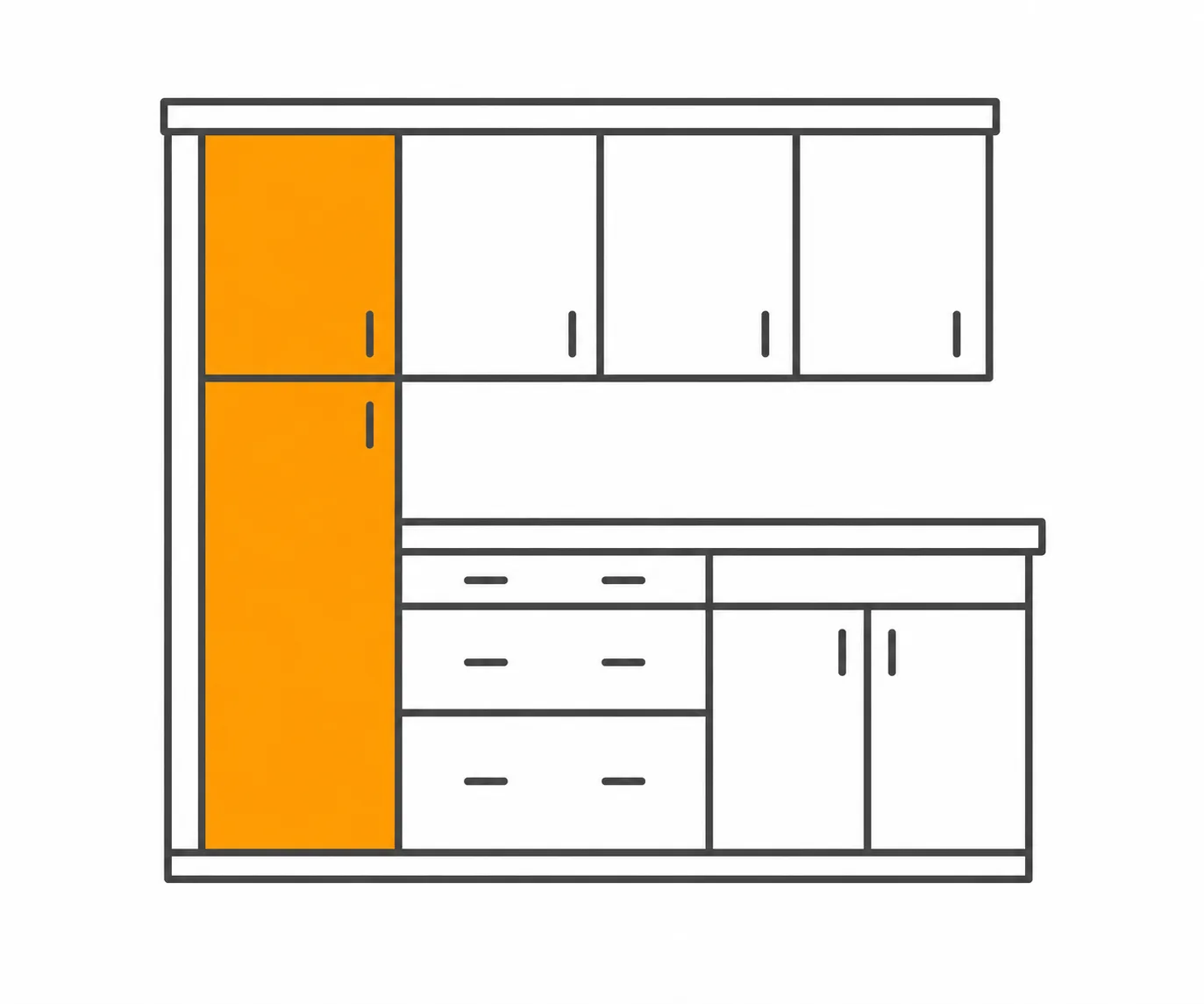
Walk into most open-plan houses and look toward the kitchen. The island is in front, its counter hiding most of the base cabinets behind it. The uppers are at the back, over the counter. The tallest, widest, most continuous piece of cabinetry you see, from the sofa or the front door, is usually the tall run: a pantry wall, a fridge surround, an oven tower. It reaches from the floor that the living room shares to the ceiling that it shares too.
A painted tall run is judged mostly as a colour. A stained one is also judged as wood, because that is what it is: grain under a translucent finish. Put it on the same sightline as an oak floor, a walnut dining table and a painted white staircase, and you will compare them without meaning to. That is the angle this page takes. The storage questions still matter and they are all here, but in a room like this the first question is how the stain sits with the wood around it.
A stain has to get along with the other wood in the house

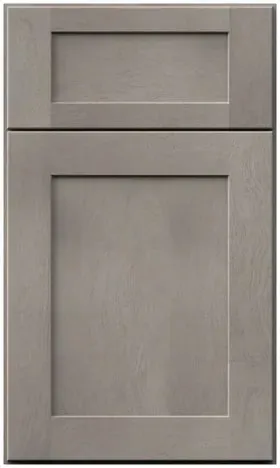
Fabuwood’s own photographs of this stain include rooms with wood accents and open wood shelving, so the manufacturer clearly sees it living beside natural wood. One Fabuwood dealer suggests oak or walnut flooring with it. Beyond that, what follows is our own experience, not a published pairing: how a light grey-taupe stain tends to behave next to the woods most houses already have.
| What is already in the room | How the stain tends to read | What we suggest |
|---|---|---|
| Golden or orange-toned oak floor | Greyer and cooler by contrast; the two can fight | Bring in a warm metal or a rug that bridges them; test the sample on the floor first |
| Natural or pale white oak | Warm and related, a soft tonal pair | The easiest match; let the grain in both show |
| Walnut table or floor | Lighter and slightly pinker against the dark brown | A good contrast; keep the metals warm |
| Grey-washed floor or grey LVP | Grey on grey; the cabinet can lose its warmth | Add warmth elsewhere, or choose a floor with more brown in it |
| Painted white trim and doors | Warmer and more like wood | Fine as it is; this is the setting most kitchens have |
The test takes five minutes. Put the door sample on the floor where the tall run will stand, then carry it to the dining table and hold it next to the wood there. Look from the far side of the room, not from above it. If the sample looks like it belongs to the family, the tall run will too. If it looks like a different kind of grey from everything around it, a warm element placed between them, a rug, a brass light, a wood shelf, usually solves it. The guide to cabinet woods is useful for naming what is already in the room.
Two leaves side by side: the biggest match in the room
A double-door pantry puts two tall stained doors next to each other, meeting at a single seam, on the most visible wall in the house. That is the largest pair of matching surfaces anywhere in the kitchen, and it is exactly where Fabuwood’s note on stained finishes applies: colour variation between pieces is normal. A slight difference between two base doors is lost among their neighbours. A slight difference between two leaves of one pantry, each several feet tall, standing side by side in direct view, is not.
Most pairs are close enough that nobody notices. The time to check is delivery day, before the tower is fixed in place. Stand it upright in daylight, open and close both leaves, and look from the living room side. If you have ordered two identical pantries, the leaves can be moved between them: the Blum hinges have Quick-Release, so a door unclips from one box and onto its twin, and the installer adjusts the gap. If a leaf is clearly out of step with everything else and you have no twin to swap with, talk to us before it is installed rather than after.
One 36-inch double pantry or two 18-inch singles
A 36″ opening can take one wide double-door pantry or two 18″ single-door pantries side by side. At 24″ deep and 96″ high they cost almost the same, but they give the wall a different face, and on a stain the difference matters more than the price.
| Option | Code | Face | Price |
|---|---|---|---|
| Double-door pantry, 36″ | GH TP362496 | Two leaves meeting at a centre seam | $2,343.25 |
| Single-door pantries, 18″ × 2 | GH TP182496 × 2 | Two separate boxes, each with its own frame | $2,301.00 |
The two singles are $42.25 cheaper and more flexible. Because they are identical boxes, they can swap places on delivery day, which gives you a way to balance tone that the double does not. Each can be set up inside for a different job, one with shelves, one with roll-out drawers behind the door (GHZ ROD-B18 BLUM E, $201.50, is the 18″ tray). The face shows two frames side by side, which reads as two cabinets.
The double reads as one piece of furniture: one frame, two leaves, one seam. That is the calmer look from across a room, and it is the one to choose if the tall run is meant to look like a single built-in. The trade-off is the leaf-to-leaf match described above. Both come in 12″ depths too (GH TP361296, $2,314.00; GH TP181296, $1,121.25 each), for a hallway or a spot where a deep box would crowd the walkway.
Four heights, and one price out of order
Every pantry comes in four heights, 84″, 90″, 93″ and 96″, so the top can line up with the uppers, with crown, or with the ceiling. The price climbs with height, with one exception worth knowing before you order.
| Height | Code | Price |
|---|---|---|
| 84″ | GH TP362484 | $1,712.75 |
| 90″ | GH TP362490 | $2,031.25 |
| 93″ | GH TP362493 | $2,548.00 |
| 96″ | GH TP362496 | $2,343.25 |
At 36″ wide, the 93″ pantry is $204.75 more than the 96″ one. It is not a typo on our side; that is how the grid is priced. If your ceiling takes either, the taller cabinet is the cheaper one. Narrower pantries are priced more evenly, and the full grid, by width, depth and height, is on the tall cabinet page.
In an open plan, choose the height from the living room side as well as the kitchen side. From across the room, the top edge of the tall run is a long horizontal line at the ceiling, and it is read against the top of the uppers and any crown. Taking the tower to the ceiling, or to the height of the crown on the uppers, makes the kitchen read as one built-in wall from the sofa. Stopping it a few inches short leaves a shadowed gap that collects dust and, on a stain, a strip of wall paint between two wood surfaces. If the tower does stop short, run the same crown profile along its top as along the uppers, ordered on the same batch, so the line is continuous in material as well as height.
Measure the ceiling at several points along the wall before choosing. Ceilings are rarely level, and a 96″ tower in a room that measures 96½″ at one end and 95¾″ at the other will not stand up. Also measure the route in: doorways, stairs and turns. These cabinets arrive built, and a 96″ box has to be tipped upright somewhere.
Oven towers in grey-taupe beside stainless
Stainless steel is one of the pairings Fabuwood shows with this stain, and an oven tower is where the two meet most directly. The cool metal draws out the warmth of the stain by contrast, and the grain around the oven gives the stainless a softer frame than a painted surround would.
The oven cabinets are 33″ wide and come for a single oven, a double oven, or an oven-and-microwave combination. At both heights the single-oven cabinet is the most expensive of the three and the double-oven the least, which surprises most people.
| Type | 84″ high | 96″ high |
|---|---|---|
| Single oven | GH OC3384S · $1,758.25 | GH OC3396S · $1,920.75 |
| Double oven | GH OC3384D · $1,599.00 | GH OC3396D · $1,748.50 |
| Oven and microwave combination | GH OC3384C · $1,677.00 | GH OC3396C · $1,836.25 |
Choose the ovens before the cabinet. The cut-out has to suit the appliance’s published dimensions, and the installer will need the specification sheet. Put the oven tower where it is not the first thing seen from the living room if you can, at the end of the tall run next to the fridge rather than in the middle, so the stained pantry doors carry the view.
Finishing parts for a stained tower, on the same order
A tall run has more exposed side than any other part of the kitchen, and each side needs its own finished part. Because a part ordered later may not match, these belong on the first order along with the cabinets.
- Exposed side of a 24″-deep tower: GH SK TALL, $169.00. For a 12″-deep box, GH SK T12D, $126.75. From the living room side, this skin is often the first surface you see.
- Beside the fridge: a refrigerator end panel, GH REP1296 (12″ × 96″) at $224.25, finished with GH RFPEC end caps at $97.50, or a 24″ × 96″ refacing panel, GH REP2496, at $295.75.
- Where the tower meets a wall: a 3″ × 96″ tall filler, GH TF396, at $84.50, or 6″ wide, GH TF696, at $152.75. Order one even if the drawing says it fits exactly.
- Over the fridge: the matching refrigerator wall cabinet, GH W362424, $578.50, so the surround is complete from the same order.
Inside, every pantry is the same Allure box: ½″ veneered plywood with a natural wood veneer interior, ¾″ adjustable plywood shelves and a solid wood face frame, pre-assembled, on Blum soft-close hinges, shipping in about 2 weeks. The pale interior is a pleasant surprise behind a grey-taupe door. The skin panels guide shows which finished part goes where, and the rest are on the decorative accessories page.
Before the tall run is ordered
Take the sample on the walk described above: floor, table, far side of the room. Then send us the plan for a free 3D design. A designer replies within one business day and the drawing and quote come back within 24 to 48 hours, drawn from the living room side as well as the kitchen side if you ask, with every skin, panel and filler listed for one order. Trade buyers get trade pricing through Captivating Pro. The colour itself, and how it compares with Nickel and Cobblestone, is on the collection page.
Common questions
- Do grey stained cabinets go with oak floors?
- Usually, yes. A natural or pale white oak is the easiest match and makes a soft tonal pair. Golden or orange-toned oak contrasts more, and the stain can look greyer beside it; a warm metal or rug between them helps. Test the door sample on the actual floor before ordering.
- Is one 36-inch double pantry or two 18-inch pantries better?
- At 24″ deep and 96″ high they cost nearly the same: $2,343.25 for the double (GH TP362496) and $2,301.00 for two singles (GH TP182496). The double reads as one piece of furniture; the two singles can swap places to balance tone and can be set up differently inside.
- Why is the 93-inch pantry more expensive than the 96-inch one?
- That is how the grid is priced. At 36″ wide and 24″ deep the 93″ pantry is $2,548.00 and the 96″ is $2,343.25. If your ceiling takes either, the 96″ is the cheaper choice.
- Will the two doors on a stained double pantry match?
- Closely, but not always exactly: Fabuwood states that colour variation between pieces is normal for stained finishes. Check the pair upright in daylight on delivery day, before installation, and talk to us then if one leaf is clearly different.
- What finished panels does a stained tall cabinet need?
- A skin on each exposed side (GH SK TALL, $169.00, for a 24″-deep box), a refrigerator end panel beside the fridge (GH REP1296, $224.25, with GH RFPEC caps at $97.50), and a tall filler where the tower meets a wall (GH TF396, $84.50). Order them with the cabinets so they match.
Keep reading
The guides behind the numbers on this page.
- Wall & Tall Kitchen Cabinets: Sizes & Buying Guide
The 84, 90, 93 and 96 inch heights and the ceilings each one suits.
- Cabinet Wood Species: Oak, Maple, Walnut & More
Useful for reading the floor and furniture the tall run will stand beside.
- Cabinet Skin Panels and Gables: What They Are and Where You Need Them
How the exposed side of a tower gets finished, and which part does the job.
- Space-Saving Cabinet Solutions That Actually Work
Roll-outs and inserts that make the lower half of a deep pantry usable.
- Pre-Assembled Kitchen Cabinets: A Dealer’s Buying Guide
What a built 96-inch cabinet needs from the doorways and stairs on its way in.


