

Glass in the dimmest spot on the wall: lighting and placing a Galaxy Horizon diagonal corner cabinet
Reviewed September 2026 · Captivating Cabinets
Prices quoted in this article were read off the grid on the review date; the live price grid on this page governs.
The inside corner of an L-shaped kitchen is the darkest part of the upper run. Two walls shade it, a window almost never sits in it, and the ceiling light is usually centred somewhere else. A diagonal corner glass cabinet puts the one see-through door in the kitchen at exactly that spot, on a face set at 45 degrees to both runs. In a Galaxy Horizon kitchen, that combination affects how the door reads and what the cabinet needs to be worth having. This page covers both, then compares the four glass sizes with the solid corner cabinet you might choose instead.
An inside corner gets the least daylight in the kitchen
Stand in a kitchen on a grey afternoon and look along the uppers. The run nearest the window is lit; the corner, set back where the two walls meet, falls into shade. Glass in that corner is visible from most of the room, because a diagonal door faces diagonally outwards, yet it is also the least lit upper in the kitchen.
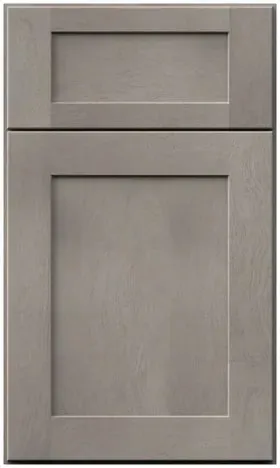
That matters more with this finish than with a white. Homeowners who have lived with this stain describe it as cool and a little dull on overcast days and warmer in the sun, and the corner is the part of the wall that sees the least sun on any day. It is a light grey-taupe that Fabuwood describes as having soft pink undertones, and in low light the warmth is what fades first. So an unlit corner glass cabinet will usually be the coolest-looking cabinet on the wall. That is not a defect; it is the corner behaving as corners do. It is also why the corner is the upper most worth lighting.
Lighting the corner from the inside

A light inside the box does two things in the corner. It lets you see what is on the shelves, which in an unlit corner you mostly cannot. And it lights the stained frame from behind, which brings back some of the warmth the corner takes away. After dark, a lit corner cabinet can become the one point of light at the far end of the kitchen, which is often what people had in mind when they chose glass.
This collection sells lighting by cabinet width: puck sets such as GHZ LED W24 at $113.75, a 48-inch interior strip, GHZ LED CAB INT 48" STRIP, at $221.00, a driver at $204.75 and a wireless switch at $221.00, all on the cabinet accessories page. The puck sets are sized for straight cabinets, and a 24-inch diagonal box is not the same interior as a 24-inch straight one, so ask us which set fits before ordering. Plan the power before the wall is closed; a corner is the hardest place to add a cable later.
A door at 45 degrees catches light across its grain

Every other door on the wall faces the room at the same angle, so they all catch light in the same way. The diagonal door faces a different direction, so window light strikes it at a different angle from its neighbours. On a flat paint that makes the angled door a shade lighter or darker. On a stain, the grain responds to the angle as well: light that runs across a grain rather than along it picks out the texture more, so the angled door can look slightly more figured or slightly different in tone from the doors either side of it. That is our general experience of stained wood, not something Fabuwood publishes, and it happens even when every door comes from the same batch.
Two consequences. Do not judge the corner door against its neighbours in a single light, because in a different light the relationship will change. And if you are checking a delivery for colour variation, which Fabuwood says is normal on its stains, compare the corner door flat on the floor beside the others before it is hung, not after, when the angle is doing its own work.
Four glass sizes against the solid corner cabinet
Every size here is 24 inches wide, in the four upper heights, and this collection carries the 39-inch height in glass as well as in solid. Below, each glass line is set against the solid-door diagonal corner cabinet of the same size and the carcass sold on its own.
| Size | Glass | Solid door | Carcass only |
|---|---|---|---|
| 24″ × 30″ | GHZ GDWDC2430 · $100.75 | GH WDC2430 · $455.00 | WDC2430 · $292.50 |
| 24″ × 36″ | GHZ GDWDC2436 · $117.00 | GH WDC2436 · $510.25 | WDC2436 · $328.25 |
| 24″ × 39″ | GHZ GDWDC2439 · $126.75 | GH WDC2439 · $536.25 | Not listed |
| 24″ × 42″ | GHZ GDWDC2442 · $139.75 | GH WDC2442 · $581.75 | WDC2442 · $373.75 |
The glass prices step evenly, $39.00 from the shortest to the tallest, with none of the inversion that affects three of the straight 39-inch glass units. The gap to the solid cabinet is large at every height, and there is no 39-inch carcass on the list, so the same caveat as on every glass line here applies: the frame is prepped to accept glass, and you need to confirm with us whether the line ships as a complete cabinet or as a glazed front for a box, and whether the glass is included. Get it in writing before the corner is drawn around it.
The height has to match the uppers on both walls, since the corner is where the two runs meet. The solid corner options, including blind corners, are on the corner wall cabinets page.
When a solid corner door is the better answer
Glass in the corner is worth it when the corner is seen, when there is something worth showing in it, and when you are prepared to light it. Take away any one of those and a solid door is often better.
- The corner is only seen from the cooking side. If the kitchen opens to the rest of the house on the other side, the corner may be the least visible cabinet in the room.
- It is where the awkward things live. The back of a diagonal corner is deep and hard to reach, which makes it good for rarely used serving pieces and poor for display.
- You will not run power to it. An unlit glass corner on a stain that already reads cool in shade is the weakest version of this cabinet.
- You want open display without a door at all. The no-door corner, matching interior page has that option.
There is a middle course if the corner is seen but you do not want to commit to keeping it tidy: a textured glass. Frosted or reeded glass lets a lit interior glow through while hiding the clutter at the back of a deep corner, and in a dim spot it still lifts the wall more than a solid panel does. Seeded glass sits between the two. Which types are available with this frame is something to confirm with us, since the titles do not list them; the glass buying guide shows what each looks like.
Putting the corner glass on the order
- Confirm what the glass line ships as, and whether the glass is included, in writing.
- Match the height to the uppers on both walls.
- Ask which light set fits a diagonal box, and plan the power before the wall closes.
- Compare the corner door with its neighbours on the floor before it is hung.
Straight glass uppers are on glass door wall cabinets. All the glass lines in this finish are on the glass doors page, and everything else is on the collection page. The free 3D design service will draw the corner with both runs and the lighting; a designer replies within one business day. Trade buyers get trade pricing through Captivating Pro.
Common questions
- Why does my corner cabinet look darker than the rest?
- An inside corner gets the least daylight on the wall, and a light grey stain reads cooler and duller in low light. A light inside a glass corner cabinet brings back much of the warmth and lets you see what is in it.
- Why does the angled corner door look slightly different from the other doors?
- Because it faces a different direction, light hits it at a different angle, and on a stain the grain picks that up. This happens even with doors from the same batch. Compare doors flat on the floor before hanging if you are checking for colour variation.
- Can you put lights in a diagonal corner glass cabinet?
- Yes. This collection sells puck sets by cabinet width, a 48-inch interior strip at $221.00 and a driver at $204.75. Puck sets are sized for straight cabinets, so ask which fits a diagonal box, and run the power before the wall is closed.
- What sizes does the diagonal corner glass cabinet come in?
- 24 inches wide, in 30, 36, 39 and 42-inch heights, at $100.75, $117.00, $126.75 and $139.75. The solid-door equivalents are $455.00 to $581.75, so confirm what each glass line ships as before ordering.
- Is glass or a solid door better in a kitchen corner?
- Glass, when the corner is visible from the room, holds something worth showing, and will be lit. If any of those is missing, a solid door or a no-door corner with a matching interior usually works better.
Keep reading
The guides behind the numbers on this page.
- Glass Cabinet Doors: Buying Guide
Clear, seeded and frosted glass, and which suits a dim corner.
- Gray Kitchen Cabinets: Finding the Right Shade
Why a grey reads cooler in shade, which is the whole corner problem.
- Space-Saving Cabinet Solutions
What a corner cabinet stores well, and what it does not.
- Kitchen Cabinet Samples: How to Order and Evaluate
Judging a stained door at the angle and in the light it will actually get.
- Free 3D Kitchen Design
Send the wall and the glass comes back placed, lit and priced in the run.


