

The one grained surface in the bathroom: buying a Galaxy Horizon vanity and keeping it for ten years
Reviewed September 2026 · Captivating Cabinets
Prices quoted in this article were read off the grid on the review date; the live price grid on this page governs.
Look around most bathrooms and count the surfaces that are not hard and shiny. Porcelain basin, glazed tile, a glass screen, a mirror, chrome taps, painted walls with a satin sheen. A Galaxy Horizon vanity is often the only thing in the room with visible grain, and that single fact shapes everything about buying one: how it reads under a mirror light, which boxes to put together, what you should expect to see when the cartons are opened, what a window does to it over the years, and how a scratch gets fixed. This page walks through that life in order, with the real cabinet prices at each step. The widths, heights and plumbing rules are the same across the whole Galaxy family and are covered on the sibling finishes; here the subject is what changes when the finish is a stain.
What this stain is, and what it is not
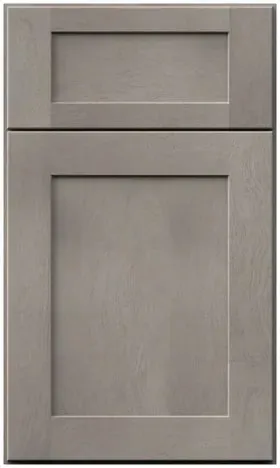
Start with the facts, because a lot of what is written about this colour online is wrong. Fabuwood’s own spec book lists it as a stain, not a paint. The door is the Galaxy five-piece shaker: solid wood stiles and rails ¾″ thick and 2½″ wide, around a ⅜″ recessed centre panel that the spec book describes as MDF with a wood veneer face. The stain sits on real wood on all five pieces, so grain shows on the frame and on the panel alike. Fabuwood does not publish the wood species, and we will not guess one. Under the door it is the same Allure build as every other finish in the family: a ½″ veneered plywood box with a natural wood-veneer interior, ⅝″ dovetailed drawer boxes on Tandem plus Blumotion runners, and Blum soft-close hinges.
The colour is a light, muted grey with a warm lean. Fabuwood gives it the hex value #989089, which is a grey-taupe: there is a little more red than blue in it. The brand’s door page describes “soft pink undertones”, and its French-country card says “soft taupe tones”. You will find dealer pages calling it a blue-grey, and at least one calling it navy. Neither is right, and nothing Fabuwood publishes says blue. Where the confusion comes from is easy to see, though. Fabuwood’s own finish page switches to “misty greys and silvery undertones”, and a cool photo of the sample door makes it look almost neutral. The honest summary is that it is a warm grey stain that can read cooler in cool light, and that no single photograph settles which one you will see.
Two neighbours help place it. Nickel is the painted grey in the same door, #A1A19A, a touch lighter and more neutral, and opaque, with no grain at all. Cobblestone is the dark stained grey-brown, #33302D, and Fabuwood pairs it with this lighter stain as a two-tone. If you want grey without grain, the painted one is the better buy; if you want a bathroom that feels like it has a piece of furniture in it, this is the stain for that job.
| Surface | What it does to light | How the vanity reads beside it |
|---|---|---|
| White glazed tile or porcelain | Bounces it back, cool and bright | The warm lean of the stain shows clearly; the grain looks deliberate |
| A large mirror | Doubles whatever the room is lit with | The vanity is seen twice, once directly and once in reflection, often at a different colour temperature |
| Chrome or polished nickel taps | Hard, cool highlights | Pushes the grey towards cool; brass or copper pushes it back towards taupe |
| Grey or white stone top | Flat, even, no grain | The vanity carries all the texture in the room, so the top should not compete with it |
| Wood-look or stone-look floor tile | Warm and patterned | Two patterns meet at the toe kick; keep one of them quiet |
Mirror light, a frosted window and a colour that moves

The best first-hand account we have of this finish comes from a homeowner who fitted it in 2022. On a cloudy day, she wrote, the cabinets can look cold or dull; on a sunny day they look warm. A kitchen designer in the same discussion put it another way: it reads warm or cool depending on what is around it. Fabuwood’s own wording for the finish is “adaptable”. All three are describing the same thing, and a bathroom makes it more obvious than a kitchen does, for two reasons.
The first is that a bathroom is usually lit by one fixture over the mirror, pointed straight at the person and, below them, straight at the vanity doors. Whatever colour temperature that bulb has, the vanity takes on. The second is the window. Many bathrooms have one, often frosted, and frosted glass passes daylight through as a soft, even, slightly cool wash with no direct sun. That is exactly the cloudy-day condition the homeowner described. So a stain that looks warm and taupe in a sunny showroom can look quieter and greyer in a north-facing bath at eight in the morning.
Neither look is wrong, and a lot of people buy this finish precisely because it changes through the day. What matters is that you see both before you order. Tape a $35.00 door sample to the wall where the vanity will stand, at knee height, and look at it three times: in morning daylight, with only the mirror light on, and with the shower running and the mirror fogged, because that is when you will see it most. If the evening version bothers you, change the bulb before you change the cabinet. A 3000K lamp keeps the taupe; a very cool 5000K lamp pulls it towards silver.
One carcass or two: combos against separate boxes
Most bathrooms wider than about 30″ can be built two ways. You can buy a sink-and-drawer combo, which is one carcass with the bowl space and a drawer stack side by side. Or you can buy a vanity sink base and set a separate vanity drawer base beside it. The finished run looks similar from across the room. Up close, and in money, it does not.
| Wall | One carcass | Price | Two boxes side by side | Price |
|---|---|---|---|---|
| 36″ | GH VSD36DL or DR | $783.25 | GH VSB21-34 + GH VDB15-34 | $1,049.75 |
| 42″ | GH VSD42 | $874.25 | GH VSB24-34 + GH VDB18-34 | $1,111.50 |
| 48″ | GH VSD48 | $975.00 | GH VSB30-34 + GH VDB18-34 | $1,134.25 |
| 60″, one bowl | GH VSD60SINGLE | $1,196.00 | GH VDB15-34 + GH VSB30-34 + GH VDB15-34 | $1,716.00 |
| 60″, two bowls | GH VSD60DOUBLE | $1,046.50 | Two GH VSB30-34 | $923.00 |
The combo is cheaper at every single-bowl width, by roughly $160 to $520. It also has one fewer thing that matters on a stain: a seam. When two separate cabinets stand side by side, two face-frame stiles meet in the middle of the run, and two separate pieces of wood, each with its own grain, sit edge to edge at eye level. On a paint that joint disappears. On a stain it is a visible line where one board’s figure stops and another’s starts. That is not a defect, and on a good install it looks like joinery. But if you want the vanity to read as one piece of furniture, one carcass gets you there for less.
The two-box build earns its extra cost in three situations. The drawer stack needs to be wider than the combo gives you. The bowl needs to sit off-centre on the wall because of where the drain is. Or the room is being built in stages and the second box comes later, which is the situation this finish handles worst, as the last section explains. The double-bowl row is the one exception to the price rule: two 30″ sink bases cost less than the one-piece double, but they put a seam under the stone right where the two bowls meet, and the one-piece version is built so that seam is not there.
Whichever way you build it, put every stained box for the bathroom on one order. The drawer base, the sink base, the vanity wall cabinet over the toilet (GH WVS2430, $490.75) and any platform all go in the same cartons from the same finishing run. The full family is on the vanities page, and the sink-and-drawer combos have their own page with the handing rules.
Delivery day: what normal variation looks like on a stained vanity
Open the cartons in daylight if you can, and expect to see differences. Fabuwood’s spec book says it plainly: because of the nature of wood and the finishing process used for stains, there may be variations in colour, and they are considered normal. The warranty adds that wood may vary in colour, texture and grain, and that these are not defects. That is not small print hiding a problem. It is what a stain on real wood looks like, and it is the reason people choose one over a paint.
In practice it shows in a few predictable places. A drawer front may read a shade lighter or darker than the door beside it, because each is a separate assembly with its own frame and panel. The veneered centre panel can show a wavier figure than the straight-grained stiles around it. And where two cabinets meet, the grain on one stile will not continue onto the next. Seen from where you stand at the basin, a run with these differences looks like wood. Seen from ten inches away with a torch, any stained cabinet from any maker will show them.
What is not normal is a different thing, and worth knowing so you can tell the two apart. A door that is plainly a different colour from everything else, not a shade but a different grey. A blotch or run in the finish. A bare patch, a crack in a joint, a panel that has split. Those are finish or build faults, and the time to report them is before installation, with photographs taken in daylight and the carton label in the frame. We would rather deal with them on day one than after the top is fitted.
A window over the tub: sun, time and what the warranty says

Every finished wood surface changes colour over time, and Fabuwood’s warranty is direct about it. Colours may darken or lighten over time, and colour change caused by UV light or sunlight is not treated as a defect. We have found no reports of this particular stain fading or yellowing. But a vanity that stands in a patch of direct sun every afternoon will not look the same in year eight as it did in year one, and the doors nearest the window will change first.
Three simple things help. A frosted or film-covered window cuts direct sun, and many bathrooms already have one for privacy. A blind or shade that is drawn in the brightest hours, especially on a south- or west-facing wall, protects the doors that face it. And if you are choosing between two layouts, the one that keeps the vanity out of the strongest sun is kinder to the finish. None of this is urgent in a room where the window is small or north-facing, which describes a lot of bathrooms.
The more important point is that the change is gradual and even across a run that all gets the same light. You will rarely notice it on its own. Where you notice it is when something new is put next to something old, which is the subject of the last section.
Wear, water and the touch-up kit: fixing a stain is not repainting it
A bathroom vanity wears in the same few spots in every house: the edge of the top drawer front where a hand hits it, the lower rail where toes and the vacuum meet it, and the edges of the sink-base doors where wet hands open them. On a painted door, a chip there shows a lighter colour underneath and is filled with matching paint. On a stain, a scratch shows lighter wood, and the fix works differently.
Fabuwood does not make spray cans for stained finishes. Its spec book says so, because a stain is built up in layers that a spray cannot reproduce. What it offers instead is a touch-up kit with a fill stick, a marker and a scraper, and in this finish that kit is $62.40 on the loose parts page. The marker colours a light scratch, drawn along the grain rather than across it. The stick fills a dent or a deeper nick, and the scraper levels the fill flush with the surface. Test it on the back of a door first, and let it set before you judge it. Buy the kit with the cabinets: it is cheap, it is from the same finish, and it will be in the drawer when the first scratch happens.
Water is the other half. The finish handles a steamy room well; what it does not like is water left standing on it. Fabuwood’s care advice is to blot spills rather than wipe them across the surface, to use only mild cleaners, and never to spray cleaner straight onto the wood. In a bathroom that means a dry towel over the edge of the top drawer after the morning routine and a cloth, lightly damp, for cleaning. The care guide has the full routine.
Adding a cabinet later, and why one order beats two
This is the section most buyers of a stain skip, and the one they come back to. Suppose the vanity goes in this year and, two years later, you decide the room needs the wall cabinet over the toilet, or a narrow drawer base where a filler used to be. The new cabinet will be finished correctly. It will still not match exactly. It comes from a different finishing run, on different wood, and it is going next to cabinets that have spent two years in your light. Fabuwood’s warranty says as much: replacement cabinets may not match display samples or existing cabinets.
The difference is often small, and a mirror or a toilet between the two pieces hides a lot. A new cabinet right beside an old one, with their stiles touching, hides nothing. So the practical rule is simple: if there is any chance you will want a piece, buy it now. GH WVS2430 at $490.75 over the toilet, a 12″ GH VDB12-34 at $601.25 or GH VB12FD at $328.25 in a leftover gap: each costs the same whether it is bought now or later, and only one of those times gets you a match.
If a box gets damaged later, from a leak under the sink for instance, there is a better option than a whole new cabinet. Most vanity codes are sold as a carcass only on the loose parts page, so your original, already-aged doors and drawer fronts move across to the new box, and only its face frame is new. That keeps the change to one narrow strip rather than a whole cabinet front. The vanity sink bases are the exception: they have no carcass listing, so ask us before you plan around one.
Common questions
- Is this finish a paint or a stain?
- A stain. Fabuwood’s spec book lists it as one, and the grain shows through on the solid wood frame and on the ⅜″ centre panel, which is MDF with a wood veneer face. Fabuwood does not publish the wood species. If you want a similar grey with no grain, the painted Nickel in the same door is the closer match.
- Is it a blue-grey?
- No. Fabuwood describes soft pink or taupe undertones, and its hex value, #989089, is a warm grey-taupe. Some dealer pages call it blue-grey; nothing from Fabuwood does. It can look cooler under cool light or on an overcast day, which is probably where that idea comes from, so judge a door sample in your own bathroom.
- Will the vanity doors all be exactly the same colour?
- Not exactly, and that is normal for a stain. Fabuwood’s spec book says colour variation is expected with stained finishes, and each door and drawer front is its own piece of wood. What is not normal is a front that is plainly a different colour, a blotch, or a bare patch; report those with daylight photos before installation.
- Is a sink and drawer combo better than a sink base and a separate drawer base?
- At single-bowl widths the combo costs less, for example $783.25 for GH VSD36DR against $1,049.75 for a 21″ sink base plus a 15″ drawer base, and it avoids a seam between two face frames in the middle of the run. Two boxes make sense when you need a wider drawer stack or an off-centre bowl.
- Will sunlight change the colour of a stained vanity?
- Over years it can. Fabuwood’s warranty says colours may darken or lighten, and it does not cover colour change from UV or sunlight. A frosted window or a blind in the brightest hours helps. The change is gradual and even across a run in the same light; it shows most when a new cabinet is placed beside old ones.
- How do I fix a scratch on a stained vanity?
- With the touch-up kit, not a spray can; Fabuwood does not make spray cans for its stains. The kit, $62.40 in this finish, has a marker for light scratches, a fill stick for dents and a scraper to level the fill. Work along the grain and test on the back of a door first.
- Can I add a matching cabinet to the bathroom later?
- You can, but expect a slight difference: it comes from another finishing run and sits beside cabinets that have aged in your light, and Fabuwood notes that replacements may not match existing cabinets. If you might want the vanity wall cabinet or a narrow drawer base, buy it with the vanity.
Keep reading
The guides behind the numbers on this page.
- Fabuwood Bathroom Vanities: Sizes, Styles and Buying Guide
The configurations and dimensions behind every code priced on this page.
- Gray Kitchen Cabinets: Finding the Right Shade
Where a pink-leaning grey stain sits among the greys, and why it gets called blue online.
- Kitchen Cabinet Samples: How to Order and Evaluate
A $35.00 door taped beside the basin settles more than any screen can.
- Cabinet Wood Species Compared
Why grain takes a stain unevenly, explained species by species.
- How Long Do Kitchen Cabinets Last
The finish, the box and the hardware each age on their own clock.
- How to Clean and Care for Cabinets
Blot, do not scrub: the routine a stained door in a wet room wants.


