

Galaxy Horizon base cabinets: a stained run you see from a foot away
Reviewed September 2026 · Captivating Cabinets
Prices quoted in this article were read off the grid on the review date; the live price grid on this page governs.
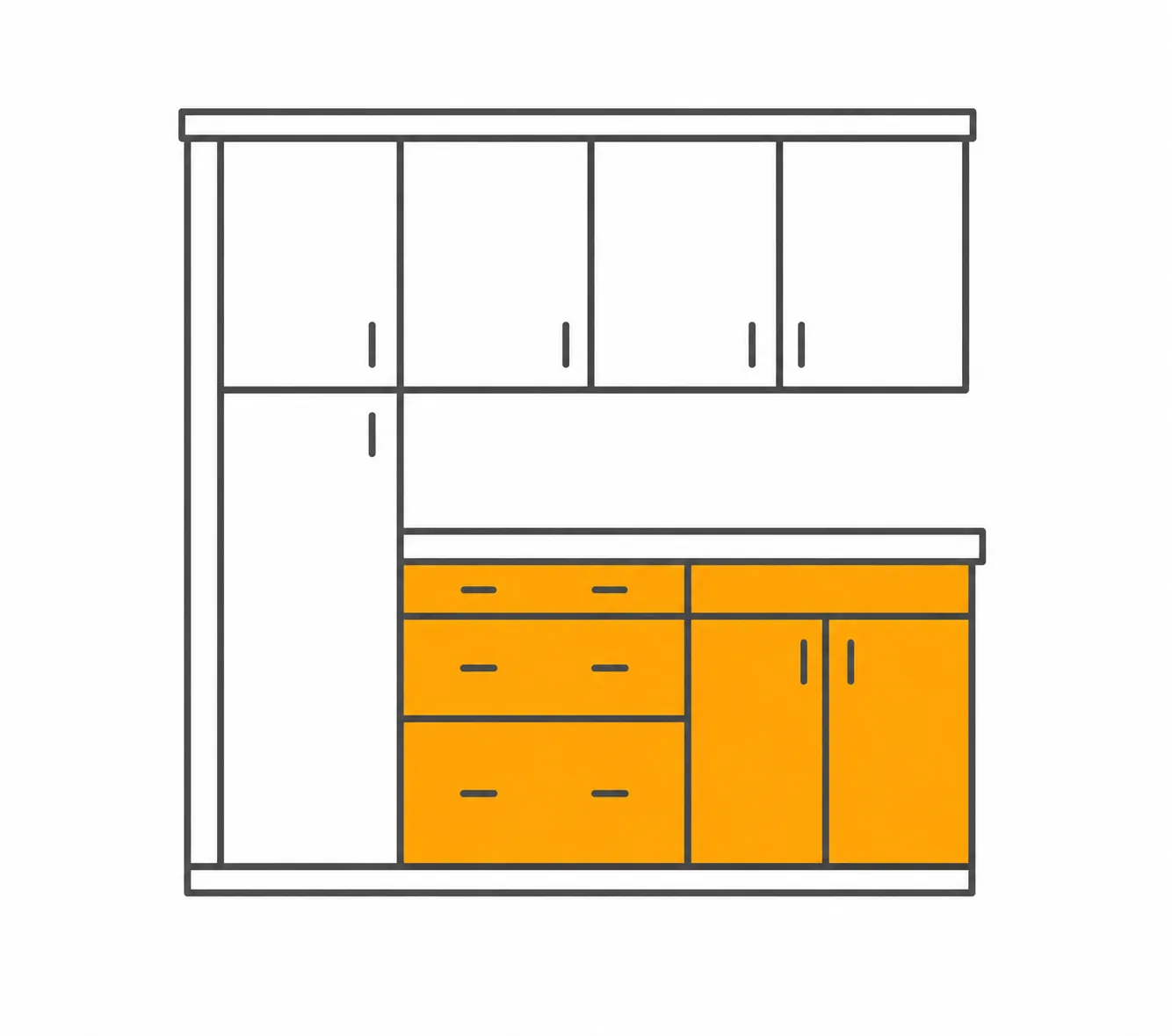
Galaxy Horizon base cabinets are the part of this stain you will know best. You look down on them from a couple of feet away every time you cook, the light from the window and the under-cabinet strip skims straight across their fronts, and your hands, knees and feet are on them all day. That makes the base run the place where the grain and the small door-to-door differences of a stain are actually judged, and where most of the wear lands. This page plans the run with that in mind: how the grain sits on doors and drawers, how to lay the fronts out so the run reads evenly, an L-shaped order priced with its trim and the spares a stain deserves, the two base-height pairings Fabuwood itself shows, and care at toe height. Every box here is 34½″ high and 24″ deep unless its code says otherwise, and every one arrives assembled on Blum soft-close hardware.
Why the lower run is where a stain gets judged
Uppers are seen from across the room and from below, at an angle, with their faces partly in their own shadow. Tall cabinets are seen as one big shape. The lower cabinets are the only ones you routinely stand over and look into, at a distance where you can read the figure of the wood. They also take light at a low, raking angle: from a window at counter level, from the strip under the wall cabinets and from pendants over an island. Raking light is what makes grain and texture visible, and it is what makes a slightly warmer door stand out next to a slightly cooler one.
None of this is a problem. It is the reason people choose a stain over a paint in the first place: the lower run has something to look at. But it does mean the decisions on this page are made at close range. Which fronts carry the most grain, which sit next to each other, and how the run is lit decide whether it reads as a calm, even piece of furniture or as a patchwork.
How the grain sits on a door and on a drawer stack

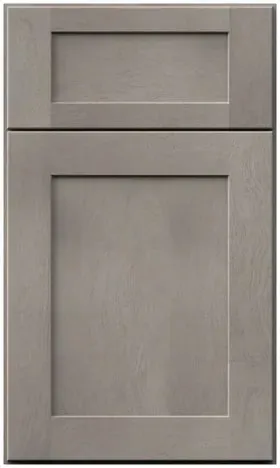
Every front on these cabinets is a five-piece frame and panel. The Galaxy door has ¾″ solid wood stiles and rails, 2½″ wide, around a ⅜″ recessed panel that Fabuwood describes as MDF/veneer. The drawer fronts are built the same way on a smaller scale, with a ½″ recessed MDF/veneer panel. Under a stain that construction shows: the frame pieces carry their grain along their length, the panel carries its own, and the two often look different. A painted door hides all of it.
That is why the choice between a door base and a drawer base changes the look of a stained run more than it would a painted one. A door base shows one tall panel of grain per door. A drawer base shows a stack of short panels, each with its own figure, separated by rails. Put four drawer bases in a row and the run becomes busy with small rectangles; put a drawer bank between two door bases and it reads as a deliberate centre. We are not suggesting fewer drawers for looks alone, because drawers are the better storage. We are suggesting you look at the elevation and count the fronts.
| Cabinet | Code | Fronts you see | Price |
|---|---|---|---|
| Full-height door base, 30″ | GH B30FD | Doors only, one panel each | $461.50 |
| Door base with a drawer, 30″ | GH B30 | A drawer over doors | $555.75 |
| Two-drawer base, 30″ | GH DB30-2 | Two deep drawer fronts | $835.25 |
| Three-drawer base, 30″ | GH DB30 | Three drawer fronts | $845.00 |
| Four-drawer base, 21″ | GH DB21-4 | Four shallow drawer fronts | $832.00 |
The two-drawer base is worth a second look in a stained kitchen. It costs within ten dollars of the three-drawer version at 30″, it holds pots better, and its two tall fronts carry longer, calmer stretches of grain. Use the three- and four-drawer banks where small things live, by the prep space and the range, and let the two-drawer and door bases do the quieter work elsewhere.
Laying out the fronts so the run reads evenly
Fabuwood says plainly that colour variation between pieces is normal for stained finishes. On a run of eight or ten base cabinets, that usually means one or two fronts that are a shade warmer or cooler than the rest, and one or two with livelier grain. You cannot order that away. You can place it.
- On delivery day, unpack as many cabinets as space allows and stand them in the order they will go in, near a window, in daylight. Look along the fronts from where you will stand at the sink.
- Find the outliers: the warmest front, the coolest, and the one with the busiest figure. Almost every delivery has them.
- Where two cabinets share a size and a type, two 15″ door bases or two 18″ drawer bases say, they can change places before anything is fixed. Put the outlier where it is least seen: at the end of a run, beside the fridge, or on the side of the island that faces the wall.
- Doors on identical boxes can also be exchanged. The Blum hinges have Quick-Release, so a door unclips from its box and clips onto another of the same size, and the installer adjusts it. Drawer fronts are fixed to their drawer boxes, so there the move is between whole cabinets rather than fronts.
- Keep the busiest grain away from the sink and the range, where the eye rests longest. A quiet front in the middle of a run makes the whole run look calmer.
This takes an installer ten minutes and it is worth asking for before the first cabinet is screwed to the wall. Afterwards, moving a box means taking the countertop off.
An L-shaped base order, priced with its trim and spares
Here is a typical L at displayed prices on the review date: a 120″ sink wall with a lazy Susan in the corner, a drawer bank, a 36″ farm sink and the dishwasher, turning onto a 96″ range wall with a 30″ drawer bank beside a 30″ range. It is costed the way we recommend a stained kitchen be ordered, with every finishing part and three small spares on the same order.
| Line | Code | Notes | Price |
|---|---|---|---|
| Lazy Susan corner | GH LSB36 | 36″ on each wall | $1,095.25 |
| Three-drawer base, sink wall | GH DB24 | Between the corner and the sink | $705.25 |
| Farm sink base | GH FS36 | Centred on the window | $825.50 |
| Dishwasher | No cabinet | 24″ opening | — |
| Three-drawer base, range wall | GH DB30 | Beside the 30″ range | $845.00 |
| Dishwasher panel | GH DWR6 | Finishes the open side of the dishwasher | $201.50 |
| Toe kick, 8 ft × 2 | GH TK8 | Along both walls | $111.80 |
| 3″ base filler × 2 | GH BF3 | Where each run meets a wall | $52.00 |
| Cabinets and trim | $3,836.30 | ||
| Spare toe kick, 8 ft | GH TK8 | Stain spare | $55.90 |
| Spare 3″ filler | GH BF3 | Stain spare | $26.00 |
| Touch-up kit | TOUCH UP KIT | Fill stick, marker, scraper | $62.40 |
| Order total | $3,980.60 |
The spares add $144.30, under four per cent of the order. They are there because Fabuwood’s warranty is candid that replacement parts may not match existing cabinets. A toe kick scuffed by a vacuum in year two, or a filler that was cut a quarter-inch short on install day, is a small job if the replacement came off the same production as the rest, and a visible patch if it did not.
Two swaps move the total the most. A blind corner base (GH BLB36/39, $614.25) in place of the lazy Susan saves $481.00 but takes 39″ of wall on the pulled side and makes the back of the corner harder to reach. A standard sink base (GH SB36, $490.75) in place of the farm sink saves $334.75 and suits an undermount sink. The rest of the base grid, from 9″ to 48″ wide, is priced on the base cabinet page.
The farm sink and the black counter Fabuwood shows

Two of the pairings in Fabuwood’s own photographs of this stain happen at base height, and both are worth planning for from the start.
The first is the farmhouse sink. Fabuwood shows it in modern farmhouse rooms with open shelving and shiplap, and it suits the stain: a white fireclay apron against grey-taupe grain is a softer contrast than white against painted grey. The farm sink bases come in three widths, GH FS30 at $806.00, GH FS33 at $815.75 and GH FS36 at $825.50. Buy the sink before the cabinet is ordered, or at least have its specification sheet, because apron sinks vary in width and depth and the sink has to suit the opening the cabinet gives it.
The second is the black countertop, which is the pairing people least expect. Over a light stain, a black top reads as a crisp horizontal line and makes the cabinets look paler and the grain more pronounced. It also hides the stain’s tendency to go cool on grey days, because the eye is pulled to the contrast rather than the hue. Honed black stone or a matte black quartz suit the stain better than high polish, in our view, which can look severe against a wood surface. If black is too much, Fabuwood also shows marble on the backsplash; a warm white quartz is our own suggestion for the counter in that case.
Either way, choose the counter with a door sample on it, on the actual base run, in daylight. A counter chosen from a small chip in a showroom tends to look cooler at home than you expected, and on this stain that is the direction you least want.
Knee and toe height: wear and repair the stain way
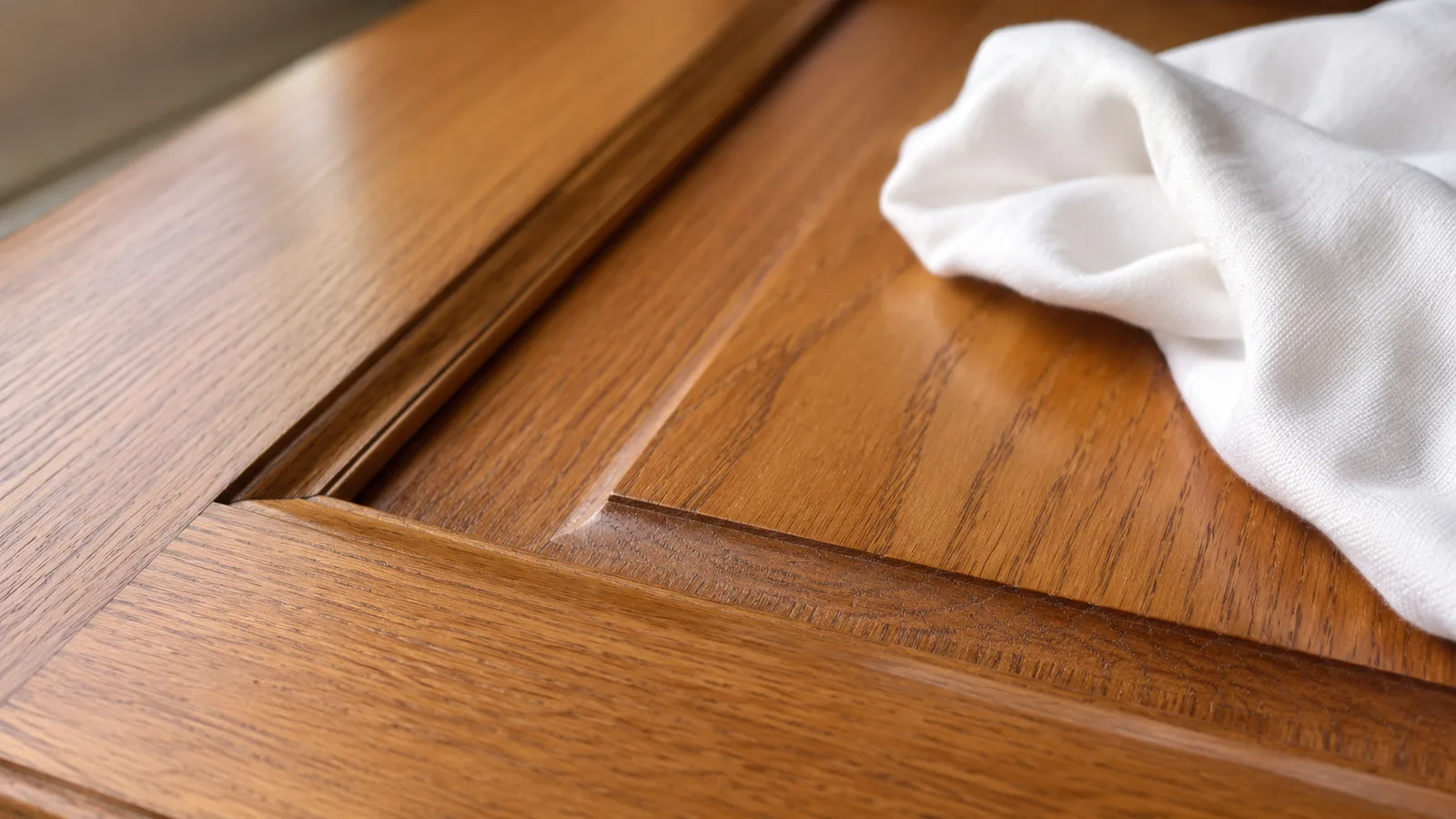
The bottom rail of a base door and the toe kick below it take the knocks: shoes, the vacuum, a mop bucket, a dog’s bowl pushed around the floor. On a painted door those knocks tend to show as pale chips where the paint lets go. On a stain they tend to read as a scratch or dent in wood, and the grain helps hide the smaller ones. That is a real advantage for the lower run, but it cuts both ways: a stain cannot be sprayed over, so a big mark stays a repaired mark.
Fabuwood’s spec book is clear that spray cans are not available for stained finishes. The repair here is the touch-up kit (TOUCH UP KIT, $62.40): a fill stick pressed into a dent, levelled with the scraper, and a marker drawn along a scratch in the direction of the grain. Work in good light, do less than you think, and stop when the mark stops catching your eye from standing height. On the toe kick, where nobody looks closely, replacement is often easier than repair, which is the reason for the spare length in the order above.
- At the sink: blot splashes on the sink base doors rather than wiping them around, and dry the bottom rail if water runs down it. Standing water at the joint between rail and stile is the one thing a sealed finish dislikes most.
- At the dishwasher: the panel beside it (GH DWR6) takes the steam when the door opens. Letting the cycle finish and cool before opening is our general advice for any finish.
- Cleaning: Fabuwood’s guidance is mild cleaner only, and never sprayed directly onto the wood; put it on the cloth. Skip abrasive pads and melamine sponges, which can dull the sheen.
- Near a sunny patio door: the warranty does not cover colour change from UV light, so a base run that takes hours of direct sun is a case for a blind.
The full routine is in How to Clean and Care for Your Kitchen Cabinets.
Behind the stained fronts
Open any of these cabinets and the build is the same as every Galaxy finish at the same price. The box is ½″ veneered plywood with a natural wood veneer interior, so the inside is a pale, clear-finished wood rather than grey. Shelves are ¾″ plywood and adjustable. The face frame is solid wood. Drawers are ⅝″ solid wood boxes with dovetail joints, running on Blum Tandem plus Blumotion full-extension runners that close themselves softly, and doors hang on Blum soft-close hinges with Quick-Release.
Everything arrives assembled, with the doors hung and drawers fitted, and the Galaxy series ships in about 2 weeks. For the corner, the accessories guide covers the Susan, the blind-corner pull-outs and the trash inserts, and the accessories page lists the roll-out trays that fit behind a door base (GHZ ROD-B30 BLUM E, $227.50, for a 30″ box). What a dovetail box is worth is argued in What Dovetail Drawers Tell You About Cabinet Quality.
Before the base order goes in
Order a door sample ($35.00) and lay it on the floor where the run will stand, then hold it at counter height under the light you will cook by. The lower run is seen from above, so that is the angle to judge it at.
Then send us the room for a free 3D design. A designer replies within one business day and the drawing and quote follow within 24 to 48 hours, with every filler, panel and toe kick listed so the whole base run, spares included, goes on one order. Trade buyers order through Captivating Pro. If you are still choosing between this stain and a paint, the collection page sets out the colour and the comparison with Nickel.
Common questions
- Will all my stained base cabinet doors be the same colour?
- Close, but not identical. Fabuwood states that colour variation between pieces is normal for stained finishes. On delivery day, stand the cabinets in order in daylight and have the installer swap same-size boxes or doors so the warmest and coolest fronts are not side by side.
- Is a two-drawer or three-drawer base better in a stained kitchen?
- Both work. The two-drawer base (GH DB30-2, $835.25) shows two tall fronts with longer stretches of grain and holds pots well; the three-drawer (GH DB30, $845.00) suits utensils and small items. Mixing them keeps a stained run from looking busy.
- How much does an L-shaped run of these base cabinets cost?
- The example on this page, a 120″ sink wall with a lazy Susan and farm sink turning onto a 96″ range wall, comes to $3,836.30 with its trim and $3,980.60 with a spare toe kick, a spare filler and the touch-up kit, at displayed prices on the review date.
- How do I fix a scuff on a stained base cabinet?
- With the touch-up kit (TOUCH UP KIT, $62.40): a fill stick for dents, levelled with the scraper, and a marker drawn along scratches with the grain. Fabuwood does not make spray cans for stained finishes.
- What countertop goes on grey stained base cabinets?
- Fabuwood’s own photographs show this stain with black countertops, which make the cabinets read paler and the grain stronger. For a lighter room, a warm white quartz is our general suggestion. Judge either with a door sample on the actual run in daylight.
- What sizes do the farm sink bases come in?
- Three widths: 30″ (GH FS30, $806.00), 33″ (GH FS33, $815.75) and 36″ (GH FS36, $825.50). Have the sink or its specification sheet before ordering, since apron sinks vary.
Keep reading
The guides behind the numbers on this page.
- Types of Base Cabinets: Sizes & Standard Dimensions
Sink, drawer, corner and door bases defined, with the standard sizes of each.
- What Dovetail Drawers Tell You About Cabinet Quality
What sits behind a stack of stained drawer fronts, and how to check it.
- Fabuwood Cabinet Accessories: Lazy Susans, Trash Pull-Outs, Drawer Inserts and Blind Corners
The inserts that decide how the corner of an L-shaped run actually works.
- Cabinet End Panels, Scribe Molding & Fillers Explained
The small finishing parts that have to come from the same order as the boxes.
- How to Clean and Care for Your Kitchen Cabinets
Blotting, not scrubbing: looking after the doors at splash and kick height.


