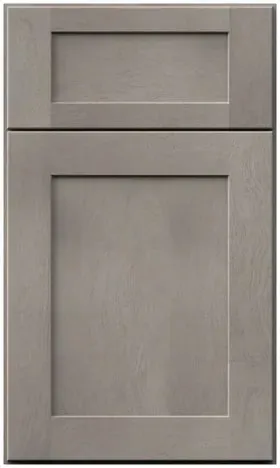


Galaxy Horizon wall cabinets: planning the uppers around the window
Reviewed September 2026 · Captivating Cabinets
Prices quoted in this article were read off the grid on the review date; the live price grid on this page governs.
In most kitchens the wall cabinets are the ones that share a wall with the window. They flank it, frame the sink below it and sometimes bridge over it, and that puts them closer to daylight than anything else in the room. For Galaxy Horizon wall cabinets, that matters twice over: this stain changes with the light more than a paint does, and sunlight is the one thing Fabuwood’s warranty says can change its colour over time. This page plans the upper run around the window: why the cabinets on the window wall and the ones on the wall beside it can look like two different tones, a 120″ window wall priced at three heights, what to do about sun, how to light the uppers, the backsplashes Fabuwood pairs with the stain, glass fronts in a grained frame, and why an upper added in two years’ time is a problem worth avoiding now.
Two walls, two tones: how the window lights the uppers

Picture a kitchen with a window over the sink and uppers either side of it, turning the corner onto a second wall. The cabinets on the window wall are seen against the brightest thing in the room. Your eye adjusts to the glass, and their faces, which get no direct light because they face the same way the window does, look darker and cooler than they really are. The cabinets on the return wall face across the window. Light lands straight on their fronts, and on a sunny afternoon they read noticeably warmer.
That happens with every finish. With a paint you rarely notice it, because an opaque, even colour looks like the same colour in shadow and in light, only darker. With this stain it is much more visible, because the finish itself leans warm or cool depending on what lights it. Owners describe it as cold or dull on a cloudy day and warm in sun; the same thing happens across two walls of one kitchen at the same moment. A designer who sells Fabuwood put it simply: it reads warm or cool depending on its surroundings.
You cannot design that away, and you do not need to. What helps is knowing it is coming. Do not judge the colour of the uppers from the window wall at 3 p.m.; stand at the sink with your back to the window and look at the return wall, then turn round. And when you choose the counter, backsplash and hardware, judge them against the cabinets on the lit wall, not the backlit one. The lit wall is the colour most people see from the doorway.
A 120-inch window wall, priced at three heights
A common window wall: a 24″ and a 15″ upper on the left, a 36″ window over the sink with a valance, a 15″ and a 30″ upper on the right. Both boxes next to the window show a side to the room, so each needs an end skin, and the run gets one length of light rail along the bottom edge. Here it is at 30″, 36″ and 42″ high, at displayed prices on the review date.
| Position | 30″ high | 36″ high | 42″ high |
|---|---|---|---|
| 24″ upper, far left | GH W2430 · $364.00 | GH W2436 · $429.00 | GH W2442 · $468.00 |
| 15″ single-door upper, left of the window | GH W1530 · $234.00 | GH W1536 · $282.75 | GH W1542 · $325.00 |
| Valance over the 36″ window | GH VAR36 · $91.00 | GH VAR36 · $91.00 | GH VAR36 · $91.00 |
| 15″ upper, right of the window | GH W1530 · $234.00 | GH W1536 · $282.75 | GH W1542 · $325.00 |
| 30″ double-door upper, far right | GH W3030 · $383.50 | GH W3036 · $451.75 | GH W3042 · $526.50 |
| End skins × 2, facing the window | GH SK W30 · $100.10 | GH SK W36 · $100.10 | GH SK W42 · $100.10 |
| Light rail, one length | GH LRM · $149.50 | GH LRM · $149.50 | GH LRM · $149.50 |
| Wall total | $1,556.10 | $1,786.85 | $1,985.10 |
Going from 30″ to 42″ adds $429.00 across the whole wall. The height itself should be decided by the ceiling: on an 8-foot ceiling, 30″ or 36″ uppers leave room for crown; the 42″ box suits a 9-foot ceiling. The skins and valance cost the same at every height, which is why they are easy to leave off a quote and then order separately later. On a stain, do not. They sit right beside the boxes, at eye level, in the best light in the room.
The standard valance (GH VAR36, $91.00) is a plain board that ties the two sides together across the window. The premium one (GH VARP36, $217.75) has a shaped profile that suits a French country or farmhouse room, the settings Fabuwood photographs this stain in. Both come from the decorative accessories page, along with crown molding if the run goes to the ceiling.
Sun on the uppers: what the warranty says and what to do
The parts of an upper run that take the most sun are not usually the fronts. They are the end skins facing the window, the underside of any cabinet over the sink, the valance, and the fronts of the cabinets on the return wall if the window faces south or west. On a sunny window those surfaces may get several hours of direct light a day.
Fabuwood’s warranty is direct about this: colour change from exposure to UV light and sunlight is not covered, and finishes may darken or lighten over time. We have not found owners reporting that this particular stain fades or yellows, and we are not predicting that it will. But wood and stain respond to sun, and a skin that sits in afternoon light for ten years will age differently from the door beside it that sits in shade. The most visible sign would be a difference between two parts that started out matching.
- A blind, a shade or a curtain on a south- or west-facing window is the simplest protection, and costs less than any cabinet part.
- UV-filtering window film cuts the ultraviolet without darkening the room much; it is a job for a glazier or a film installer.
- If the window is large and unshaded, consider an open shelf or a glass-front cabinet right beside it, where a difference in tone would be less noticeable than on a solid door.
- Keep the end skins facing the window on the same order as the cabinets, so any change starts from a match.
Lighting the uppers without turning them silver
After dark, the uppers are lit mainly by ceiling lights and by whatever you put under them. Because this stain borrows its warmth from the light, the colour of those bulbs changes the colour of the cabinets. A warm-white light brings out the taupe and the faint pink; a cool, blue-white light pulls it toward silver, which is as close as the stain ever gets to the blue-grey it is sometimes mistaken for.
Our general advice is to choose warm-white for the under-cabinet strip and for the ceiling lights nearest the uppers, and to test it with the door sample before the electrician fixes anything. Under-cabinet light also rakes across the backsplash and the counter, and on the cabinets themselves it lights the grain on the bottom rail. A light rail along the bottom edge (GH LRM, $149.50) hides the strip from view from across the room. The fittings are on the cabinet lighting page.
The backsplash between the uppers and the counter
The band of wall between the uppers and the counter is framed by cabinets above and below, so the stain is its setting on two sides. Fabuwood’s own photographs of this finish show four backsplashes: marble, black marble, glass subway tile, and plain subway tile with grey grout. Each does something different to the stain.
| Backsplash | Effect on the stain |
|---|---|
| White marble | The veining echoes the grain; the stain reads warmer against the white |
| Black marble | Strong contrast; the cabinets read paler and the room more formal |
| Glass subway tile | Reflects the under-cabinet light, so the bulb colour matters even more |
| Subway tile with grey grout | The grout grid picks up the grey; the cabinets look cooler |
If you want the warm reading of the stain, choose a backsplash with some warmth in it, or white marble; if you want the cool reading, the grey grout does it for you. Bring the sample to the tile shop and look at them together in daylight.
Glass fronts and open shelves in a grained run

A glass-front cabinet or an open shelf is a good way to break up a long run of uppers, and in a stained kitchen it has a second use. Beside a window, it puts something other than a solid stained door in the brightest light, so a small difference in tone between the window-side pieces and the rest is much less noticeable.
Behind glass, a standard box shows its natural wood veneer interior, which is pale and warm, so a lit glass cabinet reads warm against the grey-taupe frame. The open shelf and no-door uppers are from the Matching Interior series, finished inside to match the outside, so the recess carries the stain rather than plain wood. A 30″ × 36″ open-shelf box is GH WOS3036 at $672.75, and a 30″ × 36″ no-door box is GH NDW3036 at $542.75.
The glass door products are listed by the frame: a 30″ × 36″ glass-door front, for example, is GHZ GDW3036 at $234.00. These listings describe an open frame that accepts glass, so confirm with us before ordering what is included, which box it goes on, and whether the glass is supplied or cut locally. Clear, seeded and frosted glass show very different amounts of the shelf; the glass door guide compares them.
The upper you add in two years
A common plan is to buy the base run and the main wall of uppers now and add a cabinet over the fridge, or a second bank of uppers, later. With a paint that is usually fine. With a stain it is a risk worth knowing about. Fabuwood notes that colour variation is normal for stained finishes, and the warranty says replacement cabinets may not match existing cabinets. A cabinet made two years later will come from a different production, and it will hang at eye level right beside cabinets that have also had two years of light.
So if a cabinet is likely, order it now. The refrigerator wall cabinet is the usual one: GH W362424, 36″ wide, 24″ high and 24″ deep, at $578.50. If budget really does mean waiting, plan the later addition as something that is not meant to match: an open wood shelf, a glass-front box set a little apart, or a cabinet on a different wall. A later cabinet placed on its own reads as a choice; one placed tight against the originals reads as a mismatch.
The same logic applies to trim. Order all the crown, light rail, skins and fillers with the cabinets, plus a spare length of the crown profile you choose, since crown is the piece most often cut wrong on site and it runs continuously along the top of the uppers, where a patch shows.
Before the upper run is ordered
Tape a door sample ($35.00) to the wall beside the window at eye height, and another on the return wall if you have one. Look at both in the morning, in the afternoon and at night with the lights you plan to keep. Judge the colour on the lit wall, and check how far it moves on the window wall.
Then send us the room for a free 3D design. A designer replies within one business day and the full drawing and quote come back within 24 to 48 hours, with the skins, valance, crown and light rail listed so everything goes on one order. Trade buyers order through Captivating Pro. Every upper size is priced on the wall cabinet page, and the stain itself, with its pairings and the Nickel comparison, is on the collection page.
Common questions
- Why do my stained upper cabinets look darker next to the window?
- Because they are backlit. Cabinets on the window wall face the same way as the window, so no light lands on their fronts and your eye adjusts to the bright glass. Cabinets on the adjoining wall get light straight on their faces and read warmer. A stain that shifts with the light shows the difference more than a paint.
- How much do the wall cabinets for a 120-inch window wall cost?
- The example on this page, four uppers around a 36″ window with a valance, two end skins and a light rail, comes to $1,556.10 at 30″ high, $1,786.85 at 36″ and $1,985.10 at 42″, at displayed prices on the review date.
- Will sunlight change the colour of stained cabinets?
- It can. Fabuwood’s warranty does not cover colour change from UV light or sunlight and notes that finishes may darken or lighten over time. We have not found reports of this stain fading specifically, but blinds or UV film on a sunny window are sensible protection.
- What under-cabinet lighting suits grey-taupe stained cabinets?
- Warm-white light, in our experience. It brings out the taupe and the soft pink in the stain; cool, blue-white light pushes it toward silver. Test the strip with a door sample before it is fixed.
- Can I add a matching upper cabinet later?
- You can, but it may not match. Fabuwood notes that colour variation is normal for stained finishes and that replacement cabinets may not match existing ones. Order likely additions, such as the cabinet over the fridge (GH W362424, $578.50), with the first order.
- Do the glass-front uppers come with glass?
- Confirm before ordering. The glass-door listings describe an open frame that accepts glass, so ask us what is included and which box it fits. A 30″ × 36″ glass-door front is GHZ GDW3036 at $234.00.
Keep reading
The guides behind the numbers on this page.
- Wall & Tall Kitchen Cabinets: Sizes & Buying Guide
Every upper height matched to a ceiling, for planning the run around a window.
- Glass Cabinet Doors: Buying Guide, Styles & Installation Tips
Clear, seeded and frosted glass compared, and what each shows of the shelf.
- Kitchen Cabinet Molding Types and Where Each One Belongs
Crown, light rail and valance: the trim that frames the top and bottom of an upper run.
- Kitchen Cabinet Samples: How to Order & Evaluate
Test the sample on the window wall, in the afternoon, before you order the uppers.


