

Galaxy Horizon range hoods, chosen by where your range sits
Reviewed September 2026 · Captivating Cabinets
Prices quoted in this article were read off the grid on the review date; the live price grid on this page governs.
Most hood advice starts with the hood. The better place to start is the wall behind the range, because that wall decides almost everything: whether air can leave the house, how far it has to travel, how tall the chimney must be and how wide the gap between the uppers can go. The Galaxy Horizon range hood shells come in five families, with three blower inserts and a recirculating kit, and which combination is right follows from where the range sits. So this page is organized by the five range walls we see most often, with a complete build for each, and closes on living with a stained wood shell above a cooktop.
What a working hood is made of

Every hood on this page is two purchases. The shell is the wood body, finished in the cabinet stain, and it ships with a full stainless steel interior liner that is removable for cleaning. The blower is a separate Broan-NuTone insert that sits inside the liner. A shell on its own moves no air.
The shells come in five families. On our list they read as the wall-mount RHA (36″ $2,418.00, 42″ $2,502.50, 48″ $2,596.75), the chimney RHE (30″ $2,609.75, 36″ $2,788.50, 42″ $2,941.25), the slim RHS (30″ $2,785.25, 36″ $2,944.50, 42″ $3,159.00), the curved glass RHCA (36″ $3,532.75, 42″ $3,789.50, 48″ $4,062.50) and the designer RHF (30″ $3,812.25, 36″ $4,043.00, 42″ $4,277.00). All are wall-mount; there is no island shell, and 48″ is the widest.
The inserts are GHZ RHBB 250 CFM at $419.25, 400 CFM at $903.50 and 600 CFM at $1,787.50. Every insert fits every shell with one exception: the 250 is not offered for the 48″ RHA483021. Fabuwood publishes their noise at normal speed as 3 sones for the 250, 1 for the 400 and 0.5 for the 600. The last two parts are for kitchens that cannot vent outside: GHZ RHBB DCT, listed as “Duct Cover” at $263.25, is the recirculating kit, and GHZ RHBB FLTR at $71.50 is its replacement charcoal filter.
Wall one: the range is on an outside wall
This is the easy one, and the best one. The duct can leave through the wall directly behind the hood, in a run of a foot or two with a single cap outside. Short, straight, rigid metal duct is what lets an insert deliver close to its rating, and it costs the least to install.
On this wall any family works, so choose by look and by the cooktop. Size the insert to what you cook: a 30″ electric range on a wall is well served around 300 CFM, which makes the 400 insert the sensible pick, running quietly on its middle speed. A gas range with high-output burners pushes toward the 600. If the 600 goes in, run 8″ duct; it is the only one of the three that takes it, and pairing it with an old 6″ pipe wastes most of what it costs.
The build we would draw for a 30″ gas range on an outside wall: a 36″ RHA363021 at $2,418.00 with the 400 CFM insert at $903.50, $3,321.50 for the hood. A 36″ hood over a 30″ range is deliberate. The overhang catches what escapes off the edges of the cooktop, and it does more for capture than extra airflow does.
Wall two: an inside wall, with a way out through the ceiling

Many ranges sit on an inside wall or an island-facing peninsula wall, which means the air has to go up before it can go out. Whether that works depends on the joists. If they run toward an outside wall, the duct can travel along a joist bay and exit through the rim. If they run across the route, it has to cross them, which is harder and sometimes means dropping a soffit.
A chimney family suits this wall, because the chimney hides the vertical duct as it rises to the ceiling. The chimney sections on the RHE, RHF and RHS shells are removable and trimmable on site. Then count the route: every elbow adds the resistance of several feet of straight duct, and a long run with several turns takes a large bite out of what a blower actually delivers. When the run is long, go up a duct size before you go up a blower size.
Two code questions arrive here. Many areas require make-up air once a hood can move more than 400 CFM, and some read the insert’s listed maximum rather than its nominal number: the 400 lists a 450 maximum and the 600 a 650. The 600 includes Code Ready Technology that can cap it at 400 or 300 CFM, but the cap is set once, within five minutes of first power, and cannot be undone. Settle it with your inspector before the electrician turns the circuit on. The build: a 36″ RHE chimney at $2,788.50 with the 600 CFM insert at $1,787.50, $4,576.00, capped or not as the inspector decides.
Wall three: no route out at all
A condo with no outside wall, a landlord who will not allow a penetration, a kitchen in the middle of a building. Here the hood cannot exhaust, and the honest answer is a recirculating build: the insert pulls air through its grease filter and a charcoal filter and returns it to the kitchen.
The recirculating kit is GHZ RHBB DCT at $263.25. It includes a charcoal filter, a soffit grille, a 90° stack boot, a length of 7″ round duct and a 6-to-7″ transition, and the charcoal refill, GHZ RHBB FLTR, is $71.50. The kit reduces grease and smells while the charcoal is fresh. It does not remove heat or moisture, and over a gas range it does nothing about combustion gases, which is why Fabuwood recommends venting all of its hoods outside where possible. Codes generally do not count a recirculating hood as the kitchen’s required exhaust, so check whether another fan is needed.
The build for a 30″ electric range with no way out: the 30″ RHS slim shell at $2,785.25, the 250 CFM insert at $419.25 and the kit at $263.25, $3,467.75, plus a refill on whatever schedule your cooking demands. If the range is gas, make the case for a duct before settling for this.
Wall four: a tall, sloped or interrupted ceiling
An 8- or 9-foot ceiling is forgiving: the standard chimney pieces reach it and are trimmed to fit. A 10-foot ceiling, a sloped one, or a soffit running across the range wall are where hoods go wrong, because a chimney can be cut shorter on site but never made longer.
Know which families flex, and how. The RHE, RHF and RHS chimneys are removable and trimmable. The curved glass RHCA has a one-piece chimney that trims by up to 12″. The RHA is a flush-sided box rather than a chimney style; its top panel lifts, and its depth can be changed through Fabuwood’s custom-quote process. On a tall ceiling, check the spec-book dimensions against your real floor-to-ceiling measurement before you order, and ask what fills the gap above the shell if the chimney falls short.
The build for a 36″ range under a 10-foot ceiling: a 42″ RHCA curved glass shell at $3,789.50 with the 400 CFM insert at $903.50, $4,693.00, subject to the chimney height clearing the ceiling on the drawing.
Wall five: the range squeezed between tall cabinets
Some plans put the range in a short wall between a tall pantry and a fridge column, or at the end of a run hard against a tall cabinet. The hood width is then fixed by the gap, and the gap is fixed by the base run below it. Decide the hood width first and draw the uppers around it: a 36″ hood over a 30″ range needs a 36″ gap between the flanking cabinets, so the uppers either side are three inches narrower than the bases beneath them, or a filler takes up the difference.
Because the hood projects well past the 12″-deep uppers to cover the front burners, its sides are on show wherever it stands proud of a tall cabinet. The RHA is built with flush finished ends for that reason. Fabuwood’s note on the RHA is specific about crown, too: the crown molding goes above the cabinet, not on its face frame.
Mounting height is the other constraint. The insert guide places the bottom of the hood 24″ to about 30″ above the cooktop, and your range’s manual may require more; on many gas ranges the minimum is 30″, and whichever number is higher wins. So the hood usually sits higher than the bottoms of the uppers beside it. That step is correct; do not pull the hood down to line up with them. The build: a 42″ RHA423021 at $2,502.50 with the 600 CFM insert at $1,787.50 over a 36″ gas range, $4,290.00.
| Range wall | Shell | Insert or kit | Total |
|---|---|---|---|
| Outside wall, 30″ gas | GHZ RHA363021 $2,418.00 | 400 CFM $903.50 | $3,321.50 |
| Inside wall, ceiling route | GHZ RHE36 $2,788.50 | 600 CFM $1,787.50 | $4,576.00 |
| No route out, 30″ electric | GHZ RHS30 $2,785.25 | 250 CFM $419.25 + DCT kit $263.25 | $3,467.75 |
| 10-foot ceiling, 36″ range | GHZ RHCA42 $3,789.50 | 400 CFM $903.50 | $4,693.00 |
| Between tall cabinets, 36″ gas | GHZ RHA423021 $2,502.50 | 600 CFM $1,787.50 | $4,290.00 |
Ductwork, the wall or roof cap, the backdraft damper, any make-up air, the circuit and the installation come from your contractor, not from us. Anything above 600 CFM, any island hood and anything wider than 48″ is beyond these shells, and a ventilation specialist should supply it; we will still design the cabinets around it.
Matched stain, Timber or Walnut
On this finish the shell can match the cabinets or contrast with them. The matched shells, with no suffix, come in all five families. Timber versions exist for the RHS, RHCA, RHF and RHE; Walnut for the RHS and RHCA, at the same prices as the matched shells. The RHA is offered in the matched finish only.
A matched shell turns the range wall into one continuous grain-and-colour field, which suits a quiet room. A wood-tone shell makes the hood the one warm object on the wall. Fabuwood’s own photography pairs this finish with Cobblestone, its dark warm-grey stain, as a two-tone. A darker shell is our suggestion rather than something Fabuwood shows, and it would come from the Cobblestone collection; ask us to put both samples side by side before deciding.
Living with a stained wood shell above a cooktop
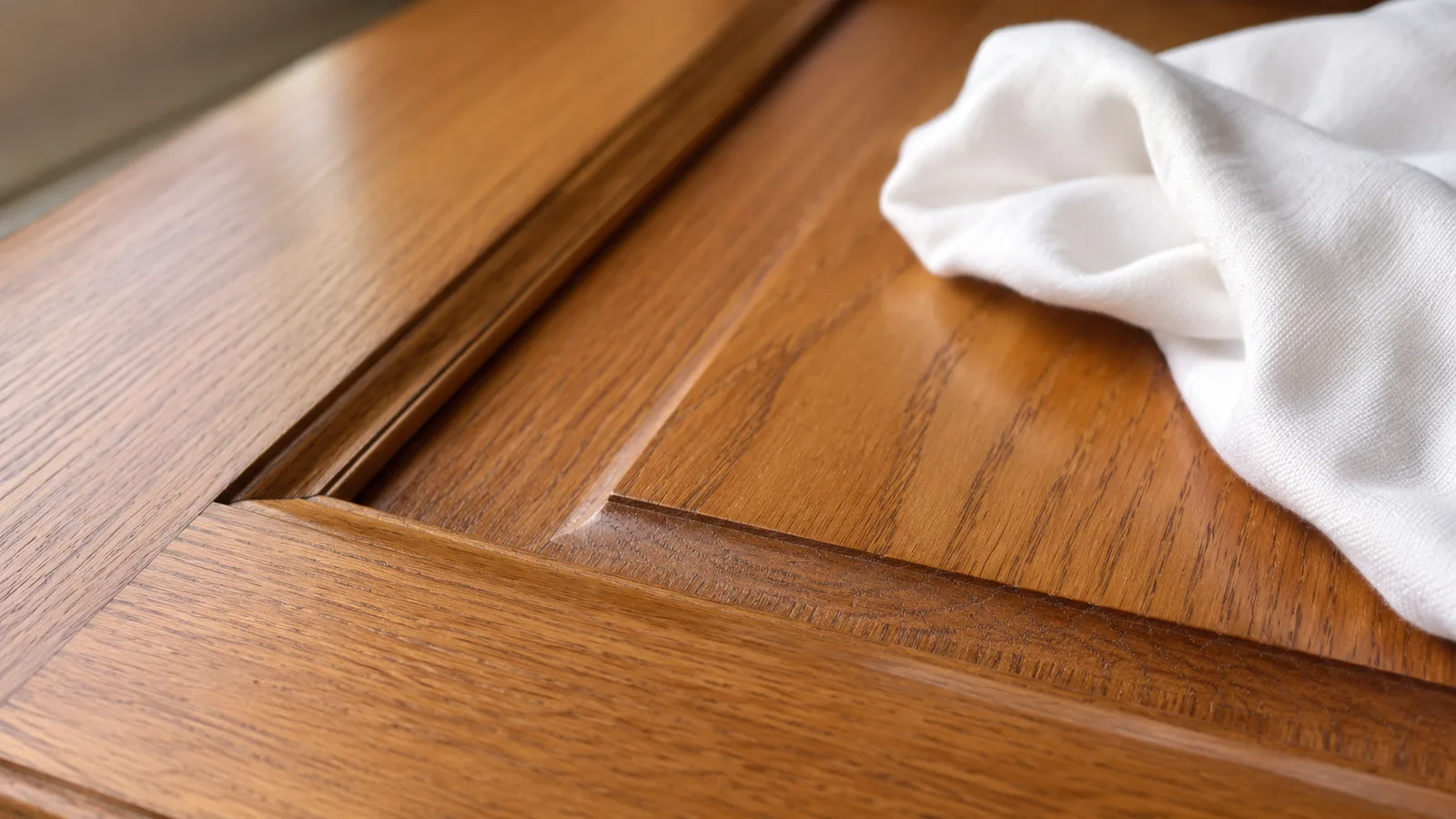
A hood is the hardest-working piece of wood in the kitchen. It lives in steam and a fine mist of grease, and on a stained finish the way you clean it matters. The stainless liner takes most of that: it is removable, and it comes out to be washed. The mesh filters on the 250 and 400 inserts are washable, and the 600 carries a hybrid baffle filter.
For the wood itself, follow Fabuwood’s care guidance: blot spills rather than wiping them across the grain while wet, use mild cleaners only, and never spray a cleaner directly onto the wood. Spray the cloth instead. A film of grease on the lower edge of the shell comes off with a warm, barely damp cloth and a drop of washing-up liquid, dried straight away.
A knock or a scratch is handled the same way as on any other stained part: with Fabuwood’s touch-up kit, which has a fill stick, a marker and a scraper. There is no spray can for a stain. And if the range wall catches strong afternoon sun, know that Fabuwood’s warranty does not cover colour change from sunlight, which on a light stain can show over years where a hood shades part of the wall.
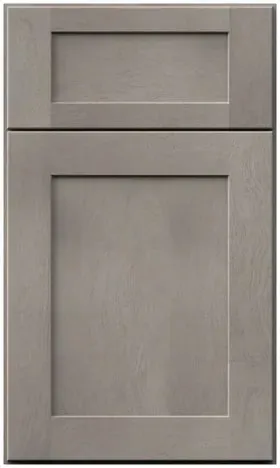
Before any of it, order the $35.00 door sample and hold it at the range wall morning and evening. This grey-taupe reads cooler on a dull day and warmer in sun, and the hood is the largest piece of it in the room. Then send the wall to the free design service: a designer replies within one business day, with the hood, the uppers and the duct route drawn in 24–48 hours. The full list is on the hoods page, and trade buyers get trade pricing through Captivating Pro.
Common questions
- Can you put a range hood on an interior wall?
- Yes, if the duct can reach outside through the ceiling. A chimney-style shell hides the vertical duct, and the route along the joists decides how much airflow survives. Count the elbows, and go up a duct size before going up a blower size on a long run.
- What if my kitchen has no way to vent a range hood outside?
- Use the recirculating kit, GHZ RHBB DCT at $263.25, with the charcoal refill GHZ RHBB FLTR at $71.50. It reduces grease and odour but not heat, moisture or gas-burner combustion products, and codes usually do not count it as required exhaust. Fabuwood recommends venting outside wherever possible.
- Which range hood works with a 10 foot ceiling?
- Any family can, but check the spec-book chimney height against your ceiling before ordering, because chimneys trim shorter, never longer. The RHE, RHF and RHS chimneys are trimmable, the RHCA trims by up to 12″, and the RHA is a box whose depth can be changed on a custom quote.
- How do you clean a stained wood range hood?
- Take out the stainless liner and wash it, clean or replace the filter, and treat the wood gently: blot rather than wipe when wet, use mild cleaners, and spray the cloth rather than the wood. Nicks are handled with Fabuwood’s touch-up kit, not a spray can.
- Which range hood insert is the quietest?
- At normal speed Fabuwood lists the 600 CFM insert at 0.5 sone, the 400 at 1 sone and the 250 at 3 sones. A larger insert running below its maximum is quieter than a smaller one flat out, and a bigger duct lowers the noise further.
- Can a range hood sit between two tall cabinets?
- Yes. The gap between the tall cabinets sets the hood width, and the hood usually sits higher than the uppers either side, because the mounting height above the cooktop comes first. The RHA has flush finished sides for a hood that stands proud of its neighbours.
Keep reading
The guides behind the numbers on this page.
- Range Hood CFM: How Much Ventilation Your Kitchen Needs
The sizing maths, duct tables and code limits behind every build on this page.
- Kitchen Layouts Guide
When moving the range to an outside wall is the best ventilation decision.
- How to Clean and Care for Kitchen Cabinets
The care routine for a stained face, which a hood shell needs most of all.
- Important Kitchen Dimensions Before Buying Cabinets
Ceiling heights, upper-cabinet heights and clearances to measure first.
- Wall and Tall Kitchen Cabinets: Sizes and Buying Guide
How the uppers either side of a hood are sized and hung.


