

Why the 21-inch wall cabinet comes one way only
Reviewed September 2026 · Captivating Cabinets
Twenty-one inches is the thinnest section of the wall catalog: six units, all single-door, in the standard six heights, $227.50 to $416.00. No corner unit, no doorless box, no wine rack, no shallow over-appliance height beyond the usual 15 and 18. It is the width the specialities skipped, and understanding why makes it easy to use well.
What twenty-one inches sits between
Corner units, blind units and microwave cabinets are all sized to what they have to reach around or hold, and none of those measurements land on 21. Corners are drawn at 24, 27 and 36 because that is what a wall corner consumes. Appliance cabinets follow appliance widths, which is 30, 33 and 36. Open display boxes cluster at 15, 18, 24, 30 and 36 because those are the widths people build symmetrical elevations from.
That leaves 21 doing one job: a single-door upper for a run that measured 21 inches once the fillers were subtracted. It does that job perfectly well, and it is the widest single leaf in the wall range — the last width before the catalog splits the front into two doors.
What three more inches buys, and where 24 is free
Set the whole family against the width either side of it and one row jumps out.
| Height | 18″, one door | 21″, one door | 24″, two doors | 21″ over 18″ |
|---|---|---|---|---|
| 15″ | W1815 — $204.75 | W2115 — $227.50 | W2415 — $230.75 | +$22.75 |
| 18″ | W1818 — $230.75 | W2118 — $250.25 | W2418 — $250.25 | +$19.50 |
| 30″ | W1830 — $273.00 | W2130 — $295.75 | W2430 — $364.00 | +$22.75 |
| 36″ | W1836 — $318.50 | W2136 — $351.00 | W2436 — $429.00 | +$32.50 |
| 39″ | W1839 — $328.25 | W2139 — $373.75 | W2439 — $442.00 | +$45.50 |
| 42″ | W1842 — $354.25 | W2142 — $416.00 | W2442 — $468.00 | +$61.75 |
At 18 inches tall the 24″ double-door box and the 21″ single cost exactly the same, $250.25 — three free inches and a second door. If your wall has 24 inches at that height, there is no case for the narrower cabinet. At the taller heights the gap opens up and the 21 becomes genuinely cheaper, but never by much: $68.25 at 30 inches, $52.00 at 42.
The other reading of that table is that the premium for height grows faster at 21 than at 18. Going from a 30″ box to a 42″ box costs $81.25 at 18 inches wide and $120.25 at 21. Tall and narrow is where this line charges you.
A single door twenty-one inches wide
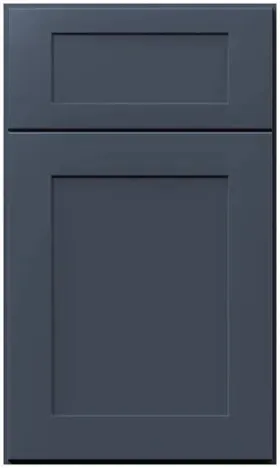
Full-overlay doors cover almost the entire face, so the leaf on a W2142 is about 21 by 42 inches — a panel the size of a small tabletop, hung on two soft-close hinges and swinging its full width into the room. That is not a durability worry; the hinges are rated for it and the box is ½″ plywood. It is a clearance worry.
Three places it bites. At the end of a run where the door opens toward a walkway and stands in it. Beside a window return, where the leaf hits the casing before it is fully open. And next to a refrigerator, where a tall handle and a wide door want the same air. In all three the fix is the same and it is free: swap the hinge side at the time of ordering.
Where a 21-inch upper is genuinely the right cabinet
When the wall measures it. A 12-foot run between two returns broken by a 30″ hood and a window rarely divides into neat 30s and 36s, and the leftover is often in the high teens or low twenties. Filling 21 inches with a cabinet built for it beats filling it with an 18 and a 3-inch filler, which is 3 inches of storage lost and a visible strip in the elevation.
When it stacks. If the base run below has a 21″ box — and 21 is a common base width — carrying the same width up keeps the vertical lines of the elevation true. That alignment is one of the few things that visually separates a planned kitchen from an assembled one.
When symmetry demands it: a pair of 21s either side of a 30″ hood fills 72 inches exactly, and two matching single doors flanking a hood reads calmer than two pairs. The whole family is on the single-door wall cabinet page, and if the run is still fluid, send the measurements to our design team before you commit to the width.
Common questions
- Is there a 21 inch wall cabinet with two doors?
- No. Every 21-inch unit in this range is a single-door cabinet; the second door appears at 24 inches. If you want a pair of doors at roughly this width, 24 is the answer, and at 18 inches tall it costs the same.
- What is the widest single door wall cabinet?
- Twenty-one inches. Above that the catalog splits the front into two leaves, which keeps the swing manageable and stops a single door from getting heavy enough to pull on its hinges.
- How much is a 21 inch wall cabinet?
- From $227.50 for the 15-inch-tall box to $416.00 for the 42-inch one, displayed. The 30-inch height, which is what most kitchens use, is $295.75.
- Why are there no 21 inch corner or open cabinets?
- Corner units are sized to what a wall corner actually consumes — 24, 27 and 36 inches — and appliance and display units follow appliance and elevation widths. Twenty-one does not land on any of those, so nothing specialised was ever drawn for it.
- Should I use a 21 inch cabinet or an 18 inch plus a filler?
- The cabinet, almost always. A 3-inch filler costs you three inches of storage and shows as a flat strip in the run, for a saving of $22.75 at typical heights.
Keep reading
The guides behind the numbers on this page.
- Kitchen layouts guide
Why real walls produce odd leftovers, and how to place them where they are least visible.
- End panels, scribe molding and fillers explained
The alternative to buying the exact width, and what a filler actually looks like once installed.
- Soft close versus self closing
Relevant when the leaf is 21 inches wide and 42 tall — the hardware is doing real work.
- Fabuwood cabinet sizes and specs
The full width ladder, including which widths carry which families.
- Free 3D kitchen design
The fastest way to find out whether your wall wants a 21 at all.