

Three planes, three kinds of light: the open Galaxy Horizon corner upper
Reviewed September 2026 · Captivating Cabinets
Prices quoted in this article were read off the grid on the review date; the live price grid on this page governs.
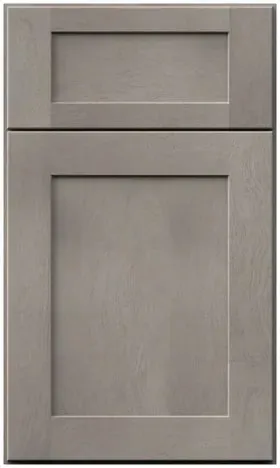
Most cabinets show you one face. An open diagonal corner shows you three: the angled front and, behind it, two back walls meeting at a right angle, each turned a different way to the window. Put a finish that changes with the light into that recess and you see its whole range at a glance. Galaxy Horizon is exactly that kind of finish, a warm grey-taupe stain that one owner describes as cooler on a dull day and warmer in sun, and the four open corners, GH NDWDC2430 to NDWDC2442 at $757.25 to $939.25, are where it will show.
Four heights on one footprint
Each box is 24 inches along each wall and 12 inches deep, with no doors and, in the listing's words, a "finished interior throughout". Four heights match the four heights of the run:
| Code | Height | Sits in a run of | Displayed price |
|---|---|---|---|
| GH NDWDC2430 | 30″ | 30″ uppers | $757.25 |
| GH NDWDC2436 | 36″ | 36″ uppers | $890.50 |
| GH NDWDC2439 | 39″ | 39″ uppers | $893.75 |
| GH NDWDC2442 | 42″ | 42″ uppers | $939.25 |
A closed diagonal corner, doored, is on the corner wall cabinet page if you decide the recess is not for you. The rest of this page assumes it is.
Why the corner shows every mood of the stain

Light from a window reaches the three surfaces of an open corner at three different angles. The back wall facing the window catches it almost head-on; the other is lit at a glancing angle; the diagonal front sees mostly the room. On a painted grey, that produces three brightnesses of one colour. On this stain the colour itself seems to shift, and people who live with it say so.
One homeowner on Houzz, with Horizon and Cobblestone installed in 2022, said that on a cloudy day the cabinets can look "cold or dull" and on a sunny day they look "warm", and that it depends on how much natural light the kitchen gets. A kitchen designer in the same thread, whose showroom sells Fabuwood, said it "can read warm or cool depending on the other furnishings". Fabuwood's own descriptions pull both ways, from "soft pink undertones" on the door page to "misty greys and silvery undertones" on the finish page, which is consistent with a colour that moves.
An open corner puts all of that side by side. The wall facing the light looks warmer; the wall in shade can look cooler and flatter. That is not a defect, and many people like it. It is the finish doing in one bay what it does across the whole kitchen through the day. But if you expect the recess to be one flat colour, it will surprise you.
The corner is where separate parts meet

Corners are where a layout absorbs its leftover inches, so fillers tend to collect there, standing between the corner box and the uppers on either side. In this finish the wall fillers are GH WF330 to WF342 at $26.00 to $41.60 for the 3-inch strips, and GH WF630 to WF642 at $48.10 to $78.00 for the 6-inch, on the filler page.
On a stain, that junction is a place where three or four separately made parts sit within a few inches of each other: the corner's frame, one or two fillers, and the neighbours' frames. Fabuwood treats colour variation between stained parts as normal, and our own panels guide notes that lots vary between production runs. The practical rule is simple. Every filler for the corner goes on the same order as the corner box. Do not leave them for the installer to "pick up later", and do not borrow one from a different job.
Ask the designer how many fillers the corner needs before you order. It depends on the handles on the neighbouring doors and on how square the room is, and it is much easier to count on a drawing than on the wall.
Things that have no front
An open corner is looked at from the doorway, from the sink and from the table, and it looks different from each. Anything you put in it is seen from at least two sides, and often three. That rules out a lot of what people put on open shelves by habit.
- Work well: bowls, jugs and pitchers, round vases, a plant, stacked plates, a single large platter stood on its rim at the back. Anything round, or anything that looks the same from any side.
- Work badly: cookbooks, which show spines from one direction and page-edges from the others; framed prints and signs, which face one way; boxed or labelled goods, which look like storage from every angle but one.
- On colour: against a warm grey-taupe, white and cream ceramics read cleanly from any angle, and so do black pieces. Mid-grey glazes tend to disappear into the recess on a dull day.
If the corner is well away from a window, a lighting kit makes the display readable in the evening. The puck sets and interior strips are on the cabinet lighting page. GHZ LED 2-1/4" PUCK is $71.50 each, and GHZ LED DRIVER, the power supply, is $204.75. Ask which parts your layout needs.
Over a darker base corner
Fabuwood pairs this finish with its own dark stain. Its light-grey ideas post puts it directly: "Galaxy Cobblestone's blend of brown and grey pairs beautifully with Galaxy Horizon's light grey tone." In a two-tone kitchen built that way, with Cobblestone below and the lighter stain above, the corner is where both tones meet in one view: a dark base corner at knee height and an open light corner above it.
That makes the open corner the most exposed part of the pairing. Three points follow from it. Keep the counter between them calm, since the two stains are already doing the contrast. Match the hardware across both tones, so the corner does not collect three metals. And order both corners, upper and base, on the same order as the rest of both runs, for the same reason every stained part should share a production. If you are weighing the two-tone, a Cobblestone sample next to this one, held in the actual corner, answers it faster than any photograph.
Getting the corner right on the order
- Match the corner's height to the uppers either side.
- Hold the door sample against both back walls of the real corner, morning and evening.
- Count the fillers on the drawing and put them on the same order.
- Ask for a photograph of a real Horizon matching-interior box if the recess is the focal point of the wall.
- Decide on lighting now, before the box is on the wall.
The corner and its fillers come back drawn in place on a free 3D design. The first answer arrives within a business day, the full plan with prices a day or two later, and the cabinets ship ready-built in about two weeks. The rest of the uppers are on the wall cabinet page, the whole finish on the collection page, and contractors order through Captivating Pro.
Common questions
- Why does my stained corner cabinet look like two different colours?
- Because each inside wall of a corner faces the window at a different angle. A Horizon owner reports it looks cooler and duller on overcast days and warmer in sun, and in an open corner you see both at once. Sampling the door against each wall of the real corner shows you what to expect.
- What sizes do open corner wall cabinets come in?
- Four heights, 30, 36, 39 and 42 inches, each 24 inches along the wall and 12 inches deep: GH NDWDC2430 to NDWDC2442, displayed at $757.25 to $939.25 on the review date.
- Do I need fillers next to a corner wall cabinet?
- Often, depending on the neighbouring doors' hardware and how square the room is. Order them with the corner box: on a stain, fillers from a later production are the parts most likely to look different.
- What should I put in an open corner cabinet?
- Things that look right from any side, such as bowls, pitchers, round vases, plants and stacked plates. Books, framed prints and labelled boxes face one way and look wrong from the other two angles a corner is seen from.
- Is the inside of an open corner cabinet stained?
- The listing describes a finished interior throughout, from the Matching Interior series. It does not show what the stained interior looks like against the frame, so ask us for a photograph of a real cabinet before ordering.
Keep reading
The guides behind the numbers on this page.
- Kitchen Cabinet Samples: How to Order & Evaluate
Morning, evening and under your own bulbs: the sampling routine a light-sensitive stain needs.
- Gray Kitchen Cabinets: Finding the Right Shade
Warm and cool greys, and why the same grey can read as both in one room.
- Cabinet End Panels, Scribe Molding & Fillers Explained
What a filler is, where it goes, and why it belongs on the same order as the box beside it.
- Kitchen Layouts Explained From Single-Wall to G-Shaped
Which layouts create an upper corner at all, and how many.


