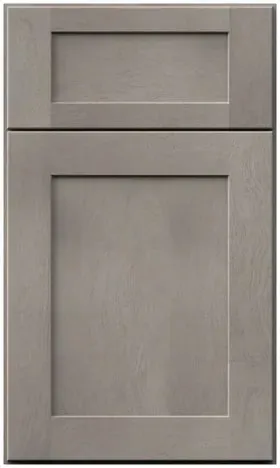


The face that turns: the angled door on a Galaxy Horizon corner wall cabinet
Reviewed September 2026 · Captivating Cabinets
Prices quoted in this article were read off the grid on the review date; the live price grid on this page governs.
Corner wall cabinets come in two shapes. The pie-cut keeps its two folding doors in the planes of the walls, so from the room it looks like the two runs simply meet. The diagonal cuts across the corner with one door set at forty-five degrees to both runs, which gives a bigger opening and a different face. With a paint, that angled door is a question of style and reach. With a stain like Galaxy Horizon it is also a question of light, because a door turned to a different angle catches the room’s light differently from every other door on the wall. That, and what the wider 27-inch diagonal is really worth, is what this page covers.
Why an angled door reads a shade apart

Every door on a straight run faces the same way, so the light from a window or a ceiling fitting strikes them all at roughly the same angle. The diagonal door does not. It faces diagonally into the room, towards the middle of the kitchen, and in most kitchens that means it faces the main light source more squarely than its neighbours, or turns away from it more sharply. Either way it receives a different amount of light at a different angle.
On a solid paint that shows as a slightly lighter or darker patch. On a stained face with the grain showing through, the effect is stronger: the grain lines catch raking light on one surface and lie flat on another, so the same finish can look warmer, cooler, lighter or more textured from one angle than another. Fabuwood describes this grey-taupe as adaptable and shifting with the light; a homeowner who has it describes it as cold on a cloudy day and warm in the sun. The diagonal door is where that behaviour is most visible, because it is the one door with its own angle to the light.
Some people like that. It makes the corner a quiet focal point rather than a blank, especially with a glazed door or a light inside. Others want the upper run to read as one continuous band, and for them the pie-cut is the better choice, because its doors sit in the same planes as the runs either side. That is the colour argument in one line: the diagonal features the corner, the pie-cut disguises it.
Testing it before you choose
Take the door sample — $35.00, full five-piece construction — and hold it in the corner at forty-five degrees, at the height the upper will hang, then flat against each wall. Do it at the time of day you use the kitchen most. If the angled position looks noticeably different and you dislike it, choose the pie-cut. If you like it, or cannot tell, the diagonal is fine. It takes two minutes and it answers a question no drawing can.
Lighting changes the answer, so check it with the lights you will have. Under-cabinet strips light the bottom rail of every door, including the angled one, from the same side, and they reduce the difference noticeably at night. A pendant or a ceiling fitting in the middle of the room does the opposite; it faces the diagonal door squarely and lights it more than the rest. How greys move under different bulbs is covered in the grey shades guide.
Twenty-four or twenty-seven: what three inches buy
The diagonal comes in two sizes along the wall, 24 and 27 inches from the corner on each side. The pie-cut comes only in 24. The 27-inch diagonal is worth a proper look, because it costs noticeably more and its shelf costs a lot more. Displayed prices on the review date:
| Height | 24″ diagonal | 27″ diagonal | Difference |
|---|---|---|---|
| 30″ | GH WDC2430 — $455.00 | GH WDC2730 — $539.50 | $84.50 |
| 36″ | GH WDC2436 — $510.25 | GH WDC2736 — $607.75 | $97.50 |
| 39″ | GH WDC2439 — $536.25 | GH WDC2739 — $633.75 | $97.50 |
| 42″ | GH WDC2442 — $581.75 | GH WDC2742 — $682.50 | $100.75 |
Three inches more on each wall enlarges the angled door and the shelf inside it. The shelf is a pentagon, and a small increase on two sides adds a larger area in the middle, so the 27 holds more than the numbers suggest. It is priced to match: an extra shelf for the 24-inch diagonal, AS-WDC24, is $62.40, and for the 27-inch, AS-WDC27, it is $139.75, more than twice as much. If you plan to add shelves, count that in.
When is it worth the extra roughly hundred dollars? When the corner is where the dinner plates or the everyday glasses will live, because a deeper, wider shelf at the right height is the most useful space in the corner. When the runs either side come out to awkward widths and three extra inches from each wall lets them land on standard sizes without a filler. And when the door itself matters — a bigger angled door is a bigger feature, which is the point if you have chosen the diagonal to show the corner off. Otherwise, the 24 is the sensible buy. The runs on either side are on the single door wall page and the double door wall page.
The short sizes, and a price that reads backwards
Both shapes also come in two short heights, 15 and 18 inches, for a corner under a low soffit or above a window head. The diagonal runs GH WDC2415 at $341.25 and GH WDC2418 at $380.25. The pie-cut runs GH WPC2415 at $409.50 and GH WPC2418 at $383.50, the shorter box priced above the taller. That is what the grid showed on the review date; if it is still that way when you order, ask us before buying the 15, because on those numbers the 18-inch pie-cut is the cheaper box. The tall pie-cuts are GH WPC2430 at $542.75 up to GH WPC2442 at $728.00, and its extra shelf, AS-WPC24, is $64.35.
One more option for the diagonal: a version with a glass-ready door, for a corner that is meant to be looked at. It is listed on the glass door page. Confirm with us before ordering exactly what arrives, because those listings describe an open frame that accepts glass rather than a glazed door, and a lit glass corner makes the angled-light effect above the whole point of the cabinet. The glass door guide covers the glass types.
Getting the corner right on the order
The corner and both runs should come off one order. A corner cabinet sits where two runs converge in full view, and with a stain that varies from part to part by nature, it is the least forgiving place to put a box from a later batch.
Every corner box is a standard Allure build: a ½-inch veneered plywood box with a natural veneer interior, a solid wood face frame, and doors with a ⅜-inch centre panel that Fabuwood specifies as MDF with a veneer face, on Blum soft-close hinges. The diagonal’s angled face frame meets the runs at a filler or a scribe on each side; how many, and how wide, depends on the walls, so let the drawing decide it. Skins for exposed sides are $50.05 at each height on the cabinet skin page. Boxes arrive assembled in about 2 weeks. Ask for a free 3D design and we will draw the corner both ways with the runs laid out from it; a designer replies within one business day. Trade buyers can use Captivating Pro. Every corner size is on the corner wall page, and the rest of the finish on the collection page.
Common questions
- Why does my diagonal corner cabinet door look a different colour?
- It faces the room at forty-five degrees, so it meets the light at a different angle from the doors on either run. On a stained finish with visible grain that can make it look lighter, darker, warmer or cooler. Under-cabinet lighting reduces the effect; a pie-cut corner avoids it.
- Is a 27-inch diagonal corner wall cabinet worth it over a 24-inch?
- It costs $84.50 to $100.75 more depending on height, and its extra shelf is $139.75 against $62.40. It is worth it when the corner will hold everyday dishes or when three more inches on each wall lets the runs land on standard widths.
- What sizes do corner wall cabinets come in?
- The diagonal comes 24 or 27 inches on each wall, 30 to 42 inches tall, plus 15- and 18-inch short heights in the 24. The pie-cut comes in 24 inches, 30 to 42 inches tall, plus the same two short heights.
- Can I get a glass door on a corner wall cabinet?
- There is a diagonal corner version listed for glass. Confirm what ships before ordering, because the listings describe an open frame that accepts glass rather than a finished glazed door.
- Why is the 15-inch pie-cut corner cabinet more expensive than the 18-inch?
- On the review date GH WPC2415 was displayed at $409.50 and GH WPC2418 at $383.50. We report the grid as it stands; ask us before ordering the 15-inch so we can check it.
Keep reading
The guides behind the numbers on this page.
- Gray Kitchen Cabinets: Finding the Right Shade
How a grey moves with the light, which is what the angled door exaggerates.
- Glass Cabinet Doors: Buying Guide
If the corner is going to be a feature, the glass to feature it with.
- Kitchen Layouts Explained From Single-Wall to G-Shaped
Every layout with a corner, and what each corner has to do.
- Fabuwood Cabinet Sizes and Specs
The catalogue dimensions behind the corner sizes on this page.
- How Free 3D Kitchen Design Works
Send a sketch and a few photos; the drawing that comes back counts every part.


