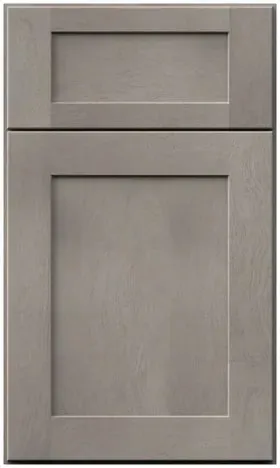



Unboxing a Galaxy Horizon vanity drawer base: how to read a stack of stained fronts
Reviewed September 2026 · Captivating Cabinets
Prices quoted in this article were read off the grid on the review date; the live price grid on this page governs.
A drawer base is the one bathroom cabinet where several separate pieces of finished wood sit directly on top of one another, edge to edge, at the height you look at most. On a painted finish, that stack reads as one colour. On a stain it reads as several related pieces of wood, because each drawer front has its own grain under the colour. That is part of what people buy a stained finish for, and it is also what makes the first fifteen minutes after a Galaxy Horizon vanity drawer base comes out of its carton worth doing carefully. This page covers how the fronts are made, what Fabuwood itself calls normal, a short routine for checking the cabinet before anyone fits it, and what to do with what you find.
Five pieces of wood per front, and one of them is veneer
Galaxy drawer fronts are five-piece recessed-panel fronts, the same construction as the doors scaled down: two solid-wood stiles, two solid-wood rails, and a recessed centre panel. Fabuwood's spec book describes that panel on a five-piece drawer front as ½-inch "MDF/veneer": a wood veneer face over an MDF core. On a paint, none of that matters to the eye. On a stain it matters a great deal, because the stain lets the grain of each piece show, and the frame pieces and the veneered panel do not have to come from the same log, or even look alike.
Fabuwood does not publish the species of the frame or the veneer, and we will not guess at one from a photograph. What its own sample-door photography shows is a panel with a wavier, more figured grain than the straighter grain of the stiles around it, which is what you would expect from a veneered panel inside a solid frame. Expect the same on your drawers: a quieter frame, a livelier panel, and some difference in how each takes the colour.
Behind each front is a ⅝-inch solid-wood dovetailed drawer box on Blum Tandem plus Blumotion full-extension concealed runners. How many drawers a given width has is not stated on the listings; ask if the count matters to your plan.
What Fabuwood calls normal, in its own words
It is worth reading the manufacturer's wording before the carton is opened, because it frames what you are about to look at. Against its stained finishes, Fabuwood's spec book says: "Due to the nature of wood and the complex finishing processes used to generate stained finishes, there may be variations in color which are considered normal." Its warranty adds that wood "may vary in color, texture and grain" and that this is not considered a defect.
In plain terms, a drawer stack in this finish will not look like a printed swatch. One front may carry a little more figure than the one above it; a rail may read a touch warmer than a stile; the grain in one panel may run in a pattern the next does not repeat. The grey-taupe colour itself, a warm grey with the soft pink undertone Fabuwood describes, can make those differences more noticeable in some light and less in others. None of that is a fault.
What is a fault is anything that is not about the wood. Chips, dents, scratches through the finish, runs or drips in it, a rough patch, a front that is warped or sits out of line with the others, a drawer that will not close softly. Those are what the check below is for.
A fifteen-minute check before the installer arrives

- Open the carton in daylight. Carry the cabinet to a room with a window, or at least out of the bathroom, whose bulb is often the worst light in the house to judge a finish by. Daylight is the most neutral light you have.
- Stand it upright and step back about six feet. Look at the stack as a whole first, the way you will see it every day. Variation that is visible only with your nose on the front will not be visible once the top is on.
- Now go close, front by front. Run a hand across each face and along each edge. Look along the surface at a low angle toward the window, which shows dents and runs that a square-on look hides.
- Open every drawer to full extension and let it close on its own from a few inches out. Each should glide the whole way and settle softly. A drawer that stops short or slams is an adjustment or a fault, and the installer will want to know before fitting.
- Look at the gaps between the fronts. They should be even from one side to the other. Small differences can usually be adjusted; a front that is visibly twisted cannot.
- Photograph anything you find in daylight, with the carton label in a second photo, and send both to us before installation. A problem reported on an unfitted box is far simpler to resolve than one found after the top is glued down.
If the grain varies, arrange it before returning it
Sometimes the check turns up nothing wrong and one thing you do not like: a front with a strong figure next to a quiet one, or a stack that reads slightly lighter at the top than the bottom. Before treating that as a return, consider where the box is going.
A drawer base usually sits beside a sink base or a combo, and the eye reads the whole vanity as one face. A livelier front in the middle of that face reads as character; the same front at the end of the run, in raking light from a window, reads louder. If the plan has two drawer bases of the same width, the fronts are the same size and a competent fitter can swap them between boxes to balance the look. And if the variation bothers you in daylight but not under the bathroom's own lights, it is worth remembering that the bathroom lights are the ones you will see it under.
If it still bothers you, call us. Some stacks are better swapped, and we would rather hear about it before the cabinet is fitted than after.
The widths, the prices, and the two that are missing
Seven widths are sold. The run steps in three-inch increments from 12 to 27, then skips to 33; there is no 30-inch or 36-inch drawer base in this finish. Five widths also have a carcass-only listing, for replacing a damaged box and keeping the fronts you have already checked and accepted.
| Width | Cabinet | Price | Carcass only |
|---|---|---|---|
| 12″ | GH VDB12-34 | $601.25 | VDB12-34-BO: $386.75 |
| 15″ | GH VDB15-34 | $627.25 | VDB15-34-BO: $403.00 |
| 18″ | GH VDB18-34 | $672.75 | VDB18-34-BO: $432.25 |
| 21″ | GH VDB21-34 | $718.25 | VDB21-34-BO: $461.50 |
| 24″ | GH VDB24-34 | $760.50 | VDB24-34-BO: $487.50 |
| 27″ | GH VDB27-34 | $802.75 | not listed |
| 33″ | GH VDB33-34 | $877.50 | not listed |
Because this is the box with the most finished fronts in the bath range, it is also the one where a carcass-only repair saves the most matching trouble: at 24 inches the difference between the complete cabinet and the carcass is $273.00, most of it drawer fronts and drawer boxes. The vanity base page explains what those listings are and what they do not state.
If the plan needs 30 inches of drawers, the usual answers are a 15-inch drawer base either side of something, or a sink-and-drawer combo that puts a stack beside the bowl in one carcass. The whole family is priced on the vanities page.
Getting a matched stack in the first place
The best protection against a stack that does not sit well with the rest of the vanity is ordering the whole vanity together. Parts from one order are finished close together in time; parts added later are not, and Fabuwood's warranty is candid that replacements "may not match" existing cabinets.
Order a door sample first, $35.00 from the sample page, and look at it in the bathroom it is going into; the sample guide explains how. Then send us the wall through the free design service. A designer replies within one business day and the full drawing and quote follow in 24 to 48 hours. Builders and designers ordering several bathrooms at once can use Captivating Pro for trade pricing. And the rest of the collection uses the same fronts, so the same check applies to every drawer in the house.
Common questions
- Is it normal for stained cabinet drawer fronts to look different from each other?
- Yes. Fabuwood says colour variation on stained finishes is normal and that wood may vary in colour, texture and grain. Each drawer front has its own grain under the stain, so a stack will not look like a flat swatch. Chips, runs, scratches and warped fronts are faults; grain differences are not.
- What should I check when my vanity is delivered?
- Unbox it in daylight, look at it from six feet and then close up, run a hand over every face and edge, open every drawer fully and let it close on its own, and check the gaps between fronts are even. Photograph anything you find, with the carton label, and send it before installation.
- What wood are the drawer fronts made of?
- The frame of each five-piece front is solid wood and the ½-inch recessed centre panel is MDF with a wood veneer face, per Fabuwood's spec book. Fabuwood does not publish the species, so we do not state one.
- Is there a 30-inch vanity drawer base?
- Not in this finish. Drawer bases come in 12, 15, 18, 21, 24, 27 and 33 inches, $601.25 to $877.50 displayed. For 30 inches of drawers, pair two narrower boxes or use a sink-and-drawer combo.
- Can drawer fronts be swapped between two cabinets?
- Between two drawer bases of the same width, the fronts are the same size, so a competent fitter can swap them to balance the grain across a run. Do it before the top goes on.
Keep reading
The guides behind the numbers on this page.
- Dovetail Drawers and Cabinet Quality
What sits behind each stained front, and why the joint matters.
- Cabinet Samples: How to Order and Evaluate Them
Judging a stained door at home before the whole order is placed.
- Cabinet Wood Species Compared
Why grain and figure change so much from one piece of wood to the next.
- Pre-Assembled Kitchen Cabinets: A Buying Guide
What arrives assembled, and what to look at before it is fitted.
- Fabuwood Bathroom Vanities: Sizes, Styles and Buying Guide
Where an all-drawer box fits in the six vanity configurations.


