

A Galaxy Horizon sink-and-drawer combo for the bathroom the children share
Reviewed September 2026 · Captivating Cabinets
Prices quoted in this article were read off the grid on the review date; the live price grid on this page governs.
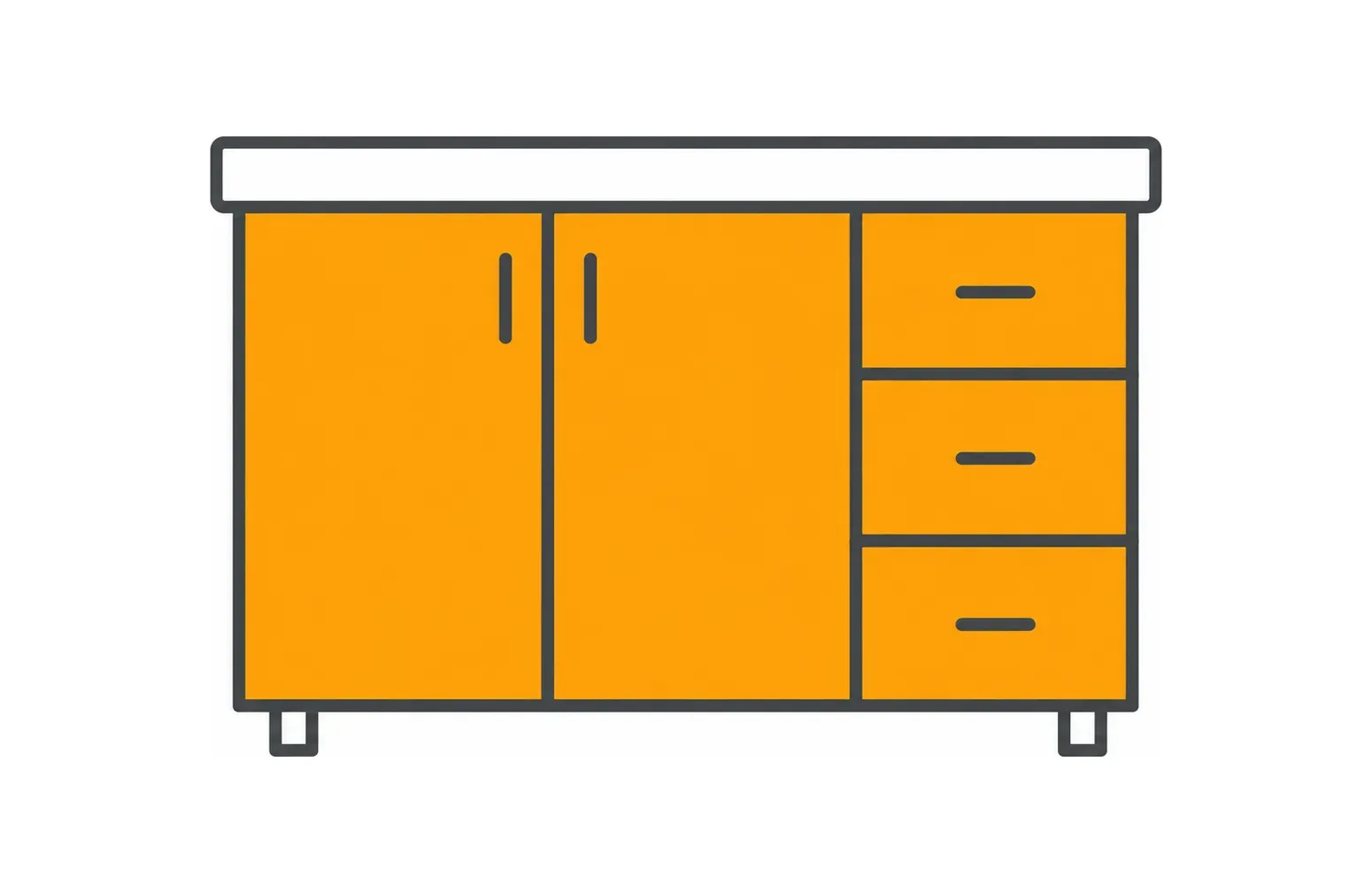
A sink-and-drawer combo puts a basin and a bank of drawers into a single carcass, and there is one bathroom where that arrangement makes more sense than anywhere else in the house: the one the children share. It is used hard, at the same times every day, by people of different heights who each want their own things kept away from everyone else's. This page looks at the Galaxy Horizon combo from that angle. It covers which size suits how many children, how to divide the drawers, what a 34-inch box means for someone who is not yet four feet tall, how a stain copes with scuffs and splashes, and why the choice should be made for the teenagers the children will become.
One bowl or two: sizing the combo to the household
Six combos are sold in this finish. The 30- and 36-inch ones come in a drawers-left or drawers-right version; the 42- and 48-inch ones are a single listing each; and the 60-inch size comes with one bowl or two.
| Width | Cabinet and price | Suits |
|---|---|---|
| 30″ | GH VSD30DL or DR: $757.25 | One child, or a small hall bath used by guests as well |
| 36″ | GH VSD36DL or DR: $783.25 | Two young children taking turns at one bowl |
| 42″ | GH VSD42: $874.25 | Two children, with a drawer bank that can be split fairly |
| 48″ | GH VSD48: $975.00 | Two or three children at one bowl, and counter for both |
| 60″ | GH VSD60SINGLE: $1,196.00 | Two older children who value drawers over a second tap |
| 60″ | GH VSD60DOUBLE: $1,046.50 | Two children at the basin at the same time |
The question that decides it is not how many children there are but whether they need the basin at the same moment. Young children brushing teeth under supervision take turns anyway, and one bowl with more drawers is the better use of the wall. Two children leaving for the same school bus at the same time are the case for two bowls, and at 60 inches the two-bowl version is also the cheaper of the pair. Where the bowl sits on the 42- and 48-inch combos is not stated on the listings; ask us before planning the mirror and the light over it.
A drawer each, and one the children cannot reach

The most useful thing a combo gives a shared bathroom is a set of drawers that can be assigned. Once each child has a drawer of their own, the arguments about whose hairbrush is whose mostly stop, and the counter stays clearer because each child has somewhere to put things away. Label the fronts on the inside of the drawer box rather than the outside, so the labels can change as the children do without leaving marks on the finished face.
Give the youngest the lowest drawer. It is the one they can open without a stool and see into from above. The top drawer, the one nearest the counter, belongs to the adults: it is where the nail scissors, the thermometer and anything else sharp or medical should live, with a latch fitted on the inside if the children are small. Medicines themselves are better still in a locked or high cabinet, not in any drawer a child can reach.
How many drawers each combo carries, and how deep each one is, is not published on the listings. If the plan depends on one drawer per child, ask us for the drawer count of your size before ordering. Every drawer is a ⅝-inch solid-wood dovetailed box on full-extension soft-close runners, which is to say it will survive being slammed by an eight-year-old, and the soft-close means it mostly cannot be.
A 34-inch box and a child who is not yet four feet tall
The box is 34 inches tall, and once a top is on, the counter sits at about 35 to 36 inches, the height most adults find comfortable. For a young child, that puts the basin rim near shoulder height. A step stool is the usual answer, and it brings two design decisions with it.
First, where it lives. A stool left in front of the drawers blocks them; a stool pushed into the corner is not used. Plan a spot for it: beside the combo against the wall, or tucked under a towel hook. Second, what it touches. A stool knocked against the cabinet every morning scuffs the toe kick and the lower edge of the doors. A stool with rubber feet and rounded edges, and a gap left between its standing position and the box, saves years of marks.
The faucet matters too, though it is not part of the cabinet. A tap with a long spout that reaches well over the bowl lets a small child rinse without leaning across wet stone, and a single lever is easier for small hands than two cross-heads. Your plumber and your designer can choose one to suit the combo's bowl.
Splashes, scuffs and a stained face

Children's bathrooms are wet. Water runs off the counter edge onto the drawer fronts and the doors under the bowl, and the base of the cabinet gets splashed every bath night. Fabuwood's care advice for its finishes is short and worth teaching to anyone old enough to hold a towel: blot water off, do not wipe it across the surface, and never spray cleaner straight onto the wood. The care guide has the full version.
Scuffs are the other daily event. On a stain, a surface scuff sits on the clear coat over the colour; a chip that goes through to the wood shows as a paler spot, because the wood under the stain is lighter than the finish. Fabuwood makes no spray-can touch-up for its stained finishes. What it offers, and what is sold in this finish as a loose part, is a touch-up kit of a stick, a marker and a scraper at $62.40, which handles nicks on door edges and the corners of drawer fronts. Buy it with the vanity and keep it in the combo's top drawer.
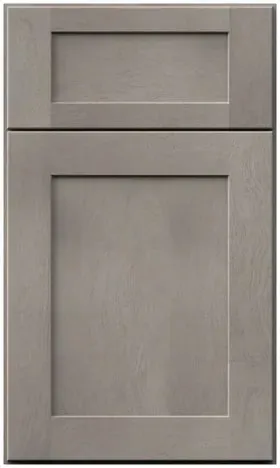
In our view a mid-tone stain with visible grain is a forgiving surface in a children's bathroom. Small marks tend to lose themselves in the figure of the wood more readily than on a flat, opaque paint, where every mark sits on a single even colour. It will not hide everything, and it is not a reason to skip the blotting, but it is a practical argument for a stained finish in this particular room.
Choosing for the teenagers they will become
A vanity is fitted for fifteen or twenty years. A child who is five when it goes in will be a teenager for half its life, and teenagers use a bathroom differently: longer, with more products, often with hair tools that need a socket and somewhere safe to cool. That is a reason to lean toward the larger combo that fits the wall rather than the one that suits the children today, and to have an electrician place a socket at a sensible height when the room is opened up.
It is also a reason to keep the cabinet itself grown-up. Theme the room with things that can change in an afternoon: the towels, the bath mat, the art on the wall, even the hardware, which unscrews. A grey-taupe stained shaker cabinet does not look like a nursery and will not need replacing when the dinosaurs come down.
Getting it into the room
A combo is one carcass, which makes it quicker to fit than an equivalent run of separate boxes, but also a single large object to carry up a stair. Measure the route before the order is placed. Each combo also has a carcass-only listing, VSD48-BO at $627.25 for example, for replacing a damaged box and keeping the fronts; the vanity base page explains what those are. The whole range is on the vanities page, and the vanity guide sets out the family.
Order a $35.00 door sample from the sample page and look at it in the children's bathroom itself, whose light may be nothing like the rest of the house. Then let us draw the room through the free design service: a designer replies within one business day, and the full design and quote follow within 24 to 48 hours. For more of the collection, or for a quick question, call (609) 900-3358.
Common questions
- What is the best vanity for a shared kids' bathroom?
- One with drawers that can be assigned, one each, under a top wide enough for two to stand at. A sink-and-drawer combo does this in a single carcass. From 36 to 48 inches suits two children taking turns at one bowl; a 60-inch two-bowl combo suits two who need the basin at the same time.
- Should a kids' bathroom have one sink or two?
- Two only if they need the basin at the same moment, which usually means older children on the same morning schedule. Young children take turns anyway, and one bowl with more drawers is the better use of the wall. At 60 inches, GH VSD60DOUBLE at $1,046.50 is less than the single-bowl GH VSD60SINGLE at $1,196.00.
- How tall is a vanity for children?
- These boxes are 34 inches tall, so the counter finishes around 35 to 36 inches with a top, the adult comfort height. A step stool with rubber feet and a planned parking spot is the usual way for a young child to reach the basin.
- How do I repair a scuff or chip on a stained vanity?
- With a touch-up kit, not paint. Fabuwood does not make spray cans for stained finishes; its kit is a stick, a marker and a scraper, sold in this finish as a loose part at $62.40, and it suits small nicks on door edges and drawer corners.
- How many drawers does a sink and drawer combo have?
- The listings do not state the drawer count or depths for each size, so ask us for the count on your width before ordering if the plan depends on one drawer per person.
Keep reading
The guides behind the numbers on this page.
- Fabuwood Bathroom Vanities: Sizes, Styles and Buying Guide
The combo alongside the other five vanity boxes, and the 60-inch fork.
- Dovetail Drawers and Cabinet Quality
Why a jointed drawer box survives a household of children.
- How to Clean and Care for Kitchen Cabinets
Blotting, mild cleaners and the other rules that apply double in a kids' bath.
- Matte Cabinet Finishes: Pros, Cons and Care
How sheen changes what fingerprints and splashes show on a cabinet face.
- Space-Saving Cabinet Solutions
Dividers and bins that keep a drawer each from turning into a jumble.


