

One Galaxy Horizon vanity wall cabinet, and the three kinds of light that fall on it
Reviewed September 2026 · Captivating Cabinets
Prices quoted in this article were read off the grid on the review date; the live price grid on this page governs.
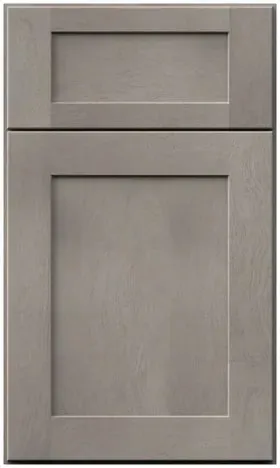
There is one bathroom wall cabinet in this finish, GH WVS2430, 24 inches wide and 30 tall, and it is the cabinet in the room you look at most directly. It hangs at eye level, usually beside a mirror, often across from or next to a window, and within a few feet of the brightest lamp in the house. That makes it the best place to understand a quality of the Galaxy Horizon stain that shows up in Fabuwood's own descriptions and in owners' reports alike: the colour moves with the light. This page is about the three kinds of light a bathroom upper lives in (daylight, bulbs and direct sun), what each does to a warm grey-taupe stain, and how to test for all three before anything is ordered.
The one cabinet, briefly
GH WVS2430 is $490.75 displayed. It is a 24-inch-wide, 30-inch-tall wall cabinet listed for the bathroom, built like the rest of the range: ½-inch veneered plywood box with a natural finished interior, a solid-wood face frame, and five-piece doors on Blum soft-close hinges. Its depth is not stated on the listing. Bathroom uppers are often shallower than kitchen ones, and if the depth matters for a tight spot beside a mirror or over a toilet, ask us to confirm it before ordering.
A carcass-only version, WVS2430-BO, is listed at $315.25, for replacing a damaged box while keeping the original doors. The vanity base page explains what those listings are and why they matter more on a stain than on a paint.
Daylight: why the same door reads warm at noon and cool on a grey morning

Fabuwood describes this finish in more than one way. Its door page calls it an "adaptable gray stain, accented with soft pink undertones"; a design card calls the tones "soft taupe"; its finish page speaks of "misty greys and silvery undertones". Its hex value is #989089, a warm grey-taupe. Those descriptions are not in conflict so much as describing the same stain under different light.
Owners say the same thing in plainer words. A homeowner who installed the finish in 2022 reported on Houzz that on a cloudy day the cabinets can look "cold or dull", while on a sunny day they look "warm". A kitchen designer in the same discussion, whose showroom sells Fabuwood, noted that it can read warm or cool depending on the other furnishings. It is not a blue-grey, whatever some older descriptions online claim; what shifts is the balance between the warm, pinkish taupe and a cooler, more silvery grey.
A bathroom exaggerates this, for two reasons. Bathroom windows are often small and frosted, which softens and cools the light. And the walls and tiles are often white or pale, which reflect that light straight back onto the cabinet. Expect the upper to look its coolest on a grey winter morning and its warmest on a sunny afternoon, and judge it at both.
The direction the window faces changes the pattern, and this is general daylight behaviour rather than anything specific to one finish. A north-facing window gives steady, cool light all day, so the cabinet will sit toward the silvery end of its range most of the time. East light is brightest and coolest in the morning; south and west light warms through the afternoon. If the bathroom is used mostly at one time of day, that is the hour to judge the sample at.
Bulbs: the light you will actually see it under
Most bathroom use happens before sunrise or after dark, which means the bulb over the mirror decides what the cabinet looks like most of the time. Two numbers on the bulb box matter, and this is general lighting advice rather than anything Fabuwood publishes.
- Colour temperature, in kelvin. Around 2700K is the warm light of a traditional incandescent bulb; 3000K is a little crisper; 4000K and above reads cool and white. On a warm grey-taupe stain, expect warmer bulbs to bring the taupe and pink forward and cooler ones to push it toward silver-grey.
- Colour rendering, shown as CRI. A bulb with a CRI of 90 or more shows colours closer to how they look in daylight, faces included. A cheap bulb with a low CRI can make any finish look flat and slightly off, and a stain with a subtle undertone suffers most.
Pick one colour temperature for the whole room and keep it consistent across the mirror light, the ceiling light and any light inside the shower. Mixed bulbs make the same cabinet read as two colours depending on which switch is on. For a face-lit mirror, many people settle on 2700K to 3000K with a high CRI; it flatters skin and keeps this stain on the warm side of its range.
Light direction matters too. A sconce beside the cabinet rakes across the doors and brings up the grain in the centre panels, which on a stain is part of the appeal. A downlight directly above throws the upper rail into shadow. Your designer can mark fixture positions on the plan.
Dimmers add one more variable. Many LED bulbs hold their colour temperature as they dim, unlike the old filament bulbs, which glowed warmer as they faded; some "warm dim" LEDs are designed to imitate that. If the mirror light will be dimmed for a late-night bath, check the sample at the low setting as well as at full brightness.
Sun: a window opposite the cabinet
The third kind of light is the one that can change the finish rather than only how it looks. Fabuwood's warranty lists colour change from exposure to UV light and sunlight among the things that are not defects, and notes that colours "may darken or lighten over time". That applies to every finish Fabuwood makes, painted or stained, and we found no reports of this finish fading or yellowing in particular. But a bathroom upper facing a clear, south- or west-facing window takes more direct sun than almost any other cabinet in a house.
The practical steps are modest. A blind or a light-filtering film on a clear window protects the cabinet and the towels alike. Avoid leaving objects standing against the doors for months at a time in a sunny room, because any gradual change would then happen unevenly around them. And if the room gets strong sun, it is one more reason to buy every visible part of the bathroom on the same order, so that whatever change happens, happens to all of it together.
Testing it: one sample, three times of day
The only reliable way to know how this stain will look in your bathroom is to put a piece of it there. A door sample is $35.00 from the sample page, and the test takes one day.
- Tape or prop the sample where the cabinet will hang, at eye level, not on the counter.
- Look at it in the morning with only daylight, at midday, and at night with the mirror light on. Take a phone photo each time from the same spot, without flash.
- Hold it next to the towels, the tile and the top you have chosen, under each of those three lights. A pairing that works at noon can clash under a cool bulb.
If it reads well in all three, it will read well on the wall. If one of the three bothers you, it is usually the bulb, and that is cheaper to change than the cabinet. The sample guide has more on judging a door at home, and the guide to grey shades explains why undertone matters more than depth.
Placing and ordering it
Most people hang a single bath upper beside the mirror or above the toilet. Wherever it goes, align it with something already on the wall, the top of the mirror or the door head, and keep its bottom edge clear of the tap and of anyone leaning over the basin. The full bath family is on the vanities page, the matching lower cabinets on the vanity sink base page and its neighbours, and the vanity guide sets out the rest.
Everything ships assembled, with Galaxy's typical lead time of about two weeks. Send us the wall, the window position and the light fittings through our design service and we will draw the room at no cost: a designer replies within one business day and the full drawing and quote follow in 24 to 48 hours. Trade buyers can use Captivating Pro for trade pricing. We're builders who sell cabinets, and the rest of the collection is built on the same box.
Common questions
- Why do my cabinets look a different colour at different times of day?
- Because the light changes, and some finishes respond to it more than others. A warm grey-taupe stain like this one is reported by owners to look cooler and duller on cloudy days and warmer in sun. Bulb colour temperature has the same effect after dark.
- What colour temperature bulb is best for a bathroom vanity?
- Many people choose 2700K to 3000K with a CRI of 90 or more for a mirror light: it is flattering on skin and keeps warm finishes looking warm. Keep one colour temperature across every light in the room so the cabinets do not read as two colours.
- Does sunlight fade cabinets?
- It can change any finish over time. Fabuwood's warranty lists colour change from UV and sunlight as not a defect and notes colours may darken or lighten with age. We found no reports specific to this stain, but a bathroom upper facing a clear sunny window is worth protecting with a blind or film.
- What size is the bathroom wall cabinet?
- GH WVS2430 is 24 inches wide and 30 inches tall, at $490.75 displayed. Its depth is not stated on the listing, so ask us to confirm it if space is tight.
- Is this finish blue-grey?
- No. Fabuwood describes it as a grey stain with soft pink undertones, and its published hex value is a warm grey-taupe. It can look cooler, even silvery, in dull or cool light, which is probably where the blue-grey description comes from.
Keep reading
The guides behind the numbers on this page.
- Gray Kitchen Cabinets: Finding the Right Shade
Undertone, not depth, is what decides how a grey reads in a room.
- Cabinet Samples: How to Order and Evaluate Them
The at-home test in full, for any finish and any light.
- Matte Cabinet Finishes: Pros, Cons and Care
How sheen changes what a light fitting does to a cabinet face.
- Fabuwood Bathroom Vanities: Sizes, Styles and Buying Guide
The bath upper alongside the lower cabinets it hangs above.


