

One onlay, not three: ornament on a Galaxy Nickel door and the shadow line a mid-tone gray gives you
Reviewed September 2026 · Captivating Cabinets
An onlay is the smallest amount of furniture you can add to a kitchen. It is a carved or moulded piece applied to a flat surface — the centre panel of a door, a drawer face, the end of an island — and it does one job: it says the cabinetry was chosen rather than fitted. GN VDO is $425.75 and it is the only listing on this page, which is appropriate, because the single most useful thing anyone can tell you about applied ornament is that the right number is usually one.
What an applied carving is doing to a plain door

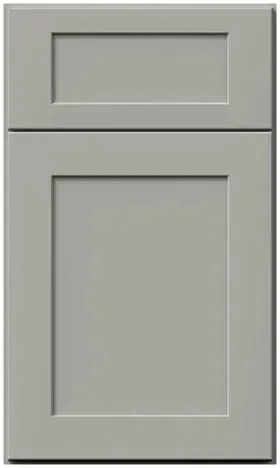
A five-piece shaker door is a frame around a recessed centre. It has exactly one shadow line, where the ⅜″ centre panel steps back inside the ¾″ stiles and rails, and that single line is the whole of its decoration. It is why shaker reads as quiet, and it is why shaker survives fashion cycles that eat more decorated doors alive.
Applying an onlay adds a second shadow line, raised this time rather than recessed, inside the first. That is the entire transformation: the door goes from one plane change to two, and the eye reads two plane changes as traditional in the same way it reads one as simple. Nothing else about the door changes — same construction, same mortise-and-tenon joints, same Blum hinges behind it.
Which is why an onlay is such an efficient purchase when it is used once. A single applied carving on one door in a run does more to change how the room reads than a second crown profile or a heavier pull, for less money than either. Used six times it stops being a detail and becomes a pattern, and patterns date.
Where it earns its place, and where it stops earning it
Ornament works where the eye already stops. Put it somewhere the eye is only passing through and it registers as noise.
- The range wall, centred over the cooktop: the single best place in a kitchen for one piece of ornament, because the hood already draws the eye there.
- The end of an island, facing the room: a panel doing nothing else, seen from a distance, which is where carving reads best.
- A single vanity door in a powder room: the smallest room in the house is the one that can carry the most decoration per square foot.
- One tall pantry door in a run of plain ones: works, but only if it is genuinely one.
- Not: every door in a run. Not: both sides of a symmetrical pair. Not: a door that already has glass, a beaded panel or a reeded insert — that door is finished.
The cumulative test is the one to apply before ordering. Count everything decorative already on the quote: a crown profile, from GN CM-1 at $117.00 up to GN CM-8 at $367.25; a light rail, GN LRM at $149.50; a pilaster at GN PP-BASE $227.50; a corner post at GN CP36 $312.00; a valance; a beaded panel plank at GN BPP-12 $126.75. Every one of those is ornament. Three is a considered room. Six is a showroom display, and showroom displays are built to demonstrate a catalogue, not to be lived in.
Matching the carving to the door it lands on
Two rules, and they are not aesthetic preferences so much as observations about what looks wrong.
First, the onlay must be smaller than the recessed centre panel it sits on, with a clear margin all round — an inch and a half at minimum, more on a wide door. An onlay that crowds the inner edge of the shaker frame reads as a mistake rather than a decision, because the two shadow lines end up almost touching and the eye cannot separate them.
Second, the profile has to agree with the door's own vocabulary. This is a contemporary five-piece shaker with square-edged stiles and rails and a flat recessed centre — crisp, geometric, unsoftened. A carving with a deep undercut and heavy scrollwork sits on it like a Victorian mantel in a new-build. A shallower, more linear onlay with clean relief is the safer match, and on a shaker door the safer match is almost always the right one. If the plan calls for heavy traditional carving throughout, the door style is the thing to revisit, not the ornament.
Third, in practice: order a door sample and hold the two together before committing. A carving that looks right in a catalogue photograph, lit from the front, can look flat or fussy on an actual door in an actual room — which brings us to the part of this that belongs to the colour.
The one place the colour changes the decision
Relief carving is not seen. Shadow is seen. A raised ornament is only visible because the light hitting the room falls on its high faces and misses its undercuts, and the contrast between those two is what your eye reads as depth and shape.
On a bright white door, the high faces and the shadowed undercuts are both pale, and the difference between them is compressed — white bounces so much light back into its own shadows that a shallow carving can nearly disappear in a well-lit kitchen. On a mid-tone gray, the high faces still take the light while the undercuts go properly dark, and the carving reads with noticeably more definition from across the room.
This cuts both ways and it is important to say both. It is an argument for using an onlay on this finish, because it will actually be seen rather than washing out. It is equally an argument for using fewer of them, because ornament that reads strongly at twenty feet does not need repeating six times to be noticed — on a paler door six might be what it takes to register at all. One carving on a gray door does the work of two on a white one. Buy accordingly.
One lighting note while you are judging it. Grays shift more with bulb temperature than whites do, and this one is at its most neutral under cooler light — a very warm 2700K lamp flattens a mid-tone and takes some of the crispness out of a shadow line. If a carved door is going somewhere lit by warm downlights, look at it under that light before deciding, not under a showroom's. Our piece on finding the right gray goes further into how these shades move.
Living with a carved surface
Carving collects. Dust settles in an undercut and stays there, grease in a kitchen finds every relief, and both are harder to get out of a profile than off a flat panel. The maintenance is a soft dry brush every few weeks rather than a cloth, which only pushes dust deeper into the detail.
There is a small, real trade-off on this finish. A mid-tone gray is far kinder than white to fingerprints, splashes and the everyday marks around a door edge — that is one of the practical reasons people choose it. It is less kind to dust, which sits pale against a darker surface, and a carved surface is a dust-catcher by design. Put the two together and the recommendation is the same one this whole article keeps arriving at: put the ornament where it will be seen and not where it will be touched, and use it once.
The rest of the trim lives under decorative accessories, the doors this goes on under vanities and base cabinets, and the collection itself has the full range in this shade. Everything is pre-assembled, 7 days to 3 weeks, with the limited lifetime warranty behind it.
Common questions
- What is a decorative onlay on a cabinet?
- A carved or moulded piece applied to a flat surface — usually the recessed centre of a door, a drawer face, or an island end. It adds a second, raised shadow line inside the door's existing recessed one, which is what makes a plain door read as traditional.
- How many onlays should a kitchen have?
- Usually one. Ornament works where the eye already stops — over the range, on the end of an island, on a single powder-room door. Repeated across a run it stops being a detail and becomes a pattern, and patterns are what date a kitchen.
- Does an onlay suit a shaker door?
- A restrained one does. This is a contemporary five-piece shaker with square edges and a flat recessed centre, so a shallow, linear carving with clean relief sits on it properly. Deep scrollwork with heavy undercuts fights the door. Keep an inch and a half of clear margin all round.
- Does a carved detail show up better on gray cabinets than on white?
- Yes. Relief is read as shadow, and a white door bounces light back into its own undercuts, flattening a shallow carving. On a mid-tone gray the undercuts go properly dark and the carving reads with more definition — which is a reason to use one, and a reason to need fewer of them.
- How much does a decorative onlay cost?
- GN VDO is $425.75 at our displayed price. The listing does not publish dimensions, a profile name, or whether that covers one piece or a set, so tell us the door it is for and we will confirm the size and profile before ordering.
- How do you clean a carved cabinet detail?
- A soft dry brush, not a cloth — a cloth pushes dust further into the undercuts. Do it every few weeks. Worth knowing that this depth of gray hides fingerprints better than a white does but shows dust more, which is another argument for keeping ornament away from the doors people actually handle.
Keep reading
The guides behind the numbers on this page.
- Gray Kitchen Cabinets: Finding the Right Shade
Where this mid-tone sits, and how these shades move under different light.
- Kitchen Cabinet Molding Types
The rest of the ornament budget, and what it competes with.
- Shaker vs Slab Cabinets
Why a shaker door has one shadow line, and what adding a second does.
- Contemporary vs Transitional Cabinets
The line an onlay moves a kitchen across.
- Ordering and Evaluating Door Samples
Judge a carving against the actual door, under the actual light.
- Fabuwood Door Styles
If heavy traditional carving is the goal, start with the door instead.
- Matte Cabinet Finishes: Pros, Cons and Care
How a finish behaves in shadow, which is the whole of this argument.


