

Trading the toe kick for four feet: the height maths of a furniture-look vanity, and who should skip it
Reviewed September 2026 · Captivating Cabinets
The look is genuinely good and it is genuinely easy to get wrong. A vanity standing on four turned feet, with daylight and floor tile running underneath it, reads as a piece of furniture that happens to have a sink in it rather than as a box screwed to a wall — and in a small bathroom the visible floor makes the room read larger. GN TBF and GN CBF are both $42.90, which makes this the cheapest transformation on the whole collection. The catch is not the money. It is that feet are a substitution, not an addition, and everything below the countertop moves when you make it.
Feet replace the toe kick — they do not go under it

Every base and vanity box in this line arrives with a recessed toe kick built into its height. That recess is what lets you stand at the sink with your toes under the cabinet, and it is already counted in the overall height the box is catalogued at. Feet are not something you add beneath that. The toe-kick area is what the feet occupy.
So there are two routes, and only two. Either the cabinet is ordered and built to sit on feet, or the toe-kick portion is cut away on site so the feet take its place. Both are done routinely. What cannot be done is standing a stock, toe-kicked box on four feet and calling it finished — do that and you raise the deck by the full height of the foot, the countertop lands too high, and the toe recess is left as a strange dark gap above the feet.
That is why the toe-kick parts and the feet are alternatives rather than companions on a quote. GN TK8 is $55.90 for an 8-foot length, GN TK8-3/4 $58.50 in the ¾″ thickness, GN TKC caps $7.80 and GN TKC-3/4 clips $10.40. If the vanity is going on feet, most of that leaves the order.
Where the finished height goes
Work down from the countertop, never up from the floor. The deck height is the number the room has to live with: it sets faucet reach, splash height, mirror centre, and whether a child can use the sink. Everything below it is arithmetic in service of that one figure.
| Layer | Stock toe-kicked vanity | On feet |
|---|---|---|
| Countertop | Set by the fabricator | Same — this is the fixed number |
| Cabinet box | Full catalogued height | Reduced, or ordered to suit |
| Below the box | Recessed toe kick, hidden | Open foot, visible, floor running through |
| Toe recess | Yes, toes go under | No — you stand a little further back |
| Floor beneath | Sealed off behind the kick | Visible and cleanable |
The rule that keeps this out of trouble is about sequence rather than numbers. Set the cabinet on its feet, level it, and have it standing in its final position before the fabricator templates the top. A template captures what is there on the day; lift or lower the cabinet afterwards and the splash line, the faucet and the mirror all move with it while the stone does not. Our dimensions checklist has the finished heights worth writing on the plan first.
What it does to the plumbing and to the floor beneath
Raising a cabinet onto feet does not move the plumbing, which is the point at which most of the surprises happen. A drain that came through the back wall at a height suited to a toe-kicked cabinet now sits in a different place relative to the cabinet floor. A P-trap that cleared comfortably may now be visible under the cabinet if the box has been shortened. And the supply stops, which were hidden behind a kick, may be in open view from the doorway.
None of that is fatal and all of it is worth knowing before the order. The fix is usually as simple as telling the plumber the vanity is going on feet, so the rough-in is set for that cabinet rather than a standard one. Say it once, early; discovering it at second fix is how a tiled wall gets opened.
The floor is the other half. Feet expose the finished floor under the cabinet, which means the floor has to be finished under the cabinet — tile carried right through, not stopped at the cabinet line with a strip of screed behind it. In a retrofit that is the most common reason this idea gets abandoned: the tile simply does not go back that far. Check it with a torch before anything is bought.
Cleaning under it, honestly
This is sold as a benefit and it is one, with a caveat. A mop or a robot gets under a vanity on feet, so the dust and hair that accumulates in the dead strip in front of a toe kick simply does not accumulate. In a bathroom in particular that is a real improvement, because the strip immediately in front of a vanity is the least pleasant six inches of floor in the house.
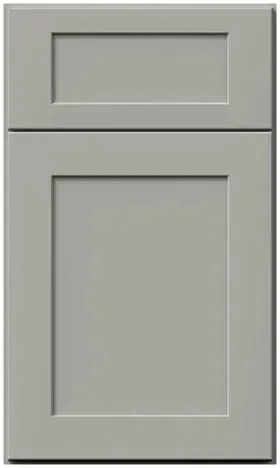
The caveat is that anything under there is now visible. A toe kick hides; open feet display. Dust under a vanity on legs is seen from the doorway, and on a mid-tone gray cabinet the pale drift of it against a darker plinth and foot shows up more than it would against white — the same property that makes this shade forgiving about fingerprints makes it unforgiving about dust. Easier to clean, more obvious when you have not. Most people consider that a fair trade; a few genuinely do not.
The rest of the routine is unchanged, and our cabinet care notes cover it. One addition: check the foot-to-floor joint twice a year in a bathroom. A foot standing in a puddle from a shower splash is a foot that will not last, and it is the sort of thing nobody looks at.
Which foot suits a square-edged shaker door
Two profiles are listed at the same $42.90: GN TBF with a taper and GN CBF with a cove. Since price is not the tie-breaker, let the door and the hardware decide.
- Taper — narrows toward the floor in a straight line. Its geometry is the same geometry as the door: square edges, flat planes, no curve. It is the safer choice under a contemporary shaker and it is the one to pick if you are hesitating.
- Cove — curves inward. It is the traditional foot, and it belongs with the traditional version of this room: an onlay on the door, brass or bronze hardware, a more decorated mirror. Under plain doors with bar pulls it reads as a foot borrowed from another kitchen.
- With matte black or chrome hardware: taper. Cool, graphic metal and a curved turned foot are two different arguments about what the room is.
- With an onlay already on the quote: pick feet or ornament, not both, unless the room is committed to being traditional throughout. Two ways of saying furniture is one too many.
Worth knowing that this finish carries either direction comfortably. A mid-tone gray is balanced and neutral without drifting blue or brown, and it takes brushed nickel, chrome, matte black and brass equally well — which means the foot profile is a genuinely free choice here rather than one the colour makes for you.
Who should skip this
- Anyone retrofitting into a bathroom where the finished floor stops at the old cabinet line. The tile is the deal-breaker, not the cabinet.
- Rentals and flips. Open feet mean the floor under the vanity is on show for every viewing and every tenant, and a toe kick is a maintenance-free surface that hides a multitude. Our notes for property managers and for flippers both land on the same side of this.
- Anyone whose countertop is already templated or fitted. The height has been captured; changing what is under the box now means changing the stone.
- Very small bathrooms where the vanity is already tight to a door swing — losing the toe recess means standing an inch or two further back at the bowl.
- Anyone who wanted this for storage reasons. It gains none. It is a look, and a cleaning improvement, and that is the honest list.
For everyone else it is $42.90 a corner against a bathroom that looks like it was designed. The boxes are under vanities, the kick parts under toe kicks, and the panels that finish an exposed end under side panels. Pre-assembled, 7 days to 3 weeks, KCMA certified, AWI Premium Grade, limited lifetime warranty — and a free 3D design with the order, which is the point at which we would rather have this conversation than after delivery.
Common questions
- Do bun feet go under the toe kick or replace it?
- They replace it. The toe-kick recess is already counted in the cabinet's catalogued height, so feet occupy that space rather than adding beneath it. Either order the cabinet to suit feet or cut the toe-kick portion away on site; standing a stock box on feet raises the countertop too high.
- How much do cabinet bun feet cost?
- GN TBF with a taper profile and GN CBF with a cove are both $42.90 at our displayed price. The listing does not state whether that buys one foot or a set, which matters when four corners need covering, so confirm it with us before ordering.
- Does putting a vanity on feet affect the plumbing?
- It does not move the plumbing, which is exactly the problem. The drain and supply stops end up in a different position relative to the cabinet, and stops that were hidden by a kick may be visible. Tell the plumber the vanity is going on feet before the rough-in, not after the wall is tiled.
- Do I need the floor tiled under a vanity on legs?
- Yes. Feet expose the finished floor beneath the cabinet, so the tile has to run right through. In a retrofit this is usually the thing that kills the idea — the old tile stops at the cabinet line. Check with a torch before you buy anything.
- Taper or cove feet with a shaker door?
- Taper. It narrows in a straight line and shares the square-edged geometry of the door, so it suits a contemporary shaker and matte black or chrome hardware. Cove is the traditional curve and belongs with brass, an onlay, and a room committed to that direction.
- Is a vanity on feet easier to clean underneath?
- Yes — a mop or a robot gets under it, so the dead strip in front of a toe kick never accumulates. The trade is that whatever is under there is now visible from the doorway, and pale dust shows more against a mid-tone gray than it would against white.
- Who should not put their vanity on feet?
- Anyone retrofitting where the tile stops at the old cabinet line, anyone whose countertop is already templated, rentals and flips where the floor under the vanity is on permanent show, and anyone hoping to gain storage. It gains none — it is a look plus a cleaning benefit.
Keep reading
The guides behind the numbers on this page.
- Fabuwood Bathroom Vanities Buying Guide
Choosing the box this stands on.
- Dimensions to Check Before Buying Cabinets
The finished heights to fix before anything is templated.
- Cabinet Terminology and Abbreviations
Toe kick, plinth, turned foot — the words this article leans on.
- Kitchen Cabinet Molding Types
The kick and base parts that leave the order when feet go on it.
- Cabinets for Property Managers
Why a toe kick usually wins in a rental.
- Cabinets for House Flippers
Where the money is better spent on a resale bathroom.
- How to Clean and Care for Cabinets
Including the foot-to-floor joint nobody checks.


