


A hood is a ventilation decision wearing a cabinet: sizing, ducting and finishing a Galaxy Nickel range hood
Reviewed September 2026 · Captivating Cabinets
A wood range hood is sold as cabinetry and photographed as a focal point, and both of those are true. But it is first a machine for moving grease, steam and combustion products out of a room, and almost every hood problem we see started as a decoration decision that never checked the airflow. So this page does the ventilation first — how much air, where it goes, how high it hangs, how wide it needs to be, and what happens when the fan is bigger than the house can feed — and gets to the wood and the finish afterwards, which is the order the money should be spent in.
How much airflow, and how to size it to what you actually cook
The shell and the blower are separate purchases here, which is the first thing to understand about the pricing: a hood body without a blower is a decorative surround. Three internal blowers are listed — 250 CFM at $419.25, 400 CFM at $903.50 and 600 CFM at $1,787.50 — and choosing between them is the decision that determines whether the hood works.
The rules of thumb are worth knowing even though your local code and the range manufacturer both override them. For a gas range, the common approach is roughly 100 CFM for every 10,000 BTU of burner output, which puts a typical 60,000 BTU domestic range around 600 CFM on paper and a modest 40,000 BTU one nearer 400. For an electric or induction cooktop the usual guide is about 10 CFM per linear inch of cooktop width, so a 30″ induction top lands near 300 CFM. What you cook matters at least as much as what you cook on: searing, wok work and frying want the higher number, and a household that mostly boils and bakes does not.
| What you cook on | How you cook | Airflow we would fit | Blower and price |
|---|---|---|---|
| 30″ induction or electric | Everyday cooking, little frying | 250 CFM is genuinely enough | GNK RHBB 250 CFM, $419.25 |
| 30″ gas, around 40,000 BTU | Mixed, some frying | 400 CFM | GNK RHBB 400 CFM, $903.50 |
| 36″ gas, 50–60,000 BTU | Regular searing or wok cooking | 600 CFM, if the house can feed it | GNK RHBB 600 CFM, $1,787.50 |
| Any cooktop, recirculating only | Anything | Airflow matters less than filter access | Add GNK RHBB FLTR, $71.50 per replacement |
More airflow is not free in any sense. A 600 CFM blower is louder, costs a thousand dollars more than the 250, and may drag the house into the make-up air problem further down this page. Size it to the cooking, not to the largest number available.
Ducted or recirculating, and the honest verdict on each
A ducted hood takes the air outside. A recirculating hood pulls it through a grease filter and a charcoal filter and pushes it back into the room. The marketing treats these as two options; in performance terms they are not close. A recirculating unit removes grease particles and some smell. It removes no heat, no steam and no combustion by-products, because there is nowhere for them to go. In a kitchen with a gas range that is the difference that matters, and it is the reason a recirculating hood over a gas range is a compromise rather than a choice.
So the verdict: duct it if the building will let you, and take a longer or less convenient duct route rather than giving up on ducting. Recirculating is the right answer in exactly one situation — an apartment, a condo or an interior wall where there is genuinely no path to the outside — and in that case spend the money on the filter regime instead of the fan. Replacement filters are $71.50 and the charcoal element in a recirculating setup is consumable; budget for changing it two or three times a year in a kitchen that fries.
Our live list does not state whether these shells ship recirculation-capable or which conversion kit applies, so if ducting is impossible, confirm that before ordering rather than assuming a hood can be converted.
Where the duct can actually go, and what every elbow costs
The best duct run is the shortest one with the fewest turns, and in a wall-mounted hood that usually means straight up through the cabinet space above the hood and out through the roof, or straight back through the exterior wall if the range is on one. Every elbow in the run costs airflow — a rated 400 CFM blower on a long duct with three turns is not delivering 400 CFM at the burner — which is why the run should be planned before the blower is chosen, not after.
Three rules that cover most of the trouble. Do not reduce the duct diameter below what the blower calls for; a 6″ outlet squeezed into a 4″ pipe throttles the whole system and makes it loud. Use rigid duct rather than flexible where you can, because corrugated interior surfaces cost airflow along the entire length. And never terminate into an attic, a soffit or a wall cavity — a hood that vents into a roof space is moving grease and moisture into the structure, which is a building problem rather than a kitchen one.
The visible part of the run is the duct cover, GNK RHBB DCT at $263.25, which encloses the pipe between the top of the hood and the ceiling. Order it with the hood: on a high ceiling it is the difference between a finished chimney and a piece of exposed ductwork, and on a nine- or ten-foot ceiling it may need to be confirmed for length before ordering.
How high above the burners, and how wide over the cooktop
Mounting height is a compromise between capture and headroom. For a wall-mounted hood over a domestic range, the usual window is roughly 27″ to 36″ above the cooking surface, and the manufacturer’s installation instructions for the specific hood and the specific range govern — they are not advisory, and a gas range in particular will state a minimum. Hang it too high and the plume spreads before it is captured, which is the single most common reason a perfectly good hood seems weak. Hang it too low and tall cooks hit it.
Width is simpler. Never narrower than the cooktop, and three inches proud on each side is the one dimensional upgrade that measurably improves capture — which makes 30″ the floor over a 30″ range and 36″ the better answer, 36″ the floor over a 36″ range and 42″ the better answer. Those extra six inches are not free on the plan: they come out of the cabinets either side, which is why the range wall has to be drawn with the hood in it rather than around a placeholder. On a tight wall the flanking wall cabinets drop a size, or a filler absorbs the difference.
Check the range depth as well. A hood shallower than the front burners is capturing air behind the plume, and on a deep professional-style range that is a real mismatch rather than a rounding error. Measured properly once, this is a five-minute decision; guessed, it is the thing people notice every day for a decade. The kitchen dimensions guide has the clearances that constrain it.
Make-up air: the requirement that catches out the biggest fan
A powerful hood does not create air, it removes it — and a tightly built modern house cannot always replace what a big blower takes out. When it cannot, the house depressurises, which at best makes the fan underperform and doors feel heavy, and at worst back-drafts a gas water heater or a fireplace. That is why many jurisdictions require a dedicated make-up air system above a threshold that is commonly around 400 CFM, though the exact figure and the way it is measured vary by code and by year.
The practical consequence for this page: the 600 CFM blower at $1,787.50 is the unit most likely to trigger a make-up air requirement, and a make-up air system is a separate mechanical installation with its own cost. Ask your inspector or your HVAC contractor where the line sits locally before ordering, because the two honest paths are to budget for the system or to step down to the 400 CFM unit at $903.50. Discovering it at inspection is the expensive version.
Older, leakier houses are less likely to have a problem; new or heavily air-sealed construction is much more likely. Either way, this is a question for a person who has seen the house, not for a web page.
The shell families, what each looks like, and what it costs
With the air settled, the shell is a design decision. Five families are listed and they differ in shape and presence far more than in function; the blower does the work in all of them. Note that tone options are not uniform across the families — some are offered in Timber and Walnut, some in Timber only, and one has no wood-tone variant listed at all. Where a Timber or Walnut version exists, it lists at the same price as the standard, except where noted.
| Family | What it is | Widths | Displayed price |
|---|---|---|---|
| GNK RHA | The plain wall-mount box — the quietest shape on the wall | 36″, 42″, 48″ | $2,418.00 / $2,502.50 / $2,596.75 |
| GNK RHE | Chimney form, tapered to a flue; Timber version listed | 30″, 36″, 42″ | $2,609.75 / $2,788.50 / $2,941.25 |
| GNK RHS | Slim profile, less mass at eye level; Timber and Walnut listed | 30″, 36″, 42″ | $2,785.25 / $2,944.50 / $3,159.00 |
| GNK RHCA | Curved glass canopy; Timber and Walnut listed | 36″, 42″, 48″ | $3,532.75 / $3,789.50 / $4,062.50 |
| GNK RHF | The designer shape, the most decorative; Timber version listed | 30″, 36″, 42″ | $3,812.25 / $4,043.00 / $4,277.00 |
A complete working hood is the shell plus the blower plus the cover. A 36″ chimney hood built properly comes to $3,955.25 — GNK RHE36 at $2,788.50, the 400 CFM blower at $903.50 and the duct cover at $263.25 — and the same build on the plain 36″ RHA shell lands at $3,584.75. That is the number to compare against a stainless insert, not the shell price alone.
The one place people either commit to the colour or deliberately break from it
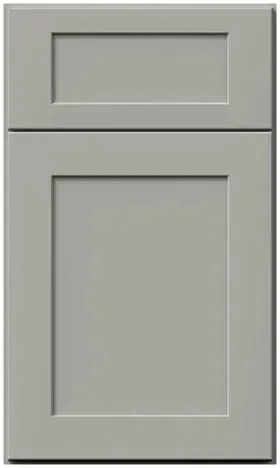
A wood hood in the cabinet finish is the largest continuous piece of this colour anywhere at eye level. Base cabinets are cut up by drawers and handles and are below the sightline; uppers are interrupted by a backsplash and a window. The hood is a single unbroken mass of gray, at face height, in the exact spot every photograph of the kitchen is taken from. It is the focal point whether or not you intended it to be one.
Which makes it the decision point. Commit to the colour and the range wall reads as one deliberate architectural element — a mid-tone gray hood above a gray run with a white quartz counter is the highest-contrast, most-photographed version of this kitchen, and the reason it works is that the hood gives the gray somewhere to be dominant. Or break from it on purpose: a Timber or Walnut shell at the same money turns the hood into the room’s one warm object, which is what keeps a gray kitchen from reading cold, and does the same job a wood floor or a walnut island does without needing either.
What we would not do is neither: a stainless insert under a drywall chimney on a gray wall is not a neutral choice, it is an absent one, and it leaves the focal point of the room to the appliance. If budget says stainless, make the wall do the work instead — tile to the ceiling, and let the hood be plain. And if you are torn between matching and contrasting, order a door sample and stand it against the wood tone in the room’s own light before deciding: the gray shade guide covers how this mid-tone behaves against wood and against black hardware.
Common questions
- Is a 30 inch hood enough over a 30 inch range?
- It is the minimum rather than the target. Going up to thirty-six buys three inches of overhang on each side, and that overhang is what catches the plume rolling off the front burners. The cost is three inches of upper cabinet on each side, so the range wall has to be drawn with the real hood in it rather than around a placeholder.
- How many CFM do I need for a gas range?
- A common rule is about 100 CFM per 10,000 BTU, so a 60,000 BTU range points at 600 CFM and a 40,000 BTU one at 400. For electric or induction, roughly 10 CFM per inch of cooktop width. How you cook matters as much as what you cook on — frying and searing want the higher figure. Confirm against the range manufacturer and local code.
- Is a recirculating range hood worth it?
- Only where ducting is genuinely impossible. It filters grease and some odour but removes no heat, steam or combustion products. Over a gas range that is a real compromise. If you must recirculate, budget for filters — replacements are $71.50 — and confirm the shell supports it, because our list does not state it.
- How high should a range hood be above the stove?
- For a wall-mounted hood the usual window is about 27″ to 36″ above the cooking surface, but the installation instructions for that hood and that range govern, and a gas range will state a minimum. Too high is the most common reason a good hood seems weak.
- Do I need make-up air for a kitchen hood?
- Often above roughly 400 CFM, depending on your local code and how tight the house is. The 600 CFM blower at $1,787.50 is the one most likely to trigger it, and make-up air is a separate mechanical system with its own cost. Ask before ordering — the alternative is the 400 CFM unit at $903.50.
- Does the hood price include the blower?
- No. The shells run $2,418.00 to $4,277.00 and the blower is a separate line at $419.25, $903.50 or $1,787.50. A complete 36″ chimney hood with a 400 CFM blower and the $263.25 duct cover comes to $3,955.25.
- Is a wood hood in the cabinet colour too much on a gray kitchen?
- No — it is the version that reads most deliberate, because it gives the colour one place to be dominant instead of spreading it thinly. The considered alternative is a Timber or Walnut shell at the same money on the families that offer one, which makes the hood the room’s single warm object. The weak answer is a stainless insert under bare drywall, which hands the focal point to the appliance.
Keep reading
The guides behind the numbers on this page.
- Important Kitchen Dimensions Before Buying Cabinets
The clearances that fix hood height and the cabinet above it.
- Kitchen Layouts Guide
Where the range can go, which decides how short the duct run can be.
- Gray Kitchen Cabinets: Finding the Right Shade
How this mid-tone behaves against wood, white quartz and black hardware.
- Fabuwood Cabinet Colors
Timber and Walnut beside this finish, if the hood is the break from it.
- Black Kitchen Cabinets: Styles, Pairings and Care
The other way to make a range wall the focal point of a gray room.
- How Much Do Fabuwood Cabinets Cost
Where a four-thousand-dollar hood sits in a whole-kitchen budget.
- Free 3D Kitchen Design
Send the range model and the duct route and the wall comes back drawn.


