

What goes behind the glass: choosing the contents, the interior and the light for Galaxy Nickel glass door cabinets
Reviewed September 2026 · Captivating Cabinets
Nearly every article about glass cabinet doors is about the glass. That is the wrong end of the problem. A glass door is a window into a box, and the box is what people will actually look at for the next fifteen years — its interior, its lighting, and whatever you decide to keep in it. Choose those three well and almost any glass works. Choose them badly and no amount of seeded or reeded glass rescues the result. So this page starts inside the cabinet and works outward to the door.
The wood veneer interior these boxes ship with, seen through clear glass

These cabinets are built the same way as every other box in the line: ½″ select solid wood construction with a natural wood-veneer finished interior, ¾″ adjustable shelves, Blum Compact Clip hinges and the same limited lifetime warranty. Behind a solid door the veneer interior is a quality note you notice twice a year. Behind clear glass it is on permanent display, and it is a warm light-wood tone sitting inside a painted frame. Some people love that contrast. Some people expected the inside to be the cabinet colour and are surprised on delivery day. Look at it before you decide, not after.
There are three honest options. Leave it — the veneer is a real wood surface and it reads as warmth against a cool frame, which is the same trick a wood floor plays in a gray kitchen. Line it, which is the version we would usually argue for: a back panel in a texture gives the box a deliberate back wall instead of a visible cabinet seam. GN BPP-12 beaded plank is $126.75, GN RFP696 reeded and GN SFP696 slatted interlocking panels are $250.25 each for 6″ × 96″, and GN PAN-1/4 at $263.25 or the two-side-finished interior plywood at $390.00 and $455.00 will do a flat back. Or paint it, which we would not: a brushed finish beside a factory finish reads as a repair, and it will be six inches from a factory-finished door frame where the comparison is unavoidable.
What actually looks good in there, and the tidiness you are signing up for
The honest warning first. A glass door is a permanent commitment to keeping one cabinet tidy. Not "tidy in the way a cupboard is tidy" — tidy in the way a shelf in a shop is tidy, because everybody who walks into the kitchen will look at it and their eye will find the one box of cereal. If that sounds exhausting, one glass cabinet is still worth having and six are not.
What holds up inside: matched sets of anything. Plain white dishes stacked in columns. Clear glassware, which nearly disappears and adds sparkle rather than clutter. Ceramics in one or two colours. Cookbooks, spine out, if the shelf is deep enough. A single large object — a serving bowl, a pitcher — on an otherwise sparse shelf reads as deliberate every time.
What does not: packaged food, mixed plastics, anything with printed branding, mugs of different colours, and the everyday plates you actually use, because those come and go at speed and never sit straight. The unglamorous fix is to plan the glass cabinet for the things you use weekly rather than daily — the good glasses, the serving pieces — and keep the daily crockery behind a solid door next to it.
Depth is worth a thought too. These are standard wall cabinets, so a dinner plate stands up comfortably and a cereal bowl stack looks better than a single row. Shelves are adjustable, and the single biggest improvement most people can make is to set them so there is air above each stack rather than filling the box.
| Contents | Glass we would ask for | Light it? | Honest verdict |
|---|---|---|---|
| Matched white or plain dishes | Clear | Yes — a lit stack of white against a gray frame is the shot | The safest and the best-looking option |
| Glassware and stemware | Clear | Yes, strongly — unlit glass goes dead | Pairs naturally with a stemware rack under the cabinet beside it |
| Mixed everyday crockery | Frosted or reeded | Optional | Better hidden; consider a solid door instead |
| Cookbooks and ceramics | Clear or seeded | Yes | Works if the colours are limited to two or three |
| Small appliances or dry goods | None — use a solid door | No | Do not put these behind glass, whatever the showroom photo says |
Lighting inside the box, and why it matters more here than on a white kitchen
An unlit glass cabinet at night is a dark rectangle. That is true in any kitchen, and it is more true in this one, which is the argument that runs through the rest of this page. The parts are on the accessories list: a 48″ interior strip at $221.00, a single 2-1/4″ puck at $71.50, or puck sets sized to the cabinet — $91.00 for a 15″ box, $97.50 for an 18″, $113.75 for a 24″, $130.00 for a 30″ and $146.25 for a 36″. Add the driver at $204.75 and the wireless switch at $221.00, which is also what lets the cabinet be lit on its own circuit rather than with the counter lights.
Two practical notes. Light from the top of the box washes down the front of whatever is on the shelf, which is what you want; light from below uplights the underside of plates, which you do not. And if you are undecided between a warm and a cool bulb, the tunable white strip at $286.00 settles it in the room. A mid-tone gray frame stays neutral and crisp under 3000–4000K, and can read slightly dull under very warm light — so the interior light and the under-cabinet light should agree with each other, not fight.
Clear, seeded, frosted, reeded — and what each one is hiding
Now the glass. Clear shows everything, including the back of the box and the shelf edges, which is why the interior decision above comes first. Seeded glass carries small bubbles that break up the view slightly without concealing it — it flatters a display and forgives a slightly untidy stack. Frosted conceals shape and colour almost entirely and turns the cabinet into a lit panel, which is a legitimate design choice rather than a compromise. Reeded, which is having a long moment, conceals through vertical distortion: you see colour and light but not objects, and the reeds themselves become the texture.
Mullions are the other variable — the bars that divide the opening into panes. A single undivided pane is the contemporary answer and suits a five-piece shaker door well. A two- or three-bar division reads more traditional and breaks the reflection up, which can help on a wall that faces a window. Neither the glass type nor the mullion pattern is stated on our live product titles, so both are questions to ask rather than assumptions to make; the glass cabinet doors buying guide walks through the options and what each does to a room.
One thing to settle before you order, because the listings do not settle it. Each of these is described as a wall cabinet “built for glass inserts”, with “an open frame [that] accepts glass” — and every one of them prices well below the solid-door cabinet of the same size (GNK GDW1530 is $97.50 against $234.00 for GN W1530). Read together, that points at a glazing-ready door frame rather than a complete cabinet with the glass already in it. We are not going to guess on your behalf: ask us what a given line covers — box, door, glass — before it goes on an order, because the gap between the two readings is most of the price.
Where one or two of these belong, and what they cost
The usual mistake is symmetry for its own sake — a glass cabinet at each end of a run because it looks balanced on a drawing. Better is to put glass where there is a reason to look: flanking a window over the sink, at the end of a run where the kitchen meets a dining space, above a bar or coffee station, or across a diagonal corner where the cabinet is already the visual pivot. One or two in a kitchen is the count that reads as considered. Four starts to read as a display case.
| Spot in the run | Unit | Price |
|---|---|---|
| Flanking a sink window, 30″ high uppers | GNK GDW1530 / GDW1830 | $97.50 / $117.00 |
| Flanking a sink window, 36″ high uppers | GNK GDW1536 / GDW1836 | $117.00 / $139.75 |
| A single feature cabinet at the end of a run | GNK GDW2436 or GDW3036 | $201.50 / $234.00 |
| Full-height feature, 42″ uppers | GNK GDW3042 / GDW3642 | $279.50 / $321.75 |
| A tall narrow display, floor-to-ceiling look | GNK GDWD1860, double door 18″ × 60″ | $188.50 |
| Diagonal corner, where two runs meet | GNK GDWDC2436 / GDWDC2442 | $117.00 / $139.75 |
Widths run 15″, 18″, 24″, 30″ and 36″ and heights 30″, 36″, 39″ and 42″, so the grid is wider than the table above. One oddity to flag rather than paper over: on our list several 39″-high units price below their 36″ equivalents — GNK GDW2439 at $107.25 against GDW2436 at $201.50, and GDW3039 at $126.75 against GDW3036 at $234.00. That looks like a pricing anomaly rather than a specification difference, so confirm the 39″ price before building a plan around it. Everything else steps the way you would expect: $234.00 to $321.75 across the 36″ and 42″-high widths, and $97.50 at the small end.
On a gray frame, an unlit glass box reads as a hole in the run
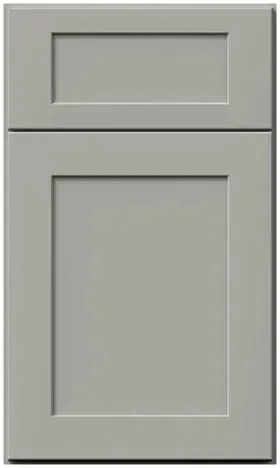
Here is the thing that makes this decision different on this finish. A run of wall cabinets in a mid-tone gray is a solid field of colour. Cut a clear glass opening into it and you have not added a window, you have added a dark rectangle — because the inside of a cabinet is always darker than a painted door face, and the contrast between a mid-tone field and an unlit interior is far greater than it is on a white kitchen, where the frame is closer in value to whatever is behind the glass.
That gives you two good answers and one bad one. Light the box, which closes the gap in value and turns the opening into the brightest thing on the wall — this is why interior lighting is close to mandatory here rather than optional. Or choose frosted or reeded glass, which raises the value of the glass itself so the opening reads as a panel rather than a void; on a gray kitchen that is a genuinely strong look and not a fallback. The bad answer is clear glass, no light, and a jumbled interior, which is the most common thing people actually build.
And if you want the display to read as one zone rather than one stray cabinet, group it: a glass upper, a stemware rack under the cabinet beside it at $403.00 for 30″ or $425.75 for 36″, and an LED floating shelf on the return. For how this mid-tone behaves against wood, white counters and brass or black hardware, the gray shade guide is the piece to read before ordering a door sample.
Common questions
- What should you put in glass front kitchen cabinets?
- Matched sets: plain dishes stacked in columns, clear glassware, ceramics in one or two colours, or a single large serving piece on a sparse shelf. Keep packaged food, mixed plastics and the everyday plates behind a solid door. And set the shelves so there is air above each stack rather than filling the box.
- What does the inside of these cabinets look like?
- A natural wood-veneer finished interior, the same as every box in the line. Behind a solid door nobody notices; behind clear glass it is a warm light-wood tone inside a painted frame. Line the back with a beaded, reeded or slatted panel if you want a deliberate back wall instead.
- Should you line or paint the inside of a glass cabinet?
- Lining is the better answer. A beaded plank at $126.75 or a reeded or slatted panel at $250.25 gives the box a finished back. We would not paint it: a site-brushed interior sits inches from a factory-finished frame, and the comparison is unavoidable.
- Do glass cabinets need lights inside?
- On a mid-tone gray kitchen, close to yes. An unlit interior is darker in value than a painted gray door, so the opening reads as a hole in the run after dark. A 48″ interior strip is $221.00, a puck set sized to a 30″ cabinet is $130.00, plus the driver at $204.75.
- What is the difference between clear, seeded, frosted and reeded glass?
- Clear shows everything including the back of the box. Seeded carries small bubbles that soften the view without hiding it. Frosted conceals contents almost entirely and turns the cabinet into a lit panel. Reeded conceals through vertical distortion — colour and light come through, objects do not. Our product titles do not state which is supplied, so confirm it.
- Is two glass cabinets too many in one room?
- Two is fine when each has a reason to be where it is — either side of a sink window, or one at a corner and one where the room meets a dining space. Two placed for symmetry alone is one too many. Past that the wall turns into a display case, and every unit added is another cabinet you have signed up to keep shop-tidy.
- What do glass door wall cabinets cost?
- From $97.50 for a 15″ × 30″ to $321.75 for a 36″ × 42″ on the displayed prices at review, with a 24″ × 36″ at $201.50 and a 30″ × 36″ at $234.00. The 18″ × 60″ double-door unit is $188.50 and diagonal corner units run $100.75 to $139.75.
Keep reading
The guides behind the numbers on this page.
- Glass Cabinet Doors: Buying Guide
Glass types, mullion patterns and where glass belongs in a plan.
- Wall and Tall Kitchen Cabinets: Sizes and Buying Guide
Upper heights, and what a 30″, 36″, 39″ or 42″ box does to the wall.
- Gray Kitchen Cabinets: Finding the Right Shade
Why a mid-tone field makes an unlit opening read as a void.
- Kitchen Cabinet Samples: How to Order and Evaluate
Judge the frame against the interior veneer before committing.
- Fabuwood Cabinet Sizes and Specs
Box depths and shelf spacing, which decide what fits on a shelf.
- How to Clean and Care for Kitchen Cabinets
Glass shows fingerprints; gray shows dust. Both are manageable.
- 27 Kitchen Cabinet Ideas
Finished rooms with one glass cabinet, and rooms with too many.


